
Reliable law enforcement vehicle equipment in Miami involves more than emergency lighting. In-car technology, fleet planning, inspections, and maintenance all need to work together to keep vehicles ready for their assigned duties.
That coordination matters: poorly integrated equipment or missed maintenance can disrupt daily fleet operations. This guide covers key equipment categories, inspection and maintenance priorities, and practical considerations for planning repairs or upgrades.
Here’s a practical overview of public safety lighting and other vehicle equipment, plus ways to organize inspections and maintenance. The aim is to help agencies in Miami make informed decisions that suit their vehicles and local operations.
Key Takeaways
- Map equipment needs to the vehicle’s duties so technology and emergency lighting support everyday operations.
- Plan vehicle customization as a coordinated process, considering equipment placement, integration, and fleet requirements.
- Use consistent inspections and maintenance planning to spot issues early and keep vehicles ready for service.
- Recognize when truck, liftgate, trailer, or hydraulic repair can address a fleet vehicle’s upkeep needs.
Where can Miami law enforcement agencies buy police vehicle equipment?
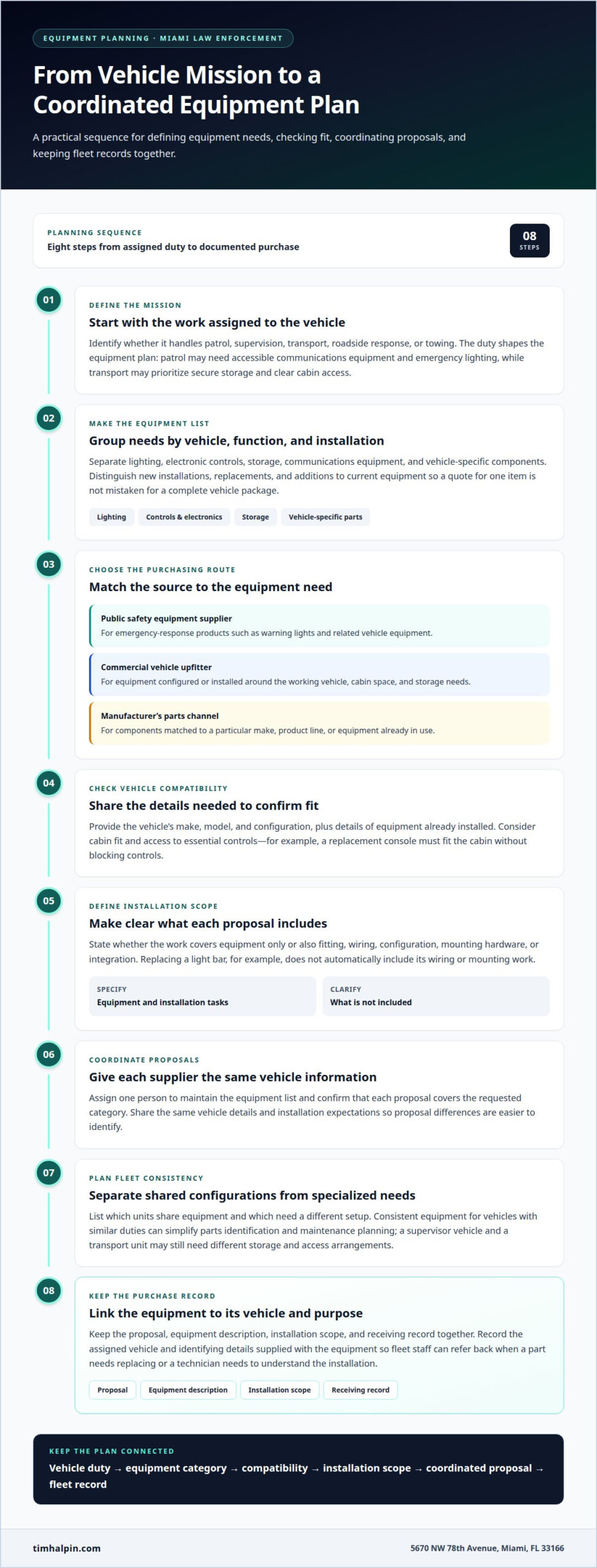
A public safety equipment supplier sells products intended for emergency-response vehicles. Miami agencies can source equipment through public safety suppliers, commercial vehicle upfitters, and manufacturers’ parts channels. The right route depends on the item: lighting, communications equipment, vehicle-specific parts, or installation components. Start by matching the purchase to the vehicle and its assigned duties. For law enforcement vehicle equipment in Miami, that fit between product and vehicle is a practical first consideration.
A commercial vehicle upfitter supplies or installs equipment configured for a working vehicle. For a patrol vehicle, this may involve planning lighting and secure storage around the available cabin space. Begin with a written equipment list, grouped by vehicle, function, and installation needs. This helps clarify the scope and reduce the chance of choosing items that do not fit the vehicle or work together.
A manufacturer’s parts channel is a source for components designed for a particular make or product line. It can help when replacing a damaged part or matching equipment already used across a fleet. Identify the vehicle model and equipment manufacturer before requesting a part. For example, a towing unit may need a component specific to its installed towing system, not a general-purpose replacement.
Public safety equipment includes products used in emergency response, such as warning lights and related vehicle equipment. Define the operating need first: visibility, mounting location, and compatibility with the existing setup. A written description helps clarify whether the work involves a new installation, a replacement, or an addition to current equipment.
An agency’s purchasing process sets out how purchases are requested and approved. The steps depend on agency procedures and the equipment involved. A clear request describes the vehicle, intended use, equipment category, and installation expectations. Keeping those details together helps purchasing staff compare proposals consistently.
Before requesting proposals, separate the equipment into categories. Lighting, electronic controls, storage, and vehicle-specific components may require different products or installation work. This prevents a quote for one item from being mistaken for a complete vehicle package. For example, purchasing a light bar does not automatically include wiring, mounting hardware, or integration with other equipment.
Compatibility means the selected equipment suits the vehicle and works with its existing systems. Provide the vehicle’s make, model, and configuration, along with details of equipment already installed. A replacement console, for instance, must fit the cabin and leave essential controls accessible. Include these requirements in the purchase request.
Installation scope clarifies whether a purchase includes fitting, wiring, configuration, or only the equipment. Ask for each task to be described plainly. If emergency lighting is being replaced, distinguish the lights from related mounting or electrical work. A clearly defined scope makes it easier to understand what a proposal covers.
Fleet standardization means choosing consistent equipment for vehicles with similar duties. This can simplify parts identification and maintenance planning. List which units share a configuration and which need specialized equipment. A supervisor vehicle and a transport unit, for example, may have different storage and access requirements.
Procurement records link each purchase to its vehicle and purpose. Keep the proposal, equipment description, installation scope, and receiving record together. Record the assigned vehicle and the identifying details supplied with the equipment. This gives fleet staff a useful reference when a part needs replacing or a technician needs to understand the installation.
For replacement parts, start with the equipment already installed. Note its manufacturer, product identification, and the issue to be addressed. A damaged towing-system component calls for a different purchase than new patrol lighting. Clear identification helps reduce the risk of ordering a part that does not match the equipment.
For new equipment, start with the task the vehicle must perform. Then identify the equipment category, fit requirements, and installation needs. A vehicle assigned to towing has different priorities from a patrol unit. This keeps the purchase focused on the job rather than a general catalogue list.
Coordination matters when a vehicle needs equipment from multiple sources. Assign one person to maintain the equipment list and confirm that each proposal covers the requested category. Share the same vehicle details and installation expectations with each supplier. Using consistent information makes differences between proposals easier to identify.
Choose the purchasing route that fits the equipment: public safety equipment for response needs, an upfitter for vehicle integration, and a manufacturer’s parts channel for matched components. For law enforcement vehicle equipment in Miami, document the vehicle, its duties, the equipment category, and the installation scope before requesting proposals. These details give purchasing and fleet staff a practical starting point.
How can a department outfit or customize a law enforcement vehicle in Miami?
A mission profile describes the work assigned to a vehicle. Start by identifying whether it handles patrol, supervision, transport, or roadside response. A patrol vehicle may need accessible communications equipment and emergency lighting, while a transport unit may prioritize secure storage and clear cabin access. These duties shape the equipment plan before installation.
An equipment map shows where each item will go inside or outside the vehicle. Sketch the cabin and exterior, then mark proposed locations for lighting controls, communications equipment, and storage. Place frequently used controls where the seated operator can reach them without interference from other equipment. The layout can also reveal conflicts before installation, such as storage blocking access to an existing control.
Electrical integration means coordinating powered equipment with the vehicle’s electrical system. List each powered item, its location, and its connection needs in the installation plan. Consider emergency lights and in-car technology together rather than as separate additions. A coordinated layout gives the installer a clearer picture of wiring routes and helps avoid an improvised setup.
Emergency lighting supports a vehicle’s public safety role. Plan its placement around the vehicle’s intended use and the department’s operational needs. Clarify whether the work involves replacing an existing light or adding equipment elsewhere. Include the vehicle configuration and existing equipment in the work description so the proposed installation suits the actual setup.
A control layout shows how switches and interfaces for installed equipment are arranged. Group related controls and make their purpose clear to vehicle users. Address labeling and placement in the plan, especially when lighting and communications controls share the cabin. Consistent layouts across vehicles with similar duties can make controls easier to locate.
Storage planning assigns secure, usable places for work equipment. Identify what the vehicle must carry and where it should go before choosing an interior arrangement. A patrol unit carrying documentation and response gear has different storage needs from a supervisor vehicle. Keep frequently used items accessible while preserving access to vehicle controls and seating.
A phased installation organizes related customization tasks in a planned sequence. A department can arrange the work using these steps:
- Define the duty: Record the vehicle’s assignment and the functions its equipment must support.
- Document the vehicle: List its configuration and equipment already installed.
- Set the layout: Map lighting, controls, communications equipment, and storage positions.
- Describe the work: Separate new equipment, replacements, and installation tasks.
- Review the completed setup: Confirm that the installed arrangement matches the approved plan.
A commissioning review is a final inspection of the completed installation against the department’s documented plan. Staff can confirm that requested components are present, controls are accessible, and storage does not obstruct the intended layout. Recording any installation changes gives fleet staff a useful reference for later maintenance.
Preventive maintenance is scheduled care intended to keep vehicles and equipment serviceable. The City of Miami Beach requires preventive maintenance inspections for leased vehicles quarterly after the initial inspection. Its policy requires the first inspection at the end of the first 30 days of operation or 1000 miles, whichever comes first. Departments can use their applicable maintenance schedule when planning equipment checks.
A vehicle equipment record documents what is installed and what work has been completed. Keep the equipment map, installation description, and inspection notes together for each unit. If a lighting control is moved, record the change alongside the vehicle’s current configuration. Clear records help maintenance staff understand the setup without relying on memory or an outdated layout.
Customization works best when vehicle duties, layout, installation, and maintenance are planned together. Agencies in Miami, Doral, Fort Lauderdale, Key West, Medley, Hialeah, Kendall, and across South Florida can start with each vehicle’s role, document equipment locations, and review the completed setup. This gives fleet staff a practical basis for managing changes across patrol, supervisory, and other assigned units.
Tim Halpin Equipment
Tim Halpin Equipment Corp supports Miami-area fleets with repairs to work vehicles and their equipment. When a truck, trailer, liftgate, or hydraulic system needs attention, the right repair can support wider fleet maintenance.
Truck repair addresses issues affecting work trucks, while trailer repair covers trailer-related faults. Liftgate and hydraulic repairs address problems with those systems. These services are a practical next step when maintenance identifies a mechanical issue, rather than a need to purchase or customize a patrol vehicle.
When contacting Tim Halpin Equipment Corp, describe the vehicle and the problem you need addressed. The team can discuss the repair support your fleet needs.
Keep Your Fleet Ready for Its Next Assignment
Use the equipment plan as a working reference, and update it after installation when duties change or a vehicle needs attention. Keeping the record current helps fleet decisions reflect each unit’s condition and role. A clear plan connects equipment needs with appropriate maintenance work.
For law enforcement vehicle equipment in Miami, a practical next step may be repairing a work vehicle or its equipment. Tim Halpin Equipment Corp offers truck, liftgate, and trailer repair to support fleet needs. Describe the issue and the equipment involved to start a focused repair discussion.
If a vehicle or component needs repair, contact Tim Halpin Equipment Corp to discuss the work. A thoughtful approach to upkeep can help your team move forward with greater clarity and keep attention on the duties ahead.