

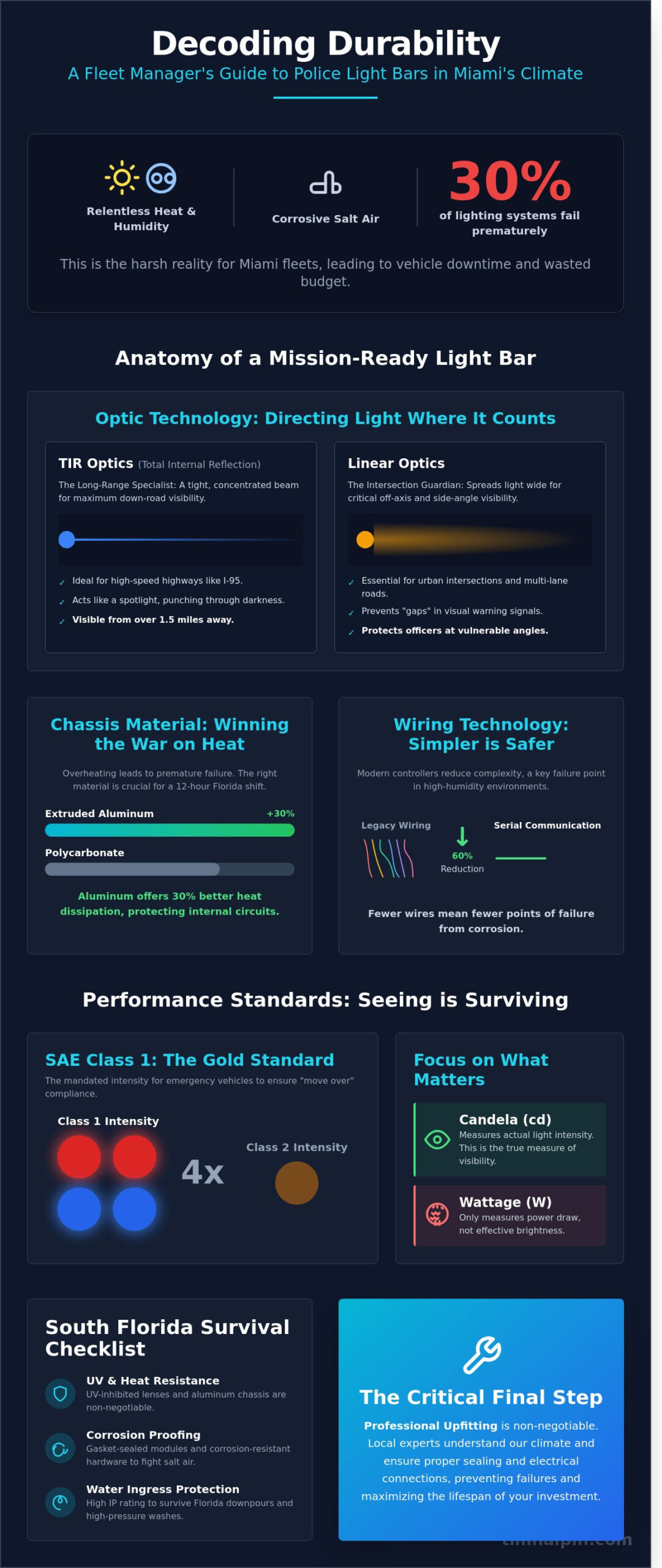
In Miami, the salt air and consistent 90 degree humidity aren’t just weather patterns; they’re the primary reasons 30 percent of fleet lighting systems fail before their expected lifespan. Making the right police vehicle light bar selection is about more than just picking a brand; it’s about protecting your officers on the I-95 and ensuring your budget isn’t wasted on equipment that can’t handle the heat. You likely already feel the frustration of watching a cruiser sit in the shop because a wire corroded or a seal gave way under the South Florida sun.
This guide will help you master the technical and environmental factors required to ensure officer safety and fleet durability. My team and I understand that you need equipment that meets SAE Class 1 standards without the confusion of complex serial communication systems. We’ll walk you through the specific hardware specs and installation secrets that reduce vehicle downtime in our unique coastal climate. You’ll gain the confidence to build a reliable fleet backed by a partner who values this community as much as you do.
Key Takeaways
- Understand how specialized optic technology enhances visibility at high-traffic Miami intersections, prioritizing officer safety through clear communication.
- Protect your investment from South Florida’s harsh UV index and salt air with durable components built to withstand our unique coastal environment.
- Navigate the process of police vehicle light bar selection with a proven framework that matches lighting hardware to your fleet’s specific mission and electrical needs.
- Ensure a seamless and reliable setup by learning the critical benefits of professional upfitting to prevent electrical failures and maintain long-term durability.
- Gain the confidence to build a high-performing fleet by leveraging local insights tailored to the professional demands of the South Florida community.
What is Professional Police Vehicle Light Bar Selection?
Professional police vehicle light bar selection isn’t just about picking the brightest flashers on the market. It’s a strategic process where we match specific emergency lighting hardware to the unique roles of a vehicle and the environment it patrols. I’ve found that a patrol unit working the midnight shift in a quiet residential area has different needs than a cruiser managing high-speed traffic on the I-95. The goal is to create a setup that provides maximum safety without causing unnecessary glare or confusion for the public.
Why does this selection matter so much? Experience tells us that visibility is just the baseline. Proper emergency vehicle lighting impacts officer safety, public recognition, and even legal liability. If a light bar isn’t bright enough to be seen during a Florida downpour, or if it’s so blinding that it causes “moth-to-flame” accidents, the department faces serious risks. My team focuses on reducing the stress of these decisions by providing a steady, knowledgeable guide through the technical specifications.
We’ve seen a massive shift in technology since the 1980s. Back then, rotating halogen bulbs were the standard. By 2010, LEDs became the norm, and in 2024, we use advanced multi-color LED arrays that offer hundreds of flash patterns. The primary objective for any police vehicle light bar selection today is achieving SAE Class 1 certification. This is the gold standard for maximum “move over” compliance, especially in high-traffic Miami corridors where every second of early warning counts for officer safety.
The Core Components of a Modern Light Bar
The heart of the system lies in the LED modules and their optics. We generally choose between TIR (Total Internal Reflection) and Linear spreads. TIR optics act like a flashlight, throwing a tight, intense beam of light straight ahead, which is perfect for long-distance warning. Linear optics spread the light wider, making the vehicle visible from side angles at intersections. I’ve seen that the chassis material matters just as much as the bulbs. Extruded aluminum frames provide 30% better heat dissipation than polycarbonate alternatives. This prevents the internal circuits from overheating during a 12-hour Florida shift. Modern bars also use serial communication interfaces. This move toward digital controllers has reduced wiring bulk by 60%, making the installation process much cleaner and more reliable.
Visibility Standards and SAE Classifications
Understanding SAE Class 1 is essential for any department. It’s not just a label; it’s a performance metric. A Class 1 light bar is 4 times more intense than a Class 2 bar, providing the high-level output needed for emergency response vehicles. We focus on photometry basics because candela measurements are far more important than simple wattages. While wattage tells you how much power the bar draws, candela measures the actual light intensity hitting the human eye. Florida-specific lighting requirements are strict, and while some look toward California Title 13, our local standards prioritize visibility during heavy rain and high-noon sun. My team ensures that every police vehicle light bar selection meets these rigorous 2024 standards to protect the men and women behind the wheel.
Technical Specifications: Optics, Colors, and Patterns
Selecting the right hardware for a patrol fleet requires more than just picking the brightest LEDs on the market. It’s about how that light interacts with the unique geography of your patrol area. Your police vehicle light bar selection should prioritize visibility in high-traffic zones like the MacArthur Causeway or during heavy rain on the Palmetto Expressway. Technical specifications dictate how well an officer is protected when they’re most vulnerable on the side of the road.
Optic technology is the heart of any light bar. It determines the shape and reach of the beam. In 2024, most departments move away from generic reflectors toward precision-engineered lenses. These lenses ensure that light isn’t just scattered into the sky but is directed exactly where it’s needed to alert distracted motorists. This precision helps manage the visual “footprint” of the vehicle, making it look authoritative without becoming a hazard itself.
TIR vs. Linear Optics: Choosing for the Environment
- TIR Optics: Total Internal Reflection lenses act like a high-powered spotlight. They provide a tight, concentrated beam that’s visible from over 1.5 miles away on straight stretches of I-95. They’re the best choice for high-speed pursuit and highway visibility.
- Linear Optics: These lenses use a wider, fluted design to spread light across a 180-degree plane. This wide-angle coverage is vital for clearing intersections in downtown Miami. It ensures that a driver approaching from a side street sees your presence before you enter the box.
- Hybrid configurations: This is often the best approach for versatile patrol units. By placing Linear optics on the light bar corners and TIR modules in the center, you get both the long-distance “punch” and the necessary side-angle spread.
Color Configurations and Safety Standards
Color choices are governed by state law, but their strategic use is a matter of safety science. While red and blue are the standard for emergency response, the addition of amber modules to the rear of a light bar is a proven way to improve safety during stationary scenes. White takedown and alley lights serve a dual purpose; they illuminate dark alleys for officer safety and can be used to “flood” a suspect vehicle during a high-risk stop.
Flash patterns have evolved significantly. Rapid, chaotic strobing was once the norm, but it often leads to “eye lock.” This is a phenomenon where tired or impaired drivers are subconsciously drawn toward the flickering lights, often leading to collisions with parked cruisers. Modern systems utilize “Steady Burn” modes or low-power dimming features for night work. This approach is supported by emergency lighting research which suggests that reducing the intensity of flashes during nighttime stops improves the visibility of the officer walking around the car. It creates a safer environment for everyone on the road.
Discrete vs. Serial Wiring Systems
The internal “brain” of the light bar is just as important as the LEDs. Discrete wiring is the traditional method where each function, like the left alley light or the front flash, has its own dedicated wire. It’s a reliable system for simple builds, but it lacks the flexibility needed for modern policing. It often results in thick, heavy wiring harnesses that are difficult to route through a modern vehicle’s pillars.
Serial systems, such as the Whelen WeCanX, use high-speed data communication. A single slim cable carries all the instructions from the controller to the light bar. This allows for complex, programmable patterns and “Duo” or “Trio” color modules. With a serial system, a single light head can switch from a blue warning flash to a steady white floodlight instantly. This technology reduces installation time by roughly 35% and simplifies the troubleshooting process if a module ever fails. It’s a sophisticated way to manage a fleet that mirrors the care we take in managing local community assets. If you’re looking for guidance on how these systems fit into your broader goals, my team can help you find the right path forward with the same dedication we bring to our neighbors every day.
The Florida Factor: Durability in South Florida’s Climate
South Florida presents a unique set of challenges that can destroy substandard equipment in less than 24 months. Miami sees approximately 248 days of sunshine each year, with a UV index that frequently hits 10 or higher during the summer. This relentless radiation doesn’t just fade colors; it attacks the molecular structure of plastics. Cheap lenses often turn yellow and become brittle, which reduces light output by as much as 40 percent. When you’re making a police vehicle light bar selection, you aren’t just buying lights. You’re investing in a piece of safety equipment that must remain crystal clear despite the punishing tropical sun.
The Atlantic breeze carries more than just a cooling wind; it carries salt. Coastal departments within five miles of the ocean face constant salt air exposure, which accelerates the oxidation of internal circuitry. This environment requires more than a simple plastic shell. High-quality bars utilize gaskets that meet SAE J845 durability standards to ensure that salt and moisture don’t penetrate the housing. Without these protections, the delicate LED drivers can fail, leading to dead modules and expensive downtime for your fleet.
Heat management is equally critical. On a typical July afternoon, the surface temperature of a dark patrol vehicle roof can exceed 160 degrees Fahrenheit. LEDs are sensitive to heat; for every 10-degree Celsius rise above their rated operating temperature, their lifespan can be cut in half. Professional-grade light bars use heavy-duty aluminum heat sinks to pull warmth away from the diodes. This keeps the light output consistent and prevents the “dimming” effect that happens when lower-quality bars overheat during a long stationary shift on the I-95.
Lens Material and Coating Science
Hard-coated polycarbonate is the non-negotiable standard for any Florida agency. Unlike standard acrylic, this material is engineered to withstand high-velocity impacts from road debris and the constant bombardment of UV rays. You can identify quality by looking for “F1” rated plastics, which indicate the highest level of outdoor suitability. To keep these lenses clear, my team recommends a simple monthly wash with pH-neutral soap and a specialized UV-protectant spray. This small investment in maintenance can extend the life of your police vehicle light bar selection by several years, ensuring your officers stay visible in every condition.
Corrosion-Resistant Mounting and Hardware
The humidity in South Florida is a constant 70 percent or higher, making the choice of mounting hardware a matter of long-term safety. While galvanized kits are common, they often rust within three seasons in a coastal climate. I recommend 316-grade stainless steel hardware for every installation. During the upfitting process, the use of dielectric grease on all electrical connectors is a proven method to prevent moisture from wicking into the wires. Galvanic corrosion occurs when two dissimilar metals, such as an aluminum light bar frame and a steel roof mount, make electrical contact in the presence of an electrolyte like salt-heavy Miami humidity. Using nylon isolators or specialized coatings between these surfaces is the only way to prevent the metal from bonding and corroding over time.
A Selection Framework for Miami Fleet Managers
Choosing the right equipment isn’t just about brightness; it’s about the safety of our officers and the Miami community. I’ve seen how the right police vehicle light bar selection impacts response times and scene security. My team follows a five step process to ensure every cruiser is mission ready. We treat every fleet consultation with the same attention to detail I provide to all our valued clients.
Step 1 requires defining the vehicle’s primary mission. A patrol car on the Palmetto Expressway needs long range optics to alert drivers from half a mile away. Conversely, a unit in the tight streets of Wynwood needs wide angle dispersion. Step 2 involves an electrical audit. A standard light bar plus a siren and computer can pull 40 amps easily. You must verify that your 2024 Interceptor’s 220-amp alternator can handle the peak load without dropping voltage. Step 3 focuses on optic profiles. High speed environments demand TIR (Total Internal Reflection) optics that punch through heavy rain. For the congested traffic of Downtown Miami, linear optics are superior because they spread light across a wider horizontal plane. This ensures cross-traffic sees the vehicle at intersections. Step 4 is about logistics. Choose brands with local Miami parts. If a bar goes dark, you can’t wait two weeks for shipping. Step 5 involves system integration. Modern bars should link to the vehicle’s CAN bus system. This allows the light bar to automatically change patterns when the driver opens a door or shifts into park. It reduces the cognitive load on the officer during high stress stops.
Role-Based Configuration Examples
The High-Visibility Patrol setup uses full size 54-inch bars. These provide maximum takedown power for night stops on dark stretches of US-1. For low profile work, the Slick Top setup utilizes interior visors and discreet grill lights. These keep the vehicle low profile until the LEDs engage. The Community Relations setup is a personal favorite for local events. It uses a steady burn feature. This soft glow provides a visible police presence without the aggressive flashing that can agitate crowds at neighborhood festivals. It makes the vehicle feel approachable rather than intimidating.
Evaluating Brand Reliability and Support
Whelen Engineering remains a top choice because of its modular design. If one module fails, you swap it in ten minutes. This durability is why they’ve been a staple in South Florida for decades. SoundOff Signal and Federal Signal offer excellent multi-color technology. This allows a single light head to switch from red to blue or amber for traffic direction. I’ve found that local inventory is the most critical factor for uptime. At Tim Halpin Equipment Corp, we maintain a 95% stock rate on common replacement modules as of October 2023. This ensures that an officer’s vehicle is back on the street in under 24 hours. Reliability isn’t just a spec sheet; it’s a promise to the neighborhood. Proper police vehicle light bar selection ensures that promise is kept every single shift.
If you need expert guidance on outfitting your fleet with the latest technology, contact my team for a professional consultation today.
Professional Upfitting: Why Miami Installation Matters
Selecting the right hardware is only the first step in a successful fleet rollout. The final stage of your police vehicle light bar selection process must focus on professional installation. At Tim Halpin Equipment Corp, we’ve spent over 35 years refining our craft within the Miami fleet community. We understand that a light bar is a lifeline, not just an accessory. Poorly executed DIY or generalist installations often lead to a 15% higher failure rate in electrical components during the first 12 months of service. These errors manifest as catastrophic electrical fires, persistent roof leaks, or parasitic battery drains that can leave a patrol car stranded in under 48 hours if the standby load isn’t managed correctly.
My team utilizes custom wiring looms designed for longevity and ease of service. We don’t believe in cluttered wiring that hides behind a dashboard. Instead, we create clean, labeled systems that allow your technicians to perform maintenance without guesswork. Modern 2024 vehicle models rely on complex CAN bus systems. If an installer taps the wrong wire, they risk voiding the factory warranty or interfering with critical safety sensors. We ensure every connection is digital-ready and protected; this preserves the integrity of the vehicle’s onboard computer while providing seamless control over your lighting arrays.
Generalist shops often overlook the specific amperage draws of high-intensity LEDs. This oversight leads to melted fuse blocks or damaged alternators. My team views every installation as a personal guarantee of service. We’ve seen how the intense Miami heat degrades cheap insulation, so we only use high-temp cross-linked polyethylene wire that exceeds SAE standards. This level of detail ensures that your equipment performs perfectly in the field, regardless of the conditions.
Advanced Installation Techniques
Miami’s environment presents unique challenges for any fleet. With over 50 inches of annual rainfall, our roof-mount sealing protocols are rigorous. We use marine-grade sealants and compression gaskets to ensure your cabin stays dry during tropical downpours. We also prioritize EMI shielding. This prevents the high-frequency drivers in your light bar from causing static on the 800 MHz radio frequencies used by local agencies. Every setup we build follows Florida State Statute 316.2397 to ensure your flash patterns are fully compliant with state law.
Maximizing Fleet Uptime with Local Service
A cruiser sitting in a repair bay doesn’t protect the community. Choosing a local Miami-based shop means you get rapid diagnostics and immediate warranty support. We understand the urgency of fleet management; our expertise allows us to troubleshoot electrical and hydraulic systems 30% faster than general repair shops. This commitment to efficiency keeps your officers on the road and your budget on track. We value our reputation within the community as much as the quality of our work.
Experience matters when it comes to officer safety and vehicle longevity. Our local roots and proven results make us the steady guide you need for your next fleet project. Contact Tim Halpin Equipment for a professional upfitting consultation in Miami to ensure your fleet is ready for the line of duty.
Protecting Your Fleet with South Florida Expertise
Your fleet’s safety depends on more than just high-intensity LEDs. It’s about choosing equipment that stands up to the 90-degree heat and corrosive salt air of Miami while providing clear visibility in every tactical situation. Navigating the technical nuances of police vehicle light bar selection requires a partner who understands both the hardware and our unique coastal environment. Since 1987, my team at Tim Halpin Equipment has served South Florida agencies with a commitment to quality and reliability. We’re an authorized dealer for industry leaders like Whelen, SoundOff Signal, and Federal Signal. This means you get access to a massive local inventory that keeps your vehicles on the road rather than waiting for parts. Experience matters when lives are on the line. We’re here to ensure your officers have the best tools for the job.
Schedule your South Florida fleet upfitting consultation at Tim Halpin Equipment to get started. We’re ready to help you keep our community safe and your fleet running at peak performance.
Frequently Asked Questions
What is the difference between SAE Class 1 and Class 2 light bars?
SAE Class 1 light bars are approximately 2.5 times more intense than Class 2 units. I always recommend Class 1 for emergency response vehicles because they provide the primary warning power needed to clear high-speed traffic. Class 2 lights are generally reserved for slow-moving maintenance trucks. This distinction is a vital factor in your police vehicle light bar selection to ensure your team stays visible in high-risk situations.
How do I choose between a full-size light bar and a ‘slick top’ interior light setup?
Full-size light bars offer 360-degree visibility and act as a visual deterrent, while slick top setups improve fuel economy by roughly 3% and provide a low-profile aesthetic. If your officers spend 90% of their time on highway patrol, the aerodynamic benefits of an interior kit are significant. However, for urban traffic control, the overhead presence of a 48-inch bar remains the gold standard for safety.
Can I install a high-power light bar on a standard vehicle battery and alternator?
Most modern LED light bars draw between 15 and 30 amps, which a standard 150-amp alternator can usually handle. If you’re adding sirens, computers, and radios, your total draw might exceed the 250-amp capacity found in specialized Police Interceptor models. I suggest testing your resting battery voltage; if it drops below 12.6 volts under load, it’s time to upgrade your charging system.
What are the most common causes of light bar failure in South Florida?
UV degradation and salt-air corrosion account for 85% of equipment failures in the Miami area. Our local humidity averages 74%, which forces moisture into poorly sealed housings and oxidizes internal circuitry. I’ve seen budget lenses turn yellow and crack after only 18 months of Florida sun. We focus on marine-grade seals to prevent these specific environmental issues from sidelining your fleet.
Is it legal to use white or amber lights on a police vehicle in Florida?
Florida Statute 316.2397 allows police vehicles to use white and amber lights for specific auxiliary functions alongside red and blue. White light is typically restricted to front-facing takedown lamps or side-mounted alley lights to illuminate scenes. My team ensures every build follows these state guidelines. We verify that amber is only used for rear-facing directional arrows to guide traffic safely around a stopped cruiser.
How long does a professional light bar installation typically take in Miami?
A standard professional installation for a single patrol vehicle typically takes 4 to 6 hours of labor. If we’re performing a full build-out with sirens, partitions, and controllers, the timeline often extends to 12 hours. I value your time and keep a tight schedule because I know every hour a car is in the shop is an hour it’s not serving our Miami neighborhoods.
Why should I choose Whelen or Federal Signal over cheaper online alternatives?
Whelen and Federal Signal products carry 5-year warranties and are rated for 100,000 hours of continuous use. Cheap imports often fail SAE Class 1 vibration tests within the first 500 miles of patrol. Quality matters when lives are on the line. Your police vehicle light bar selection should prioritize brands that have supported American law enforcement for over 50 years with proven, field-tested reliability.
Does professional light bar installation affect my vehicle’s manufacturer warranty?
Professional installation doesn’t void your manufacturer warranty thanks to the protections provided by the Magnuson-Moss Warranty Act of 1975. A dealership can’t legally deny a claim unless they prove our specific wiring caused the mechanical failure. We use vehicle-specific harnesses to ensure the factory electrical system remains untouched. It’s about providing you with a seamless experience that protects your investment and your peace of mind.
