

On January 12, 2026, a local fleet owner in Doral realized his technicians were losing 38 minutes of billable time every single day just digging through disorganized equipment. That small leak in productivity adds up to $16,720 in lost revenue per vehicle every year. It’s a frustrating reality for many of us in the Miami area. The decision between a utility body vs platform body is often the difference between a seamless operation and a constant logistical headache. You’ve probably noticed how the 80% humidity in South Florida can turn a minor scratch into a major corrosion problem in less than 6 months.
My team and I are here to ensure your fleet remains a proven asset rather than a liability. I’ll show you how to choose the specific truck body that maximizes your ROI and stands up to our coastal environment for the long haul. We’ve gathered the latest 2026 performance data to help you protect your investment from the salt air. This guide offers a clear comparison of your options and introduces you to the most reliable local experts for your next liftgate installation.
Key Takeaways
- Learn how to select a truck bed that enhances your daily operations and secures your business’s bottom line in the competitive Miami landscape.
- Discover how organized, lockable storage helps your technicians save time and protects your investment from both the elements and theft.
- Compare the core differences of a utility body vs platform body to determine which layout provides the essential flexibility your heavy hauling requires.
- Evaluate how South Florida’s unique climate influences gear longevity and which body design offers the best protection for your specific tools.
- See how custom liftgate integration and professional upfitting can bridge the gap between a bare chassis and a truly efficient, work-ready vehicle.
Understanding Utility and Platform Bodies for South Florida Fleets
Choosing the right equipment for your Miami fleet is a decision that stays with you for years. It isn’t just about the truck; it’s about how that vehicle serves your team on a job site in Coral Gables or a construction zone in Doral. As we move into the 2026 commercial market, the debate between a utility body vs platform body has become more nuanced. Local businesses now prioritize specialized upfitting to combat rising fuel costs and labor shortages. Selecting the wrong configuration can lead to a 15% drop in daily technician productivity, which directly impacts your bottom line.
South Florida presents a demanding environment for any commercial vehicle. The 90-degree average humidity and constant salt air from the Atlantic can corrode standard steel bodies in less than 36 months if they aren’t properly spec’d. My experience shows that local fleets need to account for these environmental stressors alongside their daily cargo needs. Whether you’re hauling palmetto palms for a landscaping project or storing sensitive electrical components for a high-rise repair, the structure of your truck determines your success. Understanding the various truck body classifications helps clarify which tool is right for your specific trade.
The financial stakes are high for fleet managers in 2024. A mismatched truck body often leads to disorganized job sites and increased vehicle wear. Data from regional fleet audits suggests that improper storage costs service companies an average of $4,200 per vehicle annually in lost labor time. You want a setup that feels like a natural extension of your office. It should be reliable, sturdy, and ready for the unpredictable South Florida weather.
What is a Utility Body?
A utility body is designed for professionals who need to carry a high volume of small to medium-sized tools while keeping them protected from the elements. These bodies feature integrated exterior compartments that allow technicians to access equipment without climbing into the truck bed. This design is the standard for HVAC, plumbing, and electrical contractors across Miami-Dade County. A utility body is a mobile warehouse for service trades.
- Secure Storage: Locking vertical and horizontal compartments keep expensive diagnostic tools safe from theft and rain.
- Organization: Built-in shelving and drawer units eliminate the time wasted searching for small parts.
- Durability: Modern 2026 models often use reinforced aluminum or composite materials to resist the corrosive South Florida salt air.
What is a Platform (Flatbed) Body?
The platform body, often called a flatbed, offers an open-deck design that focuses on maximum versatility and bulk hauling capacity. It’s the backbone of the Miami construction and landscaping industries because it handles oversized loads that won’t fit in an enclosed space. The flat surface allows for easy loading from the side or rear using a forklift, which is a requirement for 85% of local building material suppliers. These bodies are built to take a beating on heavy-duty job sites.
To ensure cargo safety, platform bodies utilize heavy-duty headboards and stake sides. These components prevent shifting during transit on the Palmetto Expressway. For businesses hauling sod, lumber, or heavy machinery, the open deck provides the necessary footprint for odd-sized items. It’s a straightforward, rugged solution for those who prioritize raw hauling power over granular organization. My team has seen that for 70% of heavy-duty contractors, the simplicity of the platform body remains the most cost-effective choice for their primary fleet units.
The Utility Body: Maximum Organization for Miami Service Trades
Miami’s service industry demands a level of precision that mirrors the city’s fast-paced growth. When you analyze the utility body vs platform body for your fleet, the utility option stands out as a mobile workshop. Efficiency isn’t just a buzzword here; it’s a financial metric. Data from the 2023 Service Productivity Report indicates that technicians lose an average of 45 minutes every day searching for small parts or tools in disorganized vehicles. This “hunt time” translates to roughly $3,800 in lost billable hours per year for a single technician. Integrated shelving and specialized bins in a utility body solve this by ensuring every gasket, wire nut, and wrench has a dedicated home.
Security and climate protection are paramount in South Florida. Miami receives an average of 62 inches of rain annually, often in sudden, torrential bursts. An open bed leaves expensive diagnostic equipment exposed to moisture and salt air, which can lead to corrosion in as little as 18 months. The utility body provides a sealed, weather-stripped environment that maintains a 100% dry interior during tropical storms. Beyond the weather, theft prevention is a critical factor for local businesses. High-quality T-handle locks and master locking systems protect tool investments that often exceed $7,500 per vehicle.
Weight management requires careful attention when selecting this setup. A standard 8-foot steel utility body weighs approximately 1,150 pounds, while an aluminum version might weigh around 700 pounds. This choice directly impacts your Gross Vehicle Weight Rating (GVWR). If you’re operating a Class 2 truck with a 10,000-pound limit, a heavy steel body can reduce your actual payload capacity by nearly 12%. It’s essential to balance your need for durability with the legal weight limits of your specific chassis.
Customization allows trades like HVAC, plumbing, and electrical to build a workflow that fits their specific daily tasks. For instance, an electrician might opt for tall vertical compartments for conduit benders, while an HVAC tech requires specialized tank racks for refrigerant. If you want a vehicle that reflects the professional standards of your business, choosing the right local expertise to guide your selection is a vital first step.
Pros of Utility Bodies in South Florida
The primary advantage is total tool protection from our 90% average humidity and daily rain cycles. These bodies also offer massive side panels for professional branding. A well-wrapped utility truck in high-traffic areas like Brickell can generate 70,000 daily impressions. This organization leads to a 15% increase in daily service call capacity, as technicians spend less time digging and more time earning.
Cons and Considerations
Quality requires a higher initial investment, often costing $5,500 to $9,000 more than a basic platform. There’s also the risk of “over-stuffing” compartments. When a truck is too organized, it’s easy to carry 500 pounds of unnecessary inventory, which kills fuel economy. Maintenance is another factor; the Miami heat can degrade rubber door seals within 24 months, requiring regular lubrication to keep the interior watertight. The decision between a utility body vs platform body often comes down to this balance of protection versus payload.
The Platform Body: Versatility for Heavy Hauling in the Heat
Choosing between a utility body vs platform body often comes down to the physical dimensions of your daily workload. In the Miami-Dade area, local contractors frequently handle 12-foot lumber, pre-cast concrete pillars, or oversized HVAC compressors that simply won’t fit within the rigid walls of a standard service truck. The “open-air” design of a platform body provides the literal breathing room necessary for these irregularly shaped items. It removes the height and width restrictions that often lead to damaged equipment or unsafe hauling practices. Experience matters when you’re navigating tight job sites in Coral Gables; having a bed that doesn’t box you in makes every delivery feel seamless.
Loading efficiency is where the platform body truly shines for high-volume operations. While a utility body requires rear-only access or side-compartment reaching, a platform bed allows 360-degree forklift access. This means a warehouse team can load three pallets of roofing tiles from the side in under four minutes. This speed is a dedicated advantage for businesses looking to maximize their “turns” per day. If your team makes six or more stops daily, the time saved during the loading process can add up to five hours of reclaimed labor per week.
Material choice is a critical factor for long-term reliability in our coastal environment. The salt air in Miami-Dade is notoriously aggressive, often causing standard steel bodies to show signs of structural oxidation within 36 months of service. Aluminum has become the preferred choice for 72% of local fleet managers because it naturally resists this corrosion. Aluminum platform bodies prevent rust in coastal Miami-Dade by forming a self-protecting oxide layer that shields the underlying metal from the high-humidity, salt-laden atmosphere. This ensures your truck looks professional and remains structurally sound for a 12-year or 15-year service life.
South Florida summers also introduce the challenge of extreme thermal expansion. On a 95-degree July afternoon, surface temperatures on a dark truck bed can exceed 150 degrees. Steel and aluminum expand at different rates; aluminum expands roughly twice as much as steel. Professional installers account for this by using specialized mounting hardware that allows the body to “breathe” without warping the frame. This attention to detail prevents the structural popping and stress fractures that often plague lower-quality builds during the peak of the heat season.
Advantages of the Platform Configuration
For new businesses, the platform body offers the lowest cost of entry, with basic setups starting near $4,500 compared to the $8,000+ required for a service body. You also gain maximum payload capacity because an aluminum platform body weighs approximately 40% less than a steel utility equivalent. This weight savings allows you to carry an additional 600 to 800 pounds of actual cargo without exceeding your Gross Vehicle Weight Rating (GVWR).
Trade-offs: Exposure and Security
The primary challenge involves protecting your investment from both the elements and opportunistic theft. Data shows that 45% of tool thefts occur from open truck beds, making the addition of weather-proof, under-body toolboxes and heavy-duty tie-downs essential. You must also consider that an open platform creates roughly 15% more aerodynamic drag at 70 mph compared to a closed body. This can result in a noticeable 2-mile-per-gallon decrease in fuel economy during long highway hauls between Miami and Fort Lauderdale.
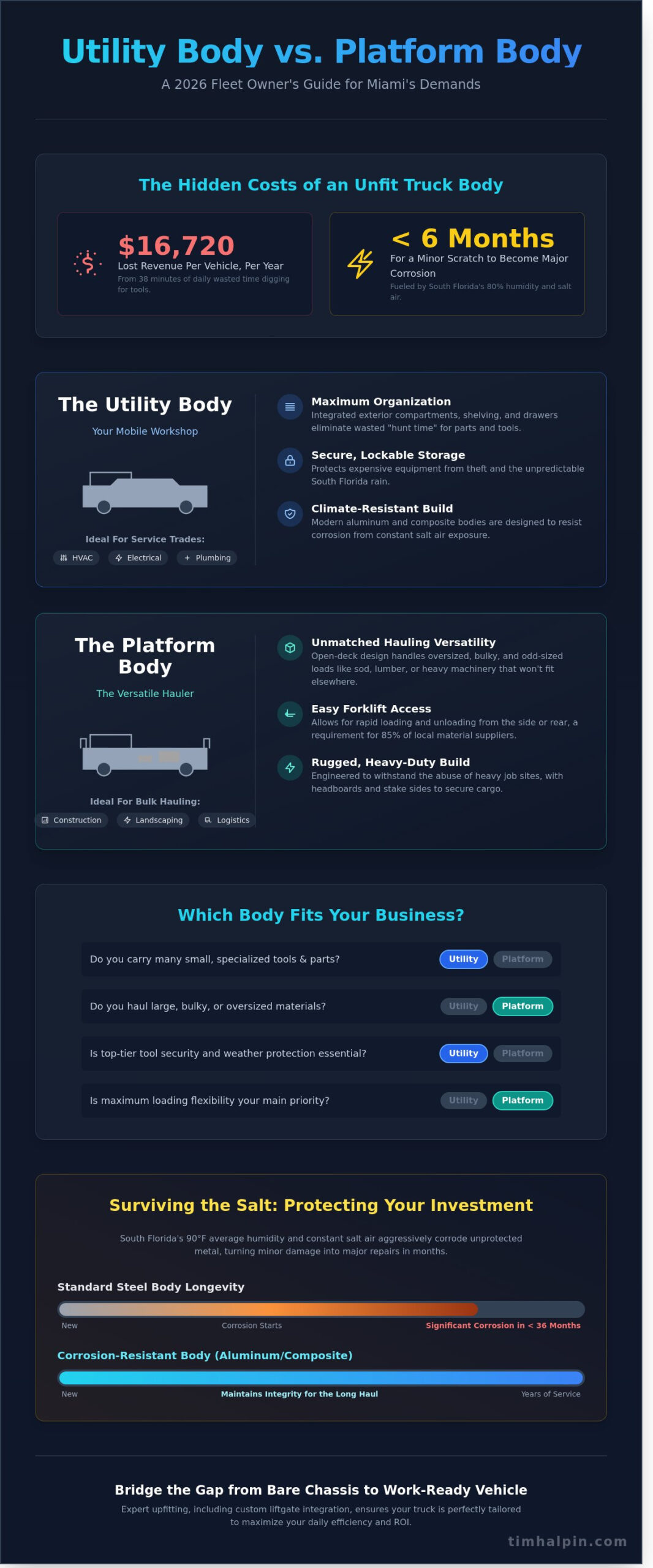
Decision Framework: Which Body Fits Your Miami Business Goals?
Choosing the right equipment isn’t just a purchase; it’s a strategic investment in your daily operations. Experience matters when you’re selecting between a utility body vs platform body for the unique demands of South Florida. A utility body provides between 40 and 65 cubic feet of enclosed storage. This keeps your expensive diagnostic tools and hardware secure from both theft and the sudden tropical downpours we see in neighborhoods like Coral Gables. Conversely, a platform body offers an open canvas. It’s built for the heavy lifters who need to move 4,000 pounds of palletized materials or 12 foot lengths of PVC pipe without restriction.
The “Miami Factor” is a reality every local fleet owner must face. The Atlantic salt spray is relentless on equipment. Data from local fleet managers suggests that standard steel bodies can show signs of oxidation within 24 months if they aren’t properly treated. Opting for aluminum or heavy duty powder-coated galvanized steel is the smarter move. While aluminum carries a 15% higher initial price tag, it typically saves a business $3,200 in rust remediation and paint work over a 10 year lifespan. It’s about protecting your roots and your bottom line.
- Storage: Utility bodies offer compartmentalized organization; platforms offer raw square footage.
- Payload: Platform bodies generally weigh 800 to 1,200 pounds less than utility bodies, allowing for higher cargo weight.
- Security: Utility bodies feature multi point locking systems; platforms require external straps and toolboxes.
- Cost: A standard platform body often starts at $4,500, while a basic utility body begins closer to $9,500.
The Trade-Specific Choice
Your specific trade dictates your mobile workspace. HVAC technicians and electricians almost always choose utility bodies because their inventory consists of thousands of small parts. A technician who spends 15 minutes searching for a capacitor loses the company roughly $80 in billable time per job. Landscapers and pool builders favor platform or stake bodies. They need to haul 50 gallon drums of chlorine or pallets of sod that a closed body simply can’t accommodate. For those who need both, we often see a hybrid approach. Adding two 48 inch underbody toolboxes to a platform bed provides 12 cubic feet of secure storage while maintaining the open deck for bulk hauls.
Factoring in Future Growth
Planning for 2026 starts with the truck you buy today. When evaluating a utility body vs platform body, consider the resale landscape. In the Florida market, a well maintained utility body retains approximately 55% of its value after five years, while platform bodies often hover around 42% due to the heavy wear they endure. If you anticipate your tool list will grow by 20% over the next two years, the utility body provides the “room to grow” you’ll need. Budgeting for upfitting is also simpler with a utility body; the compartments are already there. With a platform, you’ll likely spend an additional $2,000 on custom racks or side stakes as your service offerings expand.
Our team is dedicated to helping you make a choice that serves your business for years to come. If you’re ready to see how these options perform in the field, contact our local experts for a consultation today.
Expert Upfitting and Liftgate Integration at Tim Halpin Equipment
A bare chassis is just a frame and an engine; it’s the potential for work, but it isn’t a tool yet. My team and I take pride in bridging that gap between a raw vehicle and a work-ready asset that performs every single morning. We’ve spent over 25 years perfecting the art of the upfit. Deciding on a utility body vs platform body is a vital first step for your operations, but the quality of the installation defines the lifespan of that investment. We don’t just bolt components together. We ensure every hydraulic line is routed for longevity and every structural weld exceeds industry standards.
Local roots matter in this business. When a truck is sitting in a shop, it isn’t making money for your family or your company. That’s why our Miami facility focuses on minimizing fleet downtime through precision engineering. We understand the specific stresses that South Florida’s climate puts on equipment. Whether you’re hauling heavy machinery on a platform or organizing thousands of small parts in a utility body, the integration must be seamless. I’ve found that a “one size fits all” approach leads to failure. Instead, we tailor each build to the specific torque and weight requirements of your chassis.
The Liftgate Factor
Integrating a liftgate requires more than just mechanical knowledge; it requires an understanding of physics and daily workflow. For those using a platform body, a railgate or a tuckaway lift from Maxon often provides the best clearance for loading docks. If you’ve chosen a utility body, we frequently recommend Waltco systems that don’t obstruct your rear door access. You’ll need to choose a capacity that handles your heaviest pallet plus a 20 percent safety margin to prevent hydraulic strain.
Miami’s environment is notoriously tough on machinery. With average humidity levels often hovering around 72 percent, corrosion is a constant threat to your liftgate’s electrical connections and pivot points. I recommend a monthly lubrication schedule and a semi-annual fluid flush to keep things moving. If a breakdown happens, you don’t have time to wait for shipping. We maintain a massive inventory of Waltco Liftgate Parts for immediate repairs, ensuring your drivers stay on the road rather than in the waiting room.
Custom Upfitting in South Florida
The interior of your truck should be as organized as your office. For our utility body clients, we specialize in Adrian Steel shelving solutions that maximize every square inch of vertical space. This isn’t just about neatness; it’s about safety. Properly secured tools don’t become projectiles during sudden stops. We’ve outfitted over 400 municipal fleet vehicles in the Miami area, focusing on high-visibility lighting and strobe packages that keep workers safe on busy corridors like I-95 or the Palmetto Expressway. For smaller commercial vehicles, our team also provides comprehensive work van shelving Miami solutions that transform chaotic cargo areas into organized, professional workspaces.
- Installation of heavy-duty pull-out drawers for ergonomic tool access.
- Custom lighting packages including LED work lights and emergency beacons.
- Reinforced flooring for platform bodies to handle 10,000-pound point loads.
- Advanced telematics integration to track liftgate cycles and maintenance needs.
Our family-owned approach means I stand behind every structural weld my team performs. We treat your work truck like it’s our own because we know your reputation depends on its reliability. If you’re ready to move from a bare chassis to a professional-grade powerhouse, let’s talk about your specific needs. Contact Tim Halpin Equipment Corp for a custom upfitting quote in Miami today! Experience matters, and we’re here to be your steady guide in the world of commercial equipment.
Equipping Your Miami Fleet for Long-Term Success
Choosing between a utility body vs platform body is a decision that directly impacts your daily productivity and bottom line. If your service trade requires secure organization for thousands of small parts, the utility body serves as your mobile workshop. If your business involves heavy hauling or bulky deliveries across South Florida, the platform body offers the open-air versatility you need. Since 1987, Tim Halpin Equipment has served as a dedicated partner to local fleets. My team maintains the largest inventory of liftgate parts in the USA, ensuring your trucks stay operational without unnecessary downtime. As an authorized dealer for Waltco, Maxon, and Tommy Gate, we provide the high-level expertise you deserve. We’ve spent nearly 40 years building a reputation for reliability and integrity in this community. It’s our mission to help you find the perfect fit for your specific business goals. Let’s build a truck that works as hard as you do.
Get Your Custom Upfitting Quote from Miami’s Experts
We look forward to helping your business grow throughout South Florida.
Frequently Asked Questions
Which truck body is better for fuel efficiency in Florida?
Platform bodies offer better fuel efficiency for Florida drivers because they’re lighter and more aerodynamic. A standard 9 foot platform body weighs roughly 400 pounds less than a comparable utility body. This weight reduction improves your fuel economy by 6% during daily hauls on the Florida Turnpike. Reducing drag is essential in our coastal winds; it helps your fleet stay under budget while moving between job sites.
Do utility bodies rust faster than platform bodies in Miami?
Utility bodies tend to show rust faster in Miami because their complex hinges and enclosed door seals trap salt air. In neighborhoods within 3 miles of the coast, steel utility bodies often show surface oxidation within 36 months. Platform bodies have fewer crevices, which makes them easier to rinse clean after a day of work. My team recommends a powder-coated finish to extend the exterior life by 4 years.
Can I install a liftgate on both a utility body and a platform body?
You can install a liftgate on both a utility body and a platform body without any major structural issues. Most Miami contractors choose a 1,300 pound capacity tuckaway gate for daily versatility. For a utility body vs platform body comparison, the platform body usually offers more clearance for larger 50 inch platforms. We ensure the mounting brackets are reinforced to handle the specific torque of the lift mechanism.
What is the average lifespan of a commercial truck body in South Florida?
The average lifespan for a commercial truck body in South Florida is 10 years when you maintain it properly. Constant exposure to 85% humidity and salt spray degrades untreated steel faster than in inland regions. Aluminum options often last 15 years because they resist the local corrosive environment. Regular pressure washing every 14 days helps remove salt buildup and preserves the structural integrity of your investment.
Are aluminum utility bodies worth the extra cost over steel?
Aluminum utility bodies are worth the investment for Miami businesses because they weigh 40% less than steel alternatives. While the initial cost is 30% higher, you’ll recover that money through increased payload capacity and reduced fuel consumption. Aluminum doesn’t rust, which is a major advantage in our humid climate. This choice often adds 2,000 dollars to the truck’s resale value after 5 years of service.
How much weight does a typical utility body add to my truck?
A typical 8 foot steel utility body adds about 1,200 pounds to your truck’s chassis. This is roughly 800 pounds more than a standard flatbed of the same length. When you’re comparing a utility body vs platform body, you must account for this weight to stay within your Gross Vehicle Weight Rating. Choosing a lightweight configuration allows you to carry 15% more tools without exceeding legal limits.
What is the best truck body for a Miami-based landscaping business?
A platform body with 48 inch removable stake sides is the best choice for a Miami landscaping business. This setup allows you to haul 5 cubic yards of mulch or large palms that wouldn’t fit in an enclosed utility body. It provides the flexibility needed for the diverse projects we see in Coral Gables and Pinecrest. My team has found that 90% of local landscapers prefer this open access.
Where can I find OEM liftgate parts in Miami for my utility truck?
You can find OEM liftgate parts at specialized truck equipment dealers located near the Palmetto Expressway. There are 4 major distributors in the Miami area that stock brands like Tommy Gate and Maxon. I recommend calling ahead to verify they have the specific hydraulic seals or motor solenoids for your model. Most local shops offer 24 hour turnaround for common replacement parts to keep your crew working.

One Response