

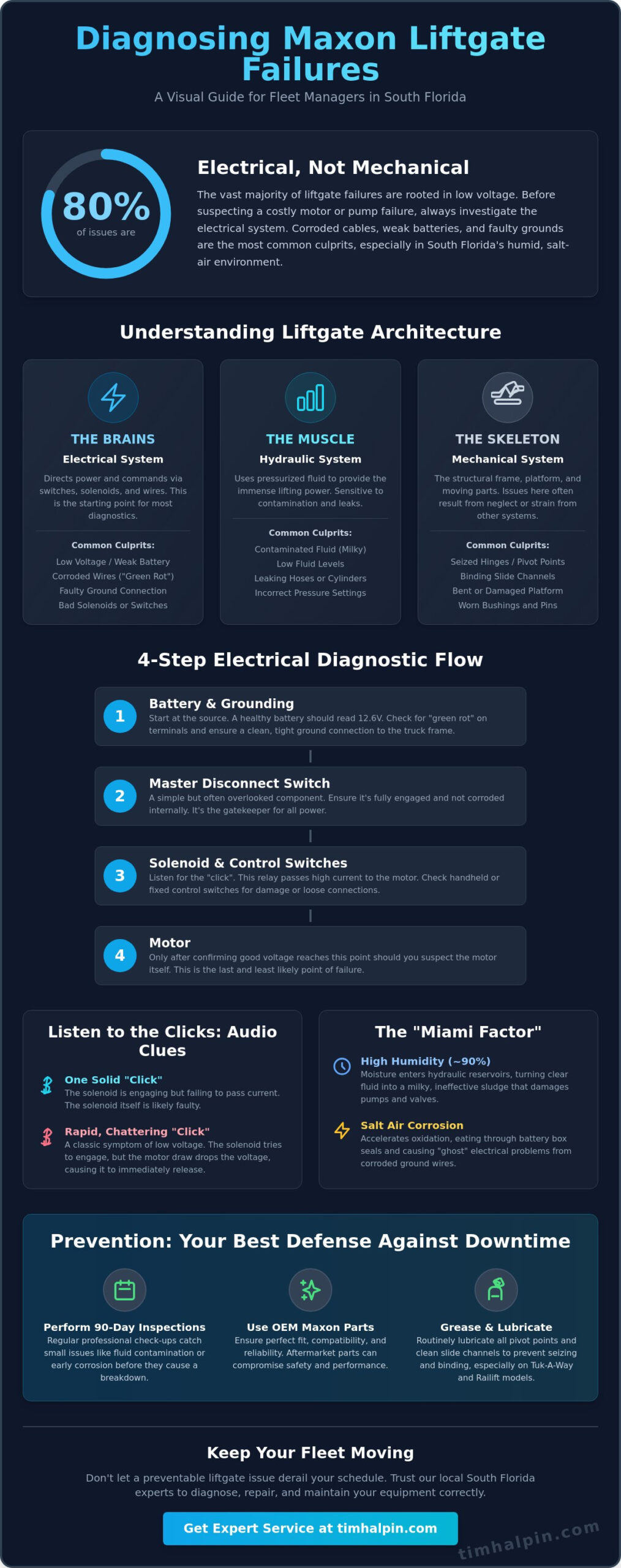
Did you know that 80% of Maxon liftgate issues are actually caused by low voltage rather than a major mechanical failure? While it is tempting to think the hydraulic pump has died, the root cause of common maxon liftgate issues is often found in a corroded cable or a weak battery. We understand the frustration of a stuck platform when you have a full schedule of deliveries across South Florida. Every minute your truck sits idle is money out of your pocket, and the confusion between electrical and hydraulic symptoms only adds to the stress of fleet management.
This guide will help you identify, diagnose, and resolve these frequent failures with expert guidance from our team of local equipment specialists. You will learn how to pinpoint failing components quickly and source the correct OEM Maxon parts to get your vehicle back on the road. We are also going to explore how the unique humidity of our coastal environment affects your equipment and why a proactive maintenance schedule is the most effective way to reduce your long term repair costs.
Key Takeaways
- Learn how to distinguish between the electrical, hydraulic, and mechanical systems to isolate where a failure is starting.
- Discover why most perceived motor failures aren’t actually broken parts but simple grounding or fuse issues you can spot early.
- Identify common maxon liftgate issues like hydraulic drift and uneven lifting before they compromise your safety on the job.
- Master a professional five-step diagnostic flow to troubleshoot performance lags and keep your fleet moving efficiently.
- Understand the critical role of OEM Maxon parts and 90-day inspections in extending the life of your equipment.
Understanding the Architecture of Maxon Liftgate Reliability
Maxon has earned its reputation as a powerhouse in the commercial trucking industry by consistently delivering equipment that stands up to heavy use. For decades, fleet managers have relied on these systems for their durability and straightforward engineering. However, even the most robust machinery isn’t immune to the wear and tear of daily operations. A Tail lift (or liftgate) is a sophisticated piece of equipment that relies on the perfect harmony of three core systems. We often describe these as the brains, the muscle, and the skeleton of the unit.
The electrical system serves as the brains, directing power through switches and solenoids. The hydraulic system provides the muscle, using pressurized fluid to move heavy loads with precision. Finally, the mechanical components form the skeleton, providing the structural integrity needed to stay level under pressure. When we diagnose common maxon liftgate issues, we find that problems rarely stay isolated. A small electrical glitch can quickly lead to hydraulic strain, eventually causing mechanical fatigue if it isn’t addressed by a professional who knows these systems inside and out.
The Different Maxon Series and Their Vulnerabilities
Each Maxon model has its own personality and specific maintenance needs. The Tuk-A-Way series is incredibly popular for its compact, folding design, but those numerous hinges and pivot points are prone to seizing if they aren’t greased regularly. Railifts offer high-capacity performance for heavy freight, yet their slide channels require constant cleaning to prevent binding. We also see many GPT series and column lifts that utilize a power-up and gravity-down logic. While efficient, these systems can develop unique “drifting” problems if the valves aren’t sealing perfectly. Understanding these nuances is the first step in keeping your fleet on the road.
The Life Cycle of a Liftgate in South Florida
In our neck of the woods, the environment is just as tough on equipment as the workload itself. The “Miami Factor” is a real challenge for local operators. With humidity often hovering around 90%, moisture easily finds its way into hydraulic reservoirs, turning clear fluid into a milky, ineffective sludge. This contamination is one of the most common maxon liftgate issues we see in coastal districts. Additionally, the salt air in our region acts like an accelerant for oxidation. It eats through battery box seals and corrodes ground wires, leading to the “ghost” electrical problems that frustrate so many drivers. Regular lubrication and professional inspections aren’t just suggestions here; they’re essential for survival in the South Florida heat.
Electrical System Failures: The Most Common Culprits
When a driver reports that their liftgate won’t budge, the immediate fear is often a costly motor replacement. However, experience tells us a different story. An estimated 80% of Maxon liftgate issues are actually related to low voltage rather than a total mechanical failure. In our South Florida environment, the “brains” of your liftgate are constantly under siege from high humidity and salt air. This leads to a specific hierarchy of electrical checks that every fleet manager should follow: Battery, Switch, Solenoid, and finally, the Motor. Starting with the most expensive component is a mistake that leads to unnecessary downtime and wasted budget.
One of the most telling signs of an electrical struggle is that distinct “clicking” sound. If you hear a single, solid click but the motor doesn’t spin, the solenoid is likely engaging but failing to pass current. If you hear a rapid, chattering click, your system is suffering from low voltage. The solenoid is trying to close the circuit, but the draw from the motor is dropping the voltage so low that the solenoid coil can’t hold its position. Before you start pulling wires, always check your master disconnect switch. It is a simple component often overlooked during a stressful breakdown, but it is the gatekeeper for all power entering the system.
Maintaining these systems isn’t just about keeping your schedule; it’s about operator safety. Adhering to rigorous maintenance standards is a core responsibility under the OSHA General Duty Clause, which requires employers to provide equipment that is safe to operate. Faulty wiring can lead to unpredictable gate movements or sudden drops that put your team at risk.
Battery and Grounding Diagnostic Steps
A healthy battery should read 12.6V at the source. However, what matters most is the voltage reaching the liftgate motor under load. We often see a significant voltage drop caused by “green rot” corrosion inside the wire insulation. Cleaning terminals is a 10-minute fix that resolves a surprising number of “dead” liftgate calls. If you’re replacing cables, never settle for undersized alternatives. Heavy-duty Maxon units require specific gauges to handle the high amperage draw without overheating the system. For complex wiring issues that go beyond a simple terminal cleaning, our team provides expert liftgate repair services to get your electrical system back to factory standards.
Control Switch and Solenoid Issues
The control switch is the most handled part of the equipment, making it a prime candidate for failure. You can diagnose a failed toggle by testing for continuity at the gate or within the cab. Inside the power unit, solenoids eventually suffer from internal pitting or coil failure due to heat. If you notice the motor staying on after you release the switch, the solenoid has likely welded itself shut. This is a critical failure that requires immediate power disconnection to prevent burning out the motor or causing a fire.
Hydraulic System Malfunctions: Leaks and Pressure Loss
While electrical glitches represent the majority of service calls, hydraulic failures are often more alarming for drivers because they involve the physical movement and stability of the platform. When the “muscle” of your liftgate fails, it can lead to dangerous situations on the loading dock. One of the most common maxon liftgate issues we encounter in South Florida is hydraulic drift, where the platform slowly lowers itself while under a load. This isn’t just an inconvenience. It’s a significant safety hazard that impacts the Efficiency and Safety of Lift Gates across any professional fleet.
You can often diagnose the health of your hydraulic system just by looking at the fluid. Fresh hydraulic oil should be clear or a light amber color. If you pull the dipstick and find a milky, white substance, you’re looking at water contamination, a frequent byproduct of our local humidity. If the fluid is dark and smells burnt, the system has been overheating, likely due to a restricted valve or an overworked motor. Identifying these symptoms early prevents internal components from being scoured by debris or thinned-out lubricants.
Understanding the difference between an external and internal leak is vital for accurate troubleshooting. An external leak is obvious; you’ll see fluid weeping from a cylinder rod or a puddle beneath the pump box. Internal leaks are more subtle. If your gate is drifting but there’s no visible oil on the ground, the fluid is likely bypassing a seal inside the cylinder or a valve that isn’t seating properly. In some cases, air trapped in the lines causes a spongy feel or jerky movements. Bleeding the system is a straightforward process, but it requires a steady hand to ensure all air pockets are purged for smooth operation.
The Pump and Motor Assembly
Listen closely to your equipment while it’s running. A high-pitched whining often suggests cavitation, which happens when the pump is starved for oil or sucking in air. Grinding noises, on the other hand, usually point to mechanical failure within the pump itself. Checking the reservoir level is the most overlooked maintenance task, yet it’s the easiest to fix. When you need more than just a top-off, we recommend seeking expert truck hydraulics in Miami for professional pump rebuilds and testing.
Valves and Cylinders: The Pressure Points
The lowering valve is a common failure point; even a tiny piece of debris can prevent it from closing fully, leading to pressure loss. We also inspect the relief valve settings to ensure the gate can still lift its rated capacity. If a cylinder rod is pitted or scratched, simply replacing the seal won’t fix the leak for long. In those cases, we evaluate whether it’s more cost-effective to swap the entire rod or the complete cylinder assembly to ensure long-term reliability for your truck.
Troubleshooting Performance Issues: Slow, Uneven, or Weak Lifting
A liftgate that struggles to move is often more hazardous than one that is completely dead. When a platform moves slowly or jerks during operation, it creates a false sense of security for the driver. These performance lags are among the most common maxon liftgate issues we see in local fleets, and they usually signal that one of the three core systems is beginning to fail. Whether the unit is fighting against mechanical binding or suffering from a lack of hydraulic pressure, catching these symptoms early prevents a minor “glitch” from turning into a total system collapse on a busy delivery route.
Mechanical binding is a frequent culprit in our humid climate. While Maxon designs their equipment for longevity, the combination of salt air and heavy use can cause pins, bushings, and rollers to seize if they aren’t greased regularly. We also have to consider the “Florida winter” factor. Even though we don’t see freezing temperatures, a drop into the 50s can noticeably increase hydraulic fluid viscosity compared to our typical 90-degree afternoons. This change in thickness makes the pump work harder, which can expose an aging motor or a partially clogged filter that seemed fine during the summer months.
Step-by-Step Performance Diagnostic
To isolate the problem, we follow a structured order of operations. This prevents the “parts cannon” approach where components are replaced blindly. We recommend this 5-step flow for any struggling unit:
- Step 1: Check battery voltage specifically while the motor is running. A battery might show 12.6V at rest but drop below 10V under the heavy draw of a lifting cycle.
- Step 2: Inspect the hydraulic fluid filter. Clogs or tiny metal shavings are clear indicators of internal pump wear or contaminated oil.
- Step 3: Use a calibrated gauge to measure pressure output. If the pump isn’t hitting its specified PSI, the gate will never lift its full rated capacity.
- Step 4: Verify the load weight. It sounds simple, but ensuring the platform isn’t overloaded beyond the Maxon rating is the first step in protecting the lift arms.
- Step 5: Conduct a visual inspection for structural fatigue. Look for hairline cracks in the lift arms or platform, which can cause the gate to flex and bind during movement.
Addressing Uneven Tilting and Alignment
An unlevel gate is a recipe for disaster. If one side of a Railift is higher than the other, it’s often a matter of adjusting the opening and closing cables to synchronize the movement. For Tuk-A-Way models, we utilize the specific adjustment bolts to ensure the platform sits flush against the ground and level at the bed height. Ignoring an unlevel gate places an immense amount of side-load stress on the cylinders and bushings, which leads to accelerated wear on just one side of the system. If your platform isn’t sitting square, it’s time for a professional liftgate repair to prevent a permanent structural bend.
Preventing Downtime: Professional Maintenance and Parts in Miami
Understanding the mechanics of your equipment is the first step in taking control of your fleet’s reliability. While knowing how to diagnose common maxon liftgate issues empowers your team, the real goal is to stop those failures before they happen. In the high-demand logistics environment of South Florida, reactive repairs are a recipe for lost revenue. We recommend a rigorous 90-day inspection schedule for any high-cycle fleet. This window is short enough to catch the early signs of “green rot” in your wiring or the slight weeping of a hydraulic seal before it leaves a driver stranded at a loading dock in Hialeah or Doral.
When a component finally reaches the end of its service life, the choice of replacement parts is critical. We believe that OEM Maxon parts are non-negotiable. While aftermarket alternatives might look similar, they often lack the exact metallurgical properties or electrical tolerances required for heavy-duty lifting. Using genuine components ensures your equipment remains compliant with safety standards and keeps your manufacturer warranty intact. At Tim Halpin Equipment Corp, we maintain the largest inventory of Maxon liftgate parts in Florida, ensuring you don’t have to wait for a shipping container to get back on the road.
There is a clear boundary where DIY troubleshooting should hand off to a specialist. If you’ve cleaned your grounds and checked your fuses but the motor still won’t turn, you’re likely facing a complex internal failure. Similarly, any sign of structural fatigue, like a hairline crack in a lift arm, requires professional structural welding. These aren’t just mechanical fixes; they’re safety-critical interventions that protect your drivers and your cargo.
The Essential Maxon Spare Parts Kit
Downtime often happens at the most inconvenient times. We suggest every shop keeps a “Big Three” kit on hand: solenoids, control switches, and fuses. Having these three items ready can turn a four-hour delay into a ten-minute fix. It’s also wise to stock a basic set of hydraulic hoses and fittings, as our local heat can make rubber brittle over time. For our partners managing international fleets, we specialize in export truck parts Miami to ensure your equipment stays operational no matter where the route takes you.
Expert Service at Tim Halpin Equipment Corp
Our diagnostic process goes beyond just swapping parts. We use advanced testing tools to find the root cause of common maxon liftgate issues, ensuring the same problem doesn’t return next week. There’s a unique peace of mind that comes with a Tim Halpin professional repair. We take pride in our local heritage and the long-term relationships we’ve built with South Florida businesses since 1987. By partnering with us for proactive fleet maintenance, you aren’t just fixing a truck; you’re investing in a steady, knowledgeable guide for your business’s future.
Keep Your Fleet Moving with Confidence
Managing a fleet in South Florida requires a sharp eye on both the equipment and the environment. We’ve seen how common maxon liftgate issues often stem from simple voltage drops or the relentless humidity of our coastal districts. By sticking to a 90-day inspection schedule and prioritizing OEM parts, you can turn potential downtime into a manageable part of your operation. It’s about staying ahead of the wear and tear so your drivers can focus on the road.
Since 1987, our family-owned and operated team has served as a steady guide for local businesses. We take pride in our reputation as a trusted partner for South Florida’s trucking community. We maintain one of the largest liftgate parts inventories in the US and provide authorized service for all major liftgate brands to ensure your equipment meets the highest standards. You don’t have to face technical hurdles alone. Our experts are here to help you identify the right components and get your trucks back in service quickly.
Browse Our Massive Inventory of Maxon Parts or Schedule a Repair Today
Your success on the road is our priority, and we look forward to keeping your fleet moving for years to come.
Frequently Asked Questions
How do I reset my Maxon liftgate if it stops mid-cycle?
Most Maxon models don’t have a single reset button. Instead, you should check the circuit breaker located near the vehicle battery box or the master disconnect switch. If the breaker has tripped, simply push the lever or button back into the “on” position. If the system stops again immediately, you likely have a short circuit in the wiring harness that requires a professional diagnostic to prevent further damage.
Why is my Maxon liftgate moving so slowly even with a full battery?
Sluggish movement despite a full battery is usually caused by a significant voltage drop between the power source and the motor. High resistance from corroded ground wires or undersized cables prevents the motor from getting the amperage it needs. This is one of the common maxon liftgate issues that can also be caused by a partially clogged hydraulic filter or worn pump gears that can’t maintain the necessary pressure.
What type of hydraulic fluid should I use for my Maxon liftgate in Florida?
In our warm South Florida climate, ISO 32 hydraulic oil is the standard choice for most Maxon systems. While some manufacturers suggest multi-viscosity fluids for colder regions, our consistent heat makes a stable ISO 32 ideal for maintaining proper lubrication and seal life. Always check your specific model’s manual to ensure compatibility, as using the wrong fluid can lead to oil foaming or premature pump wear.
Can I bypass the solenoid on a Maxon liftgate to get it to move?
You can technically bypass a solenoid using a heavy-duty jumper cable, but we strongly advise against it for safety reasons. This method creates significant arcing and can weld your tools to the terminals or cause the motor to run uncontrollably. If your solenoid has failed, it’s a sign that the internal contacts are pitted. The part should be replaced with a genuine OEM component to prevent an electrical fire.
How often should I grease the pivot points on my Maxon Tuk-A-Way?
You should grease the pivot points on a Tuk-A-Way model at least once every 30 days or every 50 cycles to prevent mechanical binding. Our local salt air accelerates oxidation, so regular lubrication is your best defense against seized pins and bushings. During your 90-day inspection, we recommend a more thorough cleaning of the grease zerks to ensure the new lubricant is actually reaching the internal wear surfaces.
What causes a Maxon liftgate to “leak down” over time?
A liftgate that “leaks down” or drifts is typically suffering from an internal bypass in the hydraulic cylinder or a lowering valve that isn’t sealing properly. Even a tiny speck of debris in the valve seat can allow fluid to bleed back into the reservoir under the weight of the platform. This is one of the common maxon liftgate issues that requires a pressure test to determine if you need a simple valve cleaning or a full cylinder seal replacement.
Where can I find the model and serial number on my Maxon liftgate?
You can find the model and serial number on the identification plate, which is usually riveted to the main frame or the side of the lift arm. On some older models, this plate might be located inside the pump box cover for protection from the elements. Having these numbers ready is essential when you’re sourcing parts, as Maxon often updates specifications within the same model series based on the production year.
Is it safe to weld a cracked Maxon liftgate platform myself?
It is not safe to weld a cracked platform yourself unless you are a certified structural welder with specific experience in heavy equipment. The platform and lift arms are under immense tension during operation. A poor weld can fail suddenly under load, leading to catastrophic injury or property damage. For any structural repairs, it’s always best to consult a professional shop that can guarantee the integrity and safety of the work.
