

What if the equipment that handles your heaviest cargo is actually the one slowing your entire South Florida delivery route to a crawl? It’s a question we often discuss with local fleet managers who feel caught between raw lifting power and operational speed. When weighing a railgate vs tuckunder liftgate, the right choice isn’t just about weight capacity. It’s about your specific dock-to-curb ratio and how your truck interacts with every stop on its schedule.
We understand that nothing stalls a workday like a hydraulic failure or a platform that’s too small for a bulky pallet. These equipment mismatches lead to expensive downtime and unnecessary stress for your drivers. This guide will show you how to choose the right liftgate to maximize your fleet’s productivity while minimizing maintenance headaches. We’ll break down the latest 2026 application trends, safety standards, and why our regional humidity makes a strict lubrication schedule your best friend for long-term reliability.
Key Takeaways
- Identify whether a railgate’s massive platform or a tuckunder’s dock-loading versatility better suits your specific delivery route.
- Evaluate the railgate vs tuckunder liftgate using our decision matrix to balance high-frequency stops with heavy load requirements.
- Learn how to protect your investment from South Florida’s salt air and humidity with application-specific maintenance strategies.
- Discover how modern high-capacity tuckunder models can handle up to 5,500 pounds without sacrificing the speed of your operations.
- Gain insights into reducing long-term maintenance costs through professional installation tailored to your vehicle’s specific hydraulic needs.
Understanding the Liftgate Dilemma: Railgate vs. Tuckunder
A liftgate isn’t just a piece of heavy metal bolted to the back of a box truck. It’s the primary productivity tool that determines how fast your drivers can clear a route and how safely they can handle expensive inventory. Choosing between a Tail lift (liftgate) that runs on tracks or one that folds out of sight is a decision that impacts every stop your fleet makes. This brings us to the central debate for many logistics professionals: the railgate vs tuckunder liftgate.
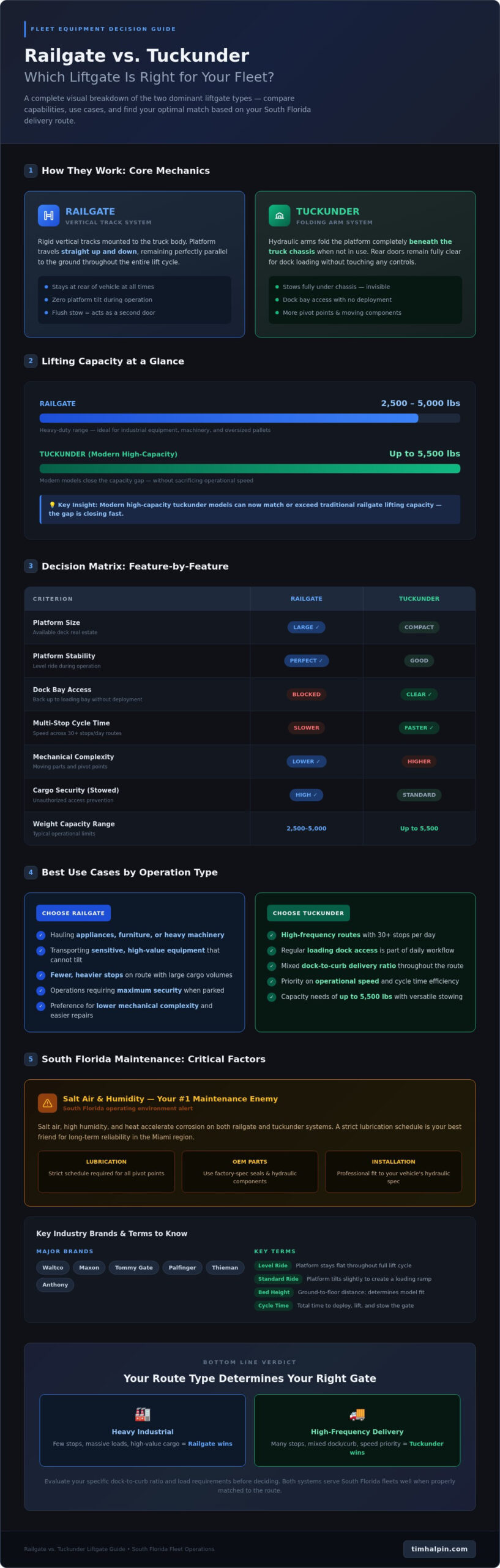
Railgates are vertical-track systems that remain at the rear of the vehicle. They provide a massive, stable platform that stays level throughout its travel. In contrast, a tuckunder liftgate features a folding mechanism that stows completely beneath the truck chassis when not in use. This design keeps the rear doors clear for dock loading. The core conflict is simple but significant. You’re balancing the need for maximum platform stability against the requirement for loading dock accessibility. Getting this choice wrong often leads to frustrated drivers and unnecessary maintenance calls.
The Mechanics of Vertical Travel
Railgates utilize rigid vertical tracks mounted directly to the truck body. This setup ensures the platform stays perfectly parallel to the ground during operation. It’s a “straight up and down” motion that prevents cargo from shifting, which is vital for sensitive equipment. Tuckunders operate differently. They use a series of hydraulic arms to unfold from their “tuck-away” storage position under the frame. While this folding action is ingenious, it introduces more moving parts and pivot points into the equation.
For our neighbors managing Miami delivery routes, “cycle time” is a critical metric. This is the total time it takes for a liftgate to deploy, lift, and stow. If your drivers make thirty stops a day, a railgate that requires deployment at every single stop—even when loading at a dock—adds hours to the weekly schedule. A tuckunder stays stowed during dock visits, allowing the driver to back right up to the bay without touching the controls.
Key Industry Terminology for 2026
Understanding the lingo helps you make a better investment for your fleet. A “Level Ride” platform stays flat during the entire lift cycle, while a “Standard Ride” might tilt slightly at the bottom to create a ramp for easier loading. Knowing your “Bed Height” is equally vital. This is the measurement from the ground to the truck floor, and it dictates which specific models from brands like Waltco, Maxon, or Tommy Gate will fit your chassis.
We always emphasize using OEM parts for maintenance and repairs. Whether you’re running a Palfinger, Thieman, or Anthony system, sticking to factory specifications ensures your hydraulic seals and electrical components survive the South Florida humidity. Using the right parts protects your warranty and keeps your trucks on the road where they belong.
The Railgate Deep Dive: Maximum Stability and Platform Size
When your daily operations involve moving oversized pallets or heavy industrial equipment, the platform’s physical real estate becomes your most valuable asset. Railgates are designed for these high-demand scenarios. Unlike folding systems, a railgate offers a massive, flat surface that can easily handle lifting capacities between 2,500 and 5,000 pounds. This makes them the go-to choice for heavy-duty fleets that prioritize load stability over everything else. When comparing a railgate vs tuckunder liftgate, the rail system wins on raw platform size and weight distribution every time.
The “straight up and down” travel of a railgate is a significant engineering advantage. Because the platform remains perfectly level throughout the entire lift cycle, there is virtually no risk of the load shifting or tilting. This precision is backed by data-driven insights, such as those found in the USPS OIG report on lift gate efficiency, which highlights how different gate styles impact safety and operational flow. For South Florida fleets transporting high-value cargo, the railgate also offers an unintentional security benefit. When stowed, the platform sits flush against the rear doors, acting as a “second door” that makes unauthorized access to the trailer significantly more difficult.
When a Large Platform is Non-Negotiable
If you’re hauling appliances, furniture, or heavy machinery, you simply can’t compromise on deck space. Many modern railgates feature extruded aluminum platforms to reduce overall vehicle weight and increase payload capacity, though steel remains a popular choice for those who need maximum durability against daily wear. The railgate’s level-ride advantage is essential for specialized deliveries like medical imaging tech or delicate electronics where even a few degrees of tilt could cause damage. If you’re noticing your tracks are sticking or the motor is straining, a quick visit for professional liftgate repair can prevent a total system failure on the road.
The Trade-off: Accessibility Challenges
The very design that makes a railgate stable also makes it a potential barrier to productivity at the loading dock. Because the gate stows vertically against the rear of the truck, it must be lowered every time you need to open the rear doors. This is true even if you’re backed up to a dock or just need to grab a small hand-carry item. For routes with thirty or forty stops, this extra cycle time adds up quickly. Maintenance is another factor to watch in our local climate. The vertical tracks are constantly exposed to South Florida’s salt air and humidity, which means a strict 90-day lubrication schedule is necessary to prevent the rollers from seizing and the hydraulic seals from degrading prematurely.
The Tuckunder Advantage: Versatility and Dock Access
When your route includes a mix of street-level deliveries and high-volume loading docks, the tuckunder liftgate offers a level of flexibility that vertical systems simply can’t match. It is the king of urban logistics. By folding and stowing completely beneath the truck chassis, this gate leaves the rear doors entirely unobstructed. This means your drivers can back directly into a loading bay without ever operating the lift. In the high-speed world of South Florida logistics, where every minute at the dock counts, this unrestricted access is a game-changer for daily productivity.
Stowing the equipment under the frame provides more than just accessibility; it offers a layer of protection against the elements and road hazards. Because the platform is tucked away, it’s shielded from direct exposure to our intense tropical sun and torrential afternoon downpours. It also stays out of the “crumple zone” during minor rear-end collisions, which can save a fleet from a total equipment write-off. Whether you’re operating a 14-foot box truck or a heavy-duty semi-trailer, the tuckunder’s design makes it a versatile fit for almost any vehicle in your lineup. Modern models have closed the gap on power too, with lifting capacities now ranging from 2,000 to 5,500 pounds.
Maximizing Dock-to-Curb Efficiency
Consider a scenario where 50% of your daily stops are at a raised warehouse dock. With a railgate, the driver must lower the platform at every single stop just to open the doors. A tuckunder eliminates this wasted motion. Many of these units also feature a “gravity down” function. This allows the platform to lower using its own weight rather than drawing power from the motor, which significantly preserves battery life during high-cycle delivery days. This efficiency is exactly why these systems are a cornerstone of commercial truck upfitting in Miami, where stop-and-go traffic already puts enough strain on your vehicle’s electrical system.
Limitations: Platform Geometry and Stability
While versatile, tuckunders do have specific geometric limitations you need to consider. Most utilize a “wedge” platform design, where the deck tapers toward the end to meet the ground. This can make it slightly more challenging to transition a heavy pallet jack compared to the perfectly flat surface of a railgate. Additionally, the travel path isn’t a straight vertical line; it moves in a slight arc as the hydraulic arms extend. You also need to be mindful of ground clearance. Because the mechanism hangs beneath the chassis, trucks operating on steep inclines or rough, unpaved lots may face a higher risk of “bottoming out” the liftgate housing. Regular inspections of the pivot pins and hydraulic lines are essential to ensure the folding mechanism remains smooth and reliable.
Decision Matrix: Matching the Gate to Your Fleet’s Daily Route
Choosing the right equipment isn’t about finding the “best” liftgate in a vacuum; it’s about finding the best fit for your specific daily operations. A fleet manager in South Florida has to look beyond simple weight capacities and consider the long-term rhythm of their delivery routes. When you evaluate the railgate vs tuckunder liftgate debate, you’re really looking at a trade-off between pure platform stability and the speed of your dock-to-curb transitions. Getting this balance right can save your team hours of labor every single week.
One common misconception we hear is that tuckunders are only for light-duty work. While that might have been true a decade ago, modern heavy-duty tuckunder models can now handle up to 5,500 pounds. This actually exceeds the 5,000-pound capacity found on many standard railgate systems. If your primary concern is weight, don’t automatically assume a railgate is your only option. Instead, look at how many times your driver has to access the rear of the truck without needing the lift itself.
The “Dock-to-Curb” Ratio Test
To find your ideal match, look at your route data and calculate your “Dock-to-Curb” ratio. If more than 30% of your stops involve backing up to a raised warehouse dock, a railgate can actually become a financial drain. The extra time spent lowering the gate just to open the doors adds up to significant labor costs over a five-year vehicle lifespan. Overspec-ing for a massive platform you only use twice a week often results in slower delivery times for the other thirty stops on the route.
The length of your truck’s chassis overhang is the primary factor that determines if a tuckunder liftgate can be safely installed without interfering with the rear axle or spring hangers. If your chassis is too short, a railgate might be your only choice regardless of your dock-loading needs. Always measure your bed height and overhang before committing to a specific model to ensure the hydraulic arms have enough clearance to sweep through their full arc of motion.
Repair Complexity and Parts Availability
Maintenance is where the two designs truly diverge. Railgates often rely on a cable-drive or chain-drive system. These cables are under high tension and are susceptible to fraying, especially when exposed to our local salt air. If a cable snaps, the platform can drop or become stuck mid-travel. Tuckunders typically use a direct-cylinder hydraulic system. While this eliminates the risk of broken cables, it introduces more pivot points and bushings that require regular greasing to prevent the folding mechanism from seizing up in the Miami heat.
When a system does go down, speed of repair is everything. We’ve seen that fleets that maintain a small inventory of high-wear components experience much less downtime. Sourcing Waltco liftgate parts in Miami from a local expert ensures you get OEM quality that stands up to heavy cycles. Similarly, keeping a stock of Maxon liftgate parts, such as solenoids and motor brushes, allows your shop to handle minor electrical issues before they turn into a “truck-down” emergency. If your current equipment is showing signs of hydraulic lag or electrical stuttering, it’s time to schedule a professional fleet inspection to catch these issues early.
Expert Installation and Maintenance: Keeping Your Liftgate Running in South Florida
South Florida is a beautiful place to live, but it’s a harsh environment for commercial equipment. The combination of salt air, high heat, and torrential afternoon rain creates a perfect storm for metal corrosion and hydraulic failure. Whether your final choice in the railgate vs tuckunder liftgate debate was based on platform size or dock access, the longevity of that investment depends entirely on how it’s installed and maintained. Professional installation ensures that the hydraulic system is properly bled and the electrical connections are sealed against our humidity. This initial attention to detail prevents small leaks from becoming major operational headaches down the road.
Regular truck hydraulics in Miami service is the most effective way to prevent a roadside breakdown. In our coastal environment, a standard maintenance schedule often isn’t enough. We recommend a strict 90-day lubrication cycle for all pivot points and tracks. This prevents the seizing and pitting that leads to expensive repairs and dangerous equipment failures during a delivery. When your equipment is properly cared for, your drivers stay safe and your delivery schedules stay on track.
Corrosion Prevention for Coastal Fleets
Humidity doesn’t just affect the metal; it wreaks havoc on your electrical system. We often see “electrical pitting” caused by poor ground connections that have been compromised by moisture. We suggest using high-performance marine-grade grease on all exposed moving parts to create a barrier against the salt air. For those choosing a railgate, we strongly recommend galvanized frames over standard powder-coating. Galvanization provides a metallurgical bond that resists corrosion much better than paint, which can chip and allow rust to spread hidden beneath the surface.
The Tim Halpin Advantage
At Tim Halpin Equipment Corp, we’ve been the steady guide for South Florida fleet managers since 1987. We understand that your trucks are only profitable when they’re moving. Our facility provides on-site installation and expert liftgate repair services tailored to the unique needs of our community. We take great pride in our local heritage, and that passion shows in the quality of every hydraulic line we crimp and every bolt we torque.
We maintain the largest inventory of OEM parts in the region. Whether you need components for Anthony, Thieman, or Palfinger systems, we have the parts on the shelf to get you back on the road quickly. This individual accountability is our personal guarantee to every client we serve. It’s the hallmark of a business that values its reputation as much as the transaction itself. If you’re ready to optimize your fleet’s performance, contact Tim Halpin Equipment Corp for expert liftgate consultation and parts today.
Future-Proofing Your Fleet Operations
Choosing the right equipment for your South Florida delivery route is a decision that impacts your bottom line every single day. Whether you prioritize the massive, level-ride platform of a railgate or the quick, unobstructed dock access of a tuckunder, the goal remains the same: maximizing uptime and keeping your team safe. The railgate vs tuckunder liftgate debate ultimately comes down to your specific dock-to-curb ratio and the nature of the cargo you handle. When you match your gear to your route, you eliminate the friction that slows down your business.
Since 1987, we’ve helped local businesses and international exporters find the perfect balance between raw power and operational speed. We’re proud to offer one of the largest liftgate parts inventories in the United States, supporting all major brands with expert hydraulic repair and commercial upfitting. Our team understands the unique pressures of the Miami market and is here to ensure your vehicles stay on the road where they belong. We’re ready to be your steady guide in maintaining a high-performance fleet.
Browse our massive inventory of liftgate parts or schedule a repair today!
We look forward to helping you build a more efficient and reliable fleet for years to come.
Frequently Asked Questions
Can I install a railgate on a truck with a rear swing door?
You can certainly install a railgate on a truck with swing doors, but it changes your daily workflow. Because the platform stows vertically against the rear, your drivers must lower the gate to open or close the doors at every stop. This is why many multi-stop fleets prefer a tuckunder style to maintain easier access to the cargo area.
What is the maximum weight capacity for a modern tuckunder liftgate?
Modern tuckunder liftgates can now handle up to 5,500 pounds thanks to significant engineering improvements. This high capacity allows them to compete directly with heavy-duty rail systems that were once the only option for heavy pallets. When comparing a railgate vs tuckunder liftgate for heavy loads, always check the specific model’s rating to ensure it meets your heaviest requirements.
How often should I service my liftgate hydraulics in a humid climate like Miami?
We recommend a strict 90-day maintenance schedule for all fleets operating in South Florida. Our intense humidity and salt air can accelerate seal degradation and electrical corrosion. Frequent lubrication of pivot points and hydraulic fluid checks will prevent the most common causes of roadside failure in our tropical environment.
Is an aluminum platform worth the extra cost over a steel one?
Aluminum platforms are often worth the investment for fleets looking to maximize payload and resist rust. They are significantly lighter than steel, which reduces the strain on your vehicle’s suspension and improves fuel economy. In our coastal environment, the natural corrosion resistance of aluminum also extends the overall life of the equipment.
Will a tuckunder liftgate interfere with my truck’s hitch or underride guard?
It is possible for a tuckunder to interfere with existing rear hardware, so specific measurements are vital before installation. The unit needs enough clearance under the chassis to fold and stow correctly. We always check the chassis overhang and hitch placement to ensure the lift operates safely without hitting the underride guard or axle.
What happens if my liftgate cable snaps while the platform is loaded?
If a cable snaps on a railgate, the platform may drop suddenly or become jammed in the tracks. Modern systems often include safety features like velocity fuses or secondary cables to prevent a total freefall. Regular inspections of cable tension and checking for fraying are the best ways to avoid this dangerous scenario during a delivery.
Are parts for older Waltco and Maxon models still available in 2026?
Yes, we maintain a robust inventory of Waltco and Maxon parts to keep older systems running reliably. Many internal components like solenoids, motors, and hydraulic seals are standardized across different model years. Working with a local expert ensures you get the right OEM parts to maintain factory safety standards even for older units.
Does a railgate provide better security for my cargo than a tuckunder?
A railgate does offer an extra layer of security because the platform stows flush against the rear doors. This makes it much harder for unauthorized individuals to tamper with the door locks or gain entry to the trailer. When evaluating the railgate vs tuckunder liftgate, this “second door” effect is a major advantage for those hauling high-value inventory in urban areas.
