The most expensive lighting system isn’t always the one with the highest price tag; it’s the one that leaves your truck sitting in a repair bay during peak season. We’ve seen it happen too often in South Florida, where the relentless UV rays yellow lenses and salt air eats through wiring before the first year is even up. When deciding between Code 3 vs Feniex lighting for Miami fleets, most managers feel torn between the battle-tested reputation of a legacy brand and the high-tech, modular flexibility of a modern innovator. You want a setup that’s tough enough to survive a July heatwave but simple enough to fix without a week of downtime.
I’ve helped local teams upfit their vehicles since 1987, and I know that what works in other climates often fails on I-95. You deserve a lighting standard that guarantees visibility and reliability without the stress of constant maintenance. This guide will help you decide which brand truly meets the 2026 standards for your specific mission. We’ll compare Code 3’s heavy-duty thermal management against Feniex’s digital modularity to see which one keeps you SAE Class 1 compliant. From lens durability to ease of repair, here is how these two industry leaders stack up against the unique challenges of the Miami environment.
Key Takeaways
- Discover how Code 3’s municipal heritage compares to Feniex’s tech-forward approach to find the right engineering fit for your specific vehicle.
- Learn why the “South Florida Stress Test” of high UV and salt air makes specific lens and board protections essential for long-term reliability.
- When comparing Code 3 vs Feniex lighting for Miami fleets, understand which system best maintains SAE Class 1 visibility under the intense midday sun.
- Evaluate the total cost of ownership by looking at modular repairability and the benefit of having local Miami inventory for immediate part swaps.
- Get a clear verdict on which brand excels for law enforcement integration versus the rugged power needed for heavy-duty towing and recovery.
Engineering DNA: Code 3 Heritage vs. Feniex Innovation
Choosing a lighting system for your truck isn’t just about picking the brightest bulb. It’s about the philosophy behind the build. I’ve spent decades looking under the hoods and inside the lightbars of South Florida’s hardest-working vehicles. Code 3 represents what we call the “St. Louis Standard.” It’s a legacy built on massive municipal contracts and a reputation for heavy-duty reliability that spans generations. On the other side of the aisle, Feniex acts as the “Austin Disruptor.” They focus on rapid prototyping and software-driven hardware that feels more like a modern gadget than a traditional piece of equipment. In 2026, the gap between these two has narrowed, but their core DNA remains distinct.
Code 3: Built for the 10-Year Lifecycle
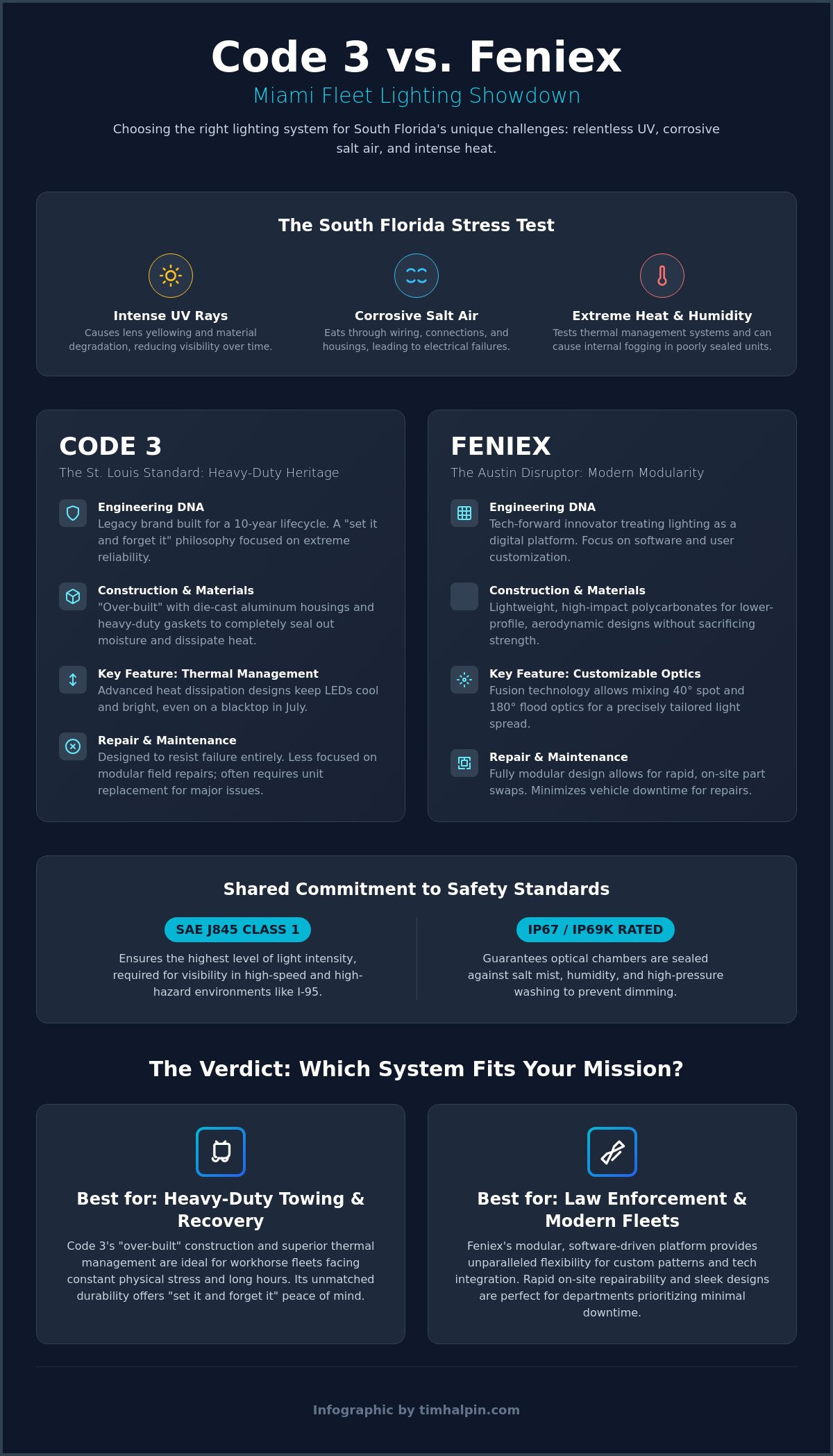
Code 3 designs their gear for long-term consistency. Large municipalities often default to them because their electronics are famously “over-built” to resist constant road vibration. Their 21TR Plus lightbar features advanced thermal management specs to keep LEDs cool even when the sun is beating down on the roof of a parked cruiser. They rely on heavy-duty gaskets and die-cast aluminum housings to seal out moisture. This traditional approach to emergency vehicle lighting ensures that the hardware survives a decade of service without internal component failure. It’s a “set it and forget it” mentality that appeals to fleet managers who don’t want to think about their lights again until the vehicle is retired.
Feniex: The Modular Tech Approach
Feniex changed the game by treating lighting like a digital platform. Their Fusion technology allows for customizable optics, which means you can mix 40-degree and 180-degree spreads in the same bar. This modularity makes Feniex a top contender when comparing Code 3 vs Feniex lighting for Miami fleets. Their designs are notably lower-profile, which helps with the aerodynamics of modern fleet vehicles. By 2026, they’ve shifted heavily toward fully digital, programmable flash controllers. These systems allow for complex patterns that can be updated via software. It’s a sharp contrast to the hard-wired nature of older systems, offering a level of flexibility that tech-savvy departments love.
The choice often comes down to housing materials and structural philosophy. While Code 3 favors the rigidity of aluminum for heat dissipation, Feniex utilizes high-impact polycarbonates to reduce weight without sacrificing strength. Modern engineering means both brands now offer incredible protection against the elements. However, their “Engineering DNA” still dictates how they feel on the road. Whether you value the heavy-duty heritage of St. Louis or the digital innovation of Austin, both brands have evolved to meet the high standards of Florida’s public safety requirements. We’ve seen both thrive in our local climate, provided they’re installed with the right attention to detail.
Optical Performance: SAE Class 1 and Visibility in the Miami Sun
The Miami sun is a different beast. At high noon, the glare reflecting off the asphalt can wash out inferior lighting systems, making your vehicle nearly invisible to distracted drivers. When we evaluate Code 3 vs Feniex lighting for Miami fleets, the first thing we look at is optical efficiency. This isn’t just about raw lumens. It is about how much of that light actually reaches the eye of an approaching motorist during the brightest part of a Florida summer day. Visibility is your primary line of defense, and the engineering behind these lenses determines how well that defense holds up.
In Florida, meeting the SAE J845 Class 1 standard is non-negotiable for primary emergency response vehicles. This certification ensures the highest level of intensity required for high-speed or high-hazard environments. By 2026, both brands have pushed their standards further, with many models now carrying IP67 and IP69K ratings. These ratings are crucial for our coastal districts, as they ensure the optical chambers remain sealed against fine salt mist and the high-pressure washes needed to keep a fleet looking professional. This level of protection prevents the internal fogging that often dims the output of lower-quality equipment.
Feniex Fusion Optics: Customizing the Light Spread
Feniex uses a precise approach to optical collimation, which is the process of aligning light rays into a parallel beam for maximum intensity. This allows them to achieve extreme brightness within a significantly smaller footprint than traditional bars. For Miami traffic, you can choose between 40-degree optics for a long-distance “punch” or 180-degree optics for wide-angle flood coverage. Many local departments opt for a mix of both. This ensures they have the long-range warning needed for the Palmetto Expressway and the off-axis visibility required to safely cross busy city intersections.
Code 3 Solaris Technology: The Power of Reflection
Code 3 takes a different path with their Solaris technology. Instead of relying solely on direct-lens optics, they use advanced reflectors to maximize the surface area of the light. This creates a distinct “flicker” effect when the vehicle is in motion. Many veteran drivers believe this specific rhythmic flash improves visibility in high-glare environments where solid light might blend into the background. It provides exceptional 360-degree coverage, ensuring there are no “dead spots” in your warning perimeter. This reliability in high-glare situations is why many legacy fleets continue to trust their reflector-based designs.
Choosing between a focused beam and a reflective spread depends on your specific patrol or work area. If you want to see how these different optics perform in person, you can view our current lighting inventory to compare the two styles. Ensuring your fleet is seen from every angle is the best way to keep your team safe on our unpredictable roads.
The South Florida Stress Test: UV, Salt, and Humidity
Miami doesn’t just have weather; it has an environment that actively tries to dismantle your equipment. I’ve seen countless lightbars come into our shop with lenses so yellowed they look like they’ve been dipped in tea. When we evaluate Code 3 vs Feniex lighting for Miami fleets, the conversation eventually moves from brightness to pure survivability. Between a UV Index that regularly hits 11 and a salt-laden breeze that never stops, your lighting system needs to be built like a fortress. If it isn’t, you’re looking at a complete system failure long before your truck’s first major service interval.
The effects of solar UV radiation are particularly harsh on the polycarbonate plastics used in lightbar lenses. Inferior materials break down at a molecular level, becoming brittle and opaque by year three. This isn’t just an aesthetic issue. It’s a safety hazard that drastically reduces your SAE Class 1 output. Beyond the sun, the “Atlantic breeze” carries fine salt mist that penetrates even the smallest gaps. Salt-laden humidity can bridge circuit traces if not properly coated, leading to short circuits that can ghost-fire your lights or drain your battery overnight.
Corrosion Resistance and Sealing
The two brands handle moisture in very different ways. Code 3 relies on heavy-duty mechanical seals and thick gaskets to keep the elements out of their 2026 models. It’s a traditional, effective approach that makes field repairs simpler. Feniex often utilizes “potted” electronics, where the internal boards are encased in a protective resin. This makes the components virtually immune to vibration and moisture, though it makes individual board repairs more difficult. Both strategies aim to prevent the dreaded “moisture fogging” that plagues so many South Florida fleets during our humid summer mornings.
Heat Dissipation in 95-Degree Weather
Heat is the silent killer of LED diodes. When the ambient temperature hits 95 degrees, the internal temperature of a lightbar can soar much higher. The 2026 Code 3 21TR Plus features updated thermal management specs designed to pull heat away from the LEDs using massive aluminum heat sinks. Feniex faces a unique challenge here; their low-profile designs have less surface area for cooling, so they utilize advanced thermal throttling software to protect the diodes. To keep these systems running at peak efficiency, I always recommend that fleet managers keep the cooling fins clear of Florida’s love bugs and road debris, as even a small blockage can lead to heat-induced dimming.
For commercial fleets that use high-pressure washes to remove salt and grime, the IP69K rating is the gold standard. It ensures your lighting can withstand the force of a power washer without losing its seal. When comparing Code 3 vs Feniex lighting for Miami fleets, checking these ingress protection ratings is the best way to ensure your investment survives our unique coastal climate. If you require this level of resilience for your facility’s exterior, you can learn more about LED Artistry for custom architectural and outdoor LED solutions.
Total Cost of Ownership: Maintenance and Local Support
When you’re signing off on a new lighting package, it’s tempting to focus solely on the initial purchase price. However, the true value of Code 3 vs Feniex lighting for Miami fleets is found in the five-year “Real Cost” of ownership. This calculation includes the hardware price, but it also accounts for every hour a truck spends off the road for repairs. In my decades of experience, a cheaper bar that takes two weeks to ship for warranty service is far more expensive than a premium unit backed by local support. Parts availability is the heartbeat of fleet management. We keep it steady.
A major factor in long-term costs is how the system handles failure. No lightbar is immortal, especially in the South Florida heat. When a module goes dark, the question is whether you can fix it in thirty minutes or if you need to pull the vehicle out of service for the day. This choice between modularity and integrated robustness defines your maintenance budget for the next half-decade. Both brands have evolved their 2026 designs to minimize these headaches, but they do so through very different engineering paths.
Modular vs. Integrated Repairs
Feniex has built its modern reputation on “Plug-and-Play” modularity. If an LED module fails, a technician can often swap it out in the field without removing the entire bar from the roof. This rapid repair capability is a major win for productivity. Code 3 takes a different approach, focusing on internal wiring robustness designed to prevent failure in the first place. Their systems are built for easy technician access, making them a favorite for shops that prefer traditional, hard-wired reliability. Both designs aim to reduce downtime, but the right choice depends on your team’s internal maintenance capabilities. This is a core part of Commercial Truck Upfitting in Miami, where we help you choose the system that matches your workflow.
The Tim Halpin Advantage in South Florida
We’ve been upfitting local fleets since 1987, and we’ve learned that immediate access to parts is everything. Because we are authorized dealers for both brands, we maintain a massive local inventory of components. You aren’t waiting on a shipping container from out of state; you’re getting your truck back on the road today. This is especially vital when sourcing Tow Truck Parts in Florida, where every minute of downtime is a missed call. As a family-owned business, we act as your advocate. We know your name and your fleet’s history. That is a level of service you’ll never get from a faceless online retailer.
If you’re ready to see how these systems fit into your budget, you can contact us for a professional consultation to compare long-term maintenance costs. We’ll help you find the balance between innovation and reliability that keeps your trucks moving.
The Verdict: Which Lighting System Fits Your Fleet Mission?
There is no single “best” brand in the world of emergency equipment. The right choice depends entirely on what your vehicle does once it leaves the lot. After comparing Code 3 vs Feniex lighting for Miami fleets across every technical category, the 2026 data shows a clear divide based on mission profile. If you’re managing a fleet that operates in high-speed, digitally integrated environments, your needs will differ wildly from a team that spends twelve hours a day on the shoulder of the Florida Turnpike. I’ve seen both systems thrive, but only when they’re matched to the right application.
Scenario A: The 24/7 Heavy-Duty Wrecker
For towing and recovery professionals, ruggedness is the only metric that truly matters. When you’re working a scene in a torrential downpour, you need high-output work lights and rear-facing traffic directors that can cut through the rain. Code 3 remains the top recommendation for this mission. Their heavy-duty aluminum housings and reflector-based optics provide a level of physical durability that resists the constant vibration of a diesel chassis. The sheer power of their work-light modules ensures your team has a safe, illuminated perimeter during midnight recoveries. To understand how these systems integrate with larger setups, you can read our guide on Public Safety Lighting in Miami.
Scenario B: The High-Visibility Municipal Fleet
Law enforcement and municipal response teams often prioritize digital integration and aerodynamic efficiency. Feniex excels in this scenario. Their software-driven controllers allow you to create unique, attention-grabbing flash patterns that can be synchronized across an entire fleet. This creates a unified “visual signature” for your department. Because their bars have a lower profile, they offer less wind resistance, which can contribute to better fuel economy over a long patrol shift. The ability to integrate lighting with sirens and vehicle data ports provides a seamless experience for the operator, allowing them to focus on the road rather than a complex switch panel.
Utility and construction fleets face a different challenge. You need maximum amber visibility with the lowest possible amp draw to avoid straining the vehicle’s electrical system during long stationary periods. Both brands have made massive strides in 2026, but Feniex’s modularity often makes it easier to configure a custom amber-and-white setup for specific job site requirements. Regardless of your choice, the most important factor is having a local partner who can handle the installation and any future warranty needs without delay. For those who prioritize this same level of reliability in passenger transportation, you can check out PDA Limo to see how luxury fleets are managed in Orlando.
Every fleet has a unique story and a specific set of hurdles. If you’re still weighing your options, the best next step is a hands-on look at the hardware. You can contact Tim Halpin for a custom fleet lighting consultation to see these systems in action and get a tailored recommendation for your 2026 upfit project.
Securing Your Fleet’s Future on Florida Roads
Building a reliable fleet means looking beyond the spec sheet to find hardware that thrives in our unique climate. We’ve compared the heavy-duty heritage of Code 3 against the digital innovation of Feniex to help you find the perfect match for your specific mission. When you’re deciding on Code 3 vs Feniex lighting for Miami fleets, remember that visibility and durability are your best tools for keeping your team safe. Whether you prioritize modular field repairs or rugged, vibration-resistant housings, your choice today defines your maintenance budget for years to come.
Tim Halpin Equipment Corp has been family-owned and operated in Miami since 1987. We’re proud to be authorized dealers for Code 3, Feniex, and Whelen, maintaining the largest local inventory of public safety lighting in South Florida. This means you don’t have to wait for shipping when a critical part is needed. We’re here to act as your local advocate and expert guide, ensuring your trucks stay on the road where they belong. Don’t leave your fleet’s safety to chance or distant retailers.
Get a Professional Fleet Lighting Quote from Miami’s Upfitting Experts
We’re ready to help you light the way for a safer, more efficient 2026 season. Let’s get to work on your next project together.
Frequently Asked Questions
Which brand is more durable for Miami fleets, Code 3 or Feniex?
Both brands are engineered to survive the South Florida stress test, but they utilize different protection methods. Code 3 relies on rigid aluminum housings and thick mechanical gaskets to seal out the elements. Feniex uses potted electronics to encase internal circuits in resin, protecting them from vibration and moisture. When comparing Code 3 vs Feniex lighting for Miami fleets, the choice often depends on whether you prefer mechanical sealing or electronic encasement.
Is Feniex lighting made in the USA?
Feniex Industries is headquartered in Austin, Texas, where they handle the majority of their engineering, design, and assembly. This American-based operation allows for rapid prototyping and strict quality control over their 2026 product lines. For many of our local clients, this domestic presence provides peace of mind regarding supply chain reliability and faster access to technical support when it matters most.
Can I mix Code 3 and Feniex lights on the same vehicle?
You can absolutely mix different lighting brands on a single vehicle. While the lightbars and perimeter lights can be from different manufacturers, syncing their flash patterns may require specific wiring configurations to ensure a unified warning signal. We often perform custom upfits that combine the strengths of both brands to meet a fleet’s specific visibility and budget requirements.
How does salt air affect the warranty of fleet lighting?
Salt air doesn’t automatically void your warranty, but it does accelerate the wear and tear that can lead to a claim. Most manufacturers cover defects in materials and workmanship, provided the equipment was installed according to their specific environmental guidelines. We always emphasize the importance of regular rinsing to prevent salt buildup from compromising gaskets or lens clarity over time.
What is the brightest lightbar available for Miami fleets in 2026?
In 2026, both the Code 3 21TR Plus and the Feniex Fusion-S series represent the peak of SAE Class 1 brightness. The “brightest” option for your vehicle often comes down to the optics you choose. Feniex offers 40-degree optics for long-distance punch, while Code 3’s Solaris reflectors provide exceptional off-axis visibility that is vital for safely crossing busy Miami intersections.
How long does a professional lightbar installation take at Tim Halpin?
A professional lightbar installation at our Miami shop typically takes between four to eight hours. This timeframe allows our technicians to handle the structural mounting, custom internal wiring, and controller programming with the attention to detail your fleet deserves. More complex setups involving multiple perimeter lights and siren integrations may require a full business day to ensure every connection is secure.
Which brand offers better modular repair options?
Feniex currently leads the industry in modular repair flexibility with their “plug-and-play” module design. Their system allows a technician to swap out a single LED module in the field without dismantling the entire lightbar. This feature is a significant advantage for Code 3 vs Feniex lighting for Miami fleets when minimizing vehicle downtime is the top priority for a fleet manager.
Are Feniex lights compatible with my existing Code 3 siren controller?
Feniex lights are generally compatible with existing Code 3 siren controllers through standard hard-wired trigger connections. While you can’t use a proprietary digital data cable from one brand to control the other directly, we can bridge the systems using traditional wiring. This allows you to upgrade your exterior lighting without the added expense of replacing your entire interior control interface.
