

Imagine your driver is halfway through a busy Monday morning route in Doral when the liftgate suddenly refuses to budge. The cargo is stuck, the schedule is slipping, and every minute of vehicle downtime is eating directly into your revenue. It’s a high-pressure situation that many fleet owners in South Florida know all too well. When your equipment fails, you need answers that don’t require a degree in hydraulic engineering to understand. This professional guide to tommy gate liftgate troubleshooting is designed to help you regain control and get your truck back in service quickly.
We understand that staring at a complex electrical schematic can be overwhelming when you’re just trying to finish a delivery. You deserve a clear path forward that balances your need for speed with the safety of your crew. We’ll show you how to master the most common issues, from a simple 150 AMP circuit breaker trip to more complex hydraulic cylinder diagnostics. By the end of this article, you’ll be able to identify exactly which OEM part you need and determine if the repair is a DIY task or if it’s time to visit a local expert for a professional rebuild. We’ll break down the diagnostic steps from the battery to the cylinder, ensuring your fleet stays as reliable as a Miami sunrise.
Key Takeaways
- Learn how to interpret common symptoms like the “clicking” sound to distinguish between a simple battery issue and a solenoid failure.
- Use our systematic approach to tommy gate liftgate troubleshooting to isolate power faults and avoid unnecessary component replacements.
- Identify hydraulic warning signs, such as milky fluid or a gate that fails only under load, to prevent long-term damage.
- Discover why testing your battery under load is more critical than a simple voltage reading for maintaining fleet uptime.
- Understand the value of sourcing OEM parts locally in Miami to protect your equipment warranty and ensure a perfect fit every time.
Identifying Common Tommy Gate Failure Symptoms
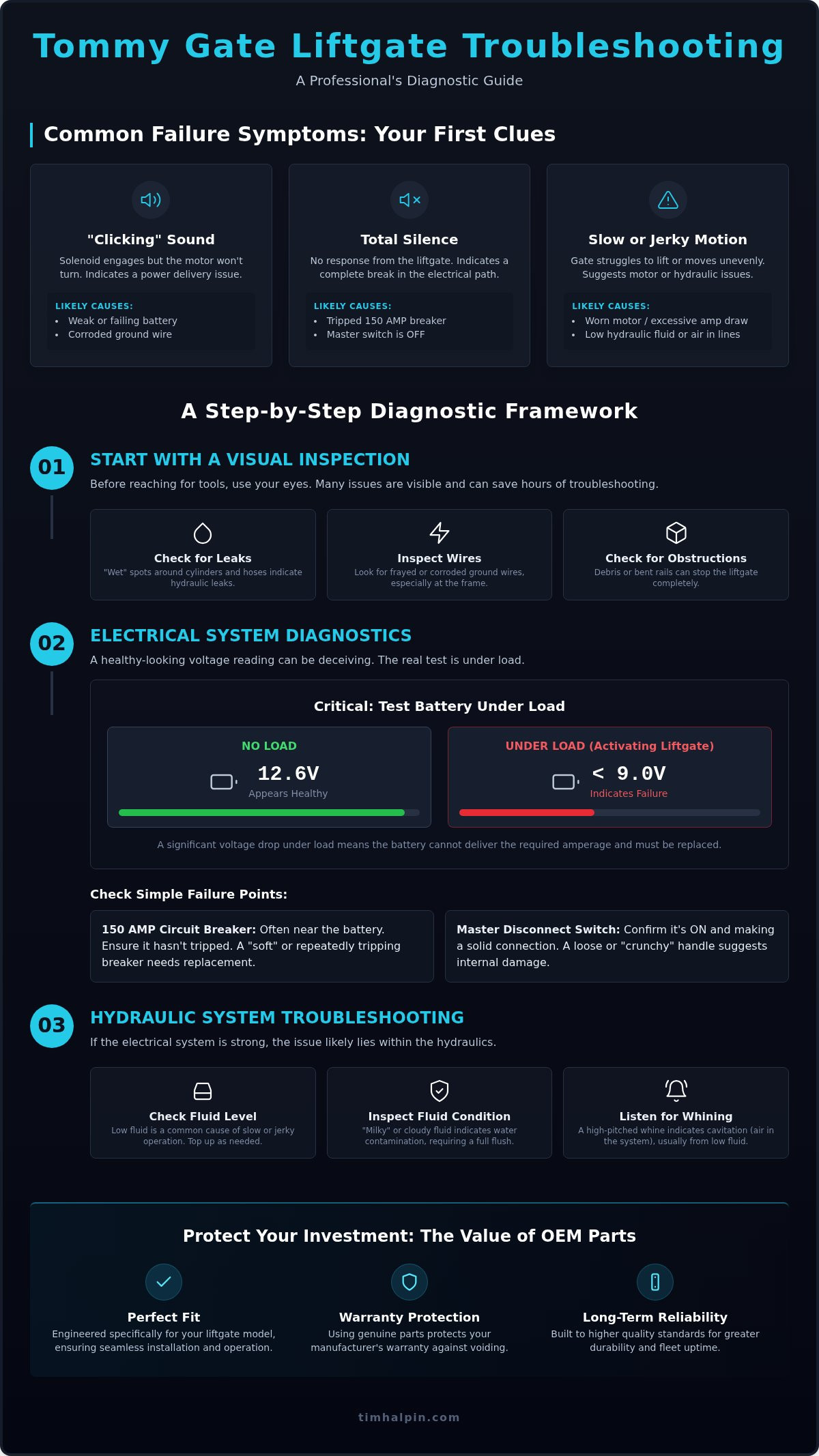
The “click-click-click” of a struggling solenoid is a sound that every fleet manager in Miami knows. When you’re starting your tommy gate liftgate troubleshooting, that specific sound is your first major diagnostic clue. It tells you the solenoid is engaging, but the electrical system isn’t delivering enough amperage to turn the motor. This is frequently caused by a weak battery or a corroded ground wire. If you toggle the switch and hear nothing but silence, the problem usually lies earlier in the chain, such as a tripped 150 AMP circuit breaker or a master switch that’s been accidentally bumped to the “off” position.
Slow operation creates a different kind of frustration. If the gate crawls upward, you’re likely looking at a motor reaching the end of its life or a hydraulic system starved for fluid. Understanding Liftgate Mechanics is essential here; most systems rely on a 12V motor, like the Tommy Gate Part #958, to drive the pump. If that motor is drawing excessive amperage because of internal wear, it’ll move slowly and feel hot to the touch. Conversely, if the gate moves in “jerks,” you’ve probably got air in the lines or the fluid level has dropped below the intake screen.
Uneven lifting is a safety hazard that requires immediate attention. If one side of the platform lags behind the other, it’s rarely a simple software glitch. You’re likely dealing with a structural issue like a bent rail or a hydraulic imbalance. In South Florida’s humid salt air, pivot points can seize if they aren’t lubricated every 120 days as the manufacturer recommends. A seized pin on one side makes the motor work twice as hard and can eventually twist the entire liftgate frame, leading to an expensive repair.
Decoding Liftgate Noises
A healthy liftgate hums with a consistent tone. A failing one screams for help. Grinding sounds usually point toward a failing pump and motor assembly. If you hear a high-pitched whine, your hydraulics are likely experiencing cavitation. This happens when air enters the system or the fluid is too low. Total silence when you toggle the switch is actually one of the easier things to diagnose. It means the electrical path is completely broken, often at the hand-held control or the main power cable connection near the battery frame.
Visual Inspection Points
Before you pull out the multi-meter, use your eyes. Look for “wet” spots around the cylinders or hoses, which indicate high-pressure hydraulic leaks. In Miami’s stop-and-go traffic, vibration is a constant enemy of electrical integrity. Check for frayed ground wires where they bolt to the truck frame. Finally, inspect the rails for physical obstructions or debris. Sometimes a simple piece of road trash or a slightly bent rail from a loading dock impact is all it takes to stop a Tommy Gate in its tracks. These small checks can save you hours of unnecessary downtime.
Electrical System Diagnostics: From Battery to Switch
A battery might show a perfect 12.6V on your multimeter while the truck is idling, but that number can be deceiving. The real test in tommy gate liftgate troubleshooting happens the moment you engage the motor. If that voltage collapses to 8V or 9V under load, your liftgate simply won’t have the torque to lift a heavy pallet. This “surface charge” often hides a battery that’s chemically incapable of delivering high amperage. Always perform a load test at the battery terminals before assuming your motor or solenoid is the culprit.
Don’t overlook the simple failure points like the 150 AMP circuit breaker or the master disconnect switch. These components are designed to protect your vehicle’s electrical system, but they can become “soft” over time or trip due to a minor surge. We often see fleet managers spend hours chasing ghost signals only to find a tripped breaker tucked away near the battery box. Ensure the master switch is making a solid internal connection; if the handle feels loose or “crunchy,” it’s likely suffered internal heat damage and needs replacement.
Voltage Drop Testing
Voltage drop is the loss of electrical potential as current flows through resistance in a circuit, which directly reduces the power available to the liftgate motor and shortens its lifespan. In South Florida, our salt-heavy air and relentless humidity act as a catalyst for oxidation. Even a connection that looks clean on the outside can have a layer of non-conductive “green” corrosion underneath the heat shrink. Cleaning your terminals with a wire brush and applying a dielectric grease is a small step that prevents major downtime. Adhering to OSHA Liftgate Safety Standards by maintaining these connections ensures your equipment remains reliable and safe for your operators during every cycle.
The Solenoid and Motor Relay
To test the solenoid, check the small trigger wire for a 12V signal when the control switch is toggled. If the signal is present but the solenoid doesn’t “click” or send power to the motor, the internal coil has failed. You can safely bypass the solenoid by using a heavy-gauge jumper cable to momentarily connect the two large copper studs. If the motor spins, you know the solenoid is your only problem. However, if the motor casing smells like ozone or feels excessively hot to the touch, the internal windings are likely burnt out. While you can sometimes clean the contacts on older solenoids, the reliability of a new OEM component is usually the better investment for a working fleet. If you’ve identified a failed component, we keep a deep stock of Tommy Gate liftgate parts to help you avoid a long wait for shipping.
Handheld control switches are the most abused part of the system. They get dropped, pinched in doors, and soaked in Miami rainstorms. If your gate works in one direction but not the other, or if it works only when you wiggle the cord, you’re dealing with a wire break or internal corrosion. Opening the switch housing often reveals frayed wires that can be trimmed and re-soldered, but a cracked housing will always let moisture back in, eventually leading to another failure.
Hydraulic Troubleshooting: Pressure, Fluid, and Seals
Hydraulic failures often feel more mysterious than electrical ones because the components are sealed, but tommy gate liftgate troubleshooting becomes much simpler once you understand how pressure moves through the system. A common sight in our humid South Florida climate is “milky” hydraulic fluid. This discoloration indicates water intrusion, usually from condensation or a compromised reservoir seal. Water doesn’t just weaken the lifting force; it causes internal rust and pump cavitation that can lead to a total system failure.
If your gate lifts perfectly when empty but stalls the moment you load a pallet, your focus should shift to the relief valve. This component is designed to protect the system from overloading, but if it’s stuck or improperly adjusted, it will bleed pressure back into the reservoir prematurely. Similarly, if the motor is spinning but the gate doesn’t move, the internal pump coupler might be sheared. This small, inexpensive part acts as a mechanical fuse, protecting the motor from damage when the pump seizes or hits a hard obstruction.
The Hydraulic Fluid Guide
Choosing the right fluid is about more than just following a manual; it’s about protecting your investment against the Florida heat. We recommend using ISO grade 32 hydraulic fluid or Dexron III automatic transmission fluid for most Tommy Gate models. Avoid the temptation to overfill the reservoir. Leaving about two inches of air space at the top is necessary to prevent “blowback” when the cylinders retract and push fluid back into the tank. For complex issues involving pump rebuilds or internal valve failures, seeking Expert Truck Hydraulics in Miami ensures your equipment is handled by professionals who understand these nuances.
Pressure Testing the System
A “bypassing” cylinder is a frequent culprit when a gate won’t hold its position. If the platform slowly drifts downward under load, fluid is likely leaking past the internal piston seals. You can identify this by checking for heat buildup on the cylinder casing after several cycles. Additionally, air in the lines can cause a “spongy” or jerky motion. Bleeding the system is usually as simple as running the gate through several full cycles, but if the problem persists, you may have a suction leak on the pump intake. Maintaining Fleet Liftgate Safety and Efficiency requires a proactive approach to hose inspections. Look for cracked outer jackets or “weeping” at the crimps before they turn into a catastrophic failure on the job site.
A Step-by-Step Diagnostic Framework for Fleet Owners
A systematic approach is the secret to minimizing downtime. Instead of guessing which part failed, following a logical sequence helps you isolate the issue without wasting time on healthy components. This framework for tommy gate liftgate troubleshooting moves from the simplest external checks to internal system tests, ensuring you don’t overlook the obvious before diving into complex repairs.
- Step 1: Verify Power. Confirm the truck engine is running and the master disconnect switch is fully engaged. It sounds basic, but a master switch that was bumped during a delivery is a frequent cause of “total power loss” calls.
- Step 2: Listen for the Solenoid. Have a technician toggle the control while you stand near the pump box. A clear “click” confirms the control circuit is working. Silence suggests a blown fuse, a broken switch wire, or a dead solenoid coil.
- Step 3: Measure Voltage at the Motor. Using a multimeter, check the voltage at the motor terminal while the switch is pressed. If you see 12V but the motor doesn’t spin, the motor has likely reached the end of its service life.
- Step 4: Check Hydraulics. Inspect the reservoir level. If it’s low, look for the “wet” spots mentioned earlier that indicate a high-pressure leak in the hoses or cylinder seals.
- Step 5: Test Mechanical Pivots. If the motor sounds strained but the gate is empty, check the grease fittings. Seized pins create massive mechanical resistance that can mimic a failing motor.
The 5-Minute Quick Check
Before pulling the truck off its route, perform a rapid sweep. Clear any debris, like gravel or pallet wrap, from the tracks and rollers. Ensure the vehicle engine is running to provide the maximum amperage needed for heavy lifts. If your model features an emergency manual override, verify it hasn’t been partially engaged. These small details often resolve “failures” that are actually just operational hiccups.
When to Call a Professional
Knowing when to stop is just as important as knowing how to start. While cleaning a terminal or topping off fluid is a standard field fix, internal pump failures and relief valve adjustments require specialized pressure gauges. Working on high-pressure hydraulic lines carries significant safety risks; a pinhole leak can cause serious injury if handled improperly. Additionally, any structural cracks or bent frames require certified welding to maintain the gate’s rated capacity. If your diagnostic steps reveal an issue beyond a simple parts swap, our team offers specialized liftgate repair to get your equipment back to factory specifications safely.
Sourcing OEM Tommy Gate Liftgate Parts in Miami
Finding the right part shouldn’t be as stressful as the breakdown itself. Once you’ve finished your tommy gate liftgate troubleshooting, you need a partner who has the exact OEM component sitting on a shelf, not one who has to order it from a distant warehouse. Using genuine Tommy Gate parts is the only way to maintain your equipment’s warranty and ensure the structural integrity of the lift. Third-party aftermarket cylinders might save a few dollars initially, but they often lack the precise tolerances required for long-term reliability in our demanding South Florida environment.
Since 1987, Tim Halpin Equipment Corp has served as a cornerstone for the Miami trucking community. We maintain one of the largest inventories of Tommy Gate liftgate parts in the United States. This isn’t just a business metric; it’s our way of ensuring your downtime is measured in hours, not weeks. Our family-owned approach means we value our reputation as much as the transaction, providing a level of individual accountability you won’t find at a faceless corporate entity.
Our location in Miami makes us a strategic hub for fleet owners operating across the Caribbean and Latin American markets. We understand the logistics of international shipping and can get critical components to your regional hubs with the same efficiency we offer our local neighbors in Hialeah or Coral Gables. We take immense pride in our local heritage, and that passion extends to every client we serve, whether they’re across the street or across the sea.
Essential Spare Parts to Keep in Stock
A proactive fleet manager is a successful one. We recommend keeping a small “emergency kit” in your shop to bypass common delays. This kit should include a spare 12V solenoid and a handheld control switch, as these are the most frequent failure points identified during tommy gate liftgate troubleshooting. For the G2 series, having replacement hydraulic hoses like Part #975 or #976 on hand can turn a major leak into a twenty-minute fix. To understand more about our commitment to this community, you can read about Tim Halpin: The Legacy Behind South Florida’s Truck Equipment Experts.
Professional Installation and Rebuilds
Sometimes the fix requires more than just a new part. Our team specializes in custom upfitting and complete liftgate rebuilds for fleets that need a fresh start. We combine rapid diagnostics with decades of hands-on experience to solve the complex hydraulic or structural issues that field repairs can’t touch. Whether you’re installing a new G2 series gate or need a specialized repair for a railgate, the Tim Halpin team is ready to act as your knowledgeable guide. Contact us today to schedule a consultation and keep your delivery fleet moving forward with confidence.
Keep Your South Florida Fleet Moving with Confidence
A reliable liftgate is the backbone of your delivery schedule. By mastering a systematic approach to tommy gate liftgate troubleshooting, you can quickly differentiate between a simple battery issue and a complex hydraulic failure. We’ve explored how to identify early warning signs like “milky” fluid or struggling motors, helping you address small problems before they lead to expensive downtime. Remember that using genuine OEM parts is essential for protecting your equipment’s warranty and ensuring the safety of your operators during every cycle.
You don’t have to navigate these technical challenges alone. Since 1987, our family-owned team has served as a trusted guide for the Miami trucking community. We maintain one of the largest liftgate parts inventories in the US, ensuring that the components you need are available when you need them most. Whether you’re performing a DIY field fix or require an expert rebuild, our seasoned technicians are ready to provide the professional support your business deserves. Get Your Tommy Gate Parts or Schedule a Repair at Tim Halpin Equipment Corp Today. Your fleet’s success is our priority, and we’re here to help you stay on the road.
Frequently Asked Questions
Why does my Tommy Gate lift slowly when the truck is off?
Your liftgate operates on a 12V system that requires high amperage to function at peak efficiency. When the truck engine is off, the motor relies solely on the battery’s reserve capacity, which can lead to a significant voltage drop. This is especially common in South Florida’s heat, which can degrade battery performance over time. Running the engine ensures the alternator provides the necessary power to maintain a consistent lifting speed.
How do I bleed air out of my Tommy Gate hydraulic system?
Bleeding air is usually an automatic process achieved by running the gate through several complete cycles. Raise the platform to its maximum height and lower it completely at least five times. This forces any trapped air back into the reservoir where it can escape. If the gate remains spongy or jerky after this, you might have a suction leak on the pump intake that requires professional attention to resolve.
What kind of hydraulic fluid does a Tommy Gate use?
Most models perform best with ISO grade 32 hydraulic fluid or Dexron III automatic transmission fluid. For fleets operating in South Florida, these viscosities provide the right balance of protection and flow in our warm climate. Always check your specific model’s reservoir cap or manual before refilling. Avoid using grease on the rails; instead, use a non-detergent petroleum-based oil to ensure smooth operation without attracting debris.
Why is my liftgate clicking but not moving?
A clicking sound indicates that the solenoid is receiving a signal from your control switch but lacks the amperage to engage the motor. This is a primary step in tommy gate liftgate troubleshooting. It’s often caused by a weak battery, a corroded ground connection, or a soft circuit breaker. Check your cable connections for the green oxidation common in Miami’s humid air. If the connections are clean, your battery likely needs a load test.
Can I replace a Tommy Gate solenoid myself?
Yes, replacing a solenoid is a common DIY task if you have basic mechanical tools and follow safety protocols. Always disconnect the main power cable at the battery before starting to prevent accidental shorts. Make sure you’re using an OEM Tommy Gate solenoid to ensure the internal coil matches your system’s requirements. If you’re unsure about the wiring, taking a quick photo before disconnecting the old unit can save you a lot of frustration.
How often should I lubricate my Tommy Gate liftgate?
Tommy Gate recommends a full lubrication service every 120 days or every 1500 to 2000 cycles, whichever comes first. In our coastal environment, regular maintenance is even more critical to prevent salt air from seizing pivot pins. Use a 10W or 20W non-detergent oil for the hinge points and rails. Consistent lubrication reduces the strain on your motor and pump, significantly extending the lifespan of your equipment and reducing long-term repair costs.
What should I do if my liftgate is stuck in the down position?
Start by verifying that your master disconnect switch hasn’t been turned off. If the power is on, listen for a click from the solenoid when you toggle the switch. If you hear nothing, you can momentarily bypass the solenoid with a jumper cable to see if the motor spins. If the motor runs but the gate doesn’t rise, check your fluid levels. For complex hydraulic failures, it’s safest to contact a local expert for a diagnostic.
Where can I find Tommy Gate parts in Miami for immediate pickup?
Tim Halpin Equipment Corp maintains one of the largest inventories of Tommy Gate liftgate parts in the United States at our Miami location. Since 1987, we’ve provided South Florida fleet owners with immediate access to solenoids, motors, switches, and hydraulic hoses. Our family-owned shop is a local authority on tommy gate liftgate troubleshooting, and we take pride in having the exact OEM components you need on the shelf to minimize your vehicle’s downtime.
