

Did you know that nearly 18.1% of commercial vehicles inspected during the latest CVSA Roadcheck were placed out of service immediately? For a fleet owner in South Florida, that isn’t just a statistic; it’s a warning about the high cost of overlooked maintenance. You already understand that every minute your equipment sits idle on the side of I-95 is money leaking from your pocket. It’s stressful to manage tight delivery windows while worrying about cargo damage or an unexpected DOT fine.
Recognizing the subtle signs you need trailer repair before they turn into catastrophic failures is the best way to protect your business and your reputation. We’ve spent decades helping our neighbors keep their equipment in peak condition, and we want to share that expertise with you. This guide provides clear diagnostic criteria for seven critical trailer issues, from air system leaks to structural rust. By the end, you’ll have the confidence to identify problems early, choose the right repair partner, and maximize the lifespan of your trailer.
Key Takeaways
- Understand how minor mechanical issues can quickly escalate into expensive “out-of-service” orders during roadside DOT inspections.
- Learn to identify the subtle signs you need trailer repair, such as irregular tire wear patterns and frame corrosion, before they lead to a breakdown.
- Discover the specific warning signs of failing hydraulic liftgates and specialized systems that could put your cargo at risk.
- Master a professional “walk-around” inspection technique to catch structural and mechanical defects at eye level and under the chassis.
- See why partnering with a local expert who maintains a deep inventory of OEM parts is essential for minimizing your vehicle’s downtime.
Why Recognizing Signs You Need Trailer Repair Is Critical for Fleet Safety
In the busy logistics corridors of Miami, the difference between a profitable run and a costly delay often comes down to a single decision: do you fix it now, or wait until it breaks? Proactive maintenance is the practice of identifying small issues before they stop your truck. Reactive repair, on the other hand, usually happens on the shoulder of the Palmetto Expressway at 2:00 AM. For South Florida fleets, the stakes are higher. Our salt-heavy air and intense humidity accelerate corrosion on crossmembers and electrical connectors far faster than in inland regions. This environment makes it vital to stay ahead of the curve.
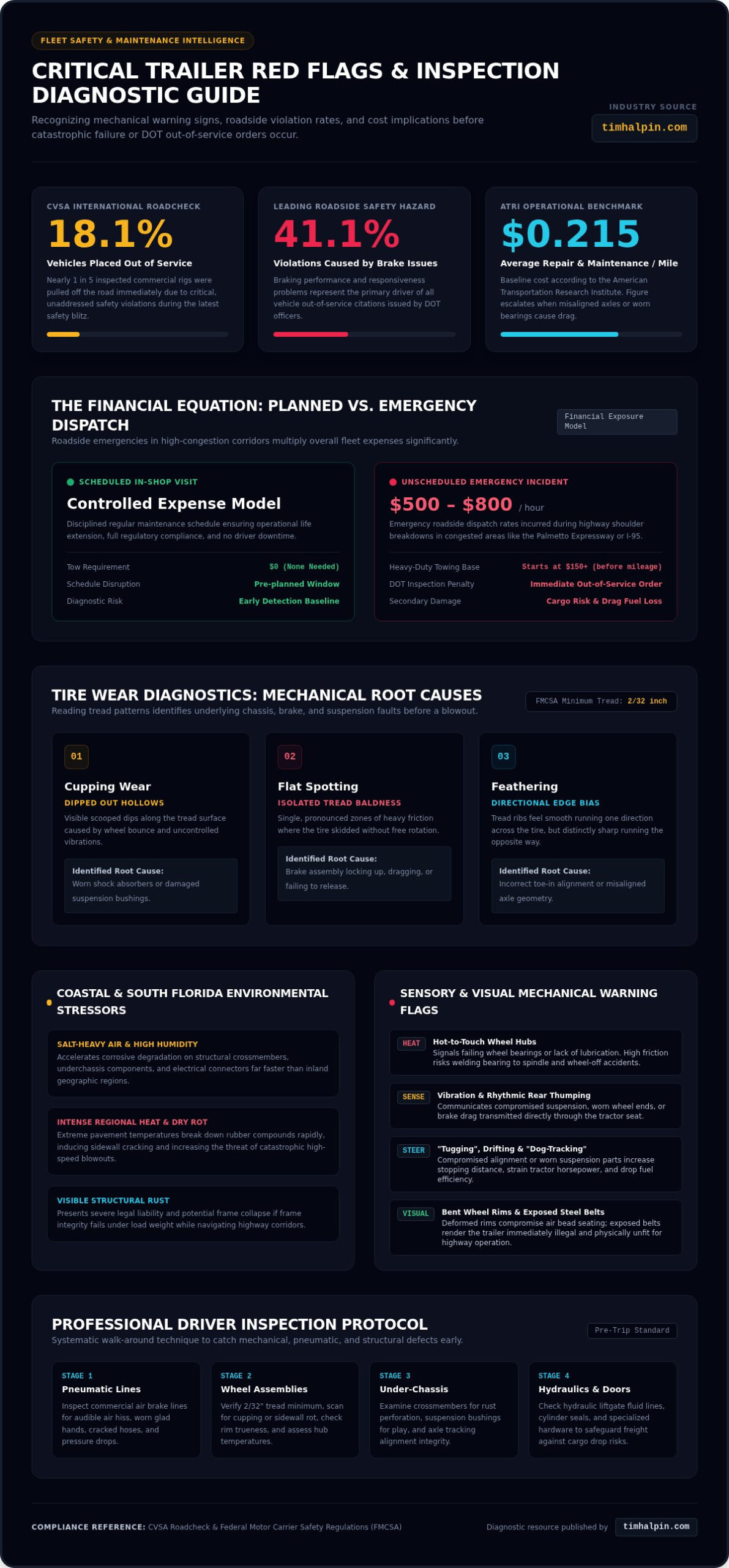
When you ignore the early signs you need trailer repair, you aren’t just risking a breakdown. You’re inviting a DOT inspector to pull your vehicle off the road. During the most recent CVSA International Roadcheck, 18.1% of commercial vehicles were placed out-of-service immediately for critical safety violations. Most of these citations involved brake and tire issues that were visible long before the flashing lights appeared. Missing these cues leads to cargo loss, liability claims, and a significant drop in fuel efficiency.
The Financial Impact of Delayed Repairs
The math is simple but painful. A scheduled shop visit is a controlled expense. In contrast, an emergency roadside dispatch in high-congestion areas can cost between $500 and $800 per hour, plus heavy-duty towing fees that often start at $150 before mileage is even added. Beyond the immediate bill, mechanical drag from worn bearings or misaligned axles significantly increases fuel consumption. Data from the American Transportation Research Institute shows that repair and maintenance costs now average $0.215 per mile. When your trailer isn’t running true, that number climbs. Keeping commercial air brake systems and wheel ends in top shape ensures your fleet remains efficient and your reputation for reliability stays intact.
Safety Risks and Liability for Fleet Managers
Operating a trailer with known defects creates a massive legal target. If a structural failure leads to an accident, the liability can be devastating for a family-owned business. Worn suspension components or soft brakes don’t just feel different; they increase your total stopping distance and make the trailer prone to “dog-tracking.” This instability puts your driver, your cargo, and every other person on the road at risk.
Preventative maintenance is the disciplined practice of scheduled inspections and minor adjustments designed to extend the operational life of a trailer while ensuring total compliance with safety regulations.
Mechanical Red Flags: Tires, Brakes, and Suspension
When you’re hauling cargo across the Sunshine State, your trailer communicates through sound and sensation. A vibration felt in the driver’s seat or a rhythmic thumping from the rear isn’t just an annoyance. These are often the first signs you need trailer repair. Identifying these mechanical red flags early prevents a minor headache from turning into a roadside disaster. If the trailer feels like it’s “tugging” or drifting, your suspension or alignment is likely compromised, putting unnecessary strain on your tractor and your fuel budget.
Tire wear patterns tell a specific story about your trailer’s health. Cupping, which looks like dipped out hollows in the tread, usually points to worn shock absorbers or suspension bushings. Flat spotting often signals a brake that is locking up or dragging. Feathering, where the tread ribs feel smooth in one direction but sharp in the other, is a classic indicator of poor toe-in alignment. According to FMCSA standards, commercial trailer tires must maintain a minimum tread depth of 2/32 of an inch. If you’re seeing steel belts or deep sidewall cuts, the trailer is legally and physically unfit for the road, and utilizing a professional Mobile Tyre Service is often the safest way to resolve the issue on-site.
Sidewall cracking is a non-negotiable red flag. In our intense South Florida heat, rubber degrades faster, leading to dry rot that can cause a high-speed blowout. You should also be wary of excessive heat near the wheel ends. If a hub is too hot to touch after a haul, your wheel bearings are likely failing or lack lubrication. This friction can eventually weld the bearing to the spindle, leading to a wheel-off incident. Checking for bent rims is equally vital, as even a slight deformation can compromise air pressure and bead seating. If you notice these symptoms, a professional trailer repair specialist can help diagnose the root cause before parts fail.
Braking Performance and Responsiveness
Brake issues are the leading cause of out-of-service orders, accounting for 41.1% of all vehicle violations during recent inspection blitzes. Listen for an audible hiss of air near the gladhands or brake chambers, which indicates a leak in the pneumatic lines. You might also experience “brake fade,” where the trailer takes longer to stop after repeated use. This often stems from glazed linings or drums that have overheated. Regular inspection of slack adjusters and S-cams is essential to ensure the system remains within allowable stroke limits. Following FMCSA Part 396 inspection and maintenance standards isn’t just about compliance; it’s about ensuring your equipment stops when you need it to.
Structural Integrity and Specialized System Failures
While tires and brakes are often the focus of roadside inspections, the frame and coupling assembly are the literal backbone of your equipment. A hairline crack in the kingpin plate or a sheared rivet along the lower rub rail can lead to a catastrophic failure at highway speeds. These are critical signs you need trailer repair because they compromise the trailer’s ability to hold its rated weight. If you notice the trailer sagging in the middle or twisting slightly when loaded, the structural integrity is already failing. According to the North American Standard Out-of-Service Criteria, frame cracks that are visible to the naked eye or structural members that are bent or broken are grounds for an immediate shutdown.
Corrosion: The South Florida Fleet’s Silent Enemy
In Miami, the salt-laden air from Biscayne Bay acts as a constant abrasive on your equipment. This coastal environment accelerates oxidation on exposed cross-members and I-beams far faster than in dry, inland climates. It’s essential to distinguish between harmless surface rust and structural rot. If you can flake off chunks of metal with your hand or see through a structural member, the metal is compromised. Protecting these areas is part of maintaining expert truck hydraulics in Miami, as corrosion often migrates from the frame to the sensitive hydraulic lines and fittings.
Liftgate and Hydraulic Warning Signs
Specialized systems like liftgates introduce their own set of potential failures. A struggling liftgate usually gives plenty of warning before it quits entirely. Look for jerky movements during the deployment cycle or a platform that moves slower than usual. These symptoms often point to air in the lines, low fluid levels, or failing hydraulic cylinders. If you see fluid seepage around the seals, the system is losing pressure. For those using specific equipment, sourcing the right waltco liftgate parts miami ensures that your repairs meet original manufacturing standards and prevent total gate failure during a delivery.
Electrical issues often manifest as flickering LED marker lamps or a persistent trailer ABS fault light. These gremlins are frequently caused by corroded 7-way receptacle pins or frayed wiring harnesses. While a single light out might seem minor, electrical malfunctions are a major red flag for DOT inspectors. Maintaining a clean connection and ensuring the ABS system can communicate with the tractor is vital for both safety and compliance. Regular checks of the coupler and kingpin assembly round out a solid structural inspection, ensuring your trailer stays securely attached to your truck.
A Professional Trailer Inspection Checklist for Drivers
The driver is the first line of defense against a roadside breakdown. Identifying the early signs you need trailer repair requires more than a quick glance; it demands a systematic walk-around. We recommend starting at the front coupling and moving clockwise. At eye level, check your reflectors and LED marker lamps for moisture or cracks. Then, crouch down to inspect the chassis. In our humid Miami climate, pay close attention to the 7-way electrical receptacle. Look for the greenish tint of copper corrosion that often hides inside the pins, which can lead to intermittent ABS faults or lighting failures during a haul.
Testing the electrical interface between the truck and trailer is a non-negotiable step. Don’t just check if the lights turn on. Ensure the brake lights and turn signals are responsive and that there’s no dimming when multiple systems are active. Documenting even minor issues, such as a slightly frayed air line or a stiff landing gear handle, allows you to track the rate of mechanical degradation. This data helps you decide when a “minor quirk” has officially become a safety hazard.
Daily vs. Weekly Inspection Points
Your daily checklist should focus on the “Go/No-Go” essentials: lights, tires, and audible air leaks. If a tire is visibly low or a brake chamber is hissing, the trailer stays in the yard. Weekly inspections should be more invasive. Take the time to grease the S-cams and slack adjusters. Examine the wooden floorboards for rot and inspect the roof for snags from low-hanging branches. This deeper dive helps you spot structural signs you need trailer repair that a rushed daily pre-trip might miss.
The Role of Professional Multi-Point Inspections
While a driver’s eyes are vital, some issues require specialized diagnostic tools. A professional shop uses laser alignment systems to detect “dog-tracking” and ultrasonic testing to find hidden frame fatigue. Many fleet managers find it efficient to combine these inspections with commercial truck upfitting in Miami, ensuring that as you add new service bodies or lighting, the underlying trailer remains structurally sound.
For a Miami fleet operator, a safety-first mindset means treating every pre-trip inspection as a personal guarantee that the equipment is resilient enough to handle both the heavy loads and the punishing coastal environment.
If your team identifies a defect that puts a load at risk, don’t wait for the next scheduled service. Reach out to our team for professional trailer repair services to get your equipment back in peak condition immediately.
Choosing the Right Partner for Miami Trailer Repair
Identifying the early signs you need trailer repair is only half the battle. The real test of your fleet’s resilience is how quickly you can move from a red flag to a certified fix. In a high-volume logistics hub like Miami, you can’t afford to wait for parts to be shipped from across the country while your cargo sits idle. Choosing a partner with a massive on-site inventory of OEM parts is the most effective way to slash downtime. When a shop already has the specific Waltco, Maxon, or Tommy Gate components on the shelf, your trailer spends more time on the road and less time taking up space in a service bay. It’s about finding a team that understands the synergy between the trailer chassis and the specialized upfitted equipment it carries.
A professional repair partner should act as a steady, knowledgeable guide through the stresses of fleet management. You need a team that doesn’t just look at a work order but understands the local environment. From the salt air near PortMiami to the stop-and-go heat of the Palmetto Expressway, your equipment faces unique challenges. We’ve found that a family-owned approach provides a level of individual accountability that corporate shops often lack. When the business owner’s name is on the building, there’s a palpable sense of pride in every weld and hydraulic seal. This neighborly sensibility ensures you receive honest advice rather than aggressive sales tactics.
Tim Halpin: South Florida’s Trusted Experts Since 1987
Since 1987, our family has served the South Florida community with a commitment to excellence that spans decades. We’ve grown alongside the local industry, developing a deep understanding of the specific needs of regional districts from Homestead to the Miami River. Our team brings specialized expertise to complex tow truck parts florida and repairs, ensuring that specialized recovery and utility equipment remains as reliable as the trailers they support. Having a one-stop shop for hydraulics, liftgates, and structural repair means you don’t have to coordinate between multiple vendors. We handle the entire unit, ensuring the upfitted systems and the trailer frame work in perfect harmony.
Minimizing Downtime with Expert Service
Efficiency is born from experience. Our seasoned technicians use advanced diagnostics to pinpoint issues quickly, preventing the “guesswork” that often leads to repeat visits. This level of precision is why we’ve become a trusted hub for international clients seeking export truck parts miami. Whether you’re operating a local fleet or managing logistics across borders, our goal is to minimize your vehicle’s downtime through professional standing and high-level industry expertise. We value our reputation within the community as much as the transaction itself, suggesting a partnership built on long-term reliability.
Don’t wait for a roadside failure to address the subtle warnings your equipment is giving you. Contact Tim Halpin to schedule your professional trailer inspection today and ensure your fleet remains a steady force on the road.
Secure the Future of Your Fleet with Proactive Care
Mastering the early signs you need trailer repair is the most effective way to protect your cargo and your bottom line. By staying ahead of mechanical red flags like uneven tire wear or hydraulic seepage, you ensure your equipment remains a reliable asset on the road. A thorough walk-around inspection isn’t just a regulatory requirement; it’s a commitment to the safety of your drivers and the community we share here in South Florida. Catching these whispers of mechanical fatigue early prevents the high costs and stress of a roadside emergency.
At Tim Halpin Equipment Corp, we’ve been the trusted local guide for fleet maintenance since 1987. As a family-owned and operated business, we take personal pride in every repair, offering the accountability of a neighbor with the resources of a national leader. With one of the largest liftgate parts inventories in the United States, we’re uniquely equipped to minimize your downtime and get your equipment back in peak condition.
Take the stress out of your maintenance schedule today. We invite you to Schedule Your Expert Trailer Repair at Tim Halpin Equipment Corp and experience the reliability that comes with decades of specialized expertise. Safe travels on every haul.
Frequently Asked Questions
What are the most common signs that my trailer’s brakes are failing?
Audible air leaks, increased stopping distances, and visible glazing on the drums are the most frequent indicators of failure. You might also feel a pull to one side or notice the trailer “pushing” the tractor during deceleration. These are definitive signs you need trailer repair to avoid a DOT out-of-service order. Regular checks of the slack adjusters and S-cams help catch these issues before they escalate into a total system failure on the highway.
How often should a commercial trailer undergo a professional inspection in Miami?
Every commercial trailer must pass a comprehensive DOT inspection at least once every 12 months. However, the intense humidity and salt air in South Florida often warrant more frequent quarterly check-ups. This proactive schedule allows a professional shop to catch structural corrosion or hydraulic seepage that develops faster in our tropical climate. Regular inspections protect your cargo and ensure your fleet remains compliant with Florida safety regulations and statutes.
Can I operate my trailer if I see minor rust on the frame?
Surface rust is often cosmetic, but structural rot is a major safety violation. You can continue operating if the rust hasn’t thinned the metal or created visible holes. However, if you see flaking metal on the crossmembers or cracks near the kingpin plate, the trailer is likely unsafe. It’s best to have a local expert distinguish between harmless oxidation and deep structural fatigue to prevent a catastrophic frame failure under a heavy load.
Why is my trailer swaying or vibrating while I’m driving at highway speeds?
Swaying and vibration usually stem from suspension misalignment, worn bushings, or uneven tire wear. If the trailer is “dog-tracking” or drifting to one side, the axles are likely out of alignment. Vibrations can also indicate a failing wheel bearing or a flat spot on a tire caused by a dragging brake. These sensations are urgent signs you need trailer repair, as they increase fuel consumption and the risk of a high-speed blowout. For those maintaining heavy-duty or off-road rigs, you can explore 4×4 Servicing for specialized suspension components like leaf springs that ensure stability under load.
Failing an inspection usually results in an “out-of-service” order, meaning the trailer cannot move until repairs are certified. You’ll likely face fines, and the violation will negatively impact your carrier’s safety score. In Florida, multi-agency enforcement blitzes are common on major freight corridors like I-95 and the Florida Turnpike. Correcting defects before an inspector finds them is the only way to avoid these costly delays and maintain your fleet’s professional reputation.
How do I know if my trailer’s liftgate needs a hydraulic rebuild or just a part replacement?
Jerky movements or a platform that fails to hold pressure often indicate air in the system or a failing cylinder that needs a rebuild. If the gate simply won’t move, it might just be a blown fuse, a corroded switch, or a failing motor. We maintain one of the largest liftgate parts inventories in the US to help you quickly identify the right fix. A professional diagnostic will confirm if you need a specific OEM part or a full hydraulic overhaul.
Is it better to repair an old trailer or invest in a new one?
The decision depends on the integrity of the frame and the cumulative cost of upcoming maintenance. If the main I-beams and kingpin plate are structurally sound, repairing specialized systems like liftgates or hydraulics is often more cost-effective than procurement. However, if structural rot has set in or the trailer has reached its fatigue limit, investing in a new unit might be safer. A trusted local partner can help you evaluate the long-term return on each option.
Can salt air in South Florida really damage my trailer’s electrical system?
The coastal environment in Miami is incredibly aggressive toward electrical connections. Salt air accelerates copper corrosion in the 7-way receptacle and lighting harnesses, leading to intermittent ABS faults or flickering lamps. This greenish oxidation creates high resistance, which can eventually melt connectors or cause total system failure. Using dielectric grease and conducting regular cleanings are essential steps for any fleet operating near PortMiami, the Miami River, or the Florida Keys.
