

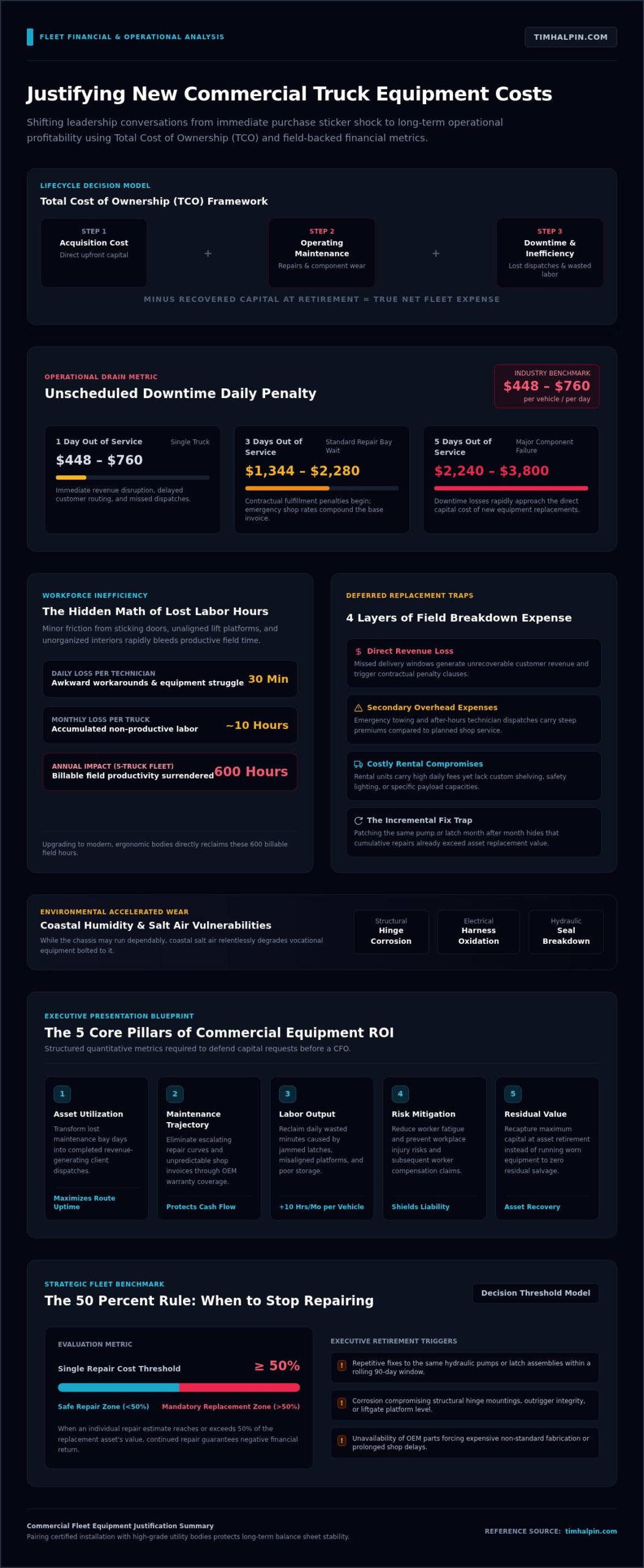
Holding onto aging truck bodies and worn components to avoid a major purchase order is often the most expensive choice a company can make. When unscheduled downtime drains between $448 and $760 per vehicle each day according to industry benchmarks, understanding how to justify new truck equipment costs becomes your strongest operational shield.
You already know the daily frustration of mounting repair bills, delayed dispatches, and technicians losing billable hours to broken gear. Still, translating those messy field headaches into clear financial metrics that win executive approval often feels like an uphill battle. You shouldn’t have to carry the burden of defending essential fleet reliability on gut feeling alone.
In this guide, you’ll learn how to build an airtight business case and calculate true ROI for commercial truck equipment upgrades, shifting the leadership conversation from sticker shock to sustained profitability. We’ll explore practical downtime calculations, crew productivity gains, and current tax incentives to ensure your next capital request earns swift executive confidence.
Key Takeaways
- Discover how to justify new truck equipment costs by measuring the hidden operational drain of aging machinery against upfront capital expenses.
- Master the five core financial metrics that translate field maintenance headaches into compelling data points your CFO will respect.
- Apply the 50 Percent Rule to identify the exact tipping point where repairing worn equipment becomes more expensive than replacing it.
- Structure executive-ready proposals around risk mitigation, crew productivity, and rapid cash payback to secure faster project approval.
- Protect your long-term equipment return by pairing high-quality bodies and components with certified installation and readily available OEM parts.
Understanding Truck Equipment Costs: Capital Expense vs. Hidden Operating Losses
Most capital requests stall because conversations fixate entirely on the purchase invoice. True equipment justification means evaluating total operational impact across an asset’s working life. Evaluating secondary truck hardware using a formal total cost of ownership framework shifts the leadership perspective away from immediate sticker shock toward long-term balance sheet stability. When you present how to justify new truck equipment costs to an executive team, your primary task is contrasting that clear capital expenditure against the quiet, relentless operating hemorrhage produced by keeping aged utility bodies, liftgates, and worn hydraulic systems past their prime.
Commercial equipment operating across South Florida faces distinct regional hazards. Intense coastal humidity and salt-laden air relentlessly corrode structural hinges, oxidize electrical harnesses, and degrade hydraulic seals. While a chassis may still run dependably, the vocational machinery bolted to it suffers steady mechanical decay that drives operating margins down.
The True Cost of Deferred Equipment Replacement
When an aging liftgate fails at an active job site, the primary repair invoice is only the first layer of expense. Unplanned field breakdowns create immediate, compounding financial losses:
- Direct revenue loss: Missing promised delivery windows causes contractual penalties and leaves unrecoverable customer revenue on the table.
- Secondary overhead expenses: Emergency towing, after-hours technician dispatch, and urgent field responses carry heavy overhead premiums compared to planned shop appointments.
- Costly rental compromises: Temporary rental vehicles charge steep daily fees yet lack the custom-tailored shelving, safety lighting, or specific payload capacities your crews require.
- The incremental fix trap: Patching the same faulty pump or latch month after month hides the reality that cumulative maintenance expenses have already outpaced a new asset’s value.
Direct Upfront Investment vs. Indirect Labor Drain
Old, degraded equipment also inflicts an invisible drain on daily labor. Technicians waste valuable time fighting sticking compartment doors, wrestling unaligned lift platforms, or digging through disorganized interior shelving. These awkward workarounds cause physical fatigue that elevates worker injury risks and associated compensation claims.
The math behind minor operational friction adds up swiftly. If an obsolete utility body or failing gate costs a technician just 30 lost minutes each workday, that equates to roughly 10 hours of wasted labor per month per vehicle. Across a small fleet of five trucks, you surrender 600 hours of billable field productivity each year. Mastering how to justify new truck equipment costs begins by demonstrating how upgrading modern, ergonomic bodies immediately reclaims those lost working hours for your bottom line.
The 5 Key Metrics for Calculating Commercial Equipment ROI
Proving return on investment to a CFO requires structured math, not vague field impressions. To understand how to justify new truck equipment costs, fleet leaders must measure the five pillars of vocational performance: asset utilization, maintenance trajectory, labor output, risk mitigation, and residual value. Total Cost of Ownership is the comprehensive lifecycle sum of acquisition, operating maintenance, unscheduled downtime, and labor inefficiency minus the final recovered capital at retirement. Modeling these numbers gives leadership a defensible baseline. You can benchmark broad capital outlay against operational variables using the U.S. Department of Energy Vehicle Cost Calculator to evaluate lifetime expenditures accurately.
Downtime Reduction and Utilization Rates
Every lost day on the calendar removes earning capacity from your business. Calculating historical maintenance hours reveals clear patterns: aging bodies and tired liftgates spend days idling in repair bays rather than generating field revenue. Restoring those operating days transforms lost schedule slots into completed client dispatches. Consistent route dependability satisfies service agreements, shields hard-won commercial relationships, and ensures your dispatch board runs at peak capacity.
Maintenance Cost Trajectory and Warranty Protection
Older secondary equipment reaches an inflection point where component failures compound rapidly. Out-of-warranty hydraulic cylinder leaks, motor burnouts, and electrical faults create unpredictable monthly expenses that ruin operational budgets. New equipment resets that risk profile by placing critical components under direct manufacturer warranty protection. Fresh equipment also streamlines scheduled servicing, allowing maintenance managers to lean on expert truck hydraulics partners to keep preventative schedules running smoothly without emergency budget surprises.
Workforce Efficiency and Driver Retention
Field mechanics and route drivers interact with their vehicle hardware hundreds of times each shift. Ergonomic layouts, rapid-cycling liftgates, and accessible compartments eliminate repetitive strain and significantly shorten each job stop. In a competitive labor market, worn equipment directly accelerates turnover:
- Daily productivity gains: Streamlined van interiors and smooth platform gates turn saved minutes at every stop into extra completed service calls each week.
- Driver morale and retention: Crews take pride in operating smooth, modern machinery rather than wrestling sticking doors in extreme heat.
- Safety and roadside visibility: High-output public safety lighting and dependable latching systems protect technicians on dark highway shoulders, reducing injury claims and equipment damage.
Equipping your team with dependable vocational hardware creates measurable field gains. When evaluating your next fleet upgrade, consulting our team at Tim Halpin Equipment Corp can help you specify the right hardware configurations to maximize long-term balance sheet returns.
Repair vs. Replace: When to Retire Aging Truck Equipment
Every piece of vocational hardware hits an economic tipping point. Deciding when to stop pouring money into existing gear hinges on clear math rather than emotional attachment. The fleet industry standard is the 50 Percent Rule: if a major repair exceeds 50% of the hardware’s fair value, or if cumulative annual maintenance surpasses half the cost of a replacement unit, retirement is overdue. Pairing this standard with formal net present value analysis clarifies whether sinking funds into an aging asset delivers positive returns compared to purchasing fresh equipment. Sourcing scarce components for obsolete units inflates wait times, leaving trucks parked for weeks while dispatchers scramble.
| Evaluation Metric | Repair Candidate | Full Replacement Candidate |
|---|---|---|
| Structural Integrity | Isolated surface rust; straight frame members; sound welds | Fatigued subframes; cracked hinges; compromised structural floor |
| Hydraulic System | Minor hose weepage; serviceable cylinder seals | Pitted cylinder rods; scored valve bodies; contaminated fluid lines |
| Component Sourcing | Active OEM parts available from regional inventory | Obsolete components requiring fabrication or multi-week delays |
| 50% Value Threshold | Single quote falls comfortably under half of replacement cost | Projected estimate exceeds 50% of fresh equipment value |
Understanding how to justify new truck equipment costs requires identifying physical decay markers early so you can advise leadership before a catastrophic failure occurs.
Evaluating Liftgate and Hydraulic Integrity
Checking liftgate integrity means looking beyond basic up-and-down travel. Inspect cylinder rods for pitting, which rapidly shreds internal packings and creates stubborn fluid leaks. If a platform sags under rated loads or twists along its pivot arms, structural fatigue has set in. While minor hydraulic leaks are easily serviced with authentic OEM parts from manufacturers like Waltco or Maxon, rebuilding an entire compromised assembly rarely makes financial sense when weighed against modern safety standards and warranty coverages.
Assessing Service Bodies and Interior Storage
Service and utility bodies carry the physical weight of your business every day. Look closely at door latch pins, weatherstripping channels, and bottom sill plates where moisture gathers. Once structural rust invades interior mounting brackets, remounting an old body onto a fresh chassis creates major safety hazards. Modern service bodies utilize lightweight, high-tensile alloys and composites that significantly boost payload capacity. Swapping a fatigued steel shell for an efficient modern utility body immediately drops curb weight, reducing tire wear and boosting daily fuel economy across every route.
How to Build and Present an Executive-Ready Business Proposal
Shop-floor frustrations rarely move executive leadership on their own. While field teams see hydraulic fluid puddles and jammed doors, CFOs look strictly at financial exposure and working capital preservation. Winning project approval requires translating operational headaches into corporate finance terms: risk reduction, asset utilization, and rapid cash payback. If you want to know how to justify new truck equipment costs before your board, you must anticipate leadership’s biggest objection, which is capital timing. Proposing a phased replacement schedule shields company cash reserves while steadily replacing your most failure-prone units first.
Structuring the Executive Summary and Financials
Open your pitch with bottom-line impact rather than technical mechanical specifications. Executives want clarity on where revenue is leaking and how this investment plugs the gap:
- Spotlight lost route revenue: Detail the unrecoverable delivery revenue, missed client SLAs, and third-party tow bills racked up over the past two quarters.
- Model the breakeven payback: Contrast the initial capital investment against the trailing twelve months of unscheduled repair invoices and technician downtime.
- Lead with risk mitigation: Frame modern hardware as an enterprise shield that ensures regulatory compliance and limits company liability for workplace injuries.
Highlighting Upfitting Tailored to Specific Operational Needs
Purpose-built vehicle layouts eliminate disorganized clutter and remove the need for auxiliary equipment. Modular interiors and secure storage units allow work crews to locate parts in seconds rather than minutes. These systems scale alongside trade growth, protecting your investment long after the vehicle enters service. For a complete blueprint on tailoring vocational specs to regional fleet demands, explore our guide to commercial truck upfitting.
By connecting job-site organization directly to daily billable efficiency, you present leadership with a commercial growth engine rather than a discretionary expense. If you’re ready to build a reliable business case with proven hardware configurations, contact the specialists at Tim Halpin Equipment Corp to plan your fleet upgrade today.
Maximizing Investment Value: Professional Installation and Partner Support
High-tier equipment guarantees nothing if poorly installed. The final, decisive step in mastering how to justify new truck equipment costs is safeguarding your capital through certified upfitting. Substandard mounting, mismatched wiring, or miscalculated hydraulic pressure will destroy a brand-new service body or liftgate within months. Securing true lifecycle ROI requires backing that hardware with an experienced partner who maintains deep regional parts inventories, ensuring single-source accountability from the initial build through long-term fleet support.
The Crucial Role of Expert Upfitting
Professional installation eliminates the hidden installation errors that cause early mechanical breakdowns:
- Clean electrical integration: Modern chassis incorporate intricate multiplex wiring. Expert wiring of public safety lighting and power accessories prevents parasitic battery draws and computer faults.
- Calibrated hydraulic plumbing: Setting relief valves to precise manufacturer tolerances and securing hydraulic lines away from heat sources avoids premature hose abrasion and pump failure.
- Axle weight distribution: Accurate structural alignment ensures legal Department of Transportation axle weight compliance, avoiding heavy fines and uneven brake wear.
Getting these details right during the initial install prevents chronic maintenance headaches later.
Partnering with Local Equipment Specialists
National supply backlogs frequently stall commercial vehicle repairs for weeks. Collaborating with a local, family-owned specialist eliminates that vulnerability through hands-on technical guidance and rapid, reliable parts support. Working with a facility that keeps substantial inventories of genuine OEM hardware like Waltco, Maxon, Adrian Steel, and Weather Guard components ensures your fleet stays on the road instead of sitting idle waiting for freight deliveries.
Long-term fleet reliability is built on relationships, not one-off transactions. Discover how decades of dedicated regional service help fleets eliminate specification errors and preserve capital by reading about the Tim Halpin legacy. Grounding your capital requests in expert local installation and guaranteed parts access gives leadership complete confidence in how to justify new truck equipment costs across your entire commercial fleet.
Turn Fleet Equipment Upgrades into Long-Term Bottom-Line Growth
Securing executive sign-off becomes straightforward when you shift the narrative from capital outlay to revenue protection. By quantifying the silent drain of downtime, measuring daily labor efficiency gains, and calculating clear payback timelines, you prove to leadership that new vocational hardware isn’t a discretionary expense. It’s a calculated investment that safeguards client routes, retains skilled technicians, and eliminates recurring shop bay delays.
Mastering how to justify new truck equipment costs is only half the journey; protecting that return depends entirely on the specialists who install and support your hardware. As a family-owned partner serving commercial fleets across South Florida since 1987, we combine a full-service installation, hydraulic repair, and commercial upfitting facility with an extensive local inventory of premier OEM liftgate, towing, and storage parts. You don’t have to navigate capital planning alone. When you’re ready to build a reliable fleet that runs with predictable operating costs, consult with the equipment specialists at Tim Halpin Equipment Corp to ensure every dollar invested delivers maximum value for years to come.
Frequently Asked Questions
How do I calculate the payback period on new commercial truck equipment?
To calculate the payback period, divide the total net equipment investment by your annual projected operational savings. Track trailing maintenance bills, lost revenue from unscheduled downtime, and technician labor recovered through efficient storage or faster hydraulics. When evaluating how to justify new truck equipment costs, showing leadership that saved shop hours and increased billable calls offset the purchase price reveals an exact breakeven timeline.
When does repairing an existing truck liftgate no longer make financial sense?
Repairing a liftgate is no longer viable when a single repair estimate exceeds half the replacement value, or when structural fatigue warps the platform frame. In South Florida’s coastal climate, severe rust around pivot points and pitted hydraulic cylinders make recurring rebuilds short-lived. If sourcing discontinued parts stalls your routes for weeks, replacing the assembly restores dependable dispatch capacity immediately.
Can custom commercial truck upfitting improve technician retention in vocational trades?
Yes, professional upfitting significantly boosts technician retention by eliminating daily workplace frustration. Outfitting service vans and utility bodies with tailored shelving from Adrian Steel and secure Weather Guard storage prevents physical strain and disorganized chaos. Skilled trade technicians take pride in running professional, well-maintained vehicles. Reliable equipment signals that company ownership values their daily safety, comfort, and on-site efficiency.
How does deferred equipment replacement affect vehicle insurance and safety compliance?
Delaying equipment replacement drastically increases fleet liability risks and regulatory exposure. Worn hydraulic hoses, slipping latch mechanisms, and dim warning lights frequently trigger Department of Transportation inspection citations. Worse, catastrophic failures like dropped loads or malfunctioning platform gates cause serious worker injuries. Maintaining fresh, compliant hardware protects your business against costly workers’ compensation claims and prevents severe commercial insurance rate hikes.
What are the hidden costs of using non-upfitted standard work trucks?
Running standard, non-upfitted pickup beds or bare cargo vans forces crews into constant operational friction. Technicians waste hours digging through disorganized tool piles, while unsecured inventory suffers costly transit damage. Standard truck beds also lack proper cargo weight distribution, accelerating tire and suspension wear. The cumulative labor drag and damaged gear quickly exceed the initial investment required for a purpose-built service body.
Is it more cost-effective to replace equipment on an existing chassis or buy an entirely new truck?
Replacing equipment on an existing chassis is exceptionally cost-effective if the powertrain and frame remain mechanically sound. When analyzing how to justify new truck equipment costs, remounting a fresh utility body or installing a modern liftgate on a proven work truck avoids vehicle acquisition debt. South Florida fleets frequently upgrade secondary bodies and hydraulics to secure another decade of dependable service without buying new chassis.
