
A tow truck waiting on a replacement part can lose valuable working time, and a component that looks right may still be the wrong fit. Before ordering vulcan V-30 parts miami, identify the equipment and gather the part details instead of relying on a quick comparison of photos or listings.
Confirming the V-30 model and recording the available equipment and part information can help narrow the search and avoid a wrong-fit order. Tim Halpin Equipment Corp. is a family-owned Miami truck-equipment business that has served customers since 1987 and offers Vulcan towing equipment parts.
This guide explains what information to gather, how to use identification details and existing part markings to narrow the search, and why similar-looking components should not be assumed interchangeable. It also covers how to approach a parts match for a V-30 or V-30 Gen 2 reference. The goal is a clearer path to the right replacement and less avoidable delay getting your truck back into service.
Key Takeaways
- The V-30 model name may not be enough to identify a replacement; gather equipment details that relate directly to the part.
- Follow a consistent match process: identify the equipment, document the component, compare references, then confirm the application.
- Compare part references, application evidence, condition, and sourcing arrangements rather than relying on appearance or the lowest listed price alone.
- Plan sourcing around the truck’s work schedule, and share the destination or pickup preference when discussing the order.
- For vulcan V-30 parts miami, Tim Halpin Equipment Corp. offers Vulcan towing equipment parts from its Miami base.
Need Vulcan V-30 Parts in Miami? Start With the Exact Equipment Identification
For a Miami towing operator, an incorrect replacement part can mean another order to manage and equipment staying out of service longer than necessary. The V-30 model name is a useful starting point, but it may not identify every component or configuration. Clear equipment details help narrow the search before you order.
Accurate equipment identification is the first step to a dependable parts match. Record the full model designation and any readable labels or identification numbers on the towing equipment. Keep these details separate from the truck’s make, model, and vehicle identification number: those describe the carrier vehicle, while the equipment identifiers describe the unit or component being serviced. General background on truck classifications and components can help explain why these are distinct layers of identification.
What information helps identify a Vulcan V-30 part?
Before searching for vulcan V-30 parts miami, collect information that ties the replacement to the equipment. A previous invoice, parts record, or number marked on the existing part may provide a useful reference. If a label is difficult to read, take a clear photo rather than relying on a partial transcription.
Capture the full model designation and readable equipment identification details, then photograph the component from more than one angle. Include its labels, connections, and mounting points. These views can help distinguish parts that appear similar in isolation. A brief note about where the component sits and what it connects to adds useful context without requiring you to guess at a technical name.
- Full equipment model designation and readable identification details
- Any part number from the component, invoice, or parts record
- Clear views of the component, labels, connections, and mounting points
- A brief description of where the part is installed and what it interfaces with
Copy label details exactly, including letters and suffixes. A small difference in a reference can change which part you need.
Why a visual match alone can lead to the wrong order
Two components can look alike in a photo yet differ in dimensions, mounting arrangement, connections, or intended application. A listing image rarely shows every feature needed to establish fit. Treat appearance as supporting evidence, not proof that a replacement is interchangeable.
Compare documented identifiers first, then use photographs and installation details to support the match. If you have an old part number, share it alongside the equipment identification rather than relying on it alone. Records can be incomplete, and the part may have been replaced before. Together, these details give the parts search a stronger starting point than resemblance alone.
Assembling this information before you begin can make the search more focused and reduce preventable uncertainty while a truck is waiting to return to work.
How to Match a Vulcan V-30 Replacement Part Without Guesswork
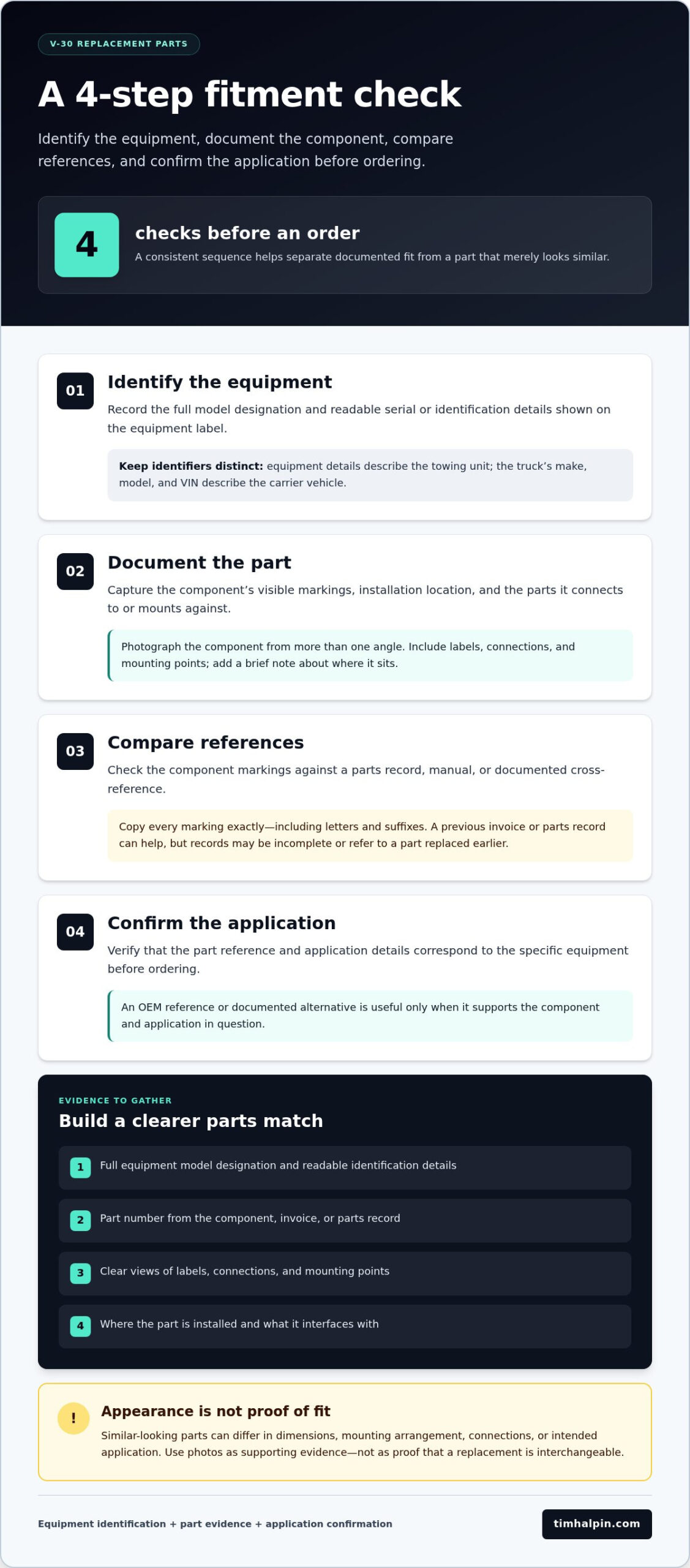
Once you have the equipment details, use them in a consistent sequence. This process helps distinguish a documented fit from a part that merely looks similar and gives a parts specialist useful information to work with.
- Identify the equipment. Record the full model designation and the readable serial or identification details shown on its label.
- Document the part. Note visible markings, where the component is installed, and what it connects or mounts to.
- Compare references. Match the markings against a parts record, manual, or documented cross-reference for the component.
- Confirm the application. Check that the reference and application details correspond to the equipment before placing an order.
Fitment verification means matching part identifiers and application details before ordering. Equipment identification and vehicle identification answer different questions. A truck’s VIN identifies the vehicle, while an equipment label or parts record can identify the towing equipment or replacement component. Share vehicle details when they help establish the specific application, but prioritize identifiers that relate directly to the part.
A practical part-identification checklist for tow operators
Keep the information brief and legible. Record the equipment model and its serial or identification details, copy visible markings from the component, and note its location on the unit. Add relevant photos and any previous invoice or parts record. Explain the truck’s working context if it helps distinguish the equipment application, rather than relying on vehicle details alone.
Before sharing your notes, compare them with the label and photographs. This quick check can catch a misread character or partial number that might send the search in the wrong direction.
OEM reference or aftermarket alternative: what to compare
An OEM reference can provide a useful starting point when it matches the requested component and equipment application. A documented cross-reference may also identify an alternative, but it should connect that part to the application in question. Similar wording or a broad category match is not enough to establish fitment.
For any proposed option, compare the part number or documented reference, the stated application, and relevant installation details. Treat an aftermarket alternative as a candidate only when those details support a match for the specific component. Do not assume a reference for one configuration applies to every V-30 setup. If details conflict, resolve the discrepancy using reliable parts documentation before ordering.
Tim Halpin Equipment Corp. offers Vulcan towing equipment parts for operators sourcing vulcan V-30 parts miami. Organizing the identifiers and application notes first can make a conversation with a Miami Vulcan parts specialist more productive.
Compare Vulcan V-30 Parts by Fit, Documentation, and Downtime Risk
A useful comparison looks beyond the asking price. The documented reference and application should match the equipment, the condition should suit the repair, and the sourcing arrangement should work for the truck’s needs. A lower listed price alone cannot show whether a part fits, what comes with it, or whether it suits the job.
Use this framework to assess options side by side. If a listing leaves a key field unanswered, treat it as an open question rather than assuming the part is correct.
| Comparison point | What to look for | Why it matters |
|---|---|---|
| Confirmed reference | A part number or documented reference that matches the requested component | Helps distinguish an identified part from one described only by a general name |
| Application evidence | Documentation connecting the part to the relevant equipment application | A familiar appearance or broad model mention may not establish fit |
| Condition | A clear description of the part’s condition and what is included | Different conditions or missing components can change its suitability for the repair |
| Sourcing route | A clear route for obtaining the part, such as local sourcing or shipment to the destination | Helps operators plan around their location and work schedule |
How to assess a part listing before purchasing
Look for a specific reference and stated application, then compare the listing’s photos and markings with the removed component. Treat visual similarity as supporting evidence, not confirmation. Check whether the description explains condition, included components, and application limits. If there is not enough detail to compare those points, a low price does not resolve the fitment question.
Judge OEM references and aftermarket options by the same standard: documented identifiers and application details for the requested part. An alternative reference is useful when documentation connects it to that application. Do not assume a cross-reference automatically covers every equipment configuration.
When a repair assessment may be more useful than a parts-only search
A symptom can point to an area to investigate, but it does not prove that a particular component has failed. Describe what the equipment is doing, when the issue occurs, and any visible change or damage. An inspection can help distinguish a replacement need from an issue that may be repairable, so you do not order a part based only on an assumption.
If the concern involves hydraulic operation, expert truck hydraulics in Miami is relevant to the diagnostic path. For wider sourcing considerations across truck equipment, the tow truck parts guide for Florida offers related context. Compare fit, documentation, condition, and practical sourcing together, not price in isolation.
Plan Vulcan V-30 Parts Sourcing Around Your Miami Fleet’s Workday
For Miami and South Florida operators, urgency matters, but ordering the wrong part can add another step instead of resolving the repair. Share the equipment details and your operational deadline together. That gives the parts conversation practical context, including whether the truck is down, whether work can be scheduled around the repair, and where the requested part needs to go.
Pickup and shipping arrangements vary with the order and destination. Include your preference and location early so you can plan around the actual arrangement rather than an assumed arrival time. If the part needs to go outside the area, the Miami guide to exporting truck parts offers relevant context for arranging an out-of-area shipment.
What to prepare before requesting a parts quote
Have the key details ready in one message or call. A concise, complete request keeps identification and fulfillment information organized, especially when a truck is waiting on a repair.
- Equipment model and readable serial or identification details
- Existing part number or documented reference, if available
- Clear photos of the part and its visible markings
- Quantity needed and whether the truck is down or the work is planned maintenance
- Destination or pickup preference for discussing fulfillment arrangements
- Any operational deadline that could affect how you plan the repair
Be direct about urgency without assuming a particular sourcing timeline. “The truck is down” and “this is for scheduled maintenance” describe different situations and help frame the discussion. If a deadline is tied to a dispatch, job, or maintenance window, state it plainly so the parts and repair needs can be considered together.
Keep a replacement record for future maintenance
After the repair, save the confirmed part reference and supplier documentation with the truck’s maintenance records. Add what was replaced and the date. If the part was selected using a documented cross-reference, keep that supporting information too. A short, accurate record can make future identification easier and give technicians useful repair history.
Keep the record specific to that equipment and replacement. A reference associated with one V-30 repair should not be treated as universal across every unit or configuration. Preserve label details and application notes, and update them if a later repair uses a different documented part.
For help organizing a vulcan V-30 parts miami request around your fleet’s needs, share your part details with Tim Halpin Equipment. Clear information helps keep the discussion focused on identification, the truck’s work schedule, and the appropriate sourcing arrangement.
Source Vulcan V-30 Parts With Tim Halpin Equipment in Miami
A V-30 parts search is more straightforward when equipment information and the sourcing conversation come together. Tim Halpin Equipment Corp. is a family-owned Miami truck-equipment business established in 1987. Vulcan towing equipment parts are among its offerings, alongside broader tow-truck equipment support. For operators in Miami, Doral, Fort Lauderdale, Key West, Medley, Hialeah, Kendall, and across South Florida, the company provides a local starting point for discussing a part and its application.
Company experience is useful context, but it does not make every component interchangeable. Fit still depends on the specific part reference and application. Share the available equipment and part details so the sourcing discussion can focus on the component you need.
What Tim Halpin brings to a Vulcan parts search
Tim Halpin Equipment’s Vulcan parts offering is part of its broader work supporting towing equipment and truck-equipment needs. Its Miami base serves South Florida customers, providing a local point of contact for operators in the region. The company’s fitment discussion starts with the specific part reference and application, not a broad model description or a photo alone.
Use equipment documentation to establish what the replacement needs to match. Part markings, application notes, and clear photos together provide more useful information than a general model description by itself.
Start your Vulcan V-30 parts request
Gather what you have before reaching out. A polished report is not necessary; clear, accurate details are the priority. Include:
- The full model designation and readable equipment identification information
- The existing part number or other reference, if available
- Photos of the component, its labels, connections, and mounting points
- The quantity needed and whether the truck is down or the work is planned
- Your preferred pickup or shipping destination for discussing fulfillment
If a number is worn or a label is difficult to read, say so rather than guessing. A clear note about what you can and cannot read helps keep the conversation accurate. Include any deadline that affects your work schedule, too. Sharing the destination early helps frame pickup or shipping arrangements for the specific order.
For vulcan V-30 parts miami, start with the information available and let the documented reference guide the parts conversation. A focused request can reduce avoidable back-and-forth and help address fitment questions before an order is placed. Discuss Vulcan towing-equipment parts with Tim Halpin to talk through the component and its application.
Make Your Next Parts Decision With Confidence
Make equipment identification part of routine fleet planning, not a task that begins only after a truck is sidelined. Review towing-equipment records during scheduled maintenance planning and note where documentation needs updating. That habit gives your team a clearer starting point the next time a component needs attention.
If you’re looking for vulcan V-30 parts miami, bring your part question to Tim Halpin Equipment Corp. The company sells Vulcan towing equipment parts and provides truck-equipment repair services in Miami and South Florida. A focused conversation can help you work toward the right sourcing path without relying on guesswork or appearance alone.
Discuss your Vulcan towing-equipment parts needs with Tim Halpin. Start with the details you have and take the next step toward addressing your equipment needs.
Frequently Asked Questions
Can I get Vulcan V-30 parts in Miami?
Yes. Tim Halpin Equipment Corp. offers Vulcan towing equipment parts from its Miami base and serves operators across South Florida, including Doral, Fort Lauderdale, Medley, Hialeah, and Kendall. For a V-30 request, the specific component and its application guide the parts search. Share the equipment details and any part reference you have so the discussion can focus on the item you need rather than a general model search.
How do I identify the correct Vulcan V-30 replacement part?
Start by separating the towing equipment’s identification from the truck’s vehicle details. Check for an equipment label, record the model and serial or identification information, and look for markings on the component or in its records. For example, if a repair history shows a prior replacement, compare that reference with the part currently installed. A documented reference tied to the application is more useful than a broad “V-30” search phrase alone.
What information should I have before requesting a Vulcan parts quote?
Have the equipment designation, readable identification details, any part number, and photos of the part ready. Also note how many you need and whether the truck is unavailable for work or the repair is planned. If the marking is damaged or incomplete, identify the characters you cannot read instead of filling them in from memory. This gives the parts discussion a clear starting point and helps avoid preventable detail gaps.
Are aftermarket parts compatible with every Vulcan V-30?
No. Do not assume an aftermarket part fits every V-30 or equipment configuration. Compatibility depends on documentation connecting the alternative reference to the particular part and application. A broad model description or similar-looking photo is not enough to establish a match. When comparing an alternative, look for a documented cross-reference and application evidence, then use those details alongside the equipment identification.
Can I have Vulcan V-30 parts shipped outside Miami?
Tim Halpin Equipment Corp. serves customers beyond South Florida, including national and international customers. Shipping arrangements depend on the specific order and destination, so provide the complete destination when discussing the part. A shipment to another U.S. state and an international export involve different fulfillment details. Sharing the location early helps frame the sourcing conversation and plan for the order.
Should I replace a Vulcan V-30 part or have the equipment repaired?
That depends on what an inspection finds; a symptom alone does not prove a component needs replacement. Describe the issue and any recent change in operation, then have the equipment assessed to determine whether the problem calls for a part or repair work. Tim Halpin Equipment Corp. provides tow-truck and hydraulic repair, as well as Vulcan towing equipment parts. For Miami-area operators, considering both options helps tie the decision to the equipment’s actual condition.
