

Could a replacement part that looks right still leave your Integrity lightbar out of service? With federal signal integrity lightbar parts, appearance alone is not enough to identify a match. The lightbar’s identifiers, the component’s markings, and the vehicle application all matter when you are narrowing down what to replace.
When a lighting issue affects an emergency vehicle, start by recording what is installed instead of choosing a part by sight. A clear record can make it easier to compare replacement information and decide whether the next step is parts sourcing, diagnostics, or installation. This guide explains what to gather, how to review fitment, and what to consider before moving ahead.
Tim Halpin Equipment Corp sells Federal Signal public safety lighting and provides emergency-vehicle lighting diagnostics and installations. Family-owned and operated since 1987, the company supports commercial and emergency-vehicle equipment needs in Miami, Doral, Fort Lauderdale, Key West, Medley, Hialeah, Kendall, and across South Florida. The steps below can help you bring the lightbar details and the service question together.
Key Takeaways
- Identify the installed lightbar before choosing federal signal integrity lightbar parts. Visual similarity alone does not establish a match.
- Distinguish the complete lightbar assembly from the individual component you are trying to replace.
- Use a fitment checklist to record unit and component details, compare the vehicle application, and consider installation needs.
- Document the lighting issue and the identifiers you find to make the next parts or service step clearer.
- Tim Halpin Equipment Corp offers Federal Signal public safety lighting, emergency-vehicle lighting diagnostics, and installation services.
Federal Signal Integrity lightbar parts: start by identifying the unit
Identify the lightbar already installed before selecting a replacement. A replacement component is not automatically interchangeable with the complete lightbar assembly. If one part appears damaged or a lighting function is not working as expected, the repair may involve a component, the wider system, or the complete unit. The equipment and the observed problem determine the right scope.
Why isn’t appearance enough to confirm compatibility? A part can look similar while having different identifiers, connections, or functions. Compare the replacement information with the installed lightbar and component details instead of relying on shape or color. This is the first step toward a focused search for federal signal integrity lightbar parts.
Federal Signal makes emergency-vehicle lighting. The Federal Signal Corporation overview provides broader company context, but a general product-family description will not identify the right replacement for a specific unit. For that, the lightbar’s identifiers and the vehicle application are more useful.
What information should you record from the lightbar?
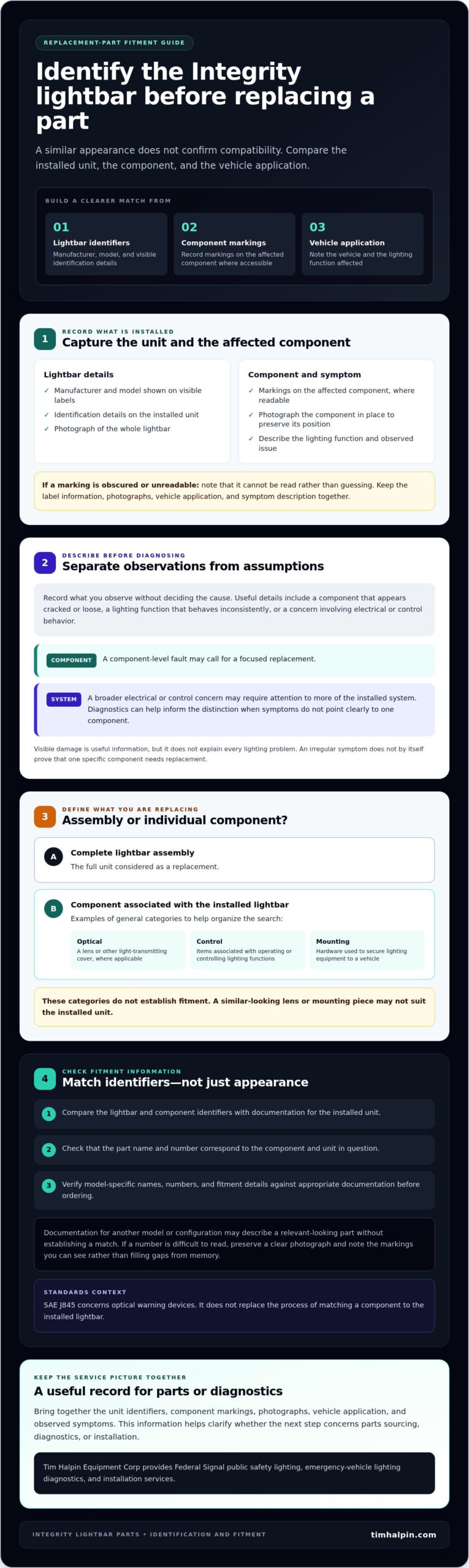
Before removing a component, record what is installed. Note the manufacturer, model, and identification details shown on visible labels, along with any markings you can read on the affected component. Photograph the whole lightbar and the component in place. The images preserve its position and appearance, details that may be harder to recall after removal.
Record the vehicle application and describe which lighting function is affected. Keep the label information, component markings, photographs, and symptom description together. If a marking is obscured or unreadable, note that rather than guessing. A complete, accurate record gives parts selection and any service discussion a more useful starting point.
Is the problem a part issue or a system issue?
Describe what you observe without assuming a cause. For example, note whether a component appears cracked or loose, whether a lighting function behaves inconsistently, or whether the concern involves electrical or control behavior. Visible damage is useful information, but it does not explain every lighting problem. An irregular symptom also does not prove that one specific component needs replacement.
A component-level fault may call for a focused replacement, while a broader electrical or control concern may require attention to more of the installed system. Diagnostics can help inform that distinction, especially when the symptoms do not point clearly to one component. Tim Halpin Equipment Corp provides diagnostics for emergency-vehicle lighting and equipment, as well as Federal Signal public safety lighting and installation services. Sharing the unit identifiers, photographs, vehicle application, and symptoms helps define the task and clarify a practical next step.
Understand the Integrity lightbar parts you may need to identify
Once you have recorded the installed unit, distinguish the complete lightbar from the individual component you are trying to replace. The lightbar assembly is the full unit; a replacement component is a separately selected item intended to support or restore part of an existing system. The problem and the specific configuration in service determine which category applies.
Separate lightbar assemblies from replacement components
Organize the search around one question: do you need a complete assembly, or a component associated with the lightbar already on the vehicle? Broad categories help frame the search, but they do not establish fitment for a particular Integrity lightbar. Examples include:
- Complete lightbar assembly: The full unit considered as a replacement.
- Optical components: A lens or other light-transmitting cover, where applicable.
- Control components: Items associated with operating or controlling lighting functions.
- Mounting items: Hardware used to secure lighting equipment to a vehicle.
These are general categories, not a claim that every item fits every Integrity configuration. A similar-looking lens or mounting piece may not suit the installed unit. Use the category to organize your search, then narrow it with identifiers and documentation for the specific lightbar.
Why part numbers and labels matter
Part numbers and model labels help reduce ambiguity. Record the identifiers on the lightbar and, where accessible, the component itself. Compare them with documentation for the installed unit. Documentation for another model or configuration may describe a part that seems relevant without establishing that it matches your equipment.
When looking for federal signal integrity lightbar parts, do not select by appearance alone. Check that the part name and number correspond to the component and unit in question. If a label is damaged or a number is difficult to read, keep a clear photograph and note the markings you can see rather than filling gaps from memory. Verify model-specific names, numbers, and fitment details against the appropriate documentation before ordering.
Standards can provide useful context, but they serve a different purpose from part identification. The SAE J845 Standard for Optical Warning Devices concerns optical warning devices; it does not replace the process of matching a component to the installed lightbar. Keep the standard’s role separate from the practical work of identifying the unit and part.
Tim Halpin Equipment Corp sells Federal Signal public safety lighting and provides emergency-vehicle lighting diagnostics and installations. Its Federal Signal lighting and service support brings product sourcing and relevant service capabilities into the same discussion.
Use a fitment checklist before buying Federal Signal Integrity parts
A fitment review compares identifiers, the vehicle application, and installation needs. Before purchasing federal signal integrity lightbar parts, work through the steps below. A close visual match can be a useful clue, but it does not prove that a component will connect to or function with the lighting system already on the vehicle.
- Identify the installed unit. Record the model and identification details shown on the lightbar. Use documentation for that unit rather than relying on a broad product description or a similar-looking lightbar.
- Record the component details. Note any accessible markings on the part you are replacing and describe its role in the system. Keep its documentation with the lightbar identifiers so you can compare them together.
- Compare the vehicle application. Record the vehicle and how the lightbar is installed. Compare the visible mounting and connection details with the replacement documentation, without assuming that similar appearance proves a match.
- Review installation needs. Consider what the replacement involves and whether the task is limited to a component or may require attention to the wider lighting system. This helps clarify whether parts selection alone is the next step.
Check the unit, component, and vehicle application
Compare the details as a set, not as isolated clues. The lightbar identifier should align with the component information, and the vehicle context should make sense for the intended application. If a label, part marking, or document conflicts with another identifier, pause the purchase and resolve the mismatch using reliable documentation. Guessing can lead you toward the wrong component.
Visible mounting points and connections are worth recording, but they are only part of the comparison. Two items may appear alike and still differ in electrical or system compatibility. Do not treat visual resemblance as proof of fit. Check model-specific part numbers and compatibility details against documentation for the installed unit before making a technical decision.
Decide whether diagnostics should come before replacement
A lighting symptom can involve an individual component or a wider electrical or control concern. If the observed issue does not clearly point to one part, diagnostics can help inform whether a focused replacement or broader service is the appropriate next step. Diagnostics support the decision, but do not guarantee a particular result.
For emergency-vehicle lighting in Miami, Tim Halpin Equipment Corp provides diagnostics and installations alongside Federal Signal public safety lighting. A clear description of the unit, vehicle application, and symptoms helps frame the service task. For more fleet-visibility context, see this Miami public safety lighting guide.
Plan installation and service around the replacement part
After narrowing down the component, consider how the replacement will be handled. A self-directed replacement may suit a clearly identified part and a straightforward task you are equipped to complete. A diagnostics-led service approach may make more sense if the fault is unclear, the part identity is uncertain, or installation involves the wider lighting system. Plan around the actual issue rather than assuming every symptom calls for the same repair.
Good preparation connects the parts search to the service task. Use the unit identifiers, component markings, and photographs you gathered to explain what is installed. Add a concise description of the lighting concern, including what you observe and when it occurs. These details provide useful context without presuming a diagnosis or a particular repair outcome.
When does professional lighting service make sense?
Consider professional support if the symptoms involve electrical or control behavior, the identifiers point in different directions, or the installation requirements are unclear. These are practical reasons to pause before committing to a component. Tim Halpin Equipment Corp provides diagnostics for emergency-vehicle lighting and equipment to help inform whether the concern is component-level or calls for broader attention.
Installation planning matters as well. Consider the replacement alongside how the existing lighting is mounted and integrated into the vehicle. Tim Halpin also performs emergency-vehicle lighting and equipment installations. For a wider view of how installation decisions fit into fleet planning, explore this commercial truck upfitting guide.
What to prepare for a parts or service discussion
Bring a focused record instead of relying on memory. Include the lightbar’s visible identifiers, markings on the affected component, and clear photographs of the unit and the area involved. Add the vehicle application and a short account of the symptoms. For example, describe which lighting function is affected and whether the concern is constant or occurs in particular circumstances, without guessing at the cause.
This information keeps the discussion practical: what equipment is present, what you have observed, and what needs to be decided next. It can also distinguish a request for a replacement component from a diagnostics or installation task. Tim Halpin Equipment Corp is family-owned and has served commercial and emergency-vehicle equipment needs since 1987.
If you are weighing a replacement against diagnostics or installation support, connect with Tim Halpin about emergency-vehicle lighting to discuss the next step for your equipment.
Source Federal Signal lighting with a clear next step
A clear buying decision starts with three actions: identify the installed lightbar, document the issue, and choose a parts or service route. If the unit and component details point to a specific replacement, pursue that parts path. If the symptom or fitment remains uncertain, diagnostics can help clarify what the system needs before you proceed.
This approach keeps the goal practical: source a component that suits the equipment in place, or plan service around the concern you have observed. Match Federal Signal Integrity lightbar parts using reliable identifiers and documentation, not appearance alone. The details from the vehicle and its installed lighting system are essential to the decision.
How Tim Halpin supports emergency-vehicle lighting needs
Tim Halpin Equipment Corp sells Federal Signal public safety lighting and provides diagnostics for emergency-vehicle lighting and equipment. The company also performs emergency-vehicle lighting and equipment installations, connecting product sourcing with relevant service capabilities. Family-owned and operated since 1987, Tim Halpin stands behind its company promise, Quality Since 1987. That phrase describes the business, not a product warranty or a guaranteed outcome for a particular repair.
For a parts inquiry, gather the lightbar’s visible identifiers, any component markings, the vehicle application, and a concise description of the lighting concern. Those details make it easier to focus the discussion on whether you need a component, diagnostics, or installation. Tim Halpin serves commercial and emergency-vehicle equipment needs in Miami, Doral, Fort Lauderdale, Key West, Medley, Hialeah, Kendall, and across South Florida.
Make the next step straightforward
Before reaching out, gather the information you already have. Note identifiers that conflict or are difficult to read, and describe what the lights are doing without trying to diagnose the cause. Keep any photographs with your notes. A focused summary gives the conversation a useful starting point and helps clarify whether your next step is parts sourcing, diagnostics, or installation planning.
You do not need every technical answer before starting the conversation. Share the unit details and explain what you are trying to resolve. Tim Halpin’s Federal Signal public safety lighting, diagnostics, and installation services give you a practical place to discuss the equipment and the work involved. Use the Federal Signal lighting and service contact page to start the conversation.
Make your next lighting decision with confidence
A replacement decision can also become a useful reference for future vehicle maintenance. Keep the documentation you gathered with the vehicle’s service records, and note the component selected and the reason for the work. This can make later troubleshooting or parts sourcing more straightforward, especially when the equipment has been in service for some time.
If you are weighing the right route, avoid turning uncertainty into a guess. Bring your questions about federal signal integrity lightbar parts and the lighting concern you are trying to address to a knowledgeable team. Tim Halpin Equipment Corp connects Federal Signal public safety lighting with relevant diagnostics and installation support, keeping the discussion focused on your vehicle’s needs.
Discuss your Federal Signal lighting needs with Tim Halpin and take the next step with a clearer plan.
Frequently Asked Questions
Is the Federal Signal Integrity lightbar a complete unit or a replacement part?
Integrity is a Federal Signal lightbar product name, not a term for one specific replacement component. You may be looking for a complete lightbar or a part related to the unit already installed. First identify the lightbar and define the need, such as replacing the complete assembly or addressing a problem with one part. This distinction helps keep a Miami-area parts inquiry focused.
Can I replace only one part of a Federal Signal Integrity lightbar?
Some lighting repairs involve replacing a component rather than the complete assembly, but the appropriate choice depends on the diagnosed issue and exact lightbar. Do not assume a component is replaceable or compatible based on appearance. Note the unit’s labels and describe what you observed, such as visible damage or a function that behaves inconsistently. Documentation for the specific product can help determine the appropriate parts path.
How much do Federal Signal Integrity lightbar parts cost?
There is no single price that applies to every part or service request. The amount depends on what the equipment needs, and Tim Halpin describes its pricing as reasonable. For a useful discussion, share the lightbar’s identifying information and explain whether you are seeking a component, diagnostics, or installation support. This provides context without assuming a particular part or delivery schedule.
Do Federal Signal Integrity lightbar parts fit every emergency vehicle?
Do not assume universal fit. Compatibility depends on the specific lightbar and component, the vehicle application, and the installation context. A Federal Signal name or a part that looks similar is not enough to establish a match. Use the equipment identifiers and documentation for the installed unit to guide the comparison. For emergency vehicles in Miami and South Florida, include the vehicle’s role and existing setup in your assessment.
Should I diagnose a lightbar problem before ordering replacement parts?
Identifying the cause first is often a sensible step because a lighting symptom may involve a component or an electrical issue. For example, an intermittently working function may not point clearly to one replacement part. Tim Halpin provides diagnostics for emergency-vehicle lighting and equipment to help inform the repair decision, without guaranteeing that every fault will be identified or that a particular repair will resolve it.
Can Tim Halpin install emergency-vehicle lighting?
Yes. Tim Halpin provides emergency-vehicle lighting and equipment installations, as well as diagnostics for those systems. To frame the task, describe the vehicle, the lighting equipment involved, and the work you have in mind. If you are coordinating equipment for a Miami-area fleet, include relevant project context so the discussion can focus on the installation need.
