

A quick walkaround may catch visible damage but miss a problem in the lift system. Knowing what’s included in a bucket truck inspection means reviewing both the truck and the aerial equipment, with checks suited to the inspection stage and the specific unit.
Routine pre-use checks, periodic inspections, and specialized testing serve different purposes. A clear, documented process helps identify what needs attention and prevents findings from getting lost between inspection and maintenance.
This guide lays out a practical checklist by system and inspection stage, from the vehicle and chassis to the boom, platform, controls, and hydraulics. It also covers how to record concerns and decide what follow-up is appropriate. Tim Halpin Equipment Corp provides diagnostics, preventative maintenance, and bucket truck repair, helping commercial vehicle customers connect inspection findings with a practical next step.
Key Takeaways
- Knowing what’s included in a bucket truck inspection starts with checking both the vehicle and aerial equipment, including visible condition, controls, and safety-related functions.
- Use the truck’s design, manufacturer instructions, and applicable requirements to guide the inspection instead of relying on a one-size-fits-all checklist.
- Pre-use checks, periodic inspections, and specialized tests serve different purposes. Identify the applicable stage before deciding what a finding means.
- Record the equipment identity, describe each concern clearly, and assign follow-up so findings don’t get lost between inspection and repair.
- Inspection observations can help guide maintenance, diagnostics, or bucket truck repair when further attention is needed.
What’s Included in a Bucket Truck Inspection, and Why Each Check Matters
A bucket truck inspection is a structured review of the vehicle, aerial device, controls, and safety-related functions. It identifies visible defects or abnormal operation and records what needs follow-up. An inspection identifies concerns; a repair corrects a diagnosed problem; specialized testing evaluates a defined property using a specific procedure.
So, what’s included in a bucket truck inspection? The answer depends on the truck and lift, not simply on the vehicle’s general category. A checklist helps an operator or maintenance team work systematically, but it doesn’t replace the manufacturer’s instructions, applicable requirements, or evaluation by a qualified person when needed.
Which bucket trucks and work settings does the checklist apply to?
Bucket trucks support utility, communications, construction, and general maintenance work. Their configurations vary, including how the aerial device is mounted and which controls, components, or safety features are present. Before using a checklist, identify the vehicle and aerial device using their identification plates and relevant equipment documentation. This helps ensure the review fits the specific unit rather than assuming all trucks are built or operated the same way.
What an inspection can, and cannot, tell you
Visual and functional checks can reveal concerns such as visible damage, leaks, missing or loose parts, or controls that don’t respond as expected. They can’t, on their own, establish that every component is free of internal damage or that the boom retains a particular electrical or structural property. The need for further assessment depends on the equipment, its history, and applicable guidance.
Keep the categories clear:
- Inspection: A structured examination and, where applicable, operational check that identifies and documents apparent concerns.
- Repair: Work to correct a diagnosed fault or damaged component.
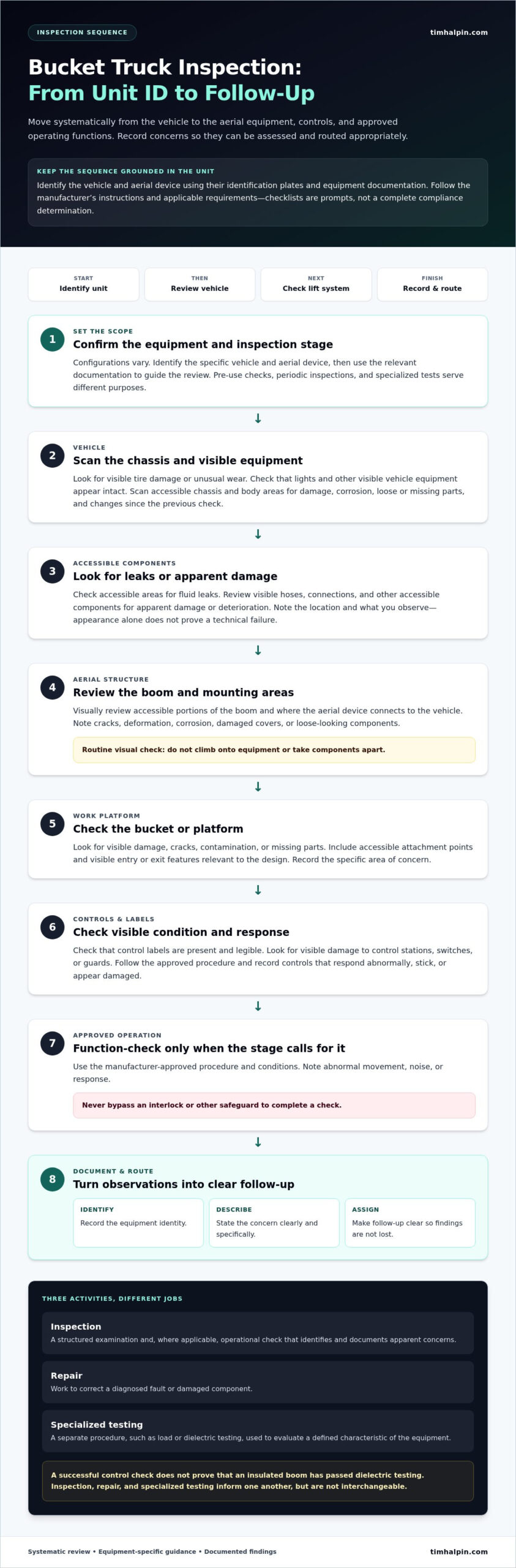
- Specialized testing: A separate procedure, such as load or dielectric testing, used to evaluate a defined characteristic of the equipment.
These activities inform one another, but they aren’t interchangeable. A successful control check, for example, doesn’t prove that an insulated boom has passed dielectric testing. A checklist entry can document what was observed, but it doesn’t establish that a load test is required or that the equipment has passed one.
To determine what’s included in a bucket truck inspection for a specific unit, use the manufacturer’s manual for equipment-specific steps and testing guidance. Compare the inspection scope with current OSHA and applicable ANSI/SAIA sources, and determine whether a cited test applies to that truck’s configuration. Requirements and procedures can differ by equipment and use, so don’t treat a general checklist as a complete compliance determination. Start with the right equipment information, follow the appropriate procedure, and record anything that needs further attention.
Bucket Truck Inspection Checklist: Truck, Boom, Bucket, and Controls
A practical checklist moves from the vehicle to the aerial equipment, then to its controls and approved operating functions. This order keeps the review organized and makes it easier to identify where a concern appears. Follow the manufacturer’s instructions for exact procedures and acceptance limits. A general checklist should prompt attention, not replace equipment-specific guidance.
For a broader regulatory reference, consult OSHA standards for bucket truck inspections. Requirements can depend on the equipment and its use, so don’t treat the checklist below as a complete compliance determination.
- Truck chassis and visible equipment: Look for visible tire damage or unusual wear, and check that lights and other visible vehicle equipment appear intact. Scan accessible chassis and body areas for damage, corrosion, loose or missing parts, and changes since the previous check.
- Fluid and accessible components: Look for fluid leaks around accessible areas and note their location. Check visible hoses, connections, and other accessible components for apparent damage or deterioration. Record what you see without assuming the appearance alone proves a technical failure.
- Boom, mounting areas, and accessible structure: Visually review accessible portions of the boom and the areas where the aerial device connects to the vehicle. Note cracks, deformation, corrosion, damaged covers, or loose-looking components. Don’t climb onto equipment or take components apart as part of a routine visual check.
- Bucket or platform: Check the visible condition for damage, cracks, contamination, or missing parts. Include accessible attachment points and visible entry or exit features relevant to the design. Record the specific area of concern rather than marking only “needs attention.”
- Controls and labels: Check that control labels are present and legible, and look for visible damage to control stations, switches, or guards. Follow the equipment’s approved procedure for checking controls. Record controls that respond abnormally, stick, or appear damaged.
- Operational functions: If the inspection stage calls for a functional check, use the manufacturer-approved procedure and conditions. Note abnormal movement, noise, or response. Never bypass an interlock or other safeguard to complete a check.
These items address the practical question of what’s included in a bucket truck inspection, but they don’t establish universal pass-or-fail criteria. The acceptable condition of a component and the proper way to operate a function must come from the relevant equipment documentation and applicable requirements, not a guessed measurement or rule of thumb.
Make observations specific: identify the component, describe the visible condition or unexpected behavior, and note when it was found. If a check reveals damage, a leak, or abnormal movement, document it for review instead of deciding from the checklist alone that the truck is safe to operate. Tim Halpin Equipment Corp provides diagnostics and bucket truck repair to address equipment concerns; bucket truck repair support is a practical next step when a finding needs attention.
Pre-Use, Periodic, and Specialized Bucket Truck Inspections Compared
One inspection can’t answer every question about a bucket truck. A pre-use check helps identify obvious concerns before operation, periodic inspections provide a broader review of equipment condition, and specialized tests assess particular properties using defined procedures. Knowing the inspection stage helps clarify what its results can tell you and what follow-up may still be needed.
Inspection schedules aren’t identical for every truck. Frequency and scope depend on current applicable requirements, manufacturer guidance, equipment configuration, and service history. Use the table to understand the differences, then check the equipment documentation and applicable rules for the procedure and timing that apply to your unit.
| Inspection stage | Main purpose | What to keep in mind |
|---|---|---|
| Pre-use check | Look for apparent issues and check relevant functions before the equipment is used, following the approved procedure. | It’s an operational check, not a substitute for a more comprehensive inspection or specialized test. Document it as required by your fleet procedure and applicable rules. |
| Periodic inspection | Review the truck and aerial device more comprehensively, with scope suited to the equipment and governing guidance. | Use the manufacturer’s instructions, current applicable standards, and equipment history to determine the inspection’s timing, scope, and personnel qualifications. |
| Specialized testing | Evaluate a specific characteristic through a defined test, such as dielectric testing for electrical insulating properties. | It’s distinct from a visual or functional check. Confirm applicability, procedure, and personnel qualifications for the specific equipment. |
How pre-use checks differ from periodic inspections
A pre-use check relates to the planned operation. It helps surface visible problems or unexpected function before work begins. A periodic inspection is broader and follows its own scope and schedule. Don’t assume a recent pre-use check covers the periodic review, or that one interval applies to every truck. Record each check as required by your inspection program and applicable rules.
When specialized testing may be involved
Dielectric testing isn’t simply a closer visual inspection. It uses a specific procedure to assess electrical insulating properties, and whether it applies depends on the truck’s design and configuration. Load testing is also distinct from routine observation or function checks. For either test, consult equipment-specific instructions and current authoritative requirements, and ensure the work is handled by appropriately qualified personnel.
For broader operating context, the National Safety Council’s bucket truck safety guidelines address safety considerations beyond the inspection itself. Use them alongside, not instead of, the truck and aerial-device manuals and applicable requirements. The practical takeaway is to identify the inspection stage, follow the appropriate procedure, and keep a record showing what was checked and what needs follow-up. This helps distinguish a routine check from a comprehensive evaluation or specialized test.
How to Record Inspection Findings and Decide What Happens Next
An inspection record should make the next step clear to someone who wasn’t there. Entries such as “hydraulic issue” or “check boom” leave too much room for interpretation. Identify the equipment, describe the observation, and show who will review or address it under the fleet’s process. This detail helps maintenance staff track a concern from discovery through follow-up.
Use this sequence to turn a checklist into a workable record:
- Identify the equipment. Record the date, truck and aerial-device identification, and inspector’s name. Include the inspection type or stage for context.
- Note what was checked. Record the relevant areas or functions reviewed, following the fleet’s inspection procedure. Mark items that weren’t applicable or couldn’t be checked as required by that procedure.
- Describe each finding. Name the affected component and state what was observed. For example, “visible fluid beneath the hose connection on the driver’s side” is more useful than “leak.” Add photographs if the fleet’s procedure permits and they can be taken safely.
- Assign and track follow-up. Route the finding to the appropriate safety or maintenance contact, record the planned next step, and track corrective action and completion according to the fleet’s documented process.
What to capture in an inspection record
A complete entry includes the inspection date, equipment identification, inspector, areas checked, and observations. Keep the wording factual: describe the location, visible condition, and any abnormal function without guessing at the cause. Add follow-up details as they become available so the record shows both the original finding and how it was addressed.
The appropriate response depends on the finding, equipment, and company procedure. The examples below are documentation prompts, not universal defect classifications or out-of-service thresholds.
| Observed finding | Document and route for follow-up |
|---|---|
| Visible fluid beneath an accessible hydraulic connection | Record the location and visible condition; assign review through the maintenance process. |
| Control responds differently than expected during an approved check | Note which control and function were involved; escalate through the fleet’s safety and maintenance procedures. |
| Visible damage on an accessible structural area | Describe the location and appearance; route it for appropriate evaluation before deciding on next steps. |
How to respond to a defect or failed function
If a finding could affect safe operation, don’t treat the checklist as permission to keep working. Follow company procedures and applicable rules to notify the responsible person and determine the next step. Keep the equipment’s status clear in the record while the concern is being reviewed. If a hydraulic observation needs technical attention, truck hydraulics in Miami is a related resource.
Clear records help maintenance teams distinguish a condition that needs monitoring from one that calls for diagnostics, repair, or further evaluation. Tim Halpin Equipment Corp provides diagnostics and bucket truck repair for equipment concerns. Learn more about bucket truck repair.
From Inspection Findings to Bucket Truck Repair and Maintenance
An inspection finding is a starting point, not a diagnosis. The next step depends on what was observed, how the equipment functions, and what the manufacturer’s instructions and applicable procedures require. A routine maintenance item may need scheduled attention. A leak, unexpected control response, or visible structural concern may call for troubleshooting, repair, or evaluation by a qualified person. Don’t assume the cause from appearance alone.
This distinction helps explain what’s included in a bucket truck inspection and what happens after the checklist is complete. The inspection record identifies the concern; diagnostics help investigate a problem, maintenance addresses planned service needs, and repair corrects a diagnosed fault. Specialized evaluation or testing follows its own scope and should be handled according to equipment-specific procedures.
When to arrange diagnostics, maintenance, or repair
Let the nature of the finding guide the next step. A maintenance item identified during a review can be tracked through the fleet’s preventative maintenance process. A hydraulic leak or inconsistent function may warrant diagnostics before deciding what repair is needed. An electrical or structural observation may require evaluation by personnel qualified for that equipment and issue. If a safety-related defect is suspected, follow company procedures and applicable rules rather than continuing to operate based on the checklist alone.
Tim Halpin Equipment Corp provides diagnostics, truck body inspections, preventative maintenance, and bucket truck repair. These services connect inspection observations with maintenance and repair follow-through. The company has served commercial vehicle and equipment customers since 1987, with a long-standing focus on supporting work equipment.
A practical next step for South Florida fleets
For fleets operating in Miami, Doral, Fort Lauderdale, Key West, Medley, Hialeah, Kendall, and across South Florida, a clear handoff helps maintenance staff understand what needs attention. Before arranging service, gather the truck and aerial-device identification, the finding and its location, any photographs allowed by your fleet procedure, and a brief note about checks or corrective work already completed. Include whether the concern affects a particular function or is awaiting qualified evaluation.
That information gives the repair conversation a useful starting point. Tim Halpin Equipment Corp diagnostics can help investigate equipment concerns, while preventative maintenance and bucket truck repair address maintenance and repair needs. Keep any component requiring specialized evaluation separate from general repair work and follow the applicable equipment procedures.
When an inspection flags a concern, document it, follow your fleet’s safety process, and arrange the appropriate maintenance, diagnostics, or repair. Talk with our team about bucket truck diagnostics and repair.
Turn Inspection Notes Into a Clear Next Step
A useful inspection record can do more than capture a concern in the moment. Consistent notes can help your team spot recurring issues, plan preventative work, and make informed decisions about equipment maintenance. Treat each finding as a prompt to decide what needs attention, who should review it, and how the outcome will be documented.
If a component needs further attention, use the recorded observations to guide the repair process. Tim Halpin Equipment Corp is family-owned and focused on quality in commercial equipment. Bring the equipment details and inspection notes to the service conversation.
Understanding what’s included in a bucket truck inspection is a strong starting point. The lasting value comes from carrying a clear finding through to an appropriate next step. Discuss your bucket truck’s diagnostics or repair needs with Tim Halpin Equipment Corp.
Frequently Asked Questions
What should be checked during a bucket truck pre-use inspection?
Check the truck and aerial equipment for visible damage, leaks, unusual wear, and missing or loose parts. Follow the manufacturer’s procedure for relevant function checks, and note anything that has changed since the last use, such as a new warning light or a control that responds differently. Exact steps depend on the equipment, so keep its manual available and record concerns using your fleet’s process.
How often does a bucket truck need an inspection?
Inspection timing depends on the equipment, its use, applicable requirements, manufacturer guidance, and service history. A pre-use check is distinct from a periodic inspection, and specialized testing may have its own schedule. Don’t assume one interval covers every truck or inspection type. For fleets operating in Miami or elsewhere in South Florida, maintain a schedule tied to each unit’s records and verify it against current authoritative requirements and the equipment manual.
Is dielectric testing included in every bucket truck inspection?
No. Dielectric testing is a specialized test, not a routine step that automatically applies to every bucket truck. Whether it’s relevant depends on the aerial device’s design and configuration, along with applicable requirements and manufacturer guidance. A visual inspection or normal function check can’t establish electrical insulating performance. Keep test results and dates as distinct records, and determine applicability and procedure using current authoritative sources and qualified personnel.
Can a bucket truck be used if an inspection finds a defect?
Don’t assume it’s safe to continue operating when a finding could affect safe function. Follow your company’s safety procedures and applicable rules to notify the responsible person and determine whether the equipment should remain out of use pending review. A control that behaves unexpectedly, for example, needs more than a note saying “monitor.” Document the issue, communicate its status clearly, and return the truck to use only through the appropriate process.
What is the difference between a bucket truck inspection and a dielectric test?
An inspection is a structured review that can include visual checks and approved functional checks of the vehicle and aerial device. A dielectric test is a specialized procedure that evaluates electrical insulating properties on applicable equipment. Passing one doesn’t establish the result of the other. Keep the reports separate, and use the relevant manual and current requirements to determine whether a specialized test applies to a particular truck.
Who can perform a bucket truck inspection?
The appropriate person depends on the inspection type and procedure. An operator may complete assigned pre-use checks when trained and authorized under the applicable program, while more comprehensive inspections or specialized tests may require a qualified person with relevant equipment knowledge. Don’t treat familiarity with the truck as a substitute for required qualifications. Use current applicable requirements and the manufacturer’s instructions to determine who should perform and document each task.
What should be included in a bucket truck inspection report?
Include the inspection date and type, truck and aerial-device identifiers, inspector, areas reviewed, and findings. Describe each concern precisely, naming the component and location instead of writing only “damage” or “repair needed.” Record follow-up responsibility and corrective-action status according to the fleet’s process. What’s included in a bucket truck inspection report can vary by program, so retain records in a way that supports clear handoffs and equipment history.
