
A truck can look ready from the ground and still have a problem with its bucket system. That’s why a practical answer to qué incluye la inspección de un camión con cesta considers both the road-going vehicle and the equipment that lifts and supports the worker. A walkaround can flag visible concerns, but it may not reveal a developing hydraulic or electrical issue.
An inspection can review the truck’s visible condition and key areas of its bucket equipment. If a finding needs investigation, diagnostics can take a closer look. This guide explains the areas that may be assessed, how an inspection differs from a pre-use check, and how to prepare for useful follow-up. At Tim Halpin Equipment Corp, Truck Body Inspections, diagnostics, bucket truck repair, hydraulic repairs, and electrical repairs help commercial operators address equipment concerns.
Key Takeaways
- Learn qué incluye la inspección de un camión con cesta by considering the truck and lifting equipment as separate areas of attention.
- Understand how inspection scope can vary with the truck’s configuration and intended use.
- Use routine observations to flag concerns, then distinguish them from a broader diagnostic assessment.
- Prepare clear notes about symptoms and when they occur to make inspection findings more useful.
- Use findings to decide whether monitoring, diagnostics, or repair may be an appropriate next step.
What Does a Bucket Truck Inspection Cover, and Why Check Two Systems?
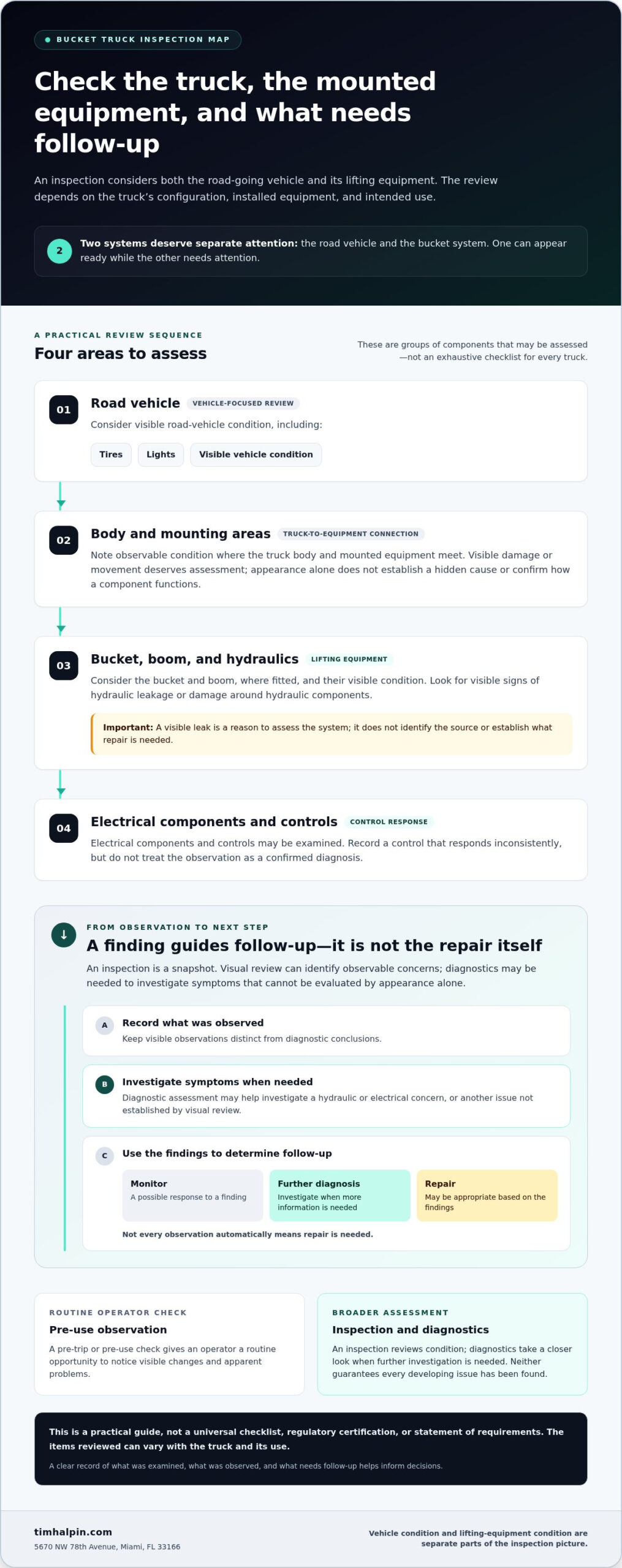
A bucket truck inspection reviews the condition of both the vehicle and its mounted lifting equipment. Its scope depends on the truck’s configuration, installed equipment, and intended use. These areas deserve separate attention: a truck may appear ready for road travel while its bucket system needs attention, or the lifting equipment may look sound while a vehicle issue affects operation.
In practical terms, an inspection looks beyond a basic walkaround to assess the observable condition of the truck and its bucket equipment, with diagnostics where further investigation is needed. The question qué incluye la inspección de un camión con cesta doesn’t have one universal answer. The review should reflect the equipment being assessed rather than assume every truck has the same setup. For a general overview of equipment types and uses, see this explanation of the aerial work platform.
Truck chassis checks versus bucket-equipment checks
The road-going truck and the elevated work system have different components and functions, so each needs attention in its own right. A vehicle-focused review may consider tires, lights, brakes, and visible structural condition. These checks relate to the truck itself, but they don’t establish the condition of its mounted bucket.
The bucket side may call for attention to the platform, boom, controls, and associated equipment. Visible damage to a bucket component and a control that doesn’t respond as expected are different observations, and each may need a different follow-up. The exact review depends on the installed equipment and how the truck is used. A truck configured for one type of work may have different equipment or wear patterns from another.
What an inspection can, and cannot, tell you
An inspection records a snapshot of condition. A visual review can identify observable concerns, while diagnostic assessment may be needed to investigate a symptom or system that can’t be evaluated by appearance alone. Findings help clarify what was observed and whether further investigation is appropriate. They don’t guarantee that every developing issue has been found or that the truck will remain problem-free.
Identifying a concern is different from repairing it. A finding may warrant monitoring, additional diagnosis, or repair; not every observation automatically means repair is needed. If diagnosis points to a hydraulic or electrical issue, that information can guide the next step without confusing the inspection with completed repair work.
This is a practical guide, not a universal checklist, regulatory certification, or statement of requirements. The items reviewed can vary with the truck and its use. A clear record of what was examined, what was observed, and what needs follow-up gives operators a more useful basis for decisions than a walkaround alone.
Which Bucket Truck Components May Be Checked?
The components reviewed depend on the truck’s configuration, installed equipment, and intended work. A useful way to organize the inspection is to consider four groups: the road vehicle, the body and mounting areas, the bucket and boom with their hydraulic components, and the electrical controls. These are areas that may be assessed, not an exhaustive checklist for every truck.
For regulatory context on vehicle-mounted elevating and rotating work platforms, consult OSHA Standard 1910.67. The scope of a specific inspection still depends on the equipment being evaluated. Understanding qué incluye la inspección de un camión con cesta can help you identify the main groups, but it doesn’t replace a truck-specific assessment or diagnostic testing.
Truck, body, and visible structural condition
On the vehicle side, a review may include tires, lights, and visible body condition, along with areas where the truck body and mounted equipment meet. The purpose is to note observable conditions, not to infer a hidden cause from appearance alone. Visible damage or movement around a mounting area deserves assessment; observation by itself doesn’t establish whether a component is loose, internally damaged, or functioning as intended.
These checks are distinct from evaluating the bucket system. Tires and lights can appear serviceable while an issue exists elsewhere, and a sound-looking body doesn’t establish that the lifting equipment operates properly.
Bucket, boom, hydraulics, and controls
On the equipment side, an inspection may include the bucket and boom, where fitted, and their visible condition. A reviewer may also look for visible signs of hydraulic leakage or damage around hydraulic components. A leak is a reason to assess the system, but it doesn’t identify the source or establish what repair is needed.
Electrical components and controls may also be examined. A control that responds inconsistently is useful information, but identifying the cause may require diagnostic testing beyond a visual review. Don’t treat an apparent control issue as a confirmed diagnosis.
- Vehicle: tires, lights, and visible road-vehicle condition.
- Body and mounting areas: observable condition where the truck and installed equipment connect.
- Bucket system: bucket, boom, and associated equipment, as applicable.
- Hydraulic and electrical systems: visible concerns and controls that may need further assessment.
This grouping helps operators describe what they’ve noticed while keeping visual observations separate from diagnostic conclusions. Tim Halpin Equipment Corp provides bucket truck repair, hydraulic repairs, and electrical repairs, so findings in those areas can inform appropriate follow-up.
Is a Bucket Truck Inspection the Same as a Pre-Trip Check?
No. A pre-trip or pre-use check gives an operator a routine opportunity to notice visible changes and apparent problems. A broader inspection or diagnostic assessment can examine a concern more closely, including issues that aren’t clear from a walkaround. These checks work together but answer different questions: “What can I observe?” and “What may need further assessment?”
The distinction matters because a bucket truck includes both a road vehicle and mounted lifting equipment. A walkaround can flag visible leakage or damage, for example, but it won’t necessarily identify the source of a hydraulic issue or explain why a control behaves inconsistently. The scope of qué incluye la inspección de un camión con cesta can go beyond routine observations, depending on the truck and the concern.
Routine pre-use observations
An operator’s walkaround can bring visible concerns to attention, such as damage, fluid appearing where it shouldn’t, or an apparent change in the truck or equipment’s condition. Follow the vehicle and equipment manufacturers’ instructions for checks and operation. Keep observations specific: note where a leak appears or which control seems different instead of trying to diagnose the cause.
Professional inspection and diagnostic assessment
A professional assessment can take a closer look at a reported concern and determine whether further diagnostics are useful. Truck-body, hydraulic, and electrical symptoms may call for different expertise. Findings guide next steps; they don’t automatically mean a repair is required. A concern may need more investigation, while another observation may not point to a repair at all.
Routine pre-use check
Purpose: Notice apparent changes before work.
Typical scope: Visible condition and operator observations, guided by manufacturer instructions.
Follow-up: Record and report concerns for appropriate assessment.
Professional inspection
Purpose: Review condition beyond a basic walkaround.
Typical scope: Areas selected for the truck’s configuration and the concern being assessed.
Follow-up: Use findings to determine whether monitoring, further diagnosis, or repair is appropriate.
Diagnostic assessment
Purpose: Investigate a symptom that observation alone can’t explain.
Typical scope: Focused evaluation of the relevant truck body, hydraulic, electrical, or equipment concern.
Follow-up: Review the assessment and decide on the next step.
Inspection schedules and documentation expectations can depend on applicable equipment guidance and rules for a particular work setting. A schedule or legal requirement that applies elsewhere shouldn’t automatically be treated as the rule for your truck or location. Use the manufacturer’s instructions and applicable local requirements rather than relying on a generic calendar or checklist.
For useful follow-up, describe what you noticed and when it happens. For example, note whether a control response changes during use or a visible leak appears after the truck has been parked. Clear observations help focus an assessment without turning an operator’s check into a diagnosis.
How to Prepare for an Inspection and Respond to Findings
A little preparation can make an inspection discussion more productive. You don’t need to diagnose the truck yourself. Give a clear account of what you’ve noticed, make the vehicle and relevant equipment available for the agreed assessment, and understand the findings before deciding on follow-up.
Before bringing the truck in
Write down visible concerns and unusual operation while the details are fresh. Include when a symptom occurs, whether it happens consistently, and whether anything changed beforehand, such as recent work or a change in use. If you’ve noticed a leak, describe its location and when you saw it rather than guessing at the source.
Gather your notes and make the truck and its installed equipment available for the assessment. Follow the manufacturer’s instructions for the vehicle and equipment. If you believe a condition could make operation unsafe, don’t use the equipment to reproduce the symptom. Share what you observed so it can be considered during the assessment.
- Note the symptom and where it appears.
- Record when it happens and whether it repeats.
- Mention relevant recent changes or work.
- Have the truck and installed equipment available for the agreed assessment.
After the inspection report or discussion
Review the findings one at a time. Ask for a plain explanation of what was observed, what was tested, and whether the assessment identified a confirmed cause or only a condition that needs more investigation. These distinctions matter. A visible leak is an observation; identifying its source requires further assessment.
Clarify the recommended follow-up and how it relates to the truck’s intended work. Findings can suggest monitoring, additional diagnostics, or repair, but an inspection observation doesn’t automatically establish that repair is required. Keep a record of the discussion and any work completed so future decisions can take the truck’s history into account.
If the concern involves hydraulics, more background may help you understand the system and its service needs. Tim Halpin Equipment Corp’s article “Expert Truck Hydraulics in Miami: Keeping South Florida Fleets Moving” offers related context. A hydraulic finding still needs to be understood in light of the specific truck and assessment; general information isn’t a diagnosis.
Keep the categories clear: what you noticed, what the inspection determined, what further diagnosis may be needed, and what repair has actually been completed. An inspection report or discussion isn’t by itself a formal compliance determination, and a recommendation isn’t the same as completed work.
For help connecting bucket-truck findings with inspection, diagnostic, or repair next steps, discuss your bucket truck inspection findings with Tim Halpin Equipment Corp.
Bucket Truck Inspections and Repair Support in Miami
An inspection finding is a starting point for an informed decision, not an automatic repair order. Tim Halpin Equipment Corp provides Truck Body Inspections and bucket truck repair for commercial vehicle operators assessing their equipment. The right next step depends on what was observed and whether additional diagnostics are appropriate.
When inspection findings point to diagnostics or repair
A truck-body concern, hydraulic symptom, and electrical issue each call for attention to a different part of the vehicle. An inspection can document a visible condition, while diagnostics can investigate a symptom that needs further assessment. If the assessment identifies a repair need, the findings can help guide the work. Not every observation requires repair, and an inspection alone isn’t a formal certification or confirmation that every system is free of concerns.
Tim Halpin Equipment Corp provides bucket truck repair, hydraulic repairs, electrical repairs, and diagnostics. These services are relevant when inspection findings involve the bucket truck’s body, hydraulic system, or electrical components. Findings help identify the area of concern, and further assessment can clarify what follow-up makes sense for that particular truck.
When considering qué incluye la inspección de un camión con cesta, keep three things distinct: the condition observed, any diagnosis made after further assessment, and repair work actually completed. That separation supports clearer decisions and records. It also avoids assuming that every note in an inspection report means a component has failed or must be replaced.
A local next step for commercial vehicle operators
Tim Halpin Equipment Corp is family-owned and operated, with a history of serving commercial vehicle equipment needs since 1987. The company supports operators in Miami, Doral, Fort Lauderdale, Key West, Medley, Hialeah, Kendall, and across South Florida with truck-body inspections, diagnostics, and related repair services.
Before discussing the truck, prepare a concise description of the concern, when it appears, and which system or area was noted. If you have an inspection report, sharing its observations can help focus the conversation. The goal is to understand the finding and consider appropriate next steps, not to assume a repair before the issue has been assessed.
Tim Halpin Equipment Corp is located at 5670 NW 78th Avenue, Miami, FL 33166. If an inspection has raised a question about your truck body, bucket system, hydraulics, or electrical components, discuss the finding and related repair needs with the team.
Make Your Next Equipment Decision with Confidence
Treat each inspection as part of your truck’s ongoing service history. Keep notes on recurring concerns and the decisions made after assessment, so future service discussions can start with a clearer picture of how the equipment has been performing. This turns individual observations into useful information for planning work and managing fleet readiness.
Understanding qué incluye la inspección de un camión con cesta can also help your team communicate more precisely. Share what you’ve noticed, describe the conditions in which it occurs, and leave diagnosis to the appropriate assessment. You don’t need to have every answer before taking the next step.
Tim Halpin Equipment Corp is a local resource for commercial vehicle equipment needs in Miami and South Florida. Talk with our team about your bucket truck inspection or repair needs and take the next step with a clear account of what your truck requires.
Frequently Asked Questions
How often should a bucket truck receive a professional inspection?
No single professional-inspection interval applies to every bucket truck. The appropriate schedule depends on the equipment, its use, manufacturer guidance, and requirements that apply to the work. Keep scheduled professional assessments distinct from routine operator observations, and use the truck’s documentation to track relevant service history. Before relying on a legal interval, verify it with a current authoritative source for your situation.
Who can inspect a bucket truck?
The right person depends on what the inspection needs to establish. Operators can make routine observations by following the truck and equipment instructions, while mechanical, hydraulic, electrical, or structural concerns may call for qualified service diagnostics. A general walkaround doesn’t prove every system is sound. For formal regulatory or certification requirements, consult the applicable authority and current equipment documentation rather than assuming a general service review meets them.
Can I operate a bucket truck if I notice a leak or damaged component?
Don’t assume the truck is safe to operate just because it still functions. A leak or damaged component may have different significance depending on its location and condition. Follow the manufacturer’s instructions and workplace procedures, and arrange an appropriate assessment if the concern could affect safe operation. Avoid trying to identify the cause or make a repair decision from appearance alone, especially if the symptom changes during use.
What happens if an inspection finds a problem?
The service professional should explain what was observed and what follow-up is recommended. Ask which part or system the finding concerns, whether it’s an observation or a confirmed diagnosis, and whether additional testing is suggested. For example, a note about a control behaving inconsistently may call for further assessment before anyone can identify the cause. Use the findings and the truck’s intended work to guide repair and return-to-use decisions.
Does a bucket truck inspection include the truck’s hydraulic system?
Hydraulic components may be included, depending on the truck’s setup and the reason for the assessment. For readers asking qué incluye la inspección de un camión con cesta, a hydraulic concern might involve a visible leak or a reported change in equipment operation. Appearance alone may not reveal the source. If further evaluation is needed, hydraulic diagnostics can help investigate the specific concern without assuming that a repair is already required.
Should I bring inspection records or describe symptoms beforehand?
Yes. Relevant records and a clear symptom description can give the assessment useful background. Note which component is involved, when the issue occurs, and whether it happens every time or intermittently. In Miami and across South Florida, where trucks may move between different job sites, also mention whether the symptom appears in a particular operating context. This information helps focus the discussion, though it doesn’t replace physical assessment or testing.
