

The model name alone may not identify the correct Anthony liftgate parts. Accurate Anthony liftgate model identification starts with the unit’s data plate: its model and serial numbers help narrow the parts search.
The plate may not always provide a clear answer. If it is faded, damaged, or missing on an older liftgate, a professional can also consider visible design details and component information. The model series matters too: names such as MTU-GLR and ATU-GLR refer to distinct product lines.
This guide explains which plate details are useful when requesting parts, how series names help with identification, and what to record when the plate is unreadable. It also covers how professionals assess older units and when liftgate repair may be useful alongside parts identification.
Key Takeaways
- Model and serial numbers on the liftgate’s identification plate are key details for narrowing down parts information.
- Include clear plate details with a parts request so the unit can be identified more accurately.
- Anthony series names, such as MTU-GLR and ATU-GLR, help distinguish product lines.
- If the plate is unreadable or missing, visible design features and component details can help a professional identify an older unit.
- Platform dimensions and liftgate repair needs can provide useful context when parts identification is challenging.
Liftgate model and serial number identification
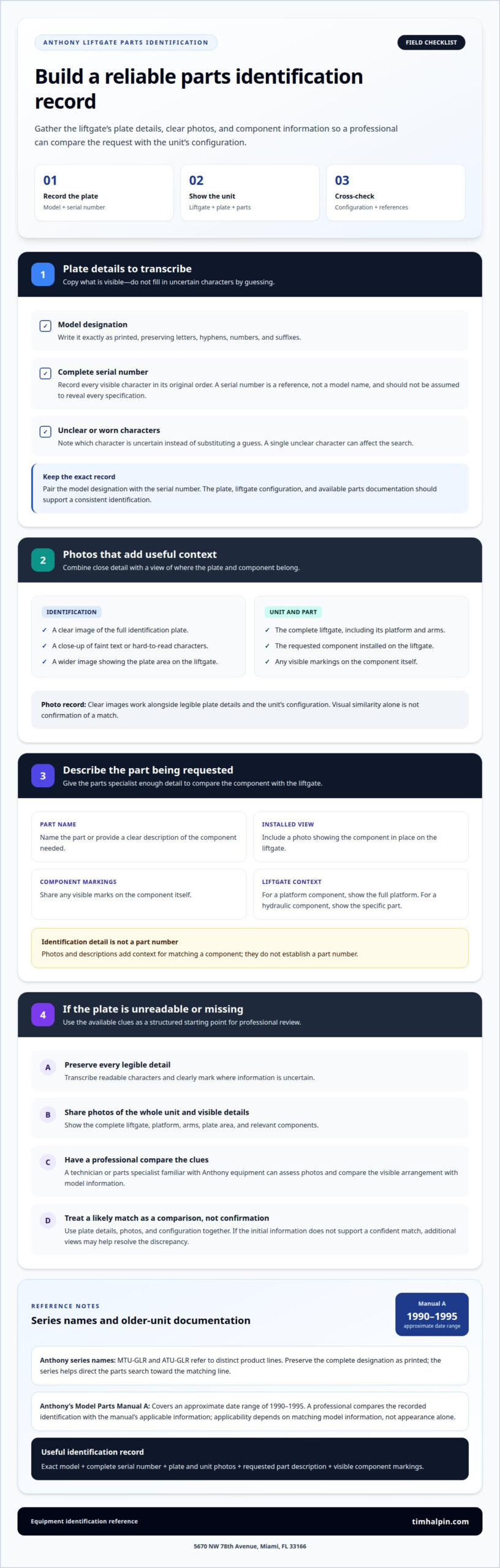
Start with the Anthony liftgate’s identification plate and record the model and serial number exactly as shown. These details help distinguish the unit from other Anthony designs and guide parts research.
Identification involves more than reading a number. The plate, liftgate configuration, and available parts documentation should support a consistent identification.
Serial Number Identification
A serial number is a reference, not a model name. A technician or parts specialist records every visible character and pairs it with the model designation, including letters, numbers, and any suffix. These details can narrow the relevant parts information, but a serial number alone should not be assumed to reveal every specification.
Anthony’s Model Parts Manual A covers an approximate date range of 1990-1995. For a unit that may fall within that period, the professional compares its recorded identification with the manual’s applicable information. The serial number should be transcribed as seen, since a single unclear character can affect the search.
Photo-Based Identification
When an older unit’s plate is unreadable or missing, a liftgate technician or parts specialist familiar with Anthony equipment can assess photos. Useful images show the complete liftgate, platform and arms, plate area, and visible components. A close, well-lit photo may make hard-to-read characters clearer.
Treat photos as evidence, alongside any legible plate details and the unit’s configuration. A professional can compare these clues with Anthony model information and explain which details support a likely match. This helps avoid treating visual similarity as confirmation.
Before an in-person inspection, a professional makes the work area stable and keeps bystanders clear of the liftgate. The technician assesses the equipment’s position and visible condition before approaching moving or hydraulic components. If inspection requires movement, the technician controls access and proceeds carefully rather than asking someone nearby to operate the gate.
For a parts inquiry, start with the model and serial number, if readable, and clear photos of the complete unit and identification plate. A professional compares the details, notes any uncertain characters, and checks whether the visible configuration fits the identification. If the plate is missing, photos and other unit details still provide a structured starting point.
Keep clear records. A transcription preserves the exact plate information, while photos show its physical context. Together, these details help a professional distinguish an older Anthony liftgate from a similar-looking configuration and narrow the parts search without relying on an assumed serial-number decoding method.
Providing plate details when ordering parts
A parts request is easier to assess when the Anthony liftgate’s plate details are provided together. A professional uses the model and serial number to find relevant parts information, then compares the requested component with the unit’s configuration. Transcribe carefully: a missed letter or digit can point to a different reference.
Include a clear image of the full plate and a written transcription of every legible field. Keep letters, digits, hyphens, and suffixes in their original order. If a character is worn, mark it as unclear rather than guessing. A close-up can make faint text easier to review, while a wider image shows that the plate belongs to the liftgate in question.
For a useful parts inquiry, provide these details where available:
- The Anthony model designation exactly as printed.
- The complete serial number, including letters and suffixes.
- A photograph of the plate and its surrounding area.
- The part name or a clear description of the component needed.
- Photos showing the component installed on the liftgate.
- Any visible markings on the component itself.
Anthony parts manuals and diagrams connect identification details to component references. A professional uses the model information to find the relevant manual or diagram, then compares the illustrated assembly with the requested part. Anthony’s Model Parts Manual A is one named reference for older equipment. Its applicability depends on whether the liftgate matches the manual’s model information, not just whether it looks similar.
For example, when requesting a platform component, identify the liftgate model and describe the part you need. A photo of the full platform and any visible component markings adds useful context to the plate record. For a hydraulic component, a photo of the specific part can help distinguish it from other assemblies. These examples guide identification; they do not establish a part number.
If the plate is partly unreadable, provide the legible characters and specify where the uncertainty lies. A professional can compare the available information with Anthony diagrams and the unit’s visible arrangement. If the model or component cannot be matched confidently from the initial details, additional views may help resolve the discrepancy. Clear records reduce the risk of searching under an assumed model or ordering from an incomplete description.
For help connecting Anthony plate details with a parts request, use the Anthony liftgate parts option and include the information available from the unit.
Anthony liftgate model names and series
Anthony model names help distinguish product families during parts identification. Names such as MTU-GLR and ATU-GLR are more useful than general descriptions like “rail lift” or “truck liftgate.” Record the complete designation as printed, preserving letters, hyphens, and suffixes. These details direct the parts search toward the matching Anthony series instead of a visually similar unit.
These figures provide context when reviewing a model name, but they don’t replace the designation. Capacity alone may not be enough to distinguish the series.
Anthony liftgate model identification starts with the complete model code, then compares it with the liftgate and requested part. Don’t shorten a code to “MTU” or “ATU” if the plate shows a longer name. Keeping the full series designation helps prevent an abbreviated label from directing the parts search toward the wrong family.
- Full designation: Preserve each visible letter, number, hyphen, and suffix.
- Parts request: Pair the model name with the specific component description.
A professional doesn’t infer a model from the series capacity alone. Capacity provides context, while the exact designation and unit configuration remain important references. If the plate is hard to read, photos of the complete liftgate can help show whether its visible design aligns with the recorded model name.
Series names also help organize parts research. Once the designation is recorded, a professional can compare the requested component with Anthony parts information for that family. If the request concerns a platform or another assembly, describe the component clearly alongside the series code. A model label may identify the family, but not the exact component needed.
Keep the distinction clear: MTU-GLR and ATU-GLR are series names, while capacity is supporting context. A professional considers both without treating a capacity figure as a substitute for the plate information. This gives a parts inquiry a clearer starting point.
Identifying a liftgate with a missing or unreadable plate
A missing Anthony identification plate removes a direct reference, but doesn’t end the identification process. A professional builds on the remaining evidence, separating confirmed details from visual clues and unknowns. That distinction matters: a similar-looking gate may belong to another configuration, and a guessed model can lead to the wrong parts search.
First, document what remains on the unit. A technician records legible plate characters, visible labels, and component markings. If the plate is present but worn, the professional distinguishes readable characters from uncertain ones instead of filling gaps with guesses. If the plate is gone, record that as part of the identification.
Next, the professional examines the Anthony liftgate as a complete assembly. The platform, arms, mounting arrangement, and visible hydraulic components help interpret partial identifiers. No single visual feature should determine the identification. The technician compares the combined observations with Anthony model information and parts documentation, looking for details that agree rather than relying on general resemblance.
- Legible evidence: Record surviving letters, numbers, and component markings as they appear.
- Visual evidence: Describe the assembly and its visible arrangement without assigning a model prematurely.
- Reference comparison: Compare the recorded details with Anthony parts information and diagrams.
- Unresolved details: Keep uncertain characters or features separate from confirmed observations.
An older unit may require a broader comparison. Anthony’s Model Parts Manual A covers an approximate date range of 1990-1995. A professional can consider that manual when the liftgate’s evidence points toward the period it covers, then compare the unit’s details with the relevant material. The manual’s date range is a research clue, not proof that every older Anthony gate belongs to it.
When evidence points in different directions, the professional narrows the question before pursuing a part. For example, a visible component marking may identify the component, but not the liftgate model. The technician can consider that marking alongside the platform and arm arrangement, then check whether Anthony documentation supports a consistent identification. This avoids treating one clue as a complete answer.
The result may be a supported model identification or a narrower set of possibilities for further assessment. Either way, the professional should explain which details support the conclusion and which remain uncertain. For parts ordering, this distinction helps prevent an assumed model from being presented as a confirmed match, especially when the original Anthony plate does not provide a complete serial number.
Can a professional identify an Anthony liftgate by its platform, arms, and dimensions?
Yes. A professional can use the platform, arm arrangement, and measurements as identification clues, especially when an Anthony plate is unreadable. These features help narrow the possibilities, but dimensions alone don’t establish a model. The professional compares several observations with Anthony parts information and the liftgate’s overall configuration.
Platform measurements can be useful when recorded consistently. Anthony ETU parts information lists complete steel platform assemblies measuring 80 inches by 44 inches and 80 inches by 50 inches. Those options show why recording both platform dimensions matters. A width alone, or an estimate taken from an angled view, may not distinguish between listed assemblies.
The arms provide another comparison point. A professional examines how they connect to the platform and liftgate, then considers their arrangement alongside the platform. The goal isn’t to identify an Anthony model from arm shape alone. It’s to see whether the arms, platform, and other visible components fit the same documented configuration.
Measurements are most useful when recorded clearly. A professional can note:
- The platform’s overall width and depth.
- Whether the platform is steel, as in the listed ETU assemblies.
- The visible arm arrangement and connection points.
- Any differences between the unit and the 80-by-44-inch or 80-by-50-inch ETU examples.
- Other visible labels or component markings that support comparison.
These details help guide identification, rather than replace the model designation. For example, a platform measuring 80 inches by 44 inches matches one listed ETU steel assembly dimension. A professional still compares the arms and surrounding liftgate configuration before connecting that measurement to a particular unit or parts request.
Accurate measurements also depend on distinguishing the platform from nearby brackets or other structures. The professional identifies the platform edges, records its dimensions, and notes where the arms attach. If the installed platform has been changed, its current measurements may not reflect the liftgate’s original configuration. Consider the platform, arms, and other Anthony components together.
For a parts inquiry, include measurements alongside any available model or serial details. Clear views of the entire platform and both arm connections show how the dimensions relate to the assembly. If the evidence doesn’t fit either listed ETU platform size, a professional can use the other visible details to narrow the identification instead of forcing a match.
Need help interpreting platform measurements and arm configuration? Send the liftgate details for identification.
Tim Halpin Equipment: Anthony Liftgate Parts
Tim Halpin Equipment Corp helps connect Anthony liftgate identification with the parts or repair support you need. For a parts inquiry, provide the model and serial number when legible, along with photos of the plate and component. If the plate is missing, platform measurements and other visible liftgate details can help inform the parts search.
Turn to Anthony Liftgate Parts when you need help identifying a component for an Anthony unit. If the liftgate also needs inspection or repair, Liftgate Repair can address the equipment itself. Truck Repair and Trailer Repair are available when the concern extends beyond the liftgate.
Share the identification details you have and describe the part or repair concern. Contact Tim Halpin Equipment Corp to discuss your Anthony liftgate parts needs.
Make Your Next Parts Decision With Confidence
Use the identification details to move from uncertainty to a practical parts or repair decision. Professional Anthony liftgate model identification can connect the equipment details to the next step, whether you need a component or support for the liftgate itself. Share the information you have and describe the issue or part you’re trying to address.
Tim Halpin Equipment Corp offers Anthony Liftgate Parts, Liftgate Repair, Truck Repair, and Trailer Repair. The conversation can address a liftgate concern or a broader truck or trailer repair need while keeping the parts question in focus. Clear details help keep the discussion centered on your equipment and next step.
Contact Tim Halpin Equipment Corp to discuss your liftgate parts or repair needs. A clear next step can make the path forward feel simpler.
Frequently Asked Questions
How does a professional identify the model of an Anthony liftgate?
A professional considers the liftgate’s identifying details and physical configuration together. The model designation provides a starting point, while visible assemblies help assess whether the unit fits that identification. For example, an Anthony MTU-GLR or ATU-GLR code names a series, but the full designation still matters. Reviewing both helps avoid identifying a model by general appearance or capacity alone.
Where is the model and serial number tag on an Anthony liftgate?
The exact tag location can’t be established from the available Anthony details, so a professional shouldn’t assume one fixed position. The technician examines the liftgate and its accessible frame areas for the identification plate, then checks whether it is obscured, damaged, or absent. A clear view of the unit can help direct that inspection. Don’t mistake a component marking for the liftgate’s model or serial number.
What information is listed on an Anthony liftgate identification plate?
Record the model designation and serial number when legible. Preserve the full sequence, including letters, digits, and punctuation, rather than shortening a code such as MTU-GLR. Don’t assume the plate includes other specific fields. If it shows additional markings, a professional can record them as supporting details, not as a substitute for the model or serial number.
How can a professional identify an Anthony liftgate model if the data plate is missing?
A professional can compare the liftgate’s visible configuration, component markings, and surviving labels with Anthony model information. For example, the platform and arm arrangement can be checked against the model family suggested by other details. If clues conflict, keep them separate rather than forcing a match. Photos document the assembly and help make the comparison more precise.
How can a professional use Anthony liftgate manuals and parts catalogs to confirm a model number?
A professional starts with the liftgate’s model information, finds the relevant Anthony manual, and compares the unit’s assemblies with its illustrations and descriptions. A diagram can help determine whether a requested component belongs to the configuration under review. The manual is useful only if its model coverage fits the liftgate. A title or visual resemblance alone doesn’t confirm a match.
How does a professional match an Anthony liftgate model to replacement parts?
A professional starts with the liftgate’s model details and narrows the search to relevant Anthony parts information. The requested component matters too: a platform inquiry and a hydraulic component inquiry require different comparisons. Clear photos or markings can help distinguish similar-looking parts. Before matching a replacement, the professional checks that its reference corresponds to the identified model and the assembly shown on the unit.
What are the differences between common Anthony liftgate models?
Anthony series have different model designations and stated capacity ranges. Because those ranges overlap, capacity alone doesn’t identify the series. The complete model code is more useful for parts research, supported by the liftgate’s configuration and applicable Anthony parts information.