
The lowest-cost replacement isn’t always the simplest choice. For commercial fleets, peace of mind with OEM truck parts starts with selecting a part made by the vehicle’s brand and matched to its model year and trim. Aftermarket parts can also be suitable, but quality varies, so the manufacturer and application matter.
It’s reasonable to want a part that fits your truck and clear warranty terms explaining what happens if it fails. OEM part providers may offer warranties covering defects or premature breakdowns, but coverage depends on the specific terms. This guide explains how to choose a replacement, review warranty support, and find parts for your commercial vehicle. It also shows how parts expertise and repair services can connect the equipment issue with a practical next step.
Key Takeaways
- Share your truck’s identifying details and repair needs so a parts specialist can narrow down suitable replacement options.
- Review warranty coverage, exclusions, and the process for handling a claim before choosing a replacement part.
- Match the parts search to the commercial vehicle and equipment involved, since support needs differ by vehicle type.
- Confirm fit using part identifiers and vehicle details, not appearance alone.
- Look for manufacturer identification and documentation to help establish whether a part is genuine OEM.
Finding the right replacement part
Start with the truck’s make, model year, and trim, then match the replacement to its intended application. OEM parts come from the vehicle’s brand and match parts originally used for that model year and trim.
OEM Quality and Durability
OEM parts are designed for particular vehicles, giving a parts specialist a clear reference for assessing fit and intended application. That doesn’t mean every OEM part lasts forever or every aftermarket part is poor. Compare the manufacturer, vehicle match, and part condition. Aftermarket quality varies, so both the maker and the specific replacement matter.
For durability, the application matters as much as the label. A part intended for a different model year or trim may not be suitable, even if it looks similar. A specialist can use the vehicle details and information about the failed part to narrow the options and assess whether a replacement suits the repair.
Genuine OEM Verification
To assess whether a replacement is genuine OEM, a parts specialist can compare its manufacturer and identifying information with the vehicle brand’s part information. The key is matching the part to the truck’s model year and trim, rather than relying on its appearance or a broad description such as “fits this truck.” Clear identification helps distinguish an OEM component from an aftermarket alternative.
VIN-level matching adds vehicle-specific information to the process. A specialist can use the VIN alongside the truck’s make, model year, trim, and repair details to narrow the application. If a component has been changed or the truck has an unusual configuration, sharing those details can help avoid a match based on the wrong assumption.
Counterfeit and Low-Quality Part Risks
Counterfeit parts may be presented as genuine OEM, while low-quality aftermarket parts can vary in materials, fit, or performance. The immediate risk is getting a component that doesn’t match the truck or perform as expected. A poor match can complicate installation, delay a repair, or contribute to another parts problem.
What risks come with counterfeit or low-quality truck parts? They may fit incorrectly, fail prematurely, or lead to repeat repairs and added downtime. Before installation, have the manufacturer identification, application details, and part documentation reviewed as part of a professional matching process.
Keep the replacement decision tied to the actual vehicle, not just the failed component. A truck may have a different trim or model-year application than expected, and a similar-looking part can still be unsuitable. For example, aftermarket suppliers may continue supporting 2018 truck models, but that doesn’t establish that every part fits every 2018 truck. The exact vehicle and component remain central to the match.
When the make, model year, trim, VIN, and repair need are considered together, a parts specialist can narrow the search. This gives fleet managers a practical basis for choosing between OEM and aftermarket options while reducing uncertainty about fit, quality, and the next repair step.
OEM warranties and peace of mind
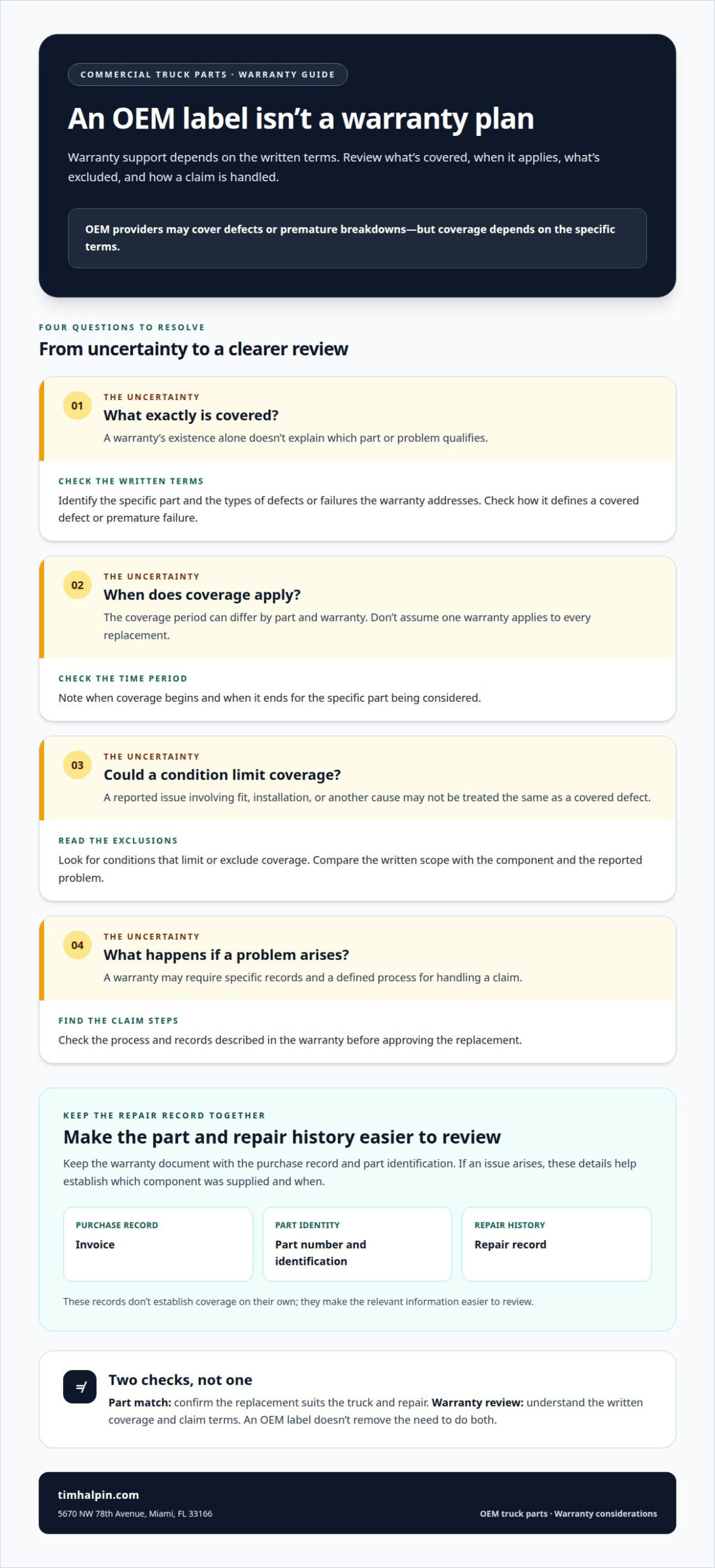
An OEM label and a warranty are separate considerations. OEM part providers may offer warranties covering defects or premature breakdowns, but coverage depends on the written terms. For a fleet manager, the useful question isn’t simply whether a warranty exists. It’s what the document says about the specific part, the covered problem, and the claim process.
Review the warranty information before approving a replacement. Identify the part covered, the coverage period, and any stated exclusions. Then check how the warranty defines a covered defect or premature failure. These details help distinguish a manufacturing issue from concerns about fit, installation, or another cause. Don’t assume that one OEM warranty applies to every part or vehicle.
- Coverage: Identify the part and the types of defects or failures addressed.
- Time period: Note when coverage begins and when it ends.
- Exclusions: Read conditions that limit or exclude coverage.
- Claim steps: Find the records and process described in the warranty.
Keep the warranty document with the purchase record and part identification. If a replacement develops a problem, those details help establish which component was supplied and when. An invoice, part number, and repair record can also clarify the sequence of events. These documents don’t establish coverage on their own, but they make the relevant information easier to review.
Consider the entire repair, not just the warranty headline. For example, when replacing a truck component, distinguish a covered defect from a separate issue involving another system. The written terms explain what the provider addresses. Clear records help connect the part, reported problem, and repair history without assuming every failure qualifies.
A warranty can support peace of mind with OEM truck parts by giving buyers defined terms to review. It doesn’t remove the need to match the part correctly or document what happened if an issue arises. Before choosing, compare the warranty’s scope with the component’s role in the truck and the repair documentation available. That grounds the decision in more than the OEM label alone.
For a replacement tied to an active repair, professional truck repair support can help connect the parts decision with the repair need.
Parts support for commercial vehicle types
Start a parts search with the vehicle’s role and the equipment needing attention. A tow truck, dump truck, and truck fitted with a liftgate may need different parts. The vehicle type helps narrow the search, while the equipment brand and part identification clarify which component is involved.
For a liftgate, identify the manufacturer rather than searching by a general description. Parts are available for Waltco, Maxon, Tommy Gate, Anthony, Thieman, Leyman, and Palfinger liftgates. The brand is a useful starting point, but the specific model and component matter too. Share the equipment details and repair need to focus the search.
Towing equipment calls for the same specific approach. Parts support includes Miller Industries, Century, and Vulcan towing equipment. The truck’s role alone may not identify the right replacement, because the search also needs to account for the equipment installed. Providing the truck information and equipment identification helps avoid assuming every tow truck has the same setup.
For a commercial fleet, organize information by vehicle and equipment instead of grouping requests under a broad label. A useful parts request can include:
- The commercial vehicle type, such as a tow truck or dump truck.
- The equipment manufacturer, such as Waltco or Miller Industries.
- The part identification or description, if available.
- The issue prompting replacement, such as a damaged or malfunctioning component.
These details give a parts specialist a clearer starting point. If identification is incomplete, the vehicle and equipment information can help guide the follow-up questions. The goal is to match the specific application, not merely find a part with a similar description.
Fleet managers can also group needs by equipment family. For example, a Maxon liftgate request belongs in a different parts search from a Vulcan towing equipment request. This distinction helps keep parts records and repair requests organized, especially when a fleet operates several types of commercial vehicles.
Once the vehicle and equipment are identified, consider how the replacement relates to the repair. A liftgate component may call for liftgate service, while towing equipment parts relate to the tow truck’s installed equipment. Matching the request to the right system keeps the parts discussion focused and supports a practical repair plan.
For the clearest results, provide details for one vehicle at a time and name the equipment brand. This gives the parts specialist a focused request, whether it involves Waltco, Palfinger, Miller Industries, Century, or Vulcan equipment. Clear identification makes commercial vehicle parts support more specific and keeps the decision tied to the equipment in service.
OEM parts fit
OEM truck parts are designed for the vehicles they’re intended to fit, making vehicle-specific identification central to replacement selection. A part that resembles the removed component still needs to match the truck and its equipment. Fit depends on the application, not appearance alone.
Start the fit assessment with the truck’s make, model year, trim, and VIN. These details help distinguish configurations that share a model name but use different components. The VIN adds vehicle-specific identification. A parts specialist can use these details alongside the failed part’s identification and repair description to narrow the application.
Next, identify the system receiving the replacement. A liftgate component, for example, belongs to a particular liftgate application, while towing equipment has its own parts requirements. Manufacturer names such as Waltco, Maxon, or Miller Industries help define the search. The brand alone won’t identify every component, so equipment details and part information matter too.
A practical fit review considers several details together:
- The truck’s make, model year, trim, and VIN.
- The equipment manufacturer and system involved.
- The part number or identifying information on the existing component.
- The repair description and the component’s position in the assembly.
Each detail closes a different information gap. A part number can identify a component, for example, while the VIN helps connect it to the vehicle. Equipment identification further narrows the search when the replacement serves an installed liftgate or towing system. A specialist can compare these details before you decide on a part.
Fit also depends on how the replacement connects to the surrounding assembly. A component that doesn’t match its intended application can complicate installation or leave the repair unresolved. For example, identifying a liftgate part only by a general description may not distinguish among equipment configurations. Manufacturer and component details create a more precise starting point.
OEM selection anchors the search to the vehicle brand and intended application, but “OEM” alone doesn’t fully describe the fit. The model year, trim, VIN, and system still guide the match. Don’t assume a replacement intended for one truck configuration suits another just because both have the same model name.
For fleet records, keep vehicle and equipment identifiers together. Pair each truck’s VIN and configuration with its equipment manufacturer and replaced-part information. This gives future parts requests a clearer reference and helps a specialist revisit the same application. A careful match supports an informed replacement decision and makes fit a defined part of the repair discussion.
How can a parts specialist verify that a truck part is genuine OEM?
A parts specialist starts by identifying the truck and component, then compares the part’s manufacturer and application details. OEM parts come from the same brand as the vehicle and match parts originally used for its model year and trim. That makes the vehicle’s identifying information central to the assessment.
A specialist can use the truck’s make, model year, trim, and VIN to define the application. The VIN identifies the specific vehicle, while the model year and trim add context. The part number or other component identification provides another reference. Together, these details are more useful than a broad label such as “fits this truck.”
Next, compare the replacement’s identifying marks and documentation with its stated manufacturer. The name on the part should align with the OEM claim and intended vehicle application. A box or label alone doesn’t prove that the component inside is genuine. Consider the part itself, its identifiers, and the accompanying information.
A practical review can include:
- Matching the truck’s VIN, model year, and trim to the part application.
- Recording the replacement’s part number and manufacturer identification.
- Comparing the part information with the vehicle brand and component being replaced.
- Reviewing purchase documentation alongside the part and its packaging.
These steps can reveal inconsistencies. For example, if a component’s stated manufacturer differs from the vehicle brand, it may be aftermarket rather than OEM. That distinction doesn’t automatically mean poor quality, but the part shouldn’t be described as genuine OEM without supporting identification.
Brand and equipment details matter for commercial trucks, too. A Waltco liftgate component, for example, needs to be assessed against the liftgate application, not just the truck make. The same principle applies to Miller Industries towing equipment. The brand narrows the context, while the specific component and application complete the check.
Specialists should assess identity, fit, and condition separately. A part may carry OEM identification yet still need to be matched to the truck’s application. Likewise, a component that looks correct doesn’t prove its source. Comparing identifiers with vehicle details provides a more reliable basis than appearance alone, especially when an aftermarket part resembles an original.
For fleet records, keep the VIN, part number, manufacturer, and purchase documentation together. If the replacement later raises questions, those details create a traceable reference for review. Get help with commercial truck parts when you need a professional to connect part identification with the vehicle’s repair needs.
Tim Halpin Equipment
Tim Halpin Equipment Corp helps commercial vehicle owners connect parts decisions with the repairs their trucks need. Turn to the team when a suspected part issue affects a truck, liftgate, trailer, or hydraulic system. Matching the component to the vehicle and diagnosing the repair need can clarify the next step, whether the concern is fit, failure, or a wider equipment problem.
Truck Repair, Liftgate Repair, Trailer Repair, and Hydraulic Repair address different needs across a commercial fleet. Share the vehicle or equipment type, affected system, and symptoms or repair concern. That context focuses the discussion on the relevant work instead of a general parts question.
For guidance on a commercial vehicle repair, contact Tim Halpin Equipment Corp.
Make the Next Parts Decision Easier
A commercial fleet can make each replacement a clearer starting point for future maintenance. Keep a record for every vehicle that connects its VIN and equipment details with the part selected and repair performed. This gives your team a consistent reference for recurring needs and keeps parts decisions tied to the right truck. It’s a practical way to build peace of mind with OEM truck parts without treating every repair as an isolated decision. For fleet managers weighing the cost of frequent repairs against updating their fleet, exploring RAM trucks for sale Mount Sterling OH offers access to new commercial vehicles with complete factory warranty coverage.
When a parts question is linked to a repair concern, professional support can bring the details together. Tim Halpin Equipment Corp provides Truck Repair, Liftgate Repair, and Trailer Repair to help commercial vehicle owners address equipment needs. Share the vehicle and issue you’re facing to start a focused conversation about the next step.
Contact Tim Halpin Equipment Corp about parts and move forward with a clear plan for your fleet’s repair needs.
Frequently Asked Questions
OEM vs Aftermarket Semi-Truck Parts: Which is Right for You?
Choose OEM when you want a replacement made by the vehicle’s brand for its intended application. Aftermarket parts can also be suitable, but quality varies by manufacturer. For a semi-truck with a specific fleet role, weigh fit, manufacturer, warranty terms, and the repair need. The right choice depends on the component and how closely it matches the truck’s configuration.
How do OEM truck parts compare with aftermarket parts in quality and fit?
OEM parts are made by the vehicle brand and designed for the intended application. Aftermarket parts come from other manufacturers, and quality varies. An aftermarket component may fit a particular model, but the manufacturer and application still matter. Compare the replacement’s identifying details with the truck and affected system rather than treating every aftermarket part as equivalent.
What warranties come with OEM truck parts?
Some OEM part providers offer warranties for defects or premature breakdowns, but coverage depends on the part’s written terms. Before a fleet purchase, identify the covered component, coverage period, exclusions, and claim process. Keep the purchase documentation and repair records together. These records help clarify which part was installed and what happened if a warranty claim becomes relevant.
Do OEM truck parts improve truck safety and reliability?
OEM parts are designed for their intended vehicle application, which supports a match for that application. That design alone doesn’t prove a part will improve safety or reliability in every repair. The component must suit the truck and be installed as part of a sound repair. Replacing a tow-truck component, for example, requires attention to the equipment it serves.
How much do OEM truck parts cost compared with aftermarket parts?
There’s no single meaningful price comparison for every OEM and aftermarket truck part. The cost depends on the component, vehicle application, manufacturer, and replacement options. Compare the specific parts under consideration, including fit and warranty terms, rather than assuming one category always costs more. For parts Tim Halpin Equipment sells, pricing is provided by quote.
Where can I buy genuine OEM truck parts in the United States?
Tim Halpin Equipment Corp supplies OEM tow truck parts and commercial equipment parts from 5670 NW 78th Avenue, Miami, FL 33166. Its parts offerings include towing equipment from Miller Industries, Century, and Vulcan, along with liftgate parts from manufacturers such as Waltco and Maxon. For a genuine OEM request, identify the equipment brand and part needed so the search can focus on the relevant application.
Will using aftermarket parts void a truck warranty?
An aftermarket part alone doesn’t determine whether a specific warranty claim is covered. The written terms and circumstances of the repair matter. Review the coverage and exclusions, and keep records identifying the installed part and work performed. This gives you a clear basis for understanding how the warranty applies to a particular failure, rather than assuming every aftermarket replacement has the same effect.
How can a parts specialist find the correct OEM parts for my truck’s make, model, and VIN?
A parts specialist can use the truck’s make, model, trim, model year, and VIN to narrow the OEM application. The component’s part number, equipment manufacturer, and repair description add useful context. For example, a Waltco liftgate request should identify the liftgate system as well as the truck. Providing these details together focuses the search on the right vehicle and equipment.