

What if an accessory that looks right is the wrong fit for your truck? When comparing flatbed truck accessories miami buyers can find, the real test is whether each item suits the truck and flatbed configuration, supports the work, and fits South Florida conditions. A mismatch can mean extra installation work and avoidable downtime.
It’s reasonable to want equipment that makes daily jobs safer and more efficient while still wondering which options are essential and which can wait. This guide explains how to compare practical accessory categories, check fitment, and identify installation questions to settle before you buy. It also flags where requirements may apply, so you can confirm details with current official sources rather than guess.
We’ll cover how to match accessories to cargo and routine tasks, what truck information to gather before requesting a quote, and how to plan for installation. Tim Halpin Equipment Corp is a family-owned Miami truck equipment business serving South Florida since 1987. Its confirmed offerings include Weather Guard truck toolboxes, service, utility, and platform bodies, and installation services. Flatbed-specific inventory and installation capability aren’t confirmed, so check availability and fitment directly before making plans.
Key Takeaways
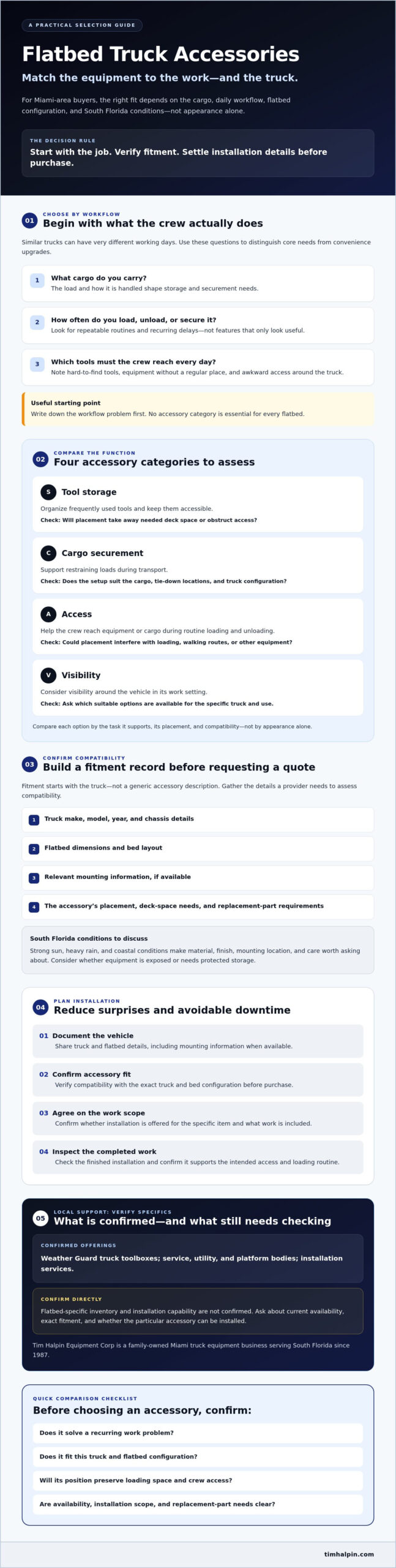
- Start with the cargo, jobsite routine, loading frequency, and crew needs to decide which accessory functions matter most.
- Compare storage, securement, access, and visibility options by the task they support, not by appearance alone.
- For flatbed truck accessories Miami buyers are considering, verify the exact truck and bed configuration, mounting approach, and replacement-part needs before purchase.
- Reduce installation surprises by documenting the vehicle, confirming accessory fit, agreeing on the work scope, and inspecting the completed work.
- Ask local equipment providers to confirm current flatbed-specific availability and whether they can install the particular accessory you need.
Flatbed Truck Accessories in Miami: Start With the Work
Choosing a truck-ready setup can feel less straightforward than it should. There are many accessory functions to consider, but not every option will solve a problem your crew actually faces. For flatbed truck accessories miami buyers are weighing, start with the work: the cargo, the jobsite routine, and how people load, secure, and access equipment throughout the day.
A flatbed truck carries loads on an open platform, so the right setup depends on what goes on that platform and how it’s handled. A contractor moving materials may prioritize access to frequently used tools. A delivery operation may focus on repeatable loading and unloading. Utility crews may have different needs based on the equipment they carry, while a fleet manager may also consider consistency across vehicles and maintenance planning. Similar trucks can have very different working days.
Which jobs influence a flatbed accessory setup?
Ask three practical questions: What cargo do you carry? How often do you secure or unload it? Which tools do crew members need to reach every day? The answers help separate core needs, such as organizing essential tools or supporting routine cargo securement, from convenience upgrades that may save steps but aren’t necessary for every operation.
Before shopping, note recurring frustrations. Are tools difficult to locate? Does loading take longer because equipment has no regular place? Do crew members need to move around the truck to reach items? A short list of these workflow problems gives a supplier a clearer starting point than a general request for “more accessories.” No category is essential for every flatbed. Its value depends on the job it supports.
What should Miami buyers assess before shopping?
Fitment starts with the truck, not a generic accessory description. Record the make, model, year, chassis details, and flatbed dimensions before requesting advice. Keep the bed layout and relevant mounting information handy too, if available. These details help a provider assess compatibility instead of relying on appearance or assumptions about interchangeability.
Then consider local exposure and placement. Miami’s strong sun, heavy rain, and coastal conditions are reasons to ask how a material, finish, or mounting location is expected to hold up, and what care it may need. Consider whether equipment will sit exposed on the bed or needs protected storage, and whether its position could interfere with loading or crew access.
Accessory selection begins with the truck configuration and its daily work. Get those details clear first. You’ll be better prepared to compare options, identify genuine needs, and ask focused questions about fit and suitability.
Flatbed Accessory Categories: Match Storage, Securement, and Visibility to the Job
Once you understand the work, compare accessories by the job they do, not by how a setup looks. Storage, cargo securement, access, and visibility are useful categories to evaluate, but none is automatically right for every truck. For flatbed truck accessories miami buyers are considering, fit, placement, and local working conditions matter as much as the accessory’s function.
| Category | Work problem addressed | Fitment questions | Availability to confirm |
|---|---|---|---|
| Tool storage | Keeping frequently used tools organized and accessible. | Where can storage sit without taking away needed deck space or obstructing access? | Tim Halpin Equipment Corp lists Weather Guard truck toolboxes. Confirm current stock and compatibility with your flatbed. |
| Cargo securement | Keeping loads restrained during transport. | Does the setup suit the cargo, tie-down locations, and truck configuration? | Ask which suitable options are available and whether installation is offered for the specific item. |
| Access | Helping the crew reach equipment or cargo during routine loading and unloading. | Will placement interfere with loading, walking routes, or other equipment? | Confirm the accessory’s fit and installation scope before purchase. |
| Visibility | Supporting visibility around the vehicle in its work setting. | Where will equipment be mounted, and could cargo or other components block it? | Verify product availability and any requirements that apply to the vehicle and intended use. |
How do storage and access accessories support daily work?
Storage can help when crews repeatedly need the same tools, but a box’s position matters as much as its presence. Consider what must stay on the deck, what needs to be reached quickly, and whether the proposed placement preserves workable loading space. Weather Guard truck toolboxes are a confirmed Tim Halpin Equipment Corp offering. Check flatbed compatibility and current availability for the specific truck and bed.
When should buyers consider securement or visibility equipment?
Securement needs depend on the cargo and how it’s carried. Review the Federal cargo securement rules and confirm which requirements apply to your operation with the relevant authority. Visibility needs also vary by vehicle and work setting. Don’t assume an accessory meets applicable requirements based on appearance alone. Verify the relevant rules before selecting or installing it.
Tim Halpin Equipment Corp is a family-owned Miami truck equipment business serving South Florida since 1987. Its listed offerings include truck toolboxes, bodies, and installation services, but flatbed-specific inventory and installation capability aren’t established. You can ask about truck equipment options and confirm whether the particular accessory and fitment you need are available.
How to Compare Flatbed Truck Accessories for Fit, Durability, and Compatibility
Two accessories can look similar yet attach differently or take up different amounts of bed space. For flatbed truck accessories miami buyers, appearance and broad “fits most” descriptions aren’t enough. Confirm compatibility with the exact truck and flatbed, then compare how the accessory will be mounted, maintained, and used during the workday.
What fitment details should you confirm before ordering?
Give the equipment supplier the truck’s make, model, year, chassis details, and flatbed dimensions. Be ready to share the bed layout and information about existing equipment or mounting points. Ask the supplier to check dimensions, clearance, mounting approach, and whether the accessory could interfere with loading, access, or other installed components.
Also ask whether the proposed equipment adds weight and whether that matters for your specific vehicle and setup. Don’t assume an accessory will interchange just because it resembles one you’ve seen on another truck. Request written confirmation of compatibility, including any conditions or limitations, before placing an order. If cargo securement is involved, check the Federal cargo securement regulations and confirm which requirements apply to your vehicle and operation.
How should you assess durability and maintenance?
Miami-area trucks may work in strong sun, heavy rain, and coastal exposure. Ask the supplier how the specific material and finish are suited to those conditions, and what cleaning or inspection the manufacturer recommends. Avoid relying on broad claims about corrosion resistance or service life without product-specific information.
Think beyond installation. Frequent loading, road exposure, and outdoor storage can affect how often a component needs attention. Ask how to inspect the mounting points, what maintenance is expected, and whether replacement components are available for the item. A setup that’s simple to access and service may better support a busy work routine than one chosen mainly for appearance.
- Fitment: Does the accessory match the truck, chassis, and flatbed dimensions?
- Function: Does it address a defined job need without disrupting loading or access?
- Mounting: Are the attachment points and clearance suitable for this setup?
- Maintenance: What inspection, cleaning, or upkeep should be planned?
- Availability: Are the specific item and any replacement components available?
Before ordering, confirm fitment, function, mounting, maintenance, and availability in writing. That check helps turn a promising accessory into a practical choice for the truck you operate.
Flatbed Accessory Installation in Miami: Plan Fitment, Safety, and Downtime
Planning before the truck reaches the shop can help prevent avoidable delays. For flatbed truck accessories in Miami, confirm not only whether an item appears to fit, but whether the shop supports your specific truck, flatbed, accessory, and mounting requirements. Verify flatbed-specific installation capability and availability directly rather than assuming.
What should a Miami installation conversation cover?
Start with the vehicle’s make, model, year, chassis details, flatbed dimensions, and photos of the bed and existing equipment. Explain how the truck is used and identify any operating deadline. Ask what information the shop needs to assess the work, whether it can handle the specific installation, and what the proposed scope includes. Structural mounting or vehicle wiring should be assessed by qualified professionals when applicable.
Clarify who supplies the accessory and parts, which labor is included, and whether additional work may be needed. Discuss how the setup will be used in South Florida, including exposure to sun and rain, and ask what upkeep the manufacturer recommends. For broader planning considerations, see this commercial truck upfitting guide.
How can you reduce installation surprises and downtime?
Share the truck details, photos, existing equipment, accessory information, and operational deadline early. Then confirm parts availability and installation capability for that exact setup. Ask how scheduling works and what might affect the planned work. Don’t rely on a general estimate of installation time before the shop has reviewed the vehicle and scope.
Tim Halpin Equipment Corp offers installation services and serves Miami-area truck equipment needs, but its flatbed-specific installation capabilities and accessory inventory aren’t established. Contact the equipment team to ask whether it supports the specific accessory and fitment you’re considering.
Before authorizing work, agree on the scope and how the completed installation will be checked. Make sure the inspection considers the accessory’s mounting and any relevant wiring or clearance concerns. Verify fitment, scope, parts, schedule, and post-installation inspection before committing the truck. A clear plan helps you manage downtime without assuming availability or a timeline.
Find Flatbed Truck Equipment Support in Miami and Confirm Your Next Step
A sound buying decision follows a simple sequence: define the work, identify the accessory function you need, verify fit with the exact truck and flatbed, then plan installation. This keeps the conversation focused on solving a real workday problem, not adding equipment that may not suit the vehicle.
Tim Halpin Equipment Corp is a family-owned Miami truck equipment business serving customers since 1987. Confirmed relevant offerings include Weather Guard truck toolboxes, service, utility, and platform bodies, and installation services. These are useful starting points, but the company’s flatbed-specific stock and installation capabilities aren’t established. Confirm whether the particular accessory fits your setup and whether the company can support its installation before making plans.
What can buyers discuss with Tim Halpin Equipment Corp?
Bring your equipment goals and ask about confirmed offerings that may be relevant to the project. You can also ask whether the team can review your truck and flatbed details, what information it needs to assess fitment, and whether the proposed installation falls within its capabilities. Be specific about the accessory and mounting needs. General experience with truck equipment shouldn’t be taken as confirmation of flatbed-specific support.
For background on the local business, read about the South Florida truck equipment company background.
What information should you have ready when you reach out?
A prepared inquiry can make it easier to establish the right next step. Gather the truck’s year, make, model, and chassis details, along with flatbed measurements and clear photos of the bed, mounting areas, and existing equipment. Describe the work the truck performs, the cargo it carries, what you want the accessory to improve, and the conditions the setup will face.
If you have a preferred installation timeframe, share it as a planning consideration, not an assumed appointment or promised turnaround. Ask directly about current product availability, compatibility, who supplies the parts, and whether installation is supported for that specific setup. Clear answers help you plan without relying on assumptions.
For flatbed truck accessories miami buyers, the next step can be a straightforward conversation about the truck configuration and intended use. Discuss your truck equipment needs and confirm product availability and service fit before moving forward.
Make Your Next Flatbed Equipment Decision With Confidence
The right setup starts with the work your truck does. Identify the accessory functions that solve real daily needs, then verify compatibility with your truck and flatbed before ordering. For flatbed truck accessories miami buyers are considering, confirm installation scope, parts availability, and any requirements that apply to the intended use.
Tim Halpin Equipment Corp is a family-owned Miami truck equipment business serving customers since 1987, with confirmed truck equipment sales and installation services. Specific flatbed accessory stock and installation capabilities aren’t established, so ask about your exact configuration and project before making plans.
Have your truck details, flatbed measurements, photos, and accessory goals ready. Discuss your truck equipment needs with our Miami team and confirm a practical next step for your vehicle.
A clear fitment check and thoughtful installation plan can help you choose equipment with confidence. Start with your work, ask focused questions, and move forward at a pace that suits your operation.
Frequently Asked Questions
What accessories are commonly used on a flatbed truck?
Common accessory categories include tool storage, cargo securement equipment, access aids, and visibility equipment. The right combination depends on the cargo, loading routine, crew needs, and where the truck operates. A contractor who reaches for the same tools throughout the day may prioritize accessible storage, while another operation may focus on securing different loads. Treat these as options to assess, not a standard package for every flatbed.
How do I know whether a flatbed accessory will fit my truck?
Confirm compatibility using your truck’s make, model, year, chassis details, and flatbed measurements. Ask the supplier to review mounting points, dimensions, clearance, added weight, and possible interference with existing equipment. Don’t rely on a generic fit description or visual similarity to another truck. Request written confirmation for your specific configuration, and check whether the accessory’s placement still allows the truck to perform its regular loading and work tasks.
Can I install flatbed truck accessories myself?
It depends on the accessory and the work involved. Some simple additions may be suitable for an experienced owner, but structural mounting or vehicle wiring should be assessed by qualified professionals when applicable. Before starting, review the manufacturer’s installation instructions and confirm whether the work could affect fit, safe operation, or applicable requirements. If you’re unsure about the mounting or electrical scope, discuss the specific job with a qualified installer first.
Which flatbed accessories are useful for contractors?
Contractors often assess tool storage, cargo securement, and access based on the materials and equipment they carry. Start by listing the tools crews use daily, how often cargo is secured, and where loading or unloading causes friction. A toolbox may help organize frequently used tools if it fits the truck and preserves needed deck space. There’s no universal contractor setup, so prioritize accessories that address recurring workflow problems.
How much do flatbed truck accessories and installation cost in Miami?
Costs vary with the accessory, truck and flatbed configuration, parts required, and installation scope. There isn’t enough confirmed pricing information here to provide a reliable Miami estimate. Request a project-specific quote and ask what parts and labor are included, whether additional work may be needed, and whether the quoted item is compatible with your setup. Confirm current availability and scheduling directly before planning around installation or vehicle downtime.
Are flatbed accessories affected by Miami weather?
Miami’s heat, heavy rain, and coastal exposure are practical factors to discuss when comparing accessory materials, finishes, and placement. Ask the supplier or manufacturer about care, cleaning, and inspection recommendations for the specific item and your work conditions. Avoid assuming that a material or finish will resist corrosion or last a particular length of time without product-specific evidence. Outdoor storage and regular road exposure may also shape maintenance needs.
Does Tim Halpin Equipment Corp sell flatbed truck accessories in Miami?
Tim Halpin Equipment Corp sells truck equipment, including Weather Guard truck toolboxes, and offers installation services, but its specific flatbed accessory inventory and flatbed installation capabilities aren’t confirmed. For flatbed truck accessories in Miami, contact the family-owned Miami business, serving South Florida since 1987, with your truck and bed details. Ask whether the accessory you need is available, compatible with your configuration, and supported by installation services for that particular application.
