

The biggest toolbox on the truck can be the wrong choice for the fleet. Fleet toolboxes need to keep tools secure and easy to find without wasting bed space or interfering with how each vehicle is used. A box that suits one truck or crew may not work for another.
Crews need quick access to the right tools, while fleet managers need a consistent way to organize and track equipment across different vehicle layouts. The answer isn’t always to install the same box everywhere. Match storage to the truck type, crew role, tools carried, and the way the vehicle is loaded and used.
This guide explains how to compare common toolbox types, check fit and placement, and plan a storage system across your fleet. Tim Halpin Equipment Corp is a family-owned, Miami-based truck-equipment business established in 1987. It offers Weather Guard truck toolboxes and installation services for South Florida customers. Before making a fleet-wide decision, confirm product fitment and installation scope for each vehicle.
Key Takeaways
- Use clear storage locations and assignment practices to make tools easier to locate and track between jobs.
- Compare fleet toolboxes by placement, bed access, tools carried, and vehicle configuration before choosing a format.
- Decide where shared layouts make sense and where crew-specific storage better serves the work.
- Build a vehicle-by-vehicle inventory that records truck make, model, bed or body type, crew role, and storage needs.
- Before selecting an installation partner, confirm product fit, specifications, installation scope, and how fitment questions will be handled.
Why Fleet Toolboxes Matter for Daily Work and Tool Accountability
A wrench buried under loose parts or a tool left in another truck can delay a crew and complicate the next handoff. Scattered, hidden, or inconsistently assigned equipment makes it harder to tell what’s available and where it belongs. A planned storage setup gives tools designated locations and makes missing items easier to notice, without promising a specific productivity gain.
A single work truck can be organized around one crew’s routine. A fleet has a broader challenge: vehicles may have different beds or bodies, and crews may carry different equipment for different jobs. The aim isn’t necessarily identical boxes on every vehicle. It’s a practical system that combines shared organization principles with storage suited to each truck’s role.
What a fleet toolbox needs to solve
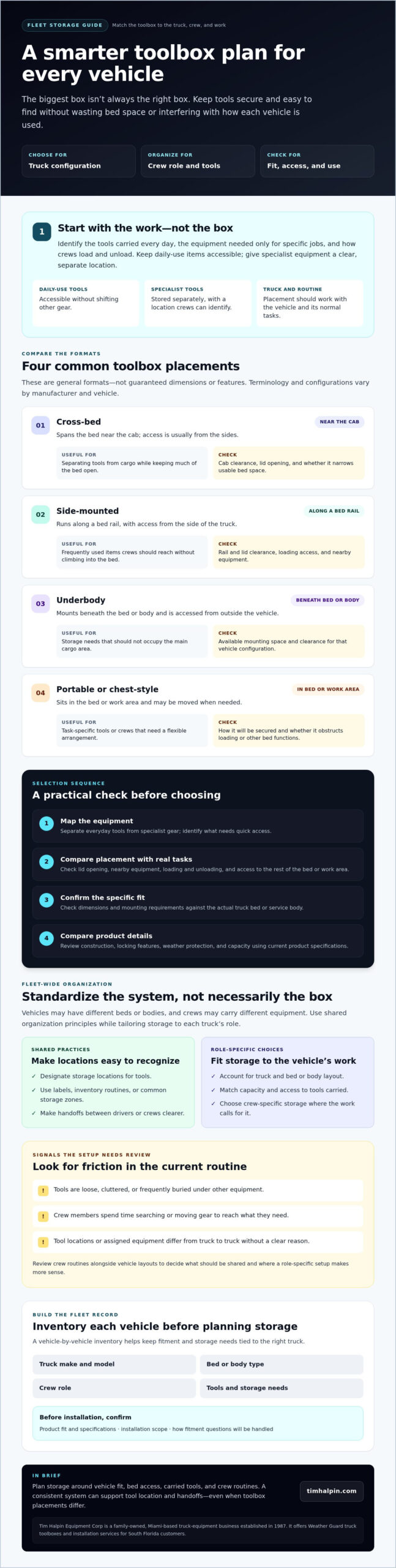
Start with the work. Which tools travel every day, and which are only needed for particular jobs? Keep daily-use items accessible without shifting other gear. Store specialist equipment separately and make its location clear. Then consider protection, access, capacity, and how the box will use space on that specific truck. Toolbox formats and materials vary, so a Toolbox types and materials overview can help frame the options. Check actual vehicle fit and product features before selecting a box.
Placement matters as much as capacity. A box that blocks routine bed access or takes space needed for work equipment may create a new problem. Compare the proposed location with the crew’s normal loading and unloading habits, including access to other equipment.
How organized storage supports fleet operations
Designated locations give crews a simple reference point: if an item isn’t where it belongs, it’s easier to notice and follow up. A consistent arrangement can also make handoffs between drivers or crews clearer, even when vehicles need different toolbox placements. The useful standard may be labels, inventory routines, or common storage zones rather than identical equipment on every truck.
Organization only works if crews use the system and the storage fits the vehicle. Before changing boxes, look for signs the current setup needs review:
- Tools are loose, cluttered, or frequently buried under other equipment.
- Crew members spend time searching or moving gear to reach what they need.
- Tool locations or assigned equipment differ from truck to truck without a clear reason.
These patterns can point to a mismatch between storage and daily work. Review crew routines alongside vehicle layouts to identify what should be standardized and where a role-specific setup makes more sense.
Fleet Toolbox Types and Features: Match Storage to the Truck
The right format depends on what the truck carries and how the crew needs to reach it. A box that provides useful capacity on a pickup may take up valuable space or conflict with equipment on a service body. Compare placement with daily tasks before standardizing a setup across vehicles.
| Format | Placement and access | Useful for | Vehicle considerations |
|---|---|---|---|
| Cross-bed | Spans the bed near the cab; access is usually from the sides. | Tools crews want separated from cargo while keeping much of the bed open. | Check cab clearance, lid opening, and whether the box narrows usable bed space. |
| Side-mounted | Runs along a bed rail, with access from the side of the truck. | Frequently used items that should be reachable without climbing into the bed. | Check rail and lid clearance, loading access, and nearby equipment. |
| Underbody | Mounts beneath the bed or body, accessed from outside the vehicle. | Storage needs that shouldn’t occupy the main cargo area. | Confirm available mounting space and clearance with the vehicle configuration. |
| Portable or chest-style | Sits in the bed or work area and may be moved when needed. | Tools for specific tasks or crews that need a flexible arrangement. | Consider how it will be secured and whether it obstructs loading or other bed functions. |
Compare placement and access
These names describe general formats, not guaranteed dimensions or features. Terminology and configurations vary by manufacturer and vehicle. Before choosing, check whether lids can open fully, whether nearby equipment blocks access, and how crews load and unload the truck during a typical shift. A format that looks convenient on paper may be awkward alongside existing gear.
Check fit, materials, security, and capacity
Confirm dimensions and mounting requirements against the specific truck bed or service body. Compare construction, locking features, weather protection, and capacity using current product specifications. In South Florida, account for exposure to sun, rain, and humidity, but don’t assume a general weather-resistant label guarantees suitability for local conditions. Verify the claim for the specific product. For construction vehicles, consult the applicable scope of the OSHA motor vehicle standard; it doesn’t replace checking fitment or cargo security.
Weather Guard truck toolboxes are an offering from Tim Halpin Equipment Corp. Check current models, specifications, and vehicle fitment before selecting one for a fleet. Buyers can review Weather Guard truck toolbox and installation services and confirm the fit and installation scope for their vehicles.
Standardized or Role-Based Fleet Toolboxes: Which Layout Fits?
Choosing one layout for every vehicle can make a fleet easier to learn, but identical storage isn’t always practical. A pickup, service body, and specialized work truck may have different space and equipment needs. A useful approach is to standardize how crews organize and identify tools, then adapt the storage itself to each vehicle and role.
Before settling on a layout, make a simple inventory of:
- Truck types and bed or body configurations
- Crew roles and the work each vehicle supports
- Frequently used shared tools and role-specific equipment
This gives you a basis for deciding what should stay consistent and what needs to vary. A familiar system can support onboarding and handoffs, but it doesn’t guarantee faster work or lower costs.
When consistent layouts make sense
Shared layouts are a good fit when vehicles are similarly configured, duties overlap, or drivers and crews regularly switch trucks. Keeping common tools in familiar locations can make it easier to learn a vehicle and check its contents during a handoff. Consistency can apply to labels, inventory practices, or storage zones, even if the toolbox format differs. Confirm fit for each vehicle rather than assuming one arrangement transfers unchanged.
When role-based storage is the better fit
Distinct trades or service responsibilities often call for different equipment. A truck assigned to one kind of job may need tools that another crew rarely carries. Keep core items in predictable locations where possible, then tailor specialist storage to the role. Document what each vehicle carries and note layout differences so crews know where to look before a job begins.
A practical fleet plan can combine both approaches:
- Set shared principles: Use consistent labels or inventory routines across vehicles.
- Group vehicles by role: Define a suitable storage arrangement for each crew or task type.
- Record exceptions: Note vehicle-specific layouts and any specialist equipment.
This balance is especially useful in mixed fleets. The goal for fleet toolboxes isn’t uniformity for its own sake. It’s a clear, documented system that helps crews understand what belongs on each truck while allowing the storage to suit the vehicle and its work.
Plan Fleet Toolbox Selection, Fitment, and Installation
Before choosing fleet toolboxes, prepare a vehicle-by-vehicle record. A fit that works for one truck may not suit another, especially when bed styles, existing equipment, or crew duties differ. Clear details help narrow the options and make fitment discussions more useful.
Prepare the information needed for a fitment decision
For each vehicle, record its make, model, bed or body type, crew role, and intended toolbox location. Add measurements and notes about existing equipment, then list tools and supplies by size, frequency of use, and security needs. Mark which trucks share a layout and which need role-specific storage.
- Inventory the fleet. Group vehicles by configuration and work role, noting differences that could affect storage.
- List what each crew carries. Separate daily-use tools from specialist equipment, and note items that need secure storage.
- Identify the preferred location. Consider how crews access the box and whether it could interfere with regular loading or vehicle functions.
- Confirm fitment details. Review dimensions, mounting requirements, clearance, payload considerations, and nearby equipment with qualified professionals.
- Agree on installation scope and scheduling. Confirm vehicle-specific requirements and the work involved before arranging installation.
Don’t assume a measurement alone confirms fit. Lid clearance, mounting points, payload limits, access to existing equipment, and effects on other vehicle functions all deserve a vehicle-specific review. Installation scope can vary with the truck and its configuration, so confirm the details rather than relying on a general estimate or assumed timeline.
Coordinate installation with broader truck upfitting
A toolbox is part of the vehicle’s working setup. Consider its location alongside other equipment, wiring, access needs, and the way the truck is used. Planning these elements together can help identify conflicts before work is scheduled. For a broader view of how equipment choices fit into vehicle planning, read the commercial truck upfitting guide.
Tim Halpin Equipment Corp is a family-owned Miami truck-equipment and upfitting business established in 1987, with toolbox installation services available. Before scheduling, confirm product fitment and installation scope for each vehicle. To discuss fleet toolbox fitment and installation, prepare your vehicle details and storage requirements for review.
Choose a Fleet Toolbox Partner and Take the Next Step
A sound fleet toolbox decision depends on more than choosing a box. Your partner should explain how product fit will be checked, which specifications are confirmed, and what installation work is included. Clear answers help you compare options without assuming that one configuration suits every truck.
Questions to ask before committing to a fleet setup
Use these questions to clarify the details before approving a setup:
- How will fit be confirmed? Ask how the product will be checked against each truck’s make, model, bed, or service-body configuration.
- Which specifications apply? Request the relevant dimensions, mounting requirements, capacity, locking details, and any weather-protection claims for the specific option under consideration.
- What does installation include? Clarify the installation scope and whether the vehicle needs preparation before the work is scheduled.
- How will differences be handled? Discuss how role-specific layouts can be documented and how future fleet additions with different configurations can be assessed.
- How will updates be communicated? Confirm what information is needed, how fitment questions will be addressed, and what details remain to be verified.
A helpful partner won’t treat an unverified specification as a confirmed fit. For fleet toolboxes, product options, mounting needs, and installation scope should be checked against the actual vehicles.
Discuss your fleet toolbox needs with a local equipment team
Tim Halpin Equipment Corp is a family-owned, Miami-based truck-equipment and upfitting business established in 1987. The company offers Weather Guard truck toolboxes and installation services. Confirm current product options, vehicle fitment, and installation scope for your fleet rather than assuming they will suit every truck.
Before starting the conversation, gather your fleet size, truck types, work roles, and a basic list of tools each crew needs to carry. Include differences between beds or service bodies, existing equipment, and storage priorities. For broader context on planning truck equipment, see the Weather Guard toolbox installation guide.
Have questions about fitment or installation? Discuss toolbox options and installation for your fleet with Tim Halpin Equipment Corp.
Build a Storage Plan That Works Across Your Fleet
The right fleet toolboxes fit the vehicles and the work, not just a preferred layout. Compare placement and access with each truck’s configuration, then decide which storage principles should stay consistent and where crews need role-specific setups. Before moving ahead, confirm product specifications, fitment, and installation scope for each vehicle.
For South Florida fleets, Tim Halpin Equipment Corp offers Weather Guard truck toolboxes and installation services. The Miami-based, family-owned truck-equipment and upfitting business has operated since 1987. Confirm current product options and fit for your trucks.
Start with your vehicle list, crew roles, and basic tool requirements. When you’re ready to discuss practical options, contact Tim Halpin Equipment Corp about toolbox options and installation for your fleet. A clear plan can help crews know what each truck carries and where to find it.
Frequently Asked Questions
What should I look for in a fleet toolbox?
Start with the truck’s bed or body configuration, the tools crews carry, and how often they need access. Compare fit, usable storage, locking, weather protection, and compatibility with other equipment. For South Florida fleets, consider local exposure and verify weather-protection claims for the specific product. Also decide whether common layouts or role-based setups fit your operation. Confirm specifications and fitment for each vehicle before choosing.
Are standardized toolbox layouts better for fleets?
Standardized layouts can make tool locations familiar across similar vehicles and support clearer crew handoffs. They aren’t automatically right for every fleet, though. Trucks with different bodies, equipment, or job roles may need tailored storage. A practical compromise is to keep frequently shared tools in consistent locations while adapting specialist compartments to the vehicle’s work. Check fit for each truck, even when the intended layout is shared.
How do I choose a toolbox for different truck types?
List each vehicle’s make, model, bed or body configuration, existing equipment, and proposed toolbox location. Compare those details with verified product dimensions and mounting requirements. Don’t assume a box that fits one truck will fit another, even if the vehicles appear similar. Check clearance, access, and installation needs with a qualified professional before ordering or scheduling work. This vehicle-by-vehicle review is useful for mixed fleets operating across South Florida.
Can one toolbox layout work for every fleet vehicle?
It can, particularly when vehicles have similar configurations and perform similar jobs. In a mixed fleet, one identical setup may use space poorly or fail to suit specialist tools. Keep shared tools in predictable locations where practical, then tailor other storage to each truck and crew. Document the differences so users know what each vehicle carries. The goal is a clear system, not identical boxes for their own sake.
What information should I have before requesting a fleet toolbox recommendation?
Gather your fleet size, truck types, bed or body styles, work roles, and a basic list of tools or supplies. Include existing equipment, intended toolbox locations, and any access or security concerns. Photos and measurements may help, but ask what details are needed to assess fitment. A clear vehicle and tool inventory gives an equipment provider a useful starting point for discussing suitable configurations for your South Florida operation.
Should fleet toolboxes be professionally installed?
Installation needs depend on the toolbox, vehicle, mounting method, and equipment already fitted. A qualified installer can help review fitment and how the toolbox relates to the truck’s configuration. Ask what work is included, whether vehicle-specific preparation is needed, and how scheduling will be handled. Tim Halpin Equipment Corp offers installation services in South Florida; confirm the details and scope for your vehicles before arranging the work.
Are Weather Guard truck toolboxes available for fleet use?
Weather Guard truck toolboxes are among Tim Halpin Equipment Corp’s offerings, but current product options and availability should be checked directly. The appropriate choice depends on each vehicle’s configuration, storage needs, and verified product specifications. Ask the company to confirm fitment and installation scope for your fleet. Don’t assume a particular model or configuration is available, or that a general description establishes fit for every truck.
