

The lowest fleet-upfit quote can be the wrong choice if it leaves equipment, installation details, or timing out of the comparison. The best practices for fleet vehicle upfitting start with matching each vehicle to its job, then comparing quotes that cover equivalent specifications and product quality.
It’s understandable to focus on the bottom line when several vehicles need to get on the road. But a useful comparison looks beyond the initial figure: equipment must suit the work, fit the vehicle’s payload and operating needs, and come with clearly defined installation work. A quote is meaningful only when you can see what it includes.
This guide explains how to define fleet requirements, select efficiency-focused equipment, and plan ordering and upfit timing. It also covers how to compare detailed quotes, assess product quality, and weigh trade-offs such as coordinating work across vendors or keeping it together. With a clear scope and a like-for-like review, you can make a steadier decision for your fleet.
Key Takeaways
- Define each vehicle’s essential job requirements before choosing equipment or finalizing the upfit scope.
- Prioritize equipment that supports driver efficiency while accounting for payload, safety, and the vehicle’s intended use.
- Plan vehicle orders and upfit timing early so delivery schedules align with operational needs.
- Compare quotes on equivalent specifications, included work, product quality, and timing, not just the bottom line.
- Consider how repairs to trucks, liftgates, trailers, or hydraulic systems fit into keeping upfitted vehicles ready for work.
How a professional upfitter reviews fleet requirements and prepares clear quotes
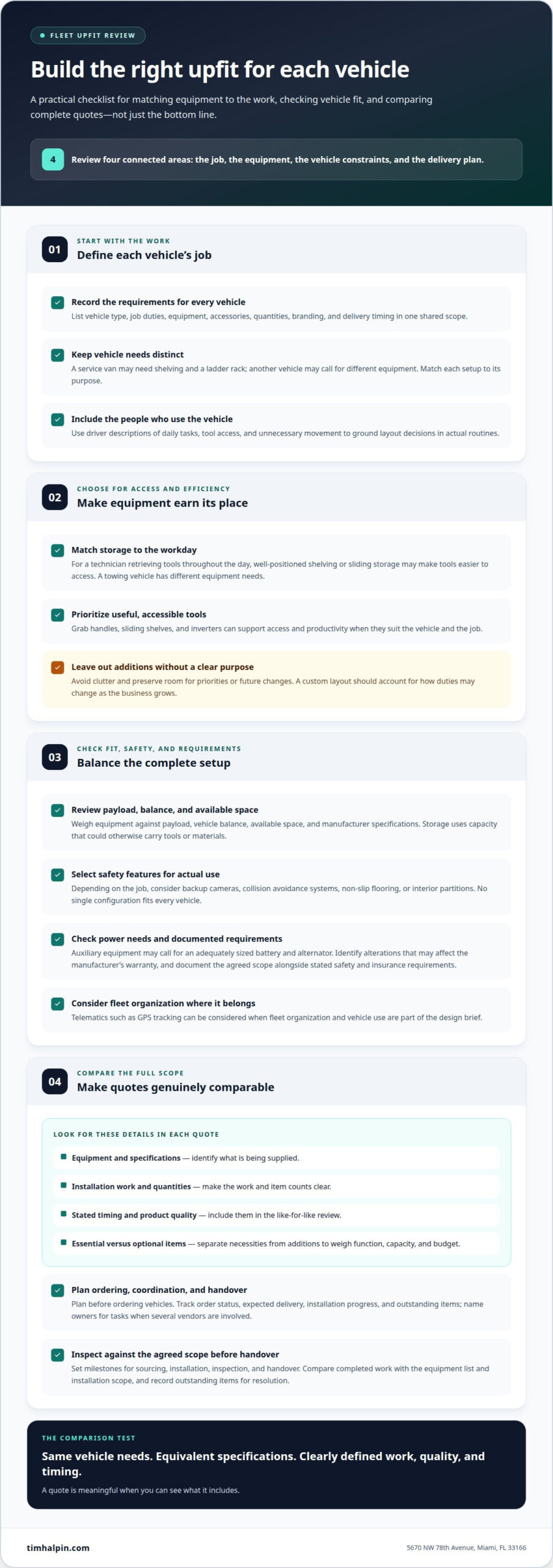
A professional upfitter starts by defining what each vehicle must do. The review covers vehicle type, job duties, equipment, accessories, quantities, branding, and delivery timing. For example, a service van may need shelving and a ladder rack, while another vehicle needs different equipment. Recording these decisions in one scope gives fleet managers and vendors a shared reference, reducing missed details and repeated administrative follow-up.
Next, translate the scope into a detailed quote. It should identify the equipment, installation work, quantities, and any stated timing so the fleet can compare equivalent specifications. A quote listing only broad categories makes it difficult to tell whether proposals cover the same work. Clear line items also help separate essential equipment from optional additions and balance function, vehicle capacity, and budget.
Vendor coordination can simplify sourcing and installation. Instead of requiring fleet staff to track every equipment supplier separately, the upfitter can coordinate product orders, installation responsibilities, and project updates. That approach can reduce administrative handoffs. An experienced upfitter also considers whether vendors can supply the required equipment reliably and communicate changes that could affect the build schedule.
Supply planning matters because a vehicle build depends on both the vehicle and its equipment. The upfitter can match each requirement to a suitable vendor, then track order status, expected delivery, installation progress, and outstanding items. A shared order record helps reveal whether a delay involves a vehicle, a component, or a scheduling handoff. Where several vendors are involved, named owners for each task make responsibility clearer.
How does a professional upfitter manage installation, quality inspections, and handover? The upfitter sets milestones for sourcing, installation, inspection, and handover, then monitors progress at each stage. Before handover, review the completed work against the agreed equipment list and installation scope, and record any outstanding items for resolution.
Warranty considerations also belong in the planning discussion. Before work begins, identify vehicle alterations that may affect the manufacturer’s warranty. Keep agreed changes visible in the quote and project record, rather than leaving fleet staff to reconcile separate vendor notes later. Tracking approvals and build status in one place gives managers a clearer view of what is ordered, installed, and ready for handover.
How a professional upfitter selects equipment to improve driver efficiency
An efficient equipment plan begins with the work each vehicle performs. A professional upfitter considers job duties, driver routines, vehicle configuration, and the equipment already carried. A technician who retrieves tools throughout the day may benefit from well-positioned shelving or sliding storage. A towing vehicle has different needs, including equipment suited to its towing role. Matching each choice to the vehicle’s purpose helps avoid clutter and keeps useful tools accessible.
Every addition also affects the vehicle. Weigh equipment against payload, balance, available space, and the vehicle manufacturer’s specifications. A heavy storage system, for example, uses capacity that could otherwise carry tools or materials. Reviewing the full load helps keep the arrangement practical instead of filling the vehicle with accessories that compete for space. Omit equipment without a clear job-related purpose, leaving room for priorities or future changes.
Driver input makes that review more grounded. A professional can use drivers’ descriptions of daily tasks to assess where tools are stored, how often they’re accessed, and what creates unnecessary movement. Grab handles, sliding shelves, and inverters can support access and productivity when they suit the vehicle and work. The upfitter can also consider how duties may change as the business grows, so a custom layout doesn’t solve only today’s needs.
Safety choices should reflect actual use, not a generic package. Depending on the job, a professional may consider backup cameras, collision avoidance systems, non-slip flooring, or interior partitions. The upfitter evaluates where each feature fits and whether auxiliary equipment calls for an adequately sized battery and alternator. Telematics, such as GPS tracking, can also be considered when fleet organization and vehicle use are part of the design brief.
How can a professional upfitter help address warranties, safety standards, and insurance requirements? Identify vehicle alterations that may affect the manufacturer’s warranty and document the agreed scope. Equipment selection can reflect the fleet’s stated safety and insurance requirements, without treating one configuration as suitable for every vehicle. Fleets reviewing their coverage alongside new equipment upgrades can consult SMI Insurance Agency to ensure commercial vehicle policies match updated asset values.
What common fleet upfitting risks can a professional help prevent? A careful design review can reduce the risk of choosing equipment that doesn’t suit job duties, uses needed payload, disrupts balance, or leaves essential tools difficult to reach. It can also flag unnecessary additions and potential power-system needs before installation.
How do fleet telematics, power systems, and safety equipment affect upfit design? GPS tracking needs to fit the fleet’s intended use, while auxiliary equipment can affect battery and alternator sizing. Safety features such as warning systems and public safety lighting also need to match the vehicle’s role; public safety lighting options can form part of that planning.
Planning and timing fleet vehicle upfits with a professional upfitter
Start planning before ordering vehicles. Manufacturer, model, configuration, and time of year can affect availability and lead times, so early coordination gives fleet management more room to align deliveries with work schedules. A professional upfitter can map equipment needs against expected vehicle arrivals, installation steps, and operational deadlines. That timeline helps identify critical dependencies before a vehicle is waiting for parts or a vacant installation slot.
Driver input makes the plan more practical. A professional can gather details about daily routes, tools, loading routines, and tasks that slow drivers down. For example, crews who frequently retrieve equipment may need a different storage layout from drivers carrying fixed materials. Telematics can also inform planning when fleet managers use vehicle-use patterns to assess how roles may change. The aim is to match the upfit to real work, not assumptions.
Plan for future changes as well as current assignments. A vehicle assigned to one service may later support a different crew, project, or workload. Considering where the business may be in 5 to 10 years can help avoid a layout that quickly becomes costly to modify. Fleet managers can also account for growth, replacement timing, and shifts in driver needs when deciding whether to standardize equipment or allow role-specific configurations.
A useful timeline follows the full sequence: vehicle order, equipment sourcing, installation, inspection, and handover. Supplier delays can leave vehicles waiting rather than working, so progress tracking should show dependencies and outstanding work. Alternative vehicle specifications, staggered replacements, or rentals may help accommodate changing schedules. The right option depends on the fleet’s operational needs and the impact of a delayed vehicle.
What federal and state regulations apply to commercial vehicle upfitting in the United States? Requirements depend on the vehicle, its intended use, its equipment, and where it operates. Identify the applicable federal and Florida requirements for the specific configuration, then record relevant compliance needs before installation begins.
Maintenance planning continues after handover. Keep records of installed equipment and service history, and include upfit components in ongoing vehicle reviews. Vehicle age, mileage, maintenance history, utilization, and operating costs can help fleet managers identify vehicles approaching replacement. As job duties change, reassess whether the equipment still fits the role and whether repairs or a revised configuration make operational sense.
What maintenance and lifecycle considerations should fleets plan for after upfitting? Track equipment condition, repair history, and how each vehicle’s workload changes over time. These records help inform maintenance planning and replacement decisions, rather than treating the completed upfit as a one-time project.
4. Assessing operational requirements
A professional upfitter begins by defining the vehicle’s operational role. A mobile service truck, for example, may carry tools, parts, and equipment to changing job sites. A dump truck has different work demands and equipment needs. The assessment separates essential requirements from desirable additions and deal-breakers, then matches each requirement to the vehicle type and its expected duties.
Next, the upfitter reviews what the vehicle must carry on a normal workday. Review the loads and equipment the vehicle is expected to carry or tow. Each addition affects available payload, so the full working load matters more than an empty vehicle’s appearance. The recommended operating target is 85 percent of maximum gross vehicle weight rating, or GVWR. This leaves room for daily load variation.
What vehicle payload, axle weight, and center-of-gravity limits must upfits meet? The build must remain within the specific vehicle’s GVWR and axle ratings, while following the manufacturer’s guidance for load placement and center of gravity. These limits depend on the vehicle and configuration, so one universal figure cannot cover every fleet unit.
Load placement matters as much as total weight. Consider where heavy tools, storage, and equipment sit, and how the driver accesses them. Placing frequently used items within easy reach can support workflow, while uneven loading can affect vehicle balance. Reviewing the intended load before installation helps prevent a layout that works on paper but complicates daily operation.
Safety requirements should also reflect actual routes and tasks. A vehicle that works near roadside crews may need warning lighting, while another fleet role may call for backup cameras or non-slip flooring. The upfitter considers the use case, driver visibility, access, and installed equipment together. This helps prevent unnecessary features from consuming space or distracting from critical job requirements.
Power needs belong in the assessment when auxiliary equipment is planned. Review whether the proposed electrical load calls for an adequately sized battery and alternator. Telematics and other systems also need to be considered in the vehicle’s overall design. Addressing these needs at the beginning can prevent late changes that interrupt installation or leave equipment poorly integrated.
Future work deserves attention, too. A fleet manager can explain whether vehicles may move between crews, projects, or service roles. A flexible storage arrangement may suit a vehicle whose duties change, while a specialized unit may need equipment dedicated to one task. The upfitter uses those operational details to shape a custom layout without filling the vehicle with additions that could soon become unused.
Finally, connect equipment choices with maintenance and repair planning. Vehicle operating weight is a primary contributor to brake and tire costs, aside from driver education. Account for the expected load and how the vehicle will be used, so fleet managers can consider long-term operating demands alongside immediate function. The result is a build grounded in real work, vehicle capacity, and driver needs.
5. Comparing detailed quotes and product quality
A useful comparison starts with matching specifications, not simply placing totals side by side. Each quote should describe the same vehicle configuration, equipment, installation scope, and delivery expectations. If one proposal includes shelving and another omits it, their totals don’t represent equivalent work. A professional upfitter can clarify those differences so fleet managers understand what each option covers before making a decision.
Look for specific descriptions of equipment and installation. For a service van, the quote might identify shelving, storage, ladder racks, and lighting separately. It should also distinguish required equipment from optional additions. This detail makes omissions easier to spot and shows where one configuration may better support driver productivity. Clear specifications also give the installation team a shared reference for the planned build.
Product quality is more than a label or a low initial figure. Evaluate whether each item suits its intended job, offers appropriate durability, and works with the vehicle’s layout. Shelving used for frequently accessed tools, for example, should support the crew’s regular workflow. The right choice depends on actual use, vehicle capacity, and how equipment will be handled in daily operations.
Installation details deserve the same attention as product descriptions. Compare which work is included, how equipment will be placed, and what inspection occurs before handover. The quote should make the planned outcome clear enough to review against the vehicle when the build is complete. If equipment locations or quantities differ, resolve those differences in the written scope rather than relying on assumptions.
How do OEM upfits compare with aftermarket upfits for fleets? OEM upfits are arranged through the vehicle manufacturer’s channel, while aftermarket upfits add or install equipment outside that channel. Neither label alone establishes quality; compare the actual specifications, products, installation work, and suitability for the fleet’s job requirements.
Timing can affect the practical value of a proposal. Compare stated milestones for equipment sourcing, installation, inspection, and handover, alongside the work included. A lower initial figure may not serve the fleet better if it excludes needed equipment or leaves key steps unclear. Review delivery expectations against operating plans, particularly when vehicles must enter service on a defined schedule.
Use a consistent review across proposals: matching scope, suitable products, clear installation details, and realistic delivery planning. Then weigh functionality, durability, and job suitability alongside the initial price. This gives fleet managers a sound basis for choosing an upfit that supports productivity, rather than assuming the lowest quote offers the best value.
A centralized marketplace can reduce research and coordination effort for fleet buyers by allowing them to compare pre-configured vehicles with detailed upfit specifications, pricing, and lead times in one place. That view can make it easier to assess whether proposals describe comparable builds and identify differences before coordinating further.
The matching costs offer a starting point for comparison, but do not by themselves show whether the vans had the same equipment, installation scope, or suitability. Fleet buyers should review the specifications and delivery details behind each proposal.
Tim Halpin Equipment
Tim Halpin Equipment Corp supports fleet operators when an upfitted vehicle needs repair or equipment service. If a truck, liftgate, trailer, or hydraulic system develops an issue, the company’s repair services can address that operational need while keeping the vehicle’s role in view. This is a practical next step when equipment condition affects readiness or a repair is needed after vehicles enter service. Share the vehicle type and the issue affecting its work so the repair discussion can focus on the relevant need. For fleet vehicle repair in Miami, Doral, Fort Lauderdale, Key West, Medley, Hialeah, Kendall, or elsewhere in South Florida, contact Tim Halpin Equipment Corp.
Keep Your Fleet Ready for What Comes Next
An upfit decision can shape fleet operations long after a vehicle enters service. Treat the completed plan as a useful reference when routes, workloads, or vehicle assignments change. That gives fleet managers a clear starting point for deciding whether equipment still supports the work or needs adjustment. Applying the best practices for fleet vehicle upfitting means keeping those operational decisions connected to the people and vehicles that depend on them.
When a vehicle needs attention after an upfit, Tim Halpin Equipment Corp offers truck repair, liftgate repair, and trailer repair. These services can address repair needs that affect fleet readiness while keeping each vehicle’s working role in view. Discuss the specific vehicle and issue with the team to identify the relevant repair need.
Contact Tim Halpin Equipment Corp to talk through a fleet repair need. A thoughtful approach today can help keep your vehicles better aligned with the work ahead.
Frequently Asked Questions
What are the key steps a professional upfitter follows when planning a fleet vehicle upfit?
A professional upfitter turns fleet work requirements into a written scope, then confirms vehicle compatibility, equipment choices, sourcing, installation, and handover. A key part of the best practices for fleet vehicle upfitting is keeping approvals and open decisions in one project file. For example, a Miami fleet can group similar vehicles into build profiles while recording exceptions, such as a unit assigned to a different route, separately.
How does a professional upfitter define requirements by vehicle type and job role?
Requirements come from matching each vehicle’s configuration to its crew’s tasks, typical load, route, and access needs. For example, a mobile repair unit visiting varied job sites may need frequently used components within easy reach, while a vehicle carrying fixed materials needs storage suited to that cargo. A professional translates these differences into appropriate build profiles instead of applying one equipment package across roles with different demands.
How can fleets choose a professional upfitter and evaluate bids?
Choose an upfitter whose capabilities and coordination approach fit the fleet’s scope, then compare bids against identical written requirements. Applying the best practices for fleet vehicle upfitting means checking each requested item as included, optional, or excluded, alongside product details, installation responsibilities, and schedule assumptions. In Miami, Doral, Fort Lauderdale, Key West, Medley, Hialeah, Kendall, and across South Florida, consider whether one point of contact suits a multi-item project or separate specialist vendors better fit distinct scopes.