

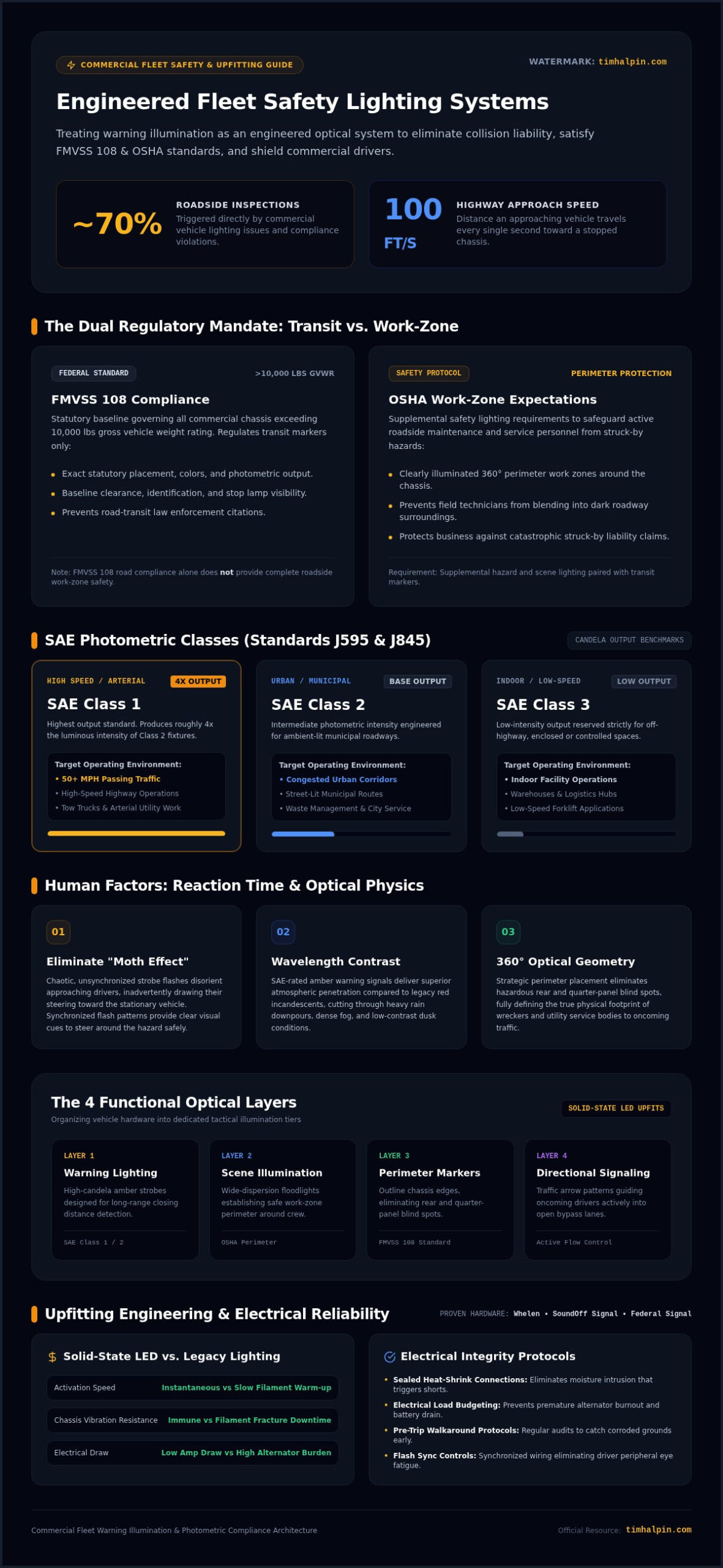
Lighting issues trigger nearly 70% of all roadside inspections. When managing commercial vehicles, improving fleet safety with proper lighting isn’t about slapping generic strobes onto a headache rack; it’s about treating warning illumination as an engineered optical system that protects your crew from day one.
We understand the daily headaches fleet managers face. Low-visibility roadside hazards, driver eye fatigue from unsynced flash patterns, and premature electrical failures caused by vibration and humidity can quickly derail an operation. You shouldn’t have to decipher conflicting DOT, SAE, and state regulations alone just to shield your business from collision liability.
In this complete upfitting guide, discover how engineered safety lighting systems reduce roadside collisions, ensure DOT compliance, and protect your commercial drivers. We walk through matching SAE Class fixtures to your duty cycles, designing full 360-degree scene illumination, and adopting reliable wiring practices that prevent costly electrical downtime.
Key Takeaways
- Learn how improving fleet safety with proper lighting safeguards commercial drivers against rear-end collisions while preventing costly roadside inspection violations.
- Discover how matching SAE photometric classes and synchronized flash patterns to your duty cycle eliminates peripheral glare and hazardous blind spots.
- Explore dependable commercial lighting solutions from established manufacturers like Whelen, SoundOff Signal, and Federal Signal built to withstand heavy vibration.
- Master electrical load budgeting and clean wiring standards using sealed heat-shrink connections to protect against moisture intrusion and alternator burnout.
- Establish proactive pre-trip walkaround protocols and electrical audits that catch corroded grounds before they cause unscheduled fleet downtime.
The Real Cost of Poor Fleet Visibility: Collision Risks and Regulatory Demands
A stationary utility truck on a dark shoulder is an immediate hazard. Struck-by incidents and rear-end impacts do not just risk lives; they drive up commercial insurance premiums, trigger severe liability claims, and sideline vital revenue-producing assets. Out on the highway, especially during sudden South Florida downpours that cut visibility to near zero in seconds, relying solely on basic factory markers is an operational gamble. Commercial operators need an intentional strategy for improving fleet safety with proper lighting that alerts distracted drivers hundreds of yards before they reach the rear bumper.
FMVSS 108 and OSHA Lighting Mandates
Federal Motor Vehicle Safety Standard (FMVSS) 108 sets the statutory baseline for all commercial chassis exceeding 10,000 pounds gross vehicle weight rating. It dictates the exact placement, color, and photometric output of identification, clearance, and stop lamps. However, statutory road compliance does not equal work-zone safety. While FMVSS 108 governs transit markers, baseline automotive lighting systems must be paired with supplemental hazard hardware to satisfy OSHA roadside expectations. OSHA protocols require clearly illuminated perimeter work zones around maintenance and service vehicles so field crews can work without blending into the dark roadway.
Human Factors: Reaction Time, Contrast, and Driver Confusion
At highway speeds, an approaching motorist travels nearly 100 feet every second. Typical perception-response time gives a distracted driver only seconds to recognize a stopped chassis, judge closing distance, and change lanes safely. Poorly configured setups compound this risk through predictable human behaviors:
- The “Moth Effect”: Chaotic, unsynchronized strobe patterns blind and disorient approaching motorists, pulling their steering toward the vehicle rather than guiding them safely around it.
- Wavelength Contrast: SAE-rated amber warning signals offer superior atmospheric penetration through heavy rain, fog, and dusk compared to standard red incandescent markers.
- 360-Degree Optical Coverage: Strategic perimeter placement eliminates rear and quarter-panel blind spots, defining the true physical footprint of wreckers and service bodies.
Engineering synchronized flash patterns and high-contrast optics gives oncoming traffic the visual clarity needed to steer clear, proving that improving fleet safety with proper lighting is fundamentally about managing roadside human behavior.
Decoding Commercial Safety Lighting: SAE Classes, Optics, and Functional Zones
Effective vehicle illumination goes far beyond bolting amber beacons to a cab protector. Real road safety requires matching optical output and dispersion angles to your specific operating environment. While legacy halogen and incandescent fixtures suffer from slow filament warm-up and high amp draw, modern solid-state LEDs deliver instantaneous intensity, withstand intense chassis vibration, and satisfy strict FMCSA lighting and reflector requirements. Improving fleet safety with proper lighting means organizing your hardware into dedicated functional layers: warning, scene, perimeter, and directional traffic signaling.
Understanding SAE Class 1, 2, and 3 Classifications
The Society of Automotive Engineers (SAE) sets photometric benchmarks under standards J595 and J845, establishing minimum candela output across specific viewing angles:
- SAE Class 1: The highest output standard, producing roughly four times the luminous intensity of Class 2 fixtures. These luminaires are engineered for high-speed highway operations, tow trucks, and arterial utility work where passing traffic travels at 50 mph or faster.
- SAE Class 2: Intended for utility, waste, and municipal service trucks working congested urban corridors where street lamps provide ambient light, but clear municipal signaling is essential.
- SAE Class 3: Emits low-intensity output reserved strictly for indoor facilities, warehouses, or low-speed forklift applications.
Flash patterns matter just as much as optical intensity. Rapid, high-frequency bursts catch driver eyes on high-speed expressways, while slower, synchronized pulses prevent blinding nearby drivers during nighttime residential utility work.
Zonal Illumination: Beyond Roof-Mounted Warning Lightbars
A single roof-mounted lightbar doesn’t fully protect a crew on the tarmac. Modern vocational builds rely on distinct zonal illumination. Downward-angled scene lights illuminate ground perimeters around liftgates and hydraulic booms, eliminating shadows that cause costly trip injuries. Inside enclosed work trucks, vibration-resistant LED strips illuminate shelving systems so technicians aren’t fumbling with handheld torches in the dark.
Designing balanced zonal layouts ensures every work angle stays visible to your crew and oncoming traffic. Learn how these systems integrate into complete work-ready rigs in our guide to commercial truck upfitting in Miami. If you are ready to configure a custom package for your chassis, the electrical specialists at Tim Halpin Equipment Corp can design an optical layout built for your operational duty cycle.
Selecting the Right Lighting Hardware for Vocational and Commercial Fleets
Factory-ordered illumination packages often fall short when vehicles face demanding vocational tasks. Tow trucks, crane trucks, and roadside maintenance rigs require purpose-built luminaires engineered to survive real-world job sites. Investing in premium public safety hardware from trusted manufacturers like Whelen Engineering, SoundOff Signal, and Federal Signal delivers rugged reliability under brutal conditions. For targeted commercial upfits needing modular flexibility, Code 3 and Feniex Industries offer specialized configurations that balance warning power with straightforward mounting. Ultimately, improving fleet safety with proper lighting begins by specifying components that exceed minimum federal lighting and reflector requirements.
Matching Fixtures to Vocational Duties
Every commercial body demands a tailored optical approach based on how it interacts with traffic:
- Wreckers and Recovery Units: High-profile cab lightbars paired with rear under-tailgate flashers cut through high-speed highway traffic. For detailed hardware specifications on recovery equipment, consult our comprehensive guide on tow truck parts in Florida.
- Utility and Service Bodies: Compact, wide-angle perimeter surface mounts set into rub rails alert passing drivers, while rear-facing directional arrows route traffic smoothly around parked service bays.
- Bucket and Boom Trucks: Low-profile beacon configurations prevent overhead limb strikes while providing broad 360-degree warning coverage when stabilizers are deployed.
Evaluating Build Quality: Ingress Protection and Thermal Management
Cheap aftermarket lights frequently fail within months due to moisture leaks and heat buildup. True commercial-grade hardware features heavy-duty die-cast aluminum heat sinks. These dissipate diode heat rapidly, avoiding thermal throttling that dims light output over extended work shifts. Polycarbonate lenses treated for UV protection resist yellowing under the relentless South Florida sun, shrugging off flying gravel and low-hanging tree branches.
Water ingress ratings are just as vital. Look for hardware carrying IP67 or IP68 ratings for continuous moisture resistance, or IP69K if your fleet uses high-pressure hot-water washdowns. By prioritizing high-grade enclosures and proven solid-state drivers, fleet managers protect their capital investments and keep their crews visible on every dark shoulder.
Engineering and Upfitting: Electrical Integrity, Wiring, and Controls
Even the highest-grade lightbar fails if the underlying electrical architecture is compromised. True progress in improving fleet safety with proper lighting requires rigorous engineering behind the dashboard and along the chassis rails. Commercial vehicles operating in South Florida battle relentless humidity, coastal salt air, and brutal thermal cycling. Without clean power management and weatherproof termination, simple lighting additions quickly cause blown fuses, dead batteries, and expensive downtime.
Power Architecture and Amp Draw Calculations
Every upfit begins with a calculated electrical load budget. Tally the maximum current draw of every cab strobe, perimeter flasher, directional bar, and high-output scene flood operating simultaneously:
- Load Sizing: Size primary conductors and master circuit breakers to handle 125% of continuous load, preventing nuisance tripping during extended roadside operations.
- Solid-State Switching: Modern programmable switch panels and digital power distribution modules eliminate tangled nests of mechanical relays, reducing parasitic battery drain and point-to-point wiring clutter.
- Charging Capacity: Heavy vocational applications involving high-draw hydraulic booms or liftgates often require auxiliary dual-battery isolators or upgraded high-output alternators to keep system voltage stable at idle.
Corrosion Prevention and Weatherproof Harness Design
Substandard wiring practices are the leading source of commercial electrical failures. Quick-splice scotch-locks and unsealed crimp terminals pierce wire jackets, allowing salty moisture to wick through copper strands. Within months, green corrosion rots the conductor beneath the insulation.
Professional installations demand cross-linked polyethylene wire, such as SAE-spec TXL or GXL, which resists engine heat, fuel exposure, and friction. All exterior connections should utilize multi-pin Deutsch DT connectors with silicone seals and adhesive-lined polyolefin heat shrink over every mechanical crimp. Wiring harnesses must follow the inside web of vehicle frame rails, clipped in abrasion-resistant split loom far clear of suspension travel or moving liftgate assemblies. Where harnesses penetrate bulkheads or utility bodies, heavy rubber grommets prevent raw sheet metal from slicing through the harness.
Building an electrical system that withstands harsh operating environments protects your crew and keeps your trucks working. If you want to eliminate electrical gremlins and protect your vehicle investment, partner with our experienced rigging team to schedule professional installation services.
Building a Fleet Lighting Maintenance Program and Partnering for Professional Upfits
A well-engineered lighting package is an investment that requires steady oversight to deliver lasting protection. Even the best fixtures can fall prey to road vibration, dirt accumulation, and harsh weather if left uninspected. Establishing a disciplined inspection routine turns safety into daily muscle memory, ensuring your trucks remain fully visible and legally compliant every time they roll out of the yard.
Daily Pre-Trip Inspections and Preventive Maintenance Checklists
A simple 60-second walkaround before each shift catches minor electrical issues before they turn into roadside citations or collisions. Drivers should activate the master hazard switch and confirm that all clearance markers, rear brake lamps, and warning strobes fire with full intensity.
During regular shop preventative maintenance intervals, technicians should inspect beneath the surface for common hardware vulnerabilities:
- Lens Condensation: Fine misting or trapped water inside a housing indicates a compromised seal, which quickly corrodes internal diode circuits.
- Flickering Diodes: Inconsistent flash patterns or intermittent dimming signal failing circuit boards or voltage drops along the harness.
- Corroded Grounds: Surface rust or oxidation where ground terminals bolt to chassis steel creates high electrical resistance, starving lights of current.
- Hardware Tension: Heavy-duty vibration can loosen mounting brackets over time, throwing directional lightbars out of optical alignment.
Professional Upfitting with Tim Halpin Equipment Corp
While basic bulb replacements can happen in-house, complex electrical rigging requires specialized shop tooling and technical mastery. As a family-owned commercial upfitter serving South Florida utility, municipal, and private fleets since 1987, we take pride in building rock-solid electrical packages that hold up to extreme heat and coastal humidity.
Our technicians are factory-trained installers for the industry’s premier public safety lighting manufacturers, including Whelen Engineering, SoundOff Signal, Federal Signal, Code 3, and Feniex Industries. We ensure every wire harness is sealed, properly fused, and calibrated to eliminate vehicle downtime. To explore hardware capabilities and local municipal requirements, review our detailed guide on public safety lighting in Miami.
Partnering with seasoned professionals ensures your vehicles are fully equipped to handle dangerous roadside assignments. Learn more about our craftsmanship and community roots in the legacy behind Tim Halpin Equipment, and let our team help you turn improving fleet safety with proper lighting into a dependable standard across your entire fleet.
Protect Your Drivers and Fleet with Engineered Safety Lighting
Protecting your crews on dark shoulders takes more than standard factory illumination. True success in improving fleet safety with proper lighting comes down to three essentials: selecting SAE-rated optics matched to your operating speeds, installing sealed wiring harnesses that resist coastal corrosion, and maintaining disciplined pre-trip electrical audits. Treating your warning setup as an engineered optical system protects your bottom line, avoids severe regulatory penalties, and gets your technicians home safely after every shift.
Since 1987, Tim Halpin Equipment Corp has served South Florida commercial truck fleets with expert upfitting. As an authorized installer of top safety lighting brands including Whelen, SoundOff Signal, and Federal Signal, our dedicated commercial facility is committed to maximum vehicle uptime and durable electrical craftsmanship. Ready to eliminate roadside blind spots and protect your team on every corridor? Upgrade your fleet’s safety lighting with Tim Halpin Equipment Corp, and equip your commercial vehicles with dependable illumination built to last.
Frequently Asked Questions
What is the difference between SAE Class 1 and Class 2 emergency lighting?
SAE Class 1 fixtures produce roughly four times the luminous output of Class 2 lights, making them suited for high-speed highway conditions where approaching traffic moves at 50 mph or faster. Class 2 fixtures offer moderate output tailored for slower urban roads and congested city traffic. When improving fleet safety with proper lighting on highway recovery units and utility trucks, Class 1 provides the extended sight distance motorists need to react safely.
Can adding high-output auxiliary lighting drain a commercial truck’s battery during roadside idling?
Yes, running high-draw lighting arrays at idle can deplete a battery if the alternator cannot supply sufficient current. While solid-state LEDs draw significantly less power than halogen bulbs, combined loads from lightbars, perimeter strobes, and high-output scene floods still add up. Vocational rigs running continuous roadside lighting often require load calculations during upfitting, along with auxiliary batteries or heavy-duty alternators, to prevent unexpected dead-battery no-starts.
What color safety lighting is legally permitted on commercial work trucks in Florida?
Commercial work trucks, wreckers, and utility vehicles in Florida are generally restricted to amber and clear/white warning lights under Florida Statute 316.2397. Red and blue warning luminaires are strictly reserved for law enforcement, fire rescue, and emergency medical responders. Tow trucks and service rigs may display flashing amber lights while actively working on roadside hazards or towing disabled vehicles, ensuring full state compliance without risking moving citations.
How does synchronized flashing improve motorist perception compared to random strobe patterns?
Synchronized flashing patterns create an organized, coherent visual cue that helps approaching drivers accurately judge a stationary truck’s distance and footprint. In contrast, unsynchronized, chaotic strobes cause visual confusion and trigger the “moth effect,” where disoriented motorists inadvertently steer toward the glare. Synchronized pulses guide traffic smoothly around roadside work zones, significantly improving fleet safety with proper lighting by eliminating dangerous peripheral blindness.
Why do commercial vehicle LED lights fail prematurely after installation?
Premature LED failure is almost always caused by inadequate thermal heat dissipation, poor ground connections, or moisture intrusion through unsealed wiring splices. Cheap hardware lacks adequate die-cast aluminum heat sinks, leading to diode burnout during long shifts. Non-weatherproof crimp connectors also invite coastal humidity and road spray inside the harness, causing internal wire rot and voltage drops that make lights flicker or die completely.
What is an IP69K ingress rating and is it necessary for commercial fleet lighting?
An IP69K rating certifies that an electrical enclosure withstands high-pressure, high-temperature washdowns from close distances without letting water penetrate the housing. While standard IP67 fixtures handle heavy rain, commercial fleet trucks subjected to daily industrial wash bays or severe South Florida thunderstorms benefit tremendously from IP69K protection. It guarantees that high-pressure sprayers won’t force moisture past silicone gaskets into sensitive circuit boards and LED arrays.
How often should commercial fleet warning and safety lighting undergo full technical inspection?
Warning and safety lighting should receive a daily driver pre-trip walkaround and a full shop inspection during every preventative maintenance service interval, typically every 90 days. Technicians should test all functional zones, inspect lens seals for condensation, measure harness voltage, and ensure ground terminals are free of surface rust. Regular technical audits catch loose mounting hardware and electrical resistance before they lead to roadside failures.
