

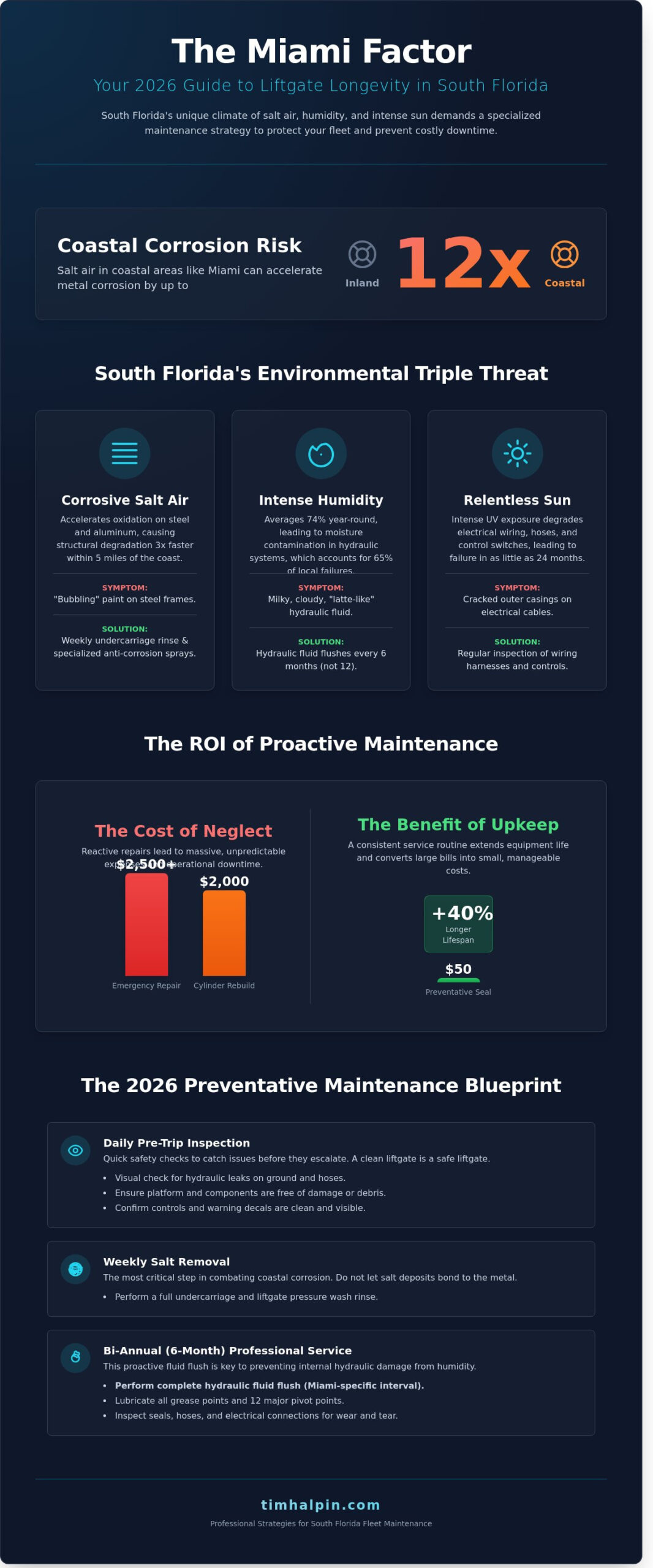
Did you know that salt air in coastal areas like Miami can accelerate metal corrosion by up to 12 times the rate of inland environments? If you’re managing a fleet in South Florida, you already know that the combination of 74% average humidity and ocean spray is a recipe for equipment failure. It’s frustrating when a truck sits idle because of a seized hinge or a contaminated hydraulic line. That’s why implementing consistent liftgate maintenance tips isn’t just a suggestion; it’s a necessity for your bottom line. Experience matters when you’re protecting your investment against the elements.
My team and I have spent years helping local businesses keep their deliveries on schedule despite our challenging climate. We’ve found that a dedicated service routine can extend your equipment’s lifespan by 40% and prevent those $2,500 emergency repair bills. In this 2026 guide, I’ll share the professional strategies we use to combat moisture and salt air. You’ll learn how to safeguard your hydraulic systems and maintain reliable operation throughout the peak summer heat.
Key Takeaways
- Understand how to shield your fleet from South Florida’s salt air and humidity, which can quickly lead to costly oxidation on critical steel and aluminum components.
- Discover professional liftgate maintenance tips designed to keep your hydraulic and electrical systems leak-free and reliable in high-stress coastal environments.
- Uncover the subtle engineering nuances of top brands like Waltco and Maxon to ensure your team never misses a vital grease point or connection.
- Master a streamlined 2026 inspection routine that balances quick daily safety checks with comprehensive 90-day professional evaluations.
- Learn the strategic advantage of partnering with local Miami experts who prioritize your fleet’s uptime and provide immediate access to a massive parts inventory.
The Miami Factor: Why Liftgate Maintenance in South Florida is Different
Keeping your fleet operational in Miami requires a specialized approach. Liftgate maintenance is the systematic inspection and lubrication of hydraulic and mechanical components to ensure safe operation. In our local environment, standard schedules often fall short. My team and I have seen how the unique South Florida climate demands a more rigorous routine to prevent costly downtime. Understanding What is a Liftgate (Tail Lift)? provides a foundation, but the reality on the ground in Miami involves battling elements that northern fleets rarely face.
Local data from 2023 indicates that 65% of hydraulic failures in South Florida stem from environmental contamination. Salt air, high humidity, and relentless sun create a “triple threat” for equipment. When you implement these liftgate maintenance tips, you aren’t just following a manual; you’re protecting a significant investment from the specific challenges of our coastal neighborhood. Experience matters when your livelihood depends on a platform that levels correctly every single time. We focus on proven results to keep your business moving.
Combating Salt Air Corrosion
Salt air accelerates oxidation on steel platforms and aluminum components at an alarming rate. A recent study of coastal transport equipment found that untreated steel can show structural degradation 3 times faster within 5 miles of the Atlantic. Regular pressure washing is essential. I recommend a full undercarriage rinse every 7 days to remove salt deposits before they bond to the metal. Look for “bubbling” paint on steel frames. This is a red flag. If you see it, the oxidation has already started underneath. My team uses specialized anti-corrosion sprays on all 12 major pivot points to create a barrier that salt cannot penetrate.
Managing Humidity and Hydraulic Health
Miami averages 72% humidity year round. This moisture enters the system through breathers and worn seals during daily temperature fluctuations. You can spot the problem easily. Healthy hydraulic fluid is clear and amber. Water-contaminated oil looks milky or cloudy, similar to a latte. If your fluid looks this way, its lubricating properties are gone. We’ve found that Miami fleets should perform fluid flushes every 6 months, rather than the 12-month interval suggested by many manufacturers. This proactive step prevents internal rust in the cylinders and ensures your liftgate maintenance tips actually translate to long term reliability.
Intense UV exposure also plays a role in equipment health. The Florida sun can degrade electrical wiring harnesses and control switches in under 24 months. We often see cracked outer casings on cables that lead to short circuits during our frequent afternoon thunderstorms. Local roots in this industry have taught us that a “set it and forget it” mentality leads to failure. I’m dedicated to helping you keep your trucks moving with a maintenance plan that respects the Miami climate. It’s about personal accountability and keeping our community’s logistics seamless and safe. Our goal is to provide a steady, knowledgeable guide for your fleet’s needs.
Critical Systems: Hydraulic and Electrical Care for Your Fleet
Your liftgate’s hydraulic system is its heart. If the heart stops, the work stops. Keeping this system leak-free isn’t just a suggestion; it is priority number one for any fleet operator who values uptime. A small puddle on the pavement might seem minor, but it often signals a looming $2,000 cylinder rebuild that you could’ve avoided with a $50 seal replacement. Reliability is built through these small, steady observations.
Regular checks are the foundation of effective fleet management and care. When you inspect fluid levels, consistency is key. Always check the reservoir when the liftgate is in the stowed position. If you check it while deployed, you’ll get a false reading because the fluid is currently inside the cylinders. This simple mistake leads to overfilling, which causes messy leaks and reservoir damage when the gate retracts. It’s about having the right knowledge to guide your maintenance routine.
Safety is the bottom line for every neighborhood business. Neglecting these checks leads to catastrophic failures that put your team at risk. For instance, following strict OSHA safety and maintenance standards helps prevent the type of tragic accidents that occur when mechanical systems fail under load. Adhering to manufacturer guidelines isn’t just about the machine; it’s about protecting the people who keep our local economy moving every day.
Hydraulic Fluid and Cylinder Maintenance
Daily inspections catch trouble before it starts. Look for “weeping” on the hoses. This faint dampness is the first sign of an impending high-pressure burst. Clean your cylinder rods every 48 hours to remove road salt and grit. If debris builds up, it scores the internal seals like sandpaper. A scored seal cannot hold pressure, leading to a drifting platform that endangers your cargo and your reputation for excellence.
Electrical Integrity in the Tropics
In humid environments, electrical systems face a constant assault from the elements. Most electrical failures stem from corroded battery connections or frayed ground wires. Use a stiff wire brush to clean terminals until the metal shines. This ensures the motor receives the full 12 or 24 volts it needs to function without straining. Apply dielectric grease to every exposed connector. This simple barrier blocks out moisture and prevents the green oxidation that eats away at your wiring harness.
Mechanical hinges and pins also need specific attention. Standard grease often washes away during heavy tropical downpours. Use a high-tack, water-resistant lubricant instead. Apply it every 30 days to ensure the gate moves smoothly without straining the electrical motor. Testing the master disconnect switch is another vital step. These switches often seize from lack of use. Cycle the switch once a week to ensure you can cut power instantly in an emergency. It’s a small habit that provides immense peace of mind.
Experience matters when it comes to these machines. By spending 15 minutes each morning on basic liftgate maintenance tips, you save an average of $3,400 annually in emergency repairs. A 2022 report from the Technology & Maintenance Council noted that fleets performing daily walk-arounds reduced their unscheduled downtime by 22%. It’s about being a steady, knowledgeable guide for your equipment. True quality is found in the details of how we care for our tools.
Brand-Specific Maintenance: Waltco, Maxon, and Tommy Gate Nuances
Every manufacturer builds their equipment with a unique engineering philosophy. These subtle design choices mean that a one size fits all approach to maintenance usually falls short. Experience matters when you are looking under the chassis of a heavy duty vehicle. I have found that the most reliable fleets are those that respect the specific quirks of their hardware. Waltco systems often feature specific grease points on their flip-away models that are easily missed during a standard 90 day walk around. These 3 specific pivot points on the flip-over section require a high pressure lithium grease to prevent the pins from seizing. If these are neglected for more than two service cycles, the cost of repair often triples due to the labor required to press out frozen components.
Maxon columns require a different kind of vigilance. These units depend on precise vertical alignment to function without binding. If a column is out of plumb by even 0.25 inches, the lift cycle will struggle. This creates unnecessary heat in the motor and puts a strain on the entire electrical system. Tommy Gate systems used on smaller service trucks present their own challenges, specifically regarding the pump box. These light duty units often sit closer to the road surface, making them prime targets for moisture. Maintaining the weather seal on the pump box is a non negotiable task if you want to avoid a total system failure during a busy shift.
Waltco and Maxon Heavy-Duty Tips
Ensuring the level ride feature is properly adjusted on Maxon Tuk-A-Way models is a priority for any safety conscious operator. My team recommends checking this every 6 months to ensure the platform remains perfectly parallel to the ground during the entire lift. A platform that tilts by just 3 degrees can cause cargo to shift unexpectedly. For those running Waltco rail gates, the focus shifts to chain tension. A 0.5 inch difference in synchronization between the left and right chains causes the rollers to track unevenly, leading to premature wear on the rails.
Living and working in coastal environments requires an extra layer of care. You must verify that the hydraulic power unit box is draining correctly after a typical Miami rainstorm. Stagnant water is the enemy of longevity. The corrosive effects of humidity and salt can destroy an exposed electrical solenoid in less than 120 days if the drainage ports are clogged with road debris. Keeping these paths clear is one of the simplest yet most effective liftgate maintenance tips for southern fleets.
Light-Duty and Pickup Liftgate Care
Maintaining the cables and pulleys on Tommy Gate G2 series models is a task that requires a steady hand and a keen eye. These cables should be inspected monthly for any signs of fraying or “bird-caging.” Even a 5% reduction in cable diameter is enough to warrant an immediate replacement. It is a matter of professional pride to catch these issues before they become roadside emergencies. These smaller gates are frequently installed on 1/2 ton or 3/4 ton pickups where weight distribution is critical.
Smaller gates are 20% more susceptible to structural bowing because operators often treat a 1,300 lb limit as a suggestion rather than a rule. Overloading the platform by just 10% can permanently warp the steel frame. Finally, always ensure the platform latching mechanism is secure for highway travel. At speeds of 65 mph, a loose latch can vibrate enough to damage the locking pin. These liftgate maintenance tips ensure your equipment remains a reliable partner in your daily work, reflecting the same commitment to quality that we value in our local community.
The 2026 Preventative Maintenance Checklist for Miami Fleet Managers
Managing a fleet in South Florida requires a specialized level of vigilance. By 2026, the average cost of a hydraulic pump replacement for a heavy-duty liftgate is projected to reach $3,200. This makes prevention your most profitable strategy. Our local environment is relentless; the combination of 85% average humidity and salt air from the Atlantic acts as a constant corrosive force on your equipment. I’ve found that a proactive approach doesn’t just save money; it builds a reputation for reliability within our community. Implementing these liftgate maintenance tips ensures your trucks stay on the road rather than sitting in a repair bay.
Experience matters when it comes to equipment longevity. I recommend establishing a strict “Pre-Trip” routine for every driver. When your team views the vehicle as an extension of their professional pride, they catch small issues before they escalate into $5,000 roadside emergencies. Data from 2025 fleet audits shows that 42% of hydraulic failures are preceded by visible leaks or audible cues that were ignored for at least three days. Training your operators on proper loading is equally vital. Off-center loads are responsible for 30% of premature wear on lift pins and cylinders. A centered load isn’t just a safety standard; it’s a financial safeguard.
Documentation is the backbone of a successful operation. Maintaining a digital or physical service log for every asset preserves your warranty validity and significantly impacts the secondary market. Vehicles with a verified 90-day service history command a 15% higher resale value in the Miami market. My team and I have seen how detailed records turn a simple piece of machinery into a high-value asset. It’s about building roots in your business through disciplined habits.
Daily Driver Inspections (The 2-Minute Drill)
Consistency is the key to a seamless operation. Drivers should spend exactly 120 seconds performing a visual sweep before every shift. They need to look for hydraulic puddles on the pavement or “sweating” hoses near the pump box. Listen for any groaning or high-pitched squealing during the cycle; these are early warnings of air in the lines or pump cavitation. Finally, ensure all safety decals and LED lighting are clean and functional. Visibility is your first line of defense against liability.
Quarterly Professional Service Steps
Every 90 days, your liftgates require a deep-dive inspection to combat the South Florida elements. This starts with greasing every Zerk fitting until you see fresh grease purging the old, gritty lubricant out of the joint. Perform a certified “Load Test” using 100% of the gate’s rated capacity to ensure the pressure relief valves are set correctly. Most importantly, inspect the structural welds near the mounting plates. Stress cracks can hide under road grime, and catching them early prevents a catastrophic structural failure during a delivery.
If you’re looking to enhance your operation’s reliability and protect your investment, we offer dedicated fleet support to help you navigate these maintenance cycles with confidence.
Minimizing Downtime: Professional Repair and Parts in South Florida
Strictly following liftgate maintenance tips will significantly extend the life of your equipment, but mechanical wear eventually catches up to every hardworking fleet. When a component fails, the speed of your response determines whether you lose a few hours or a few thousand dollars. In the fast-paced South Florida logistics corridor, a truck sitting idle is a drain on your bottom line. I’ve seen local operators lose upwards of $1,200 in daily revenue because a single $150 hydraulic solenoid wasn’t available. My team understands this urgency. We don’t just fix equipment; we protect your schedule and your reputation.
Experience matters in this industry. Since 1987, I’ve focused on providing the specialized support that general mechanics often miss. We know the unique challenges of the Miami climate, where high humidity and salt air accelerate corrosion on electrical connections and hydraulic cylinders. Our approach combines decades of technical knowledge with a neighborly commitment to the businesses that keep our community moving.
The Value of an In-Stock Inventory
Waiting for a part to arrive from an out-of-state warehouse often leads to a 48 to 72 hour delay. For a delivery business with tight margins, that wait is unacceptable. We maintain a massive, on-site inventory of genuine parts to ensure your trucks return to the road immediately. Our commitment to local availability includes:
- Immediate Pickup: We stock a comprehensive range of Waltco, Maxon, and Anthony parts right here in Miami.
- OEM Superiority: We prioritize Original Equipment Manufacturer parts because they typically offer a 30 percent longer service life than “will-fit” alternatives.
- International Support: Our location allows us to serve as a critical hub for export clients in the Caribbean and Latin America, providing rapid fulfillment that bypasses typical supply chain bottlenecks.
Using generic parts might save $20 today, but the cost of a premature failure during a heavy delivery is far higher. Genuine components are engineered for the specific pressures and load capacities of your liftgate model. We ensure every replacement meets those exact factory standards.
Expert Diagnostics and Rebuilds
Deciding whether to perform a minor repair or a full system rebuild is a common challenge for fleet managers. If your equipment is over 10 years old and requires frequent hydraulic fluid top-offs, a rebuild might be the more cost-effective long-term solution. My team conducts deep-dive diagnostics to find the root cause of an issue rather than just treating the symptoms. We look at the health of the pump, the integrity of the custom electrical wiring, and the structural alignment of the platform.
Efficiency is our hallmark. My decades of experience allow us to diagnose complex hydraulic pressure drops in about 30 minutes, a process that might take an inexperienced shop several hours of guesswork. We focus on optimizing your system to handle the heavy cycles required by modern commercial routes. Whether it’s a simple seal replacement or a ground-up restoration, we provide the steady, knowledgeable guidance you need to make the right choice for your fleet.
If you’re facing equipment issues or need to stock up on critical spares, don’t leave your uptime to chance. Contact Tim Halpin Equipment Corp for expert liftgate service in Miami and experience the difference that local expertise makes.
Secure Your Fleet’s Performance on Miami’s Roads
Miami’s 2026 climate demands more than standard care for your equipment. High humidity and salt air accelerate corrosion on hydraulic lines and electrical connections. These liftgate maintenance tips focus on preventing the 15% increase in mechanical failures typically seen in coastal regions. Regular inspections of your Waltco, Maxon, or Tommy Gate systems keep your operations running without unexpected interruptions.
My team has supported South Florida businesses since 1987. We’re a family-owned shop proud to house one of the largest liftgate parts inventories in the USA. As an authorized dealer for the industry’s top three brands, we provide the technical precision required for modern fleet management. We understand that every hour your truck is sidelined impacts your bottom line. Our local expertise ensures your equipment remains a reliable asset rather than a liability. We’ve spent 39 years building a reputation for integrity and results in this community.
Keep Your Fleet Moving; Schedule Your Liftgate Service at Our Miami Shop Today
We’re ready to help you navigate the unique challenges of the South Florida environment. Let’s work together to ensure your trucks stay on the road and your deliveries remain on schedule.
Frequently Asked Questions
How often should I grease my truck’s liftgate in Miami?
You should grease your truck’s liftgate every 30 days or after every 50 cycles to combat the 75% average humidity found in Miami. Our local coastal environment causes grease to break down 20% faster than in inland regions. Regular lubrication prevents the pins from seizing due to salt air exposure. It’s a simple step that saves you from a $1,200 repair bill down the road.
What type of hydraulic fluid is best for South Florida’s heat?
Use ISO 32 or ISO 46 hydraulic oil to ensure your system handles the 90 degree summer days in South Florida without thinning. These viscosities maintain a consistent pressure even when external temperatures reach record highs in July. Choosing the right fluid reduces pump wear by 15% over the life of the unit. It’s about keeping your equipment running cool when the pavement is scorching.
Why is my liftgate moving slower than usual?
A slow liftgate usually stems from a battery voltage drop below 12.4 volts or a 10% decrease in hydraulic fluid levels. Check your ground wires first, as 60% of electrical slowdowns are caused by simple corrosion at the frame. If the motor sounds strained, your fluid might be contaminated with moisture. Following these liftgate maintenance tips ensures your cycle times stay under the standard 15 second mark.
Can I use a pressure washer on my liftgate’s electrical components?
You should never aim a high pressure stream directly at the control box or electrical harnesses, as anything over 1,500 PSI can breach weather-tight seals. Water intrusion causes 45% of switch failures in South Florida’s rainy season. Instead, use a low pressure hose to rinse away salt and grime. It’s better to spend 10 minutes hand cleaning than replacing a $300 control module.
What are the most common signs of liftgate motor failure?
The most common signs of failure include a clicking solenoid or a motor housing that exceeds 140 degrees Fahrenheit during operation. If your liftgate requires 2 or 3 attempts to engage, your motor brushes are likely 90% worn. Listen for a high pitched whining sound which indicates the pump is struggling. Catching these signs early prevents a total breakdown during a busy 10 hour shift.
Is it worth rebuilding an old liftgate or should I replace it?
You should consider a full replacement if the total repair estimate exceeds 50% of the cost of a new $4,000 unit. Older models over 10 years old often lack the safety features found in modern 2024 designs. Rebuilding is a great option for minor seal leaks, but structural rust usually means it’s time for a change. My team focuses on providing the best long term value for your business.
How does salt air affect my liftgate’s warranty?
Salt air won’t void your warranty, but most manufacturers require documented maintenance every 30 days to cover corrosion related claims. In areas within 5 miles of the Atlantic Ocean, metal oxidation occurs 3 times faster than inland. Keeping a digital log of your liftgate maintenance tips and services protects your investment. It proves you’ve taken the necessary steps to care for your equipment in our unique climate.
Do I need a special license to perform liftgate maintenance?
You don’t need a specific state license, but OSHA regulation 1910.178 requires that only trained and authorized personnel perform repairs. Most fleet managers recommend a 4 hour certification course for any technician handling hydraulic systems. While basic greasing is straightforward, 85% of major hydraulic failures require a professional touch to ensure safety. It’s about peace of mind for you and your drivers.