

What if the part that seems most likely to have failed isn’t the real cause? With palfinger liftgate hydraulic problems, a gate that won’t raise, lower, or hold position can point to different issues. Replacing parts based on guesswork may not get your truck back to work. It’s frustrating when hydraulic symptoms interrupt vehicle use, especially when the cause isn’t clear.
This guide will help you recognize common symptoms, gather useful information, and narrow down possible causes without taking unsafe repair steps. You’ll learn what observations can help distinguish one issue from another, when the exact Palfinger model matters, and when professional inspection or model-specific troubleshooting is the sensible next step.
We’ll also cover the details to have ready for a technician or parts supplier, such as the liftgate model and relevant part information. Tim Halpin Equipment Corp is a family-owned Miami business serving South Florida since 1987, with liftgate and hydraulic repair and Palfinger liftgate parts among its offerings. A clear description of the symptoms can make the next conversation more productive.
Key Takeaways
- Describe whether the gate has no movement, moves slowly or unevenly, or shows visible fluid leakage to help focus diagnosis.
- For palfinger liftgate hydraulic problems, treat electrical supply, controls, fluid, hoses, and hydraulic components as possibilities to verify, not parts to replace by guesswork.
- Use the applicable Palfinger manual for model-specific checks, and limit personal inspection to safe external observations it allows.
- Have the liftgate’s model identification, symptom details, and relevant part information ready when requesting diagnosis or compatible parts.
- South Florida operators can explore liftgate repair, hydraulic repair, or Palfinger parts through Tim Halpin Equipment Corp, a family-owned Miami business serving the region since 1987.
Palfinger Liftgate Hydraulic Problems: Recognize the Symptom First
A liftgate that won’t move can delay loading, deliveries, or other vehicle work. With palfinger liftgate hydraulic problems, start by describing what the gate is doing rather than guessing which part has failed. A symptom can help focus diagnosis, but it doesn’t confirm the cause. Hydraulic systems use fluid to transmit force, as outlined in this overview of hydraulic machinery; the liftgate’s design and troubleshooting steps depend on its model.
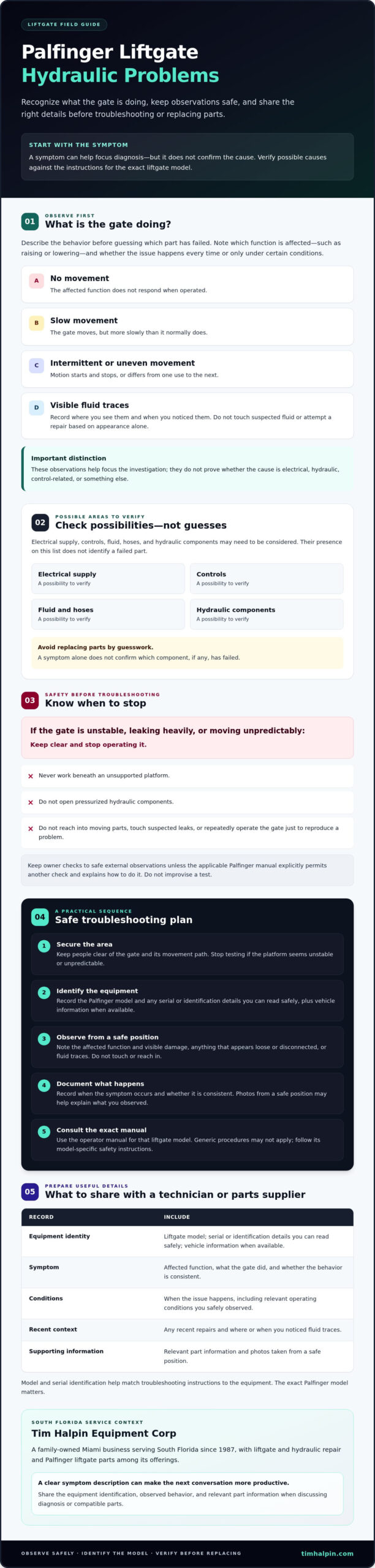
Begin with the observable behavior. Note which function is affected, how the gate responds, and whether the issue happens every time or only under certain conditions:
- No movement: The affected function doesn’t respond when operated.
- Slow movement: The gate moves, but more slowly than it normally does.
- Intermittent or uneven movement: Motion starts and stops, or differs from one use to the next.
- Visible fluid traces: Record where you see them and when you noticed them. Don’t touch suspected fluid or attempt a repair based on appearance alone.
These observations can indicate areas that need checking, but they don’t prove whether the cause is electrical, hydraulic, control-related, or something else. Hydraulic troubleshooting starts with observing the symptom, then verifying possible causes against the instructions for the exact liftgate model.
What does a Palfinger liftgate do when hydraulic operation is failing?
Note whether the gate is completely inactive, moves slowly, or behaves inconsistently. Record whether the issue affects raising, lowering, or another function identified in the operator manual. If you can observe it safely, include when it happens, such as during a particular operation or after the equipment has been idle. Don’t repeatedly operate the gate just to reproduce a problem.
Which details should you record before troubleshooting?
Write down the Palfinger model and any serial or identification details you can read safely, along with the vehicle information. Note the affected function, what the gate did, the conditions at the time, any recent repairs, and where you see fluid traces. Photos taken from a safe position may help explain what you observed. Before checking anything further, consult the operator manual for that exact model. Generic procedures may not apply, so follow the model-specific safety instructions for any owner checks.
How to Diagnose Palfinger Liftgate Hydraulic Problems Safely
A careful diagnosis starts with a safe work area, not a wrench. If the gate is unstable, leaking heavily, or moving unpredictably, keep clear and stop operating it. An OSHA report documents a fatal liftgate-related crushing hazard, a reminder that a malfunctioning platform can pose serious risks. Never work beneath an unsupported platform or open pressurized hydraulic components.
For palfinger liftgate hydraulic problems, keep owner troubleshooting to safe observations and a few information-gathering steps:
- Secure the area: Keep people clear of the gate and its movement path. Don’t continue testing if the platform appears unstable or behaves unpredictably.
- Identify the equipment: Record the model and serial or identification details, plus vehicle information when available. Model and serial identification help match troubleshooting instructions to the equipment.
- Observe from a safe position: Note the affected function and look only for visible damage, anything that appears loose or disconnected, or fluid traces. Don’t touch suspected leaks or reach into moving parts.
- Document what happens: Record when the symptom occurs and whether it is consistent. Photos taken from a safe position may help explain what you see.
- Consult the exact manual: Use the operator manual for that liftgate model before attempting any check. Don’t assume generic instructions apply.
What can an operator safely check before calling for service?
Limit checks to external visual observations unless the applicable Palfinger manual explicitly permits another check and explains how to do it. Follow its instructions for any control, power, or fluid-level check. Don’t improvise a test. If there’s a heavy leak, unstable platform, or unexpected movement, stop. Don’t try to correct a suspected problem by tightening fittings, disconnecting lines, or adding fluid without model-specific guidance.
When should troubleshooting stop and a technician take over?
Stop if the next step would require pressure testing, disassembly, or working beneath the platform. Hydraulic systems can retain pressure even when equipment isn’t operating, so a stationary gate isn’t necessarily safe to work on. Recurring, worsening, or unexplained symptoms also call for qualified service rather than trial-and-error repairs.
If safe observations and the correct manual don’t clarify the issue, professional diagnosis is a practical next step. South Florida operators can learn more about liftgate and hydraulic repair from Tim Halpin Equipment Corp, a family-owned Miami business serving the region since 1987.
Palfinger Liftgate Hydraulic Problems: Compare Causes Before Replacing Parts
A symptom is a starting clue, not a parts diagnosis. If the gate won’t move, runs slowly, operates unevenly, or shows fluid traces, different system areas may need attention. Electrical supply, controls, fluid condition, hoses, and hydraulic components are all possibilities to verify against the exact liftgate design and its manual.
Use the table to organize your observations for a technician. It doesn’t identify a failed component or provide instructions for testing or repair.
| Observed symptom | Possible system area | Evidence to record | Next step |
|---|---|---|---|
| No movement | Electrical supply, controls, or hydraulic system | Which function is affected; whether there is any visible response | Check the model-specific manual for permitted observations, then share the details with a technician. |
| Slow movement | Fluid condition, hoses, or hydraulic components | When slow operation occurs and whether it affects one or more functions | Document the pattern; don’t assume a pump or other component is at fault. |
| Uneven or intermittent movement | Controls, electrical supply, or hydraulic components | Whether the behavior repeats and which direction or function is affected | Stop if operation becomes unpredictable and arrange qualified diagnosis. |
| Visible fluid traces | A hose, connection, or another hydraulic area | Where the trace appears and when it was noticed, without touching it | Keep clear of suspected leaks and ask a technician to inspect safely. |
Does a liftgate that will not move always have a hydraulic fault?
No movement doesn’t confirm a hydraulic failure. Depending on the liftgate’s design, the issue may involve electrical supply or controls, or another part of the system. Use the applicable Palfinger manual to understand which components and observations apply to that model. Keep descriptions factual: “the platform didn’t respond” is an observation; “the pump failed” is a diagnosis that needs verification.
What clues can slow, uneven, or leaking operation provide?
Movement quality and the location of visible fluid traces can help a technician decide what to inspect next, but neither proves which component is faulty. A trace near a hose, for example, doesn’t confirm that the hose has failed. Avoid opening lines or testing pressure. OSHA’s hydraulic safety guidance discusses hazards associated with hydraulic systems, including high-pressure fluid. Replacing a pump, valve, cylinder, or hose based on symptoms alone can leave the actual fault unresolved and create another compatibility or repair issue. Confirm the diagnosis before sourcing parts.
Next Steps: Palfinger Liftgate Troubleshooting Plan
Once you’ve recorded what the gate is doing, turn those observations into a clear service request. For palfinger liftgate hydraulic problems, accurate identification and a concise symptom history help a technician assess what information or inspection may be needed. They can also guide a parts inquiry, but they don’t confirm a diagnosis or guarantee compatibility.
How do you prepare for a Palfinger liftgate service call?
Before contacting a qualified technician, gather the details you can safely access. A short, organized record can help keep the conversation focused:
- Liftgate identification: Record the Palfinger model and serial or identification details. If you can’t read them safely, say so rather than reaching into a hazardous area.
- Vehicle information: Note the vehicle details that may help identify the installation.
- Symptom history: Describe the affected function, what happens, when it occurs, and whether the behavior is consistent.
- Repair history: Mention relevant recent work or changes you know about, without assuming they caused the issue.
- Safe photographs: Share clear images of identification plates or visible concerns only if you can take them from a safe position.
Ask the service provider which manual or additional information would help, and whether the next step is an inspection or another form of diagnosis. For information about broader hydraulic service, see the truck hydraulics repair guide.
When is repair or replacement-part sourcing the better next step?
That decision should follow a confirmed diagnosis, not a guess based on one symptom. A technician can identify the fault and advise whether repair or a compatible replacement part is appropriate. Before ordering, confirm the exact Palfinger model and relevant part information with the service provider or parts supplier. A similar-looking part isn’t enough to establish compatibility, and the repair scope depends on the equipment and confirmed fault.
Tim Halpin Equipment Corp provides liftgate repair and hydraulic repair and sells Palfinger liftgate parts. The family-owned Miami business has served South Florida since 1987. Ask about Palfinger liftgate repair or parts with the model and identification details available.
Palfinger Liftgate Repair and Parts Help in South Florida
After recording the symptoms and identifying the liftgate, the next step may be professional diagnosis, repair, or a parts inquiry. Tim Halpin Equipment Corp provides liftgate repair and hydraulic repair and sells Palfinger liftgate parts. The family-owned business is based in Miami and has served customers since 1987, making it a local option for South Florida operators dealing with palfinger liftgate hydraulic problems.
What information helps identify compatible Palfinger liftgate parts?
Share as much equipment information as you can safely gather. These details can guide a parts inquiry, though a technician or parts supplier may need to confirm the exact match:
- The Palfinger model and serial or other identification details.
- The part number, if it’s available and legible.
- A clear photo of the identification plate, taken only from a safe position.
- A description of the affected liftgate function and the symptoms you observed.
Visual resemblance alone doesn’t establish that a component is compatible. Two parts that look similar may not be appropriate for the same liftgate. For hydraulic replacement components, confirm the diagnosis and verify compatibility against the specific model before ordering. If identification details are missing or unclear, explain that when you make an inquiry rather than guessing at a part number.
Where can South Florida operators seek liftgate repair support?
For operators in South Florida, Tim Halpin Equipment Corp offers a Miami-based point of contact for liftgate and hydraulic repair, along with Palfinger parts. The right next step depends on the liftgate’s identification, its symptoms, and what inspection confirms. Share those details with the business to discuss a suitable repair or parts inquiry. A symptom description alone can’t establish a specific fault or promise a particular outcome.
For broader context on hydraulic support, read the Miami truck hydraulics service guide. If you’re seeking help, have the model and serial information, any available part number, and a concise account of the symptoms ready. This gives the conversation a clear starting point without committing to a repair or replacement before the equipment has been assessed.
Take the Next Step Toward a Reliable Repair
The best response to palfinger liftgate hydraulic problems starts with clear observations, safe checks, and the correct model information. Symptoms can point a technician toward areas to inspect, but they don’t confirm which component has failed. Follow the applicable Palfinger manual, and avoid replacing parts until the fault and compatibility have been verified.
If the cause remains unclear, professional diagnosis can help you decide whether repair or a replacement part is appropriate. Tim Halpin Equipment Corp is a family-owned, Miami-based business serving customers since 1987, with liftgate repair, hydraulic repair, and Palfinger liftgate parts among its offerings.
Have the model and serial details, vehicle information, and a brief description of what the gate is doing ready. Contact Tim Halpin Equipment Corp about Palfinger liftgate repair and parts to discuss a suitable next step.
Frequently Asked Questions
Why will my Palfinger liftgate not raise?
A liftgate that won’t raise may have an issue involving its electrical supply, controls, or hydraulic system, depending on the model. No movement alone doesn’t identify the failed component. Check the applicable operator manual for permitted observations, then record which functions respond and under what conditions. Don’t replace a pump, valve, or other part based only on the symptom; a technician may need to verify the cause.
Why is my Palfinger liftgate lowering slowly?
Slow lowering can point to more than one possible system area, so the symptom alone can’t confirm a specific fault. Note whether the change is consistent, which function is affected, and when it occurs. Consult the manual for your exact model before attempting any check. Avoid adjusting components or changing fluid based on a guess; model-specific inspection may be needed to determine the right next step.
Can I troubleshoot a Palfinger liftgate hydraulic problem myself?
You can document symptoms and make safe external observations, such as noting visible damage or fluid traces from a clear position. Follow the exact operator manual for any owner checks, including checks involving controls, power, or fluid level. Don’t work beneath an unsupported platform or open hydraulic components. If the gate is unstable, leaking heavily, or moving unpredictably, stop and seek qualified service.
How do I find the correct Palfinger liftgate parts?
Start with the liftgate’s model and serial or identification details, and record a part number if one is available. A clear photo of the identification plate can help if it’s safe to take. Visual resemblance doesn’t prove compatibility, so confirm the exact part against the equipment and diagnosis before ordering. Tim Halpin Equipment Corp sells Palfinger liftgate parts and serves South Florida from Miami.
What should I do if hydraulic fluid is leaking from my Palfinger liftgate?
Keep clear of the suspected leak and don’t touch the fluid, open a line, or try to tighten a fitting. If the leak is heavy or the platform behaves unpredictably, stop operating the liftgate and arrange qualified inspection. From a safe position, note where the fluid trace appears and when you noticed it. The location can guide an inspection, but it doesn’t confirm which component has failed.
When should I call a technician for Palfinger liftgate hydraulic problems?
Contact a qualified technician if symptoms recur, worsen, or remain unexplained after safe observations and review of the correct manual. Stop owner troubleshooting if the next step involves pressure testing, disassembly, or working beneath the platform. Hydraulic systems may retain pressure when equipment isn’t operating. Tim Halpin Equipment Corp provides liftgate and hydraulic repair for South Florida customers from its Miami base.
Can a Palfinger liftgate problem be electrical rather than hydraulic?
Yes. Depending on the liftgate’s design, a symptom such as no movement may involve electrical supply or controls rather than a hydraulic component. The observation doesn’t establish which system is at fault. Use the model-specific manual to understand what checks are permitted, and share what the gate does with a technician. Avoid assuming that every operating problem requires hydraulic parts or repair.
