

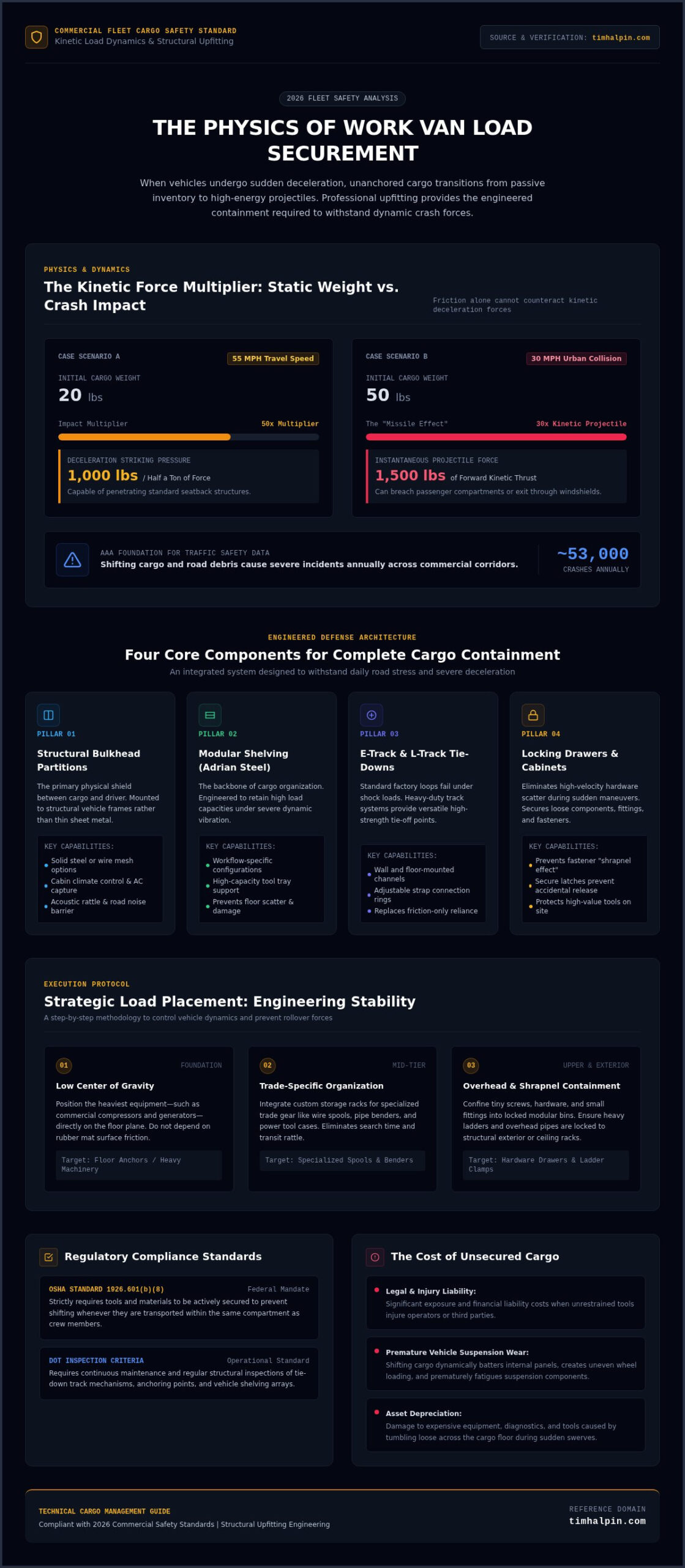
An object weighing just 20 pounds that shifts in a vehicle traveling at 55 mph carries a striking pressure equivalent to half a ton. It’s a sobering reality for every professional who hits the South Florida roads each morning. When you’re navigating the Palmetto or I-95, securing equipment in a work van isn’t just about keeping things tidy. It’s a critical safety system that protects your livelihood and your life. We’ve seen how a single unsecured ladder or a loose power tool can turn a routine commute into a dangerous situation.
You probably know the frustration of arriving at a job site only to find your expensive gear damaged or scattered across the floor. We believe your van should be a silent partner, not a source of stress or rattling noise. This guide will show you how to master professional upfitting using industry leading strategies to ensure your mobile workspace stays organized. You’ll learn about current 2026 safety regulations, the best ways to extend the lifespan of your tools, and how a secure cargo area helps you work faster every single day.
Key Takeaways
- Understand the physics behind cargo movement to prevent everyday tools from becoming dangerous projectiles during sudden stops or collisions.
- Identify how safety partitions and Adrian Steel modular shelving serve as the primary structural defense for both your crew and your equipment.
- Master a step-by-step strategy for securing equipment in a work van by prioritizing a low center of gravity for heavy compressors and generators.
- Implement trade-specific securement layouts that eliminate wasted time by keeping specialized gear like wire spools and pipe benders perfectly in place.
- Recognize the long-term value of professional upfitting to ensure your vehicle remains compliant with 2026 safety standards while protecting your tool investment.
The Hazards of Unsecured Cargo: Why Van Safety Starts with Upfitting
When you’re driving through Miami traffic, the cargo behind you isn’t just inventory; it’s potential energy. We often see professionals treat their van like a mobile storage unit without realizing that a loose wrench can become a lethal threat in a split second. Effective cargo management relies on the fundamental principles of load securement, which combine structural barriers like partitions with active tie-downs to keep everything in its place. Securing equipment in a work van isn’t just about tidiness. It’s about containing forces that your vehicle wasn’t designed to handle internally during an accident.
Consider the math. In a 30 mph collision, a 50-pound tool doesn’t just slide. It transforms into a 1,500-pound projectile. This “missile effect” can punch through seats or exit through the windshield. For fleet managers, the risks go beyond physical safety. You’re looking at significant liability costs if an unsecured load causes injury or property damage. Beyond the legalities, shifting weight constantly batters your van’s interior panels and prematurely wears out your suspension, leading to expensive repairs that could’ve been avoided with a professional upfit.
Understanding Kinetic Energy in a Commercial Van
Don’t rely on friction to do the work. A heavy generator might feel stable on a rubber mat, but physics says otherwise during a sudden swerve. Every loose item maintains its forward speed until something stops it. In 2026, safety data from the AAA Foundation for Traffic Safety shows that road debris and shifting loads contribute to roughly 53,000 crashes annually, proving that kinetic cargo risk is a constant threat for every commercial driver. Without professional securement, that “something” stopping your gear is usually the back of the driver’s seat or the dashboard.
OSHA and DOT Compliance for Work Vans
Staying on the right side of the law is a full-time job. OSHA standard 1926.601(b)(8) is clear: tools and materials must be secured to prevent movement when transported in the same compartment as employees. A professional safety partition is your first line of defense. It acts as a bulkhead that prevents cabin intrusion. Securing equipment in a work van also involves meeting DOT standards, which require regular inspections of your tie-downs and shelving. We help local businesses maintain these standards, ensuring every van in the fleet is a safe, compliant environment for the team.
Core Components for Professional Equipment Securement
Professional upfitting isn’t just a collection of shelves. It’s an integrated safety system designed to withstand the rigors of daily commercial use. When you’re securing equipment in a work van, you need components that work together to create a rigid, predictable environment. We focus on four main pillars: structural partitions, modular shelving, heavy duty tie-downs, and locking storage. Each piece plays a specific role in keeping your tools exactly where you left them, even during emergency maneuvers on the Turnpike.
Heavy-duty commercial shelving systems form the backbone of this setup. These modular units allow for a customized layout that matches your specific workflow while providing the structural integrity required to hold heavy power tools. We also emphasize the use of locking drawer units and cabinets. These are essential for small parts like fittings and fasteners. Without them, loose items become “shrapnel” during a sudden stop, creating a mess at best and a safety hazard at worst.
The Role of Safety Partitions
Think of the safety partition as your first line of defense. It creates a physical bulkhead between the heavy cargo in the back and the driver in the cab. You can choose between solid steel partitions for maximum protection or mesh versions if you need to maintain visibility into the cargo area. Beyond safety, these barriers significantly improve climate control by keeping your AC in the cab where it belongs. They also dampen the constant rattling of tools, making for a much quieter, less stressful drive. For those managing fleets, Tim Halpin Equipment Corp provides expert commercial truck upfitting in Miami to ensure these partitions are mounted to structural points rather than just thin sheet metal.
Tie-Down Systems and Anchor Points
Standard factory tie-downs often fall short for professional needs. We recommend E-Track or L-Track systems, which provide multiple, versatile anchor points along the walls and floor. These systems allow you to adjust your securement based on the day’s load. It’s vital to avoid using factory plastic trim or thin interior panels as anchor points; they will simply rip out under the stress of a shifting load. To stay compliant with OSHA regulations on securing materials, you must use rated straps.
- Ratchet Straps: Best for heavy equipment like compressors or generators that require high tension.
- Cam Buckles: Ideal for lighter, more fragile items where over-tightening could cause damage.
- Floor-Mounted D-Rings: Necessary for anchoring the heaviest items directly to the vehicle’s frame.
If you’re unsure which system fits your specific trade, you can always connect with Tim Halpin Equipment Corp for a professional consultation on the best hardware for your vehicle. Securing equipment in a work van effectively starts with choosing the right tools for the job.
How to Secure Equipment in a Work Van: A Step-by-Step Guide
Setting up your van isn’t just about finding a spot for everything. It’s about engineering a mobile workspace that stays balanced under pressure. When you’re securing equipment in a work van, you need a systematic approach that starts with the heaviest items and ends with a final safety check. We follow a four-step process that ensures every piece of gear is locked down tight before you hit the road. This method protects your equipment investment and ensures your vehicle handles predictably in Miami’s unpredictable traffic.
Step one is all about gravity. Keep your heaviest gear low to the floor and centered between the axles. Step two focuses on the “Big Three”: compressors, generators, and ladders. These are the heavy hitters that cause the most damage if they break loose. Step three involves utilizing vertical space with secure shelving and bins to clear the floor for larger cargo. Finally, step four is the daily pre-trip inspection, where you check strap tension and look for any loose bolts in your shelving units.
Weight Distribution and Balance
Placement matters as much as the tie-downs themselves. You should always place your heaviest items directly over or slightly in front of the rear axle. Improper loading doesn’t just make the van handle poorly; it significantly increases your braking distance and causes uneven tire wear. To keep the vehicle stable, follow the 60/40 weight distribution rule: aim to place 60% of your cargo weight in the front half of the cargo area and 40% toward the rear. This balance keeps the front tires planted for better steering and prevents the “fishtailing” effect during sharp turns.
Securing Large Exterior Equipment
Not everything fits inside the van, but exterior gear needs even more attention due to wind resistance. Ladder racks are a prime example. We recommend drop-down systems that bring the ladder to you, reducing physical strain while ensuring the equipment is locked into a rigid frame. For long materials like PVC or copper, conduit carriers are essential to keep items from sliding forward during hard braking. If you’re using Weather Guard truck toolboxes, take a moment each week to inspect the mounting points for structural integrity. Following the Federal Motor Carrier Safety Administration (FMCSA) rules for exterior loads isn’t just about avoiding fines; it’s about making sure your gear doesn’t become a hazard to the drivers behind you. Securing equipment in a work van effectively means thinking about the outside of the vehicle just as much as the inside.
Trade-Specific Securement Strategies for Maximum Efficiency
Every professional has a unique rhythm to their workday, and your vehicle should reflect that. A one-size-fits-all approach to securing equipment in a work van often leads to wasted time and unnecessary frustration. We’ve spent decades helping Miami contractors build mobile shops that work as hard as they do. By tailoring your securement strategy to your specific trade, you aren’t just improving safety; you’re streamlining your entire workflow from the moment you park at the job site.
Electricians benefit most from specialized spool racks that keep wire organized and ready to pull without tangling. For plumbers, the challenge lies in securing heavy, awkward items like pipe benders and pressurized water tanks. HVAC technicians require dedicated tank racks for refrigerants, ensuring these canisters remain upright and immobile even on bumpy residential streets. General contractors, who may carry lumber one day and tile the next, need the flexibility of modular Adrian Steel systems that allow for quick reconfiguration as project requirements change.
The ‘Golden Zone’ for Frequent Tools
Efficiency starts at the doors. We call the area immediately accessible from the side and rear openings the “Golden Zone.” This space is reserved for the tools you reach for ten times a day. By placing high-use items here, you reduce the physical strain of climbing into the van repeatedly. These frequent-use tools should be double-secured with quick-release systems, providing a balance between immediate access and absolute safety. It’s a simple ergonomic shift that saves hours over a busy work week.
Securing Specialized Gas and Chemicals
Transporting chemicals requires a higher level of vigilance. Whether you’re carrying oxygen, acetylene, or modern refrigerants, proper tank racks are non-negotiable. These racks must be bolted directly to the vehicle’s structural frame to prevent movement during a collision. Ventilation is equally critical; enclosed vans carrying chemicals must have active or passive venting to prevent the buildup of dangerous fumes in the cabin. We also recommend equipping every professional van with high-visibility safety lighting and accessible fire extinguishers. If you need a setup that meets these rigorous standards, contact us today for a professional upfitting consultation. Securing equipment in a work van that carries hazardous materials is a responsibility we take seriously to keep our local community safe.
The Professional Upfitting Advantage in South Florida
DIY upfitting often feels like a smart way to save a few dollars on a Saturday morning. However, commercial work demands more than a few self-tapping screws and a bit of hope. Daily vibrations and heavy loads quickly expose the weaknesses in home-grown solutions. Securing equipment in a work van requires a level of precision that only comes from years of hands-on experience in the field. When a shelf fails at 60 mph, the cost of that DIY project suddenly skyrockets far beyond the initial savings.
Since 1987, Tim Halpin Equipment Corp has served as the steady, knowledgeable guide for Miami’s service fleets. We understand the specific challenges of South Florida’s roads and weather. Professional installation ensures your setup stays compliant with safety standards and maintains your equipment warranties. We focus on minimizing your downtime because we know that if your van isn’t on the road, you aren’t earning. Our team can often complete a professional upfit faster and more reliably than a weekend project, letting you get back to serving your customers.
Authorized Adrian Steel and Weather Guard Installation
We don’t just put shelves in a van; we engineer a workspace. As authorized distributors for Adrian Steel and Weather Guard, we ensure every component is bolted to structural points. Thin sheet metal won’t hold up in a collision. You need the integrity of the vehicle’s frame to provide true safety. Our deep inventory in Miami means you don’t have to wait weeks for parts to arrive. You get the peace of mind that comes with certified safety equipment installed by experts who value their reputation in the community as much as you value yours.
Maintaining Your Upfit in the Miami Climate
Our local environment is uniquely tough on metal. The combination of high humidity and salt air can lead to hardware corrosion if your securement systems aren’t properly managed. We recommend regular maintenance checks for your interior shelving and your liftgates to ensure everything remains structurally sound. A simple securement audit can prevent a catastrophic failure down the line. It’s about protecting your investment and your crew. If you’re concerned about how the elements are affecting your gear, our South Florida team is here to help with a comprehensive fleet audit. Securing equipment in a work van is a long-term commitment, and we’re here to ensure your mobile workspace remains a safe, quiet, and efficient partner for years to come.
Transform Your Van into a High-Performance Tool
Mastering the art of securing equipment in a work van is a choice that pays dividends every single day. Properly installed structural partitions and modular shelving systems turn a cluttered cargo area into a quiet, efficient mobile workshop. By prioritizing proper weight distribution and trade-specific layouts, you protect your expensive tools and ensure your crew arrives safely at every job site across South Florida. It’s about more than just avoiding a mess; it’s about building a professional reputation based on reliability and precision.
At Tim Halpin Equipment Corp, we’ve been helping local professionals stay organized since 1987. As an authorized Adrian Steel dealer, we maintain a massive inventory of securement hardware to get your fleet back on the road without delay. We take pride in being your steady guide through every upfitting decision, ensuring your vehicle stands up to the stress of daily commercial use. Ready to see the difference a professional installation makes? Get a Professional Van Upfitting Quote from Tim Halpin Equipment Corp today. We look forward to helping you build a workspace that works as hard as you do.
Frequently Asked Questions
What is the best way to stop tools from sliding in a van?
The most effective method for securing equipment in a work van involves a two-part system: modular shelving for organization and rated tie-downs for stability. Adrian Steel shelving provides a rigid structure that prevents lateral movement of smaller items. For heavier machinery, we recommend floor-mounted D-rings and ratchet straps. This setup ensures your gear stays put during sharp turns on the Palmetto or sudden stops in heavy Miami traffic, protecting both your tools and your vehicle.
Are van partitions required by law for commercial vehicles?
OSHA 1926.601(b)(8) mandates that tools and materials must be secured to prevent movement when transported in the same compartment as employees. While the law doesn’t explicitly name a “partition,” a steel or mesh bulkhead is the industry standard for meeting this safety requirement. It provides a physical barrier between your crew and heavy cargo. This helps you remain compliant with federal safety standards while protecting your team during daily commutes across South Florida.
How do I secure compressed gas tanks in a work van?
Compressed gas tanks require specialized tank racks that are bolted directly to the vehicle’s structural frame. You should never rely on simple bungee cords for oxygen or acetylene tanks. Instead, use heavy-duty steel racks with integrated straps. These systems keep tanks upright and immobile, preventing dangerous leaks or impact damage. Proper ventilation in the cargo area is also essential for safely transporting these materials in the South Florida heat to prevent dangerous fume buildup.
Can I use bungee cords to secure heavy equipment?
You should never use bungee cords to secure heavy equipment. Bungees lack a certified Working Load Limit (WLL) and can easily snap or stretch under the force of a shifting load. For professional applications, you need ratchet straps or cam buckles that are rated for the weight of your cargo. Using properly rated securement hardware is the only way to guarantee your gear doesn’t become a dangerous projectile during an emergency maneuver on the highway.
What is the most durable shelving brand for work vans?
Adrian Steel is widely considered the most durable shelving brand for commercial fleets. Their systems are engineered to withstand years of vibration and heavy use without rattling or failing. We’ve seen these units outlast the vans they were originally installed in. As an authorized dealer in Miami, we stock a variety of Adrian Steel components that are specifically designed to handle the high-volume demands of professional tradespeople who value long-term reliability and efficiency.
How does cargo securement affect my commercial insurance rates?
While every carrier is different, maintaining a safe, upfitted fleet can lead to lower commercial insurance premiums. Proper cargo securement reduces the likelihood of unsecured load accidents and driver injuries, which are major sources of high-cost claims. Demonstrating a commitment to safety through professional upfitting shows insurers that you’re proactive about risk management. It’s a smart long-term investment for any South Florida business owner looking to protect their bottom line and reduce overall operational risk.
How do I secure a ladder inside my van without it rattling?
The best way to secure a ladder inside your van is by using an interior ladder rack mounted to the ceiling or side wall. These racks use tension-based clamping mechanisms to hold the ladder firmly in place, eliminating the constant metal-on-metal rattling that plagues many DIY setups. By getting the ladder off the floor and into a dedicated rack, you also free up valuable floor space for other essential tools and equipment.
What is the ‘Golden Zone’ in van organization?
The “Golden Zone” refers to the cargo space immediately accessible from the side and rear doors of your van. You should reserve this prime real estate for the tools and materials you use most frequently throughout the day. By organizing your van so high-use items are within arm’s reach, you minimize the need to climb into the vehicle. This ergonomic approach to securing equipment in a work van saves time and reduces physical strain during long days.
