The right truck body can still be the wrong upfit if the chassis, equipment, and installation plan don’t work together. If you’re comparing options for commercial truck upfitting miami, it’s reasonable to focus on the body or tools your crew needs, but vehicle fit, electrical requirements, and installation planning matter just as much.
Start with the work the truck must handle, then check whether the chassis can support the body and equipment you have in mind. This guide explains how to define your project, assess compatibility, and confirm installation requirements before approving the work. It also covers equipment and wiring scope, downtime planning, and how to evaluate a Miami-area partner. Tim Halpin Equipment Corp is a family-owned Miami business serving customers since 1987. Its installation capabilities include truck bodies, toolboxes, van shelving, safety lighting, custom electrical wiring, and structural mounting. Confirm which capabilities apply to your specific vehicle and project.
Key Takeaways
- Start with the truck’s day-to-day duties, then select equipment to fit the work rather than choosing a body first.
- Before approving an upfit, verify payload needs, axle ratings, wheelbase, cab configuration, and mounting points for the specific vehicle.
- When comparing commercial truck upfitting miami providers, ask who checks vehicle fit and coordinates body, mounting, and electrical work.
- Plan the process from vehicle assessment through handover, and discuss site access, operating schedules, and downtime early.
- Confirm the proposed work and each provider’s responsibilities before committing. Not every partner performs every type of chassis modification.
Start with the job: what should a Miami truck chassis modification accomplish?
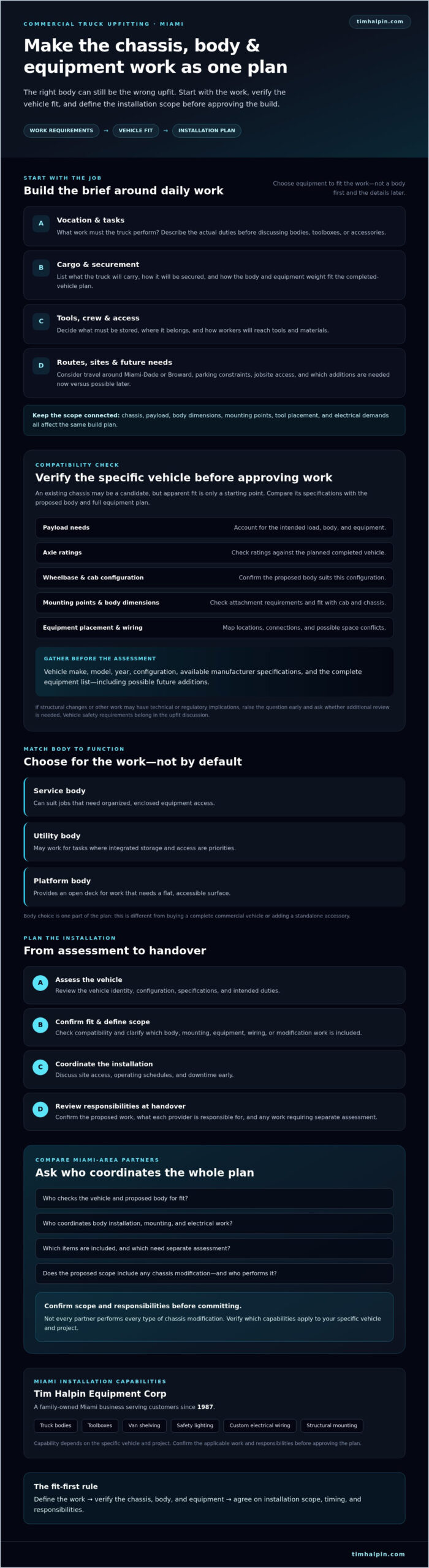
Before choosing a body, toolbox, or other equipment, define the work the truck must do. A clear job brief keeps commercial truck upfitting miami decisions focused on daily fleet needs, not features that may not fit the vehicle or the crew’s routine.
Consider the chassis, payload, body dimensions, mounting points, and electrical demands as one connected plan. A body that suits the trade still needs to fit the chassis, carry the intended load within the vehicle’s ratings, and provide practical access to tools and equipment. Include added electrical components in the installation scope. Considering each choice separately can leave important fit questions unanswered.
A chassis-focused upfit is different from buying a complete commercial vehicle or adding a standalone accessory. A rolling chassis is the vehicle foundation that can be outfitted with a specialized body. An accessory may add one item without addressing the broader body, mounting, or electrical plan. Buying a vehicle and planning an upfit are related, but they’re separate decisions.
Which work requirements should shape the chassis brief?
Describe the actual work before discussing equipment. What will the truck carry? Where will tools and materials be stored, and how will workers reach them? Include routes around Miami-Dade or Broward, parking constraints, and jobsite access needs. Separate essentials from possible future additions to keep the initial scope clear.
- Vocation: What work will the truck perform?
- Cargo: What will it carry, and how will it be secured?
- Tools and crew: What must be stored, and who needs access?
- Routes and conditions: Where will it travel, park, and work?
- Future needs: Which additions are required now, and which are only possibilities?
When is a chassis-focused upfit the right path?
An existing chassis may be a candidate if its specifications appear to support the planned body and equipment. That’s a starting point, not confirmation that the build will fit. Gather the vehicle’s identifying and specification information, then have compatibility assessed before setting the scope. Tim Halpin Equipment Corp is a Miami resource for discussing equipment installation needs, including truck bodies, toolboxes, and safety lighting. Confirm directly which work applies to your vehicle.
Check chassis, body, and equipment compatibility before choosing an upfit
A body can suit the work and still be a poor match for a particular chassis. Before approving installation, compare the vehicle’s specifications with the proposed body and complete equipment plan. Payload, axle ratings, wheelbase, cab configuration, and mounting points all matter. Account for the body and equipment weight when considering the completed vehicle, not just the empty chassis.
Start with the vehicle’s documentation. Record its make, model, year, and configuration, then gather available manufacturer specifications. Ask who will verify the relevant ratings and mounting requirements against the proposed build. If the scope includes structural changes or other work with possible technical or regulatory implications, raise that early and ask whether additional review is needed. NTEA’s guide to Federal Motor Vehicle Safety Standards is a useful reference for understanding why vehicle safety requirements belong in an upfit discussion.
- Chassis: Confirm the vehicle’s configuration and specifications relevant to the planned build.
- Body: Check dimensions, mounting requirements, and how the body fits with the cab and chassis.
- Equipment: Map toolboxes, lighting, and electrical accessories so their placement and connections are included in the plan.
Placement matters. A toolbox may occupy space needed for another component. Lighting needs a suitable mounting location, and electrical accessories need to be included in wiring plans. Share the full equipment list before approving work, including possible future additions. This lets the provider clarify what’s included and what needs separate assessment.
Choose a body by work function rather than assuming one type is always better. A service body can suit jobs that need organized, enclosed equipment access. A utility body may work for tasks where integrated storage and access are priorities. A platform body provides an open deck for work that needs a flat, accessible surface or cargo area. The right choice depends on what you carry, which tools need to be close at hand, and how the crew works around the vehicle. Confirm the specific configuration and compatibility before deciding.
For commercial truck upfitting miami, share the chassis details and proposed equipment with an installation partner, then ask which fit checks and installation tasks can be confirmed for that vehicle. Tim Halpin Equipment Corp lists truck bodies, toolboxes, safety lighting, and installation services among its offerings. Review its commercial equipment installation information as you prepare questions about your project’s scope.
Compare Miami truck upfitters by scope, installation, and support
A useful comparison goes beyond the equipment list. For commercial truck upfitting miami, ask each provider what they’ll handle, what’s outside their scope, and who is responsible for confirming the proposed work fits your truck. Clear answers can reveal coordination gaps before work begins.
Questions to ask before approving a Miami upfit
Ask which tasks the provider performs directly and which require another specialist. Confirm who checks chassis compatibility and coordinates the body, mounting, and electrical work. Request a written scope that lists proposed equipment, identifies exclusions, and notes vehicle information or requirements still to be verified. Ask how scope or schedule changes will be communicated before work proceeds.
Make responsibilities clear. If one company installs a body and another handles a separate component, establish who coordinates between them and who answers questions about the overall installation. Before authorizing work, agree on what you’ll review at handover, such as whether listed equipment is installed in the agreed locations and whether outstanding items are documented. Ask what the provider’s inspection or acceptance process covers rather than assuming one is included.
How to compare installation and after-service support
Compare specific installation tasks and available service options, not broad claims of complete support. Ask what follow-up is available for the equipment involved and whether the provider’s services match your needs. OSHA’s OSHA safety and health standards provide a reference for workplace safety considerations. Discuss requirements relevant to your operation with the appropriate qualified professionals.
Local coverage can matter too. A South Florida provider may make it easier to discuss inspection or follow-up needs in the region where the truck operates, but confirm the actual arrangements. Tim Halpin Equipment Corp is a family-owned Miami business serving South Florida. Its stated installation capabilities include truck bodies, toolboxes, van shelving, safety lighting, custom electrical wiring, and structural mounting. Ask which apply to your vehicle and project, and confirm work beyond that scope with the relevant provider.
A sound choice is a partner who explains the scope plainly, identifies open fit questions, documents responsibilities, and describes the handover process without promising what hasn’t been verified. For a wider fleet-planning perspective, explore Tim Halpin’s commercial truck upfitting guide.
Plan a South Florida chassis modification from assessment to handover
A well-planned upfit creates a clearer path from assessment to putting the truck back to work. For commercial truck upfitting miami, bring vehicle details, work requirements, and scheduling constraints into the conversation early. Timing can depend on the project scope, chassis, components, and confirmed availability, so avoid relying on a fixed estimate before those details are reviewed.
What information should you prepare for an assessment?
Gather vehicle identification and specification documents, photos of the truck, and a list of equipment already installed. Add the tools and materials the truck will carry, crew needs, daily tasks, preferred installation timing, and fleet scheduling constraints. This information gives the installer context to discuss the proposed work and identify questions that need confirmation.
Use this workflow to keep decisions in order:
- Define the use: Describe the truck’s tasks, cargo, crew, routes, and operating conditions.
- Gather vehicle details: Share identifying information, specifications, photos, and current equipment.
- Assess fit: Have the proposed equipment and installation requirements reviewed for the specific vehicle.
- Confirm the scope: Document included work, exclusions, responsibilities, open questions, and handover checks.
- Schedule installation: Discuss timing after the scope and component availability are confirmed.
- Inspect handover: Compare completed work with the approved scope and review equipment operation with the installer.
For Miami-Dade and Broward fleets, discuss site access, operating schedules, and vehicle downtime before setting an installation date. If the truck can’t be spared during a busy work period, raise that constraint early. Share access restrictions and fleet commitments, and ask how schedule changes will be communicated.
Permitting, documentation, and vehicle requirements can vary with the build. Treat them as items to verify with the appropriate provider or authority, rather than assuming they apply uniformly. Confirm which checks or records are needed before work begins.
What should the handover confirm?
At pickup, compare installed equipment with the documented scope and ask the installer to review how each relevant component operates. Request available operating, maintenance, and support information for the equipment. Confirm whether any vehicle-specific documentation or inspection requirements remain outstanding, and clarify who will address them.
Tim Halpin Equipment Corp is a family-owned Miami business serving South Florida, with stated installation capabilities that include truck bodies, toolboxes, van shelving, safety lighting, custom electrical wiring, and structural mounting. Discuss your equipment installation needs and confirm which work applies to your vehicle and project.
Choose a Miami installation partner that can support the complete equipment plan
A sound upfit decision comes down to three checks: the vehicle can support the proposed work, the equipment scope is clear, and everyone understands who is responsible for each installation task. Don’t approve a build while chassis fit, included work, or handoff responsibilities remain uncertain. For commercial truck upfitting miami, a clear discussion with a local installation partner can identify what’s confirmed and what needs further review.
Where Tim Halpin Equipment Corp may fit your project
Tim Halpin Equipment Corp is a family-owned Miami business serving customers since 1987. Its stated installation capabilities include truck bodies, toolboxes, van shelving, safety lighting, custom electrical wiring, and structural mounting. These offerings can help you start a conversation about your equipment plan, but they don’t mean every chassis modification or vehicle configuration is supported. Confirm which requested tasks the company performs and what may require another provider.
If your project involves hydraulic equipment or related repair needs, the truck hydraulics guide offers relevant background. Discuss the specific vehicle and work required before treating any part of the project as confirmed.
Prepare for a useful first conversation
A focused discussion is easier when you have the basics ready. Share the chassis make, model, year, configuration, and available specifications, along with photos and details of existing equipment. Describe the truck’s daily work, what it needs to carry, how the crew will use it, and which equipment is essential now versus a possible future addition. Include preferred installation timing and fleet scheduling constraints.
Then ask for a clear outline of the proposed scope. Which body or equipment items are included? Who will coordinate mounting and electrical work? What chassis details still need verification? Are there vehicle requirements or tasks that need review by another provider or authority? Specific answers make proposals easier to compare and help prevent open questions from being mistaken for resolved details.
Before authorizing work, make sure vehicle fit, the equipment list, installation responsibilities, and outstanding checks are understood. If you’re still shaping the project, share your vehicle details and work requirements with Tim Halpin Equipment Corp to discuss the equipment installation scope that may fit your needs.
Build a Clear Plan for Your Next Upfit
A successful chassis project starts with the truck’s work requirements, then brings vehicle fit, equipment choices, and installation responsibilities into one clear scope. Verify chassis and body requirements before approving the build, and agree on what will be installed and checked at handover. These steps make commercial truck upfitting miami a more informed decision for your fleet.
Tim Halpin Equipment Corp is a family-owned Miami business serving customers since 1987. Its stated installation capabilities include truck bodies and commercial vehicle equipment, with commercial equipment repair and parts support also available. The right fit depends on your specific vehicle and requested work, so confirm the details directly.
Have your chassis information, equipment preferences, and job requirements ready for a practical scope discussion. Discuss your commercial truck equipment project with Tim Halpin.
Frequently Asked Questions
What is commercial truck chassis modification?
Commercial truck chassis modification adapts a vehicle’s chassis configuration or equipment setup to support a particular work function. The scope depends on the vehicle and project. Chassis work is distinct from adding a standalone accessory, installing a body, or purchasing a different vehicle. Describe the truck’s intended work and ask an upfitter to confirm which tasks are appropriate and available for your vehicle.
How do I choose a truck upfitter in Miami?
Choose a provider that can discuss your specific chassis, explain the installation scope, and identify who handles mounting, wiring, equipment coordination, and follow-up support. Ask for written inclusions and exclusions, and confirm experience with your requested equipment. For commercial truck upfitting miami, South Florida fleet managers should also discuss site access, operating schedules, and downtime early, then confirm how project changes will be communicated.
Can any truck body be installed on any commercial chassis?
No. Compatibility depends on the chassis configuration and specifications, the body’s requirements, mounting points, and the truck’s intended work. Vehicles in a similar category aren’t automatically interchangeable for an upfit. Share exact vehicle details and information about the proposed body, then have relevant ratings and installation requirements verified. If the project changes the vehicle’s original configuration, ask whether additional technical or regulatory review is needed.
What information should I give a Miami truck upfitter?
Provide the vehicle’s make, model, year, configuration, and available specifications, along with photos and details of existing equipment. Explain what the truck carries, which tools or body features the crew needs, and how the vehicle is used each day. Include preferred installation timing and fleet scheduling constraints. This helps a South Florida provider discuss the project scope and identify details that need technical verification.
How long does commercial truck upfitting take in Miami?
There isn’t one reliable timeline for every project. The schedule can depend on the chassis, scope of work, equipment selection, component availability, and any additional review or work required. Ask for a project-specific schedule after the vehicle and proposed scope have been assessed. Before authorizing installation, discuss fleet downtime and scheduling needs, and confirm how the provider will communicate schedule changes.
Do truck chassis modifications need approval or inspection in Florida?
Approval, inspection, permitting, or documentation needs depend on the vehicle and the specific work. Don’t assume one requirement applies to every upfit, and don’t treat a general online checklist as a compliance decision. Ask the installer what requirements may apply, then verify them with the appropriate authority or qualified professional before work begins. Confirm any required records or inspections for your vehicle and build.
Does Tim Halpin Equipment Corp perform every type of chassis modification?
No. Tim Halpin Equipment Corp lists commercial equipment installation, including truck bodies, toolboxes, van shelving, and safety lighting, along with commercial truck equipment repair and parts support. That doesn’t establish that every chassis modification or vehicle configuration is supported. For commercial truck upfitting miami in South Florida, contact the team with your chassis details and requested scope to confirm fit, responsibilities, and any requirements needing separate verification.
