
Imagine you’re out on a heavy recovery on a humid Florida afternoon and your equipment suddenly fails under tension. It’s a nightmare scenario that leads to lost revenue and serious safety risks for your crew. We understand that your wrecker is more than just a truck. It’s your livelihood and a source of pride in our local community. Keeping your gear in top shape through regular tow truck winch maintenance isn’t just about following the rules; it’s about having total confidence that your cable will hold when it matters most.
You deserve equipment that works as hard as you do without the stress of premature replacement costs. Our professional guide for 2026 provides a clear, repeatable maintenance schedule designed to lower your long-term repair expenses. We’ll walk you through the latest federal safety mandates, including the annual DOT inspection requirements, and the critical differences between maintaining steel and synthetic lines. From daily inspection tips to deep-dive hydraulic care, you’ll learn exactly how to keep your fleet running smoothly and safely.
Key Takeaways
- Discover how a systematic approach to tow truck winch maintenance protects your investment and prevents the high cost of equipment downtime.
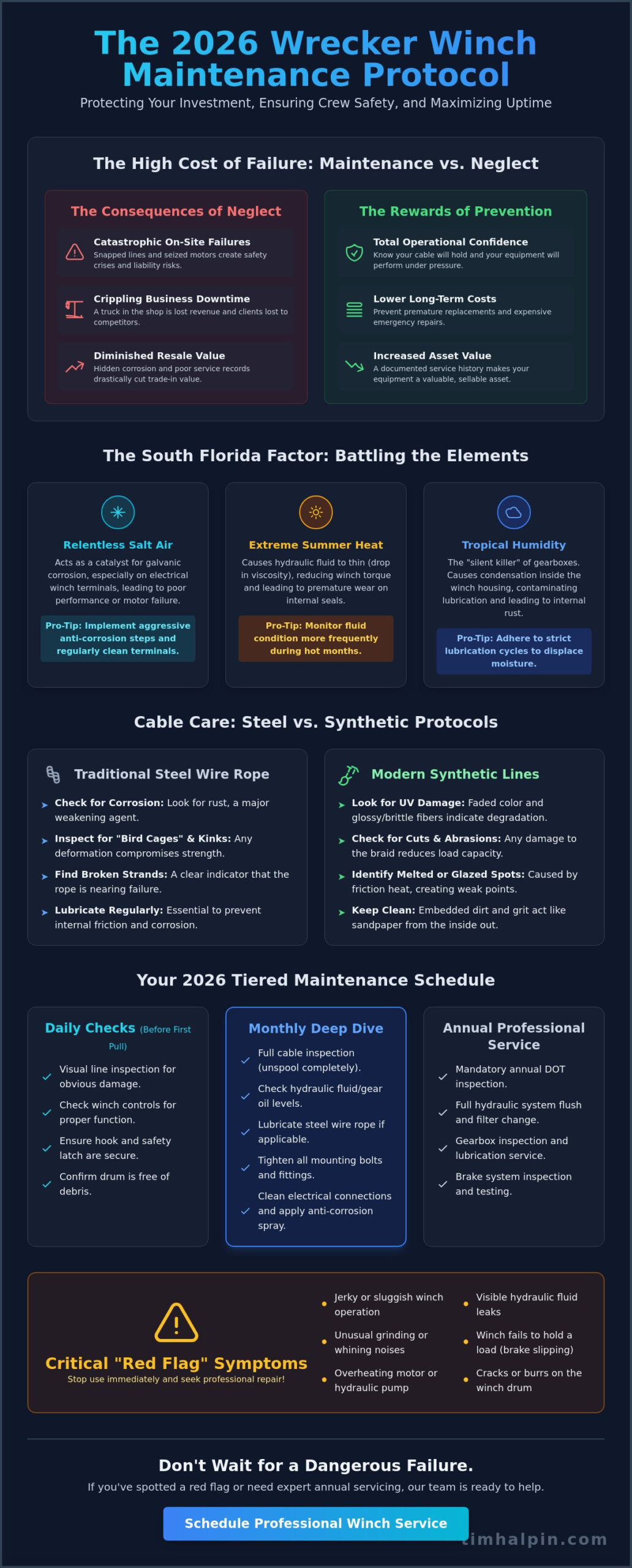
- Learn how to combat South Florida’s unique challenges, from salt-driven terminal corrosion to heat-related hydraulic fluid thinning.
- Master the specific inspection protocols for both traditional steel wire ropes and modern synthetic lines to ensure maximum recovery safety.
- Implement a tiered maintenance schedule for 2026 that integrates daily checks into your busy recovery workflow without sacrificing efficiency.
- Identify the critical “Red Flag” symptoms that signal it’s time to seek professional hydraulic or gearbox repair to avoid dangerous equipment failures.
The High Cost of Winch Failure: Why Preventative Maintenance is Your Best Investment
Professional tow truck winch maintenance is more than just a chore. It is a systematic, disciplined approach to cleaning, lubricating, and inspecting the recovery gear that serves as the heart of your wrecker. For a local operator, your truck is your office and your primary tool. When you commit to a rigorous maintenance schedule, you are protecting the integrity of your business. This process involves looking past the surface to ensure every gear, seal, and cable is ready for the next heavy pull.
Neglecting these tasks creates a direct path to catastrophic on-site failures. A snapped line or a seized motor during a recovery isn’t just a mechanical issue; it is a safety crisis. These failures often happen at the worst possible moments, such as during a technical recovery on a busy highway. Beyond the immediate danger, there are significant liability risks to consider. If equipment isn’t maintained to manufacturer standards, your company could face severe legal and insurance consequences following an accident. Your reputation in the community depends on being a reliable, safe partner for every job.
The financial impact of a failure extends far beyond the repair bill. A broken Winch means a truck that isn’t making money. While your vehicle sits in the shop, you’re losing revenue and potentially losing long-term clients to competitors. We’ve seen how “Business Downtime” can cripple a fleet’s growth. Investing a small amount of time today prevents the high cost of a truck being out of service for a week later.
Core Components of Professional Wrecker Winches
The drum is the foundation of your recovery system. You must check it regularly to ensure structural integrity and a smooth spooling surface. Any burrs or cracks on the drum can shred your cable and lead to a break. The motor requires different care depending on whether it’s electric or hydraulic. Electric motors need clean, corrosion-free terminals, while hydraulic systems require pristine fluid and tight seals to maintain torque. Finally, the brake system is often the most overlooked part. In the towing world, the “hold” is much more important than the “pull.” A failing brake means you lose control of the load, which is a risk no professional should take.
How Maintenance Impacts Equipment Resale Value
When it comes time to upgrade your fleet, a documented service history is a massive value-add for liquidation or trade-in. Prospective buyers look for proof that the equipment was cared for properly. Preventing internal rust in gearboxes is essential, as hidden corrosion can kill the trade-in value of an otherwise great truck. Regular lubrication cycles are the single most effective way to extend the operational life and ensure the longevity of your winch. By keeping detailed records of your tow truck winch maintenance, you turn a piece of working equipment into a valuable asset that holds its worth over the vehicle’s life.
The South Florida Factor: Battling Humidity, Salt Air, and Heat
Operating a wrecker in Miami or along the coast is a badge of honor, but it comes with a unique set of environmental challenges. Living in our beautiful coastal region means your equipment is constantly exposed to a harsh, saline environment. This isn’t just about keeping the truck looking sharp. Salt air acts as a relentless catalyst for galvanic corrosion, especially on electrical winch terminals. When salt deposits settle on copper or aluminum connections, they create a bridge for electrical current to leak. This leads to poor performance or total motor failure at the worst possible time. For local fleets, tow truck winch maintenance must include aggressive anti-corrosion steps that inland operators might ignore.
The heat is just as relentless as the salt. During the peak of a Miami summer, your hydraulic fluid can thin significantly as temperatures climb. This drop in viscosity reduces the winch’s torque and can lead to premature wear on internal seals. It’s a subtle change that often goes unnoticed until a heavy recovery feels sluggish or jerky. We recommend monitoring your fluid condition more frequently during the hotter months to ensure your system maintains the pressure needed for heavy pulls. High-quality corrosion inhibitors are your best friend here, acting as a shield against the elements.
Tropical humidity is the silent killer of gearboxes. It causes condensation to form inside the winch housing, which eventually contaminates the oil and causes internal pitting on the gears. While following OSHA winch safety standards provides a solid foundation for safety, our local conditions require going a step further with moisture-resistant lubricants. Keeping your gear clean and dry is a neighborhood tradition we take seriously to keep our community’s service vehicles running.
Corrosion Prevention for Electrical and Hydraulic Connections
Professional tow truck winch maintenance in our climate starts with sealing out moisture. Apply a generous layer of dielectric grease to every electrical connection to prevent salt-driven oxidation. You should also inspect your hydraulic fittings for salt-crust buildup or “sweating,” which often signals a micro-leak that’s attracting grime. Regularly washing the winch housing is essential; don’t let debris trap moisture against the metal surfaces. If you notice persistent leaks or corrosion, our team provides expert hydraulic repair services to keep your fleet in top shape.
Managing Overheating in High-Temperature Environments
Miami’s summer peaks mean you must respect your equipment’s duty cycles. Overheating a hydraulic winch is easy when the ambient temperature is already in the 90s. Keep your hydraulic coolers clear of bugs, road grime, and salt to ensure maximum airflow. If you notice your winch losing power in the afternoon heat, it may be time to switch to a heavy-duty summer fluid with higher viscosity. These small adjustments ensure that your equipment remains a steady, knowledgeable guide for every recovery job.
Cable and Drum Care: Steel vs. Synthetic Maintenance Protocols
The choice between steel wire rope and synthetic lines often comes down to the specific needs of your fleet. Steel remains the industry standard for its incredible resistance to abrasion, especially when you’re dragging lines across rough Florida pavement. Synthetic lines are gaining popularity because they’re 85% lighter and significantly safer if a snap occurs. However, each material requires a distinct approach to tow truck winch maintenance to ensure long-term reliability. Your choice of material dictates your cleaning and inspection routine.
For those using synthetic rope, the biggest threat in our local environment is sand. Miami’s fine grit can work its way deep into the fibers of the rope. As the line tensions, these tiny grains act like microscopic knives, cutting the fibers from the inside out. You must regularly wash your synthetic lines with fresh water to flush out these abrasives. If you’re sticking with steel, your focus shifts to corrosion and physical deformation. Bird-caging, where the outer strands pull away from the core, or sharp kinks are signs that the cable’s structural integrity is gone. Following best practices from the Towing and Recovery Association of America (TRAA) ensures your team stays safe and compliant during heavy recoveries.
Pre-tensioning is a critical step that many operators skip. When you install a new cable, you can’t just wrap it loosely around the drum. It needs to be spooled under a load, typically about 10% of the winch’s capacity, to ensure the layers sit tightly against each other. Without this tension, the upper layers will “dive” into the lower ones under a heavy load, causing permanent damage to the rope.
Inspecting Wire Rope for Kinks and Broken Strands
Steel cables require a keen eye. You should retire a cable if you find more than six broken wires in one rope lay, or three broken wires in one strand in one lay. This is often called the 10% rule. Look for flat spots along the cable, as these usually indicate that the internal core has failed. To find hidden “fish hooks” or broken strands, lightly run a gloved hand with a rag over the cable. The rag test is a simple way to detect broken wire strands that might be too small to see but large enough to snag the fabric.
Proper Spooling: Preventing Drum Crushing and Overlapping
How you wrap your cable is just as important as the cable itself. Nested cables occur when the top layers of the rope pull down into the gaps of the lower layers. This creates massive pressure that can actually crush or warp the winch drum. When installing a new line, you must pre-tension it by spooling it under a load of at least 500 to 1,000 pounds. This ensures a tight, uniform wrap. We also recommend lubricating the drum core before installing the first layer. This prevents the inner layers from rust-bonding to the metal, a common issue in our humid coastal air. Proper spooling is a cornerstone of effective tow truck winch maintenance and prevents expensive drum replacements down the road.
Your 2026 Tow Truck Winch Maintenance Schedule: Daily, Monthly, and Annual Checklists
A successful recovery business runs on reliability. We’ve found that the best way to maintain that reliability is through a tiered maintenance system. This approach separates quick daily checks from the deeper technical services required every few months. By following a structured schedule for tow truck winch maintenance, you empower your drivers to spot trouble before it leaves them stranded on the side of the Palmetto Expressway. It’s about protecting your team and your bottom line. Consistency is what separates the seasoned professionals from the discount competitors.
Daily checks are your first line of defense against road-side emergencies. While these only take a few minutes, they provide a baseline for your equipment’s health. For heavy-duty Jerr-Dan or Miller units, a quarterly deep-service is non-negotiable. These high-capacity machines handle immense stress, and their internal components require more frequent attention than a standard light-duty wrecker. When you do find wear and tear, using the right tow truck parts Florida operators trust ensures your repairs actually last.
The 5-Minute Daily Pre-Shift Operator Check
Every shift should begin with a focused walkaround. Your operators should perform a visual inspection of the hook, latches, and pins for any hairline cracks or signs of metal fatigue. Next, they must test the remote control and manual overrides for immediate responsiveness. A delay in the controls can be dangerous during a precision recovery. Finally, check the pavement for fresh hydraulic puddles under the winch motor. Catching a small leak in the morning prevents a total system failure during a high-stakes pull later in the day.
Deep-Dive Quarterly Service Requirements
Every three months, your winch needs shop-level attention to address internal wear. This starts with draining and replacing the gearbox oil. This process removes metal shavings and accumulated moisture that can lead to gear pitting. You should also perform a full cable extraction. Pull the entire length off the drum to inspect the inner layers for kinks or “bird-caging” that are hidden during daily use. Finally, load test the brake system. If the winch shows any sign of slippage at maximum capacity, it requires immediate professional attention. If your quarterly inspection reveals complex issues, our team offers expert tow truck repair to help you get back on the road safely.
When to Call the Experts: Professional Tow Truck Winch Repair in Miami
Even with the most diligent tow truck winch maintenance, mechanical components eventually reach the end of their service life. Recognizing the “Red Flag” symptoms early can be the difference between a controlled repair and a dangerous on-site failure. If your winch begins making unusual grinding noises or feels hot to the touch after a standard pull, it’s time to stop and seek a professional diagnosis. These sounds often signal that internal gears are slipping or that the bearings have finally succumbed to the relentless South Florida heat and salt.
Attempting a DIY gearbox repair or messing with hydraulic winch timing is a high-stakes gamble. These systems are engineered with precise tolerances to manage thousands of pounds of tension. A small mistake during reassembly can lead to a catastrophic failure under load, putting your operators and the public at risk. We believe in the power of partnership and local expertise. When the job requires opening the case or recalibrating hydraulic pressures, trusting a seasoned professional is the only way to ensure the long-term safety of your fleet.
Using high-quality OEM parts from trusted brands like Miller Industries or Century is non-negotiable for professional wreckers. Generic components rarely meet the same stress-test standards as original equipment. At Tim Halpin Equipment Corp, we’ve spent decades positioning ourselves as the steady, knowledgeable guide for South Florida’s towing community. We take immense pride in our local heritage and the relationships we’ve built with fleet owners across the region. Our goal is always to get you back to work with equipment you can trust implicitly.
Signs Your Winch Needs a Professional Rebuild
One of the most common signs of trouble is a hydraulic bypass issue. This happens when the winch continues to pull but lacks the rated power to handle its usual loads. You might also notice visible structural cracks in the winch mounting plates or the frame itself; these are immediate “out-of-service” indicators. Finally, don’t ignore electrical “ghosts.” If your winch starts or stops unexpectedly, it often points to a deep-seated wiring harness failure that requires specialized diagnostic tools to trace and fix correctly.
The Tim Halpin Advantage: South Florida’s Largest Inventory
When downtime isn’t an option, having access to the right parts is everything. We maintain an extensive inventory of Miller Industries towing equipment parts to ensure our neighbors aren’t waiting weeks for a shipment. With over 35 years of experience in the South Florida truck equipment industry, we understand the specific toll our environment takes on your gear. Our specialized truck hydraulics Miami services are designed to minimize your downtime and keep your revenue flowing. We invite you to connect with our team for a professional overhaul that honors the hard work you put in every day.
Protecting Your Fleet and Your Future
Your wrecker is more than just a truck; it’s a commitment to the safety and movement of our South Florida community. By implementing a tiered approach to tow truck winch maintenance, you’re doing more than just ticking a box for compliance. You’re ensuring that when the call comes for a heavy recovery on a humid Miami afternoon, your gear will perform exactly as it should. We’ve explored how daily vigilance and specialized care for our coastal environment keep your business profitable and your operators safe.
When the job requires professional precision or hard-to-find components, you need a partner who understands the local landscape. Since 1987, we’ve served as a steady guide for fleets across the region. As an authorized dealer for Miller Industries and Jerr-Dan parts, we maintain the largest inventory of specialized truck parts in Miami. Don’t let equipment wear slow you down. Get Expert Winch Repair and OEM Parts at Tim Halpin Equipment Corp and keep your fleet moving with confidence. We’re here to help you stay ahead of the curve and ready for every recovery.
Frequently Asked Questions
How often should I grease my tow truck winch?
You should grease your winch at least once a month if you’re running a busy recovery schedule. For trucks working fewer calls, a quarterly schedule is usually sufficient. Focus on the drum supports and any external grease fittings. Consistent lubrication prevents metal-on-metal wear and keeps the internal gears moving smoothly during a heavy pull. It’s a small task that prevents expensive gear failures.
Can I use WD-40 to lubricate my winch cable?
No, you should never use WD-40 as a primary lubricant for your winch cable. While it’s great for displacing water, it’s actually a solvent that can strip away necessary internal grease. Instead, use a dedicated wire rope lubricant that penetrates the strands to prevent internal friction and rust. This is a vital part of long-term tow truck winch maintenance for any professional fleet.
Why is my hydraulic winch losing pulling power when it gets hot?
Your hydraulic winch loses power because the hydraulic fluid thins as its temperature rises. When the oil’s viscosity drops, the system can’t build the pressure needed to maintain maximum torque. This is particularly common during Miami summers. If you notice a consistent loss of power in the afternoon heat, check your hydraulic cooler for blockages or consider switching to a higher-viscosity summer fluid.
Is synthetic rope better than steel for Miami towing operations?
It depends on your specific workload, but steel often remains the choice for professional towing due to its superior abrasion resistance. Synthetic rope is excellent for safety and reduced weight, but it can be easily damaged by the sharp debris and rough pavement found at accident scenes. If you choose synthetic, you must be extremely diligent about washing out sand and grit to prevent internal fiber wear.
How do I know if my winch brake is failing?
You can tell your winch brake is failing if the load “creeps” or slips when the winch is stopped under tension. The brake’s primary job is to hold the load securely, not just slow it down. If you notice any movement after you release the controls, the brake pads or springs are likely worn and need immediate professional attention to ensure the safety of your crew.
Should I replace my winch cable after every heavy recovery?
You don’t need to replace the cable after every recovery, but you must inspect it every single time. Look for kinks, flat spots, or “bird-caging” where the strands have separated. If you see more than six broken wires in one rope lay, it’s time for a replacement. Regular inspections are the best way to prevent a catastrophic failure during your next big job in the field.
What is the best way to clean salt off my wrecker equipment?
The most effective way to clean salt off your equipment is a thorough rinse with fresh, low-pressure water after every shift near the coast. Use a mild soap to break down stubborn salt deposits on the winch housing and electrical terminals. Don’t use high-pressure washers directly on seals or electrical connections, as this can force water and salt deeper into the components and cause corrosion.
How do I ground an electric winch to prevent motor burnout?
To prevent motor burnout, always ground your electric winch directly to the vehicle’s battery or a dedicated frame grounding point. Ensure the connection surface is clean, bare metal with no paint or rust. A poor ground creates electrical resistance, which generates excessive heat and is a leading cause of winch motor failure. Proper grounding is a foundational step in tow truck winch maintenance.
