

You’re halfway through a busy delivery route when a standard 2,000-pound pallet suddenly feels like an anchor because the liftgate is struggling to move. It’s a frustrating moment that puts your schedule behind and your equipment at risk of a costly failure. Finding the sweet spot between lifting power and truck payload is a challenge every fleet manager faces. This liftgate weight capacity guide provides the clarity you need to keep your drivers safe and your equipment running smoothly without overtaxing your vehicle’s limits.
We understand that you want to protect your investment and avoid the stress of unexpected repairs. It’s common to feel concerned about how a heavy-duty liftgate might affect your truck’s Gross Vehicle Weight Rating or void a warranty. We’re here to show you that specifying the right power doesn’t have to be complicated. In this article, you’ll learn a reliable framework for calculating load requirements and discover which brands, like Maxon, Waltco, or Tommy Gate, best suit your specific cargo needs. We’ll also walk through how to ensure your installation stays compliant and efficient so you can stay focused on the road ahead.
Key Takeaways
- Distinguish between rated capacity and safe working load to ensure your fleet always operates within safe engineering limits.
- Follow this liftgate weight capacity guide to calculate real-world requirements by combining cargo weight with the weight of your pallet jacks or walkies.
- Master the Center of Gravity rule to prevent structural damage and maintain the hydraulic pressure necessary for consistent lifting power.
- Match your specific cargo needs to the right liftgate design to optimize truck payload while maintaining equipment longevity.
- Prioritize professional installation and genuine OEM parts to protect your vehicle’s warranty and ensure every lift meets its rated capacity.
Understanding Liftgate Weight Capacity Ratings
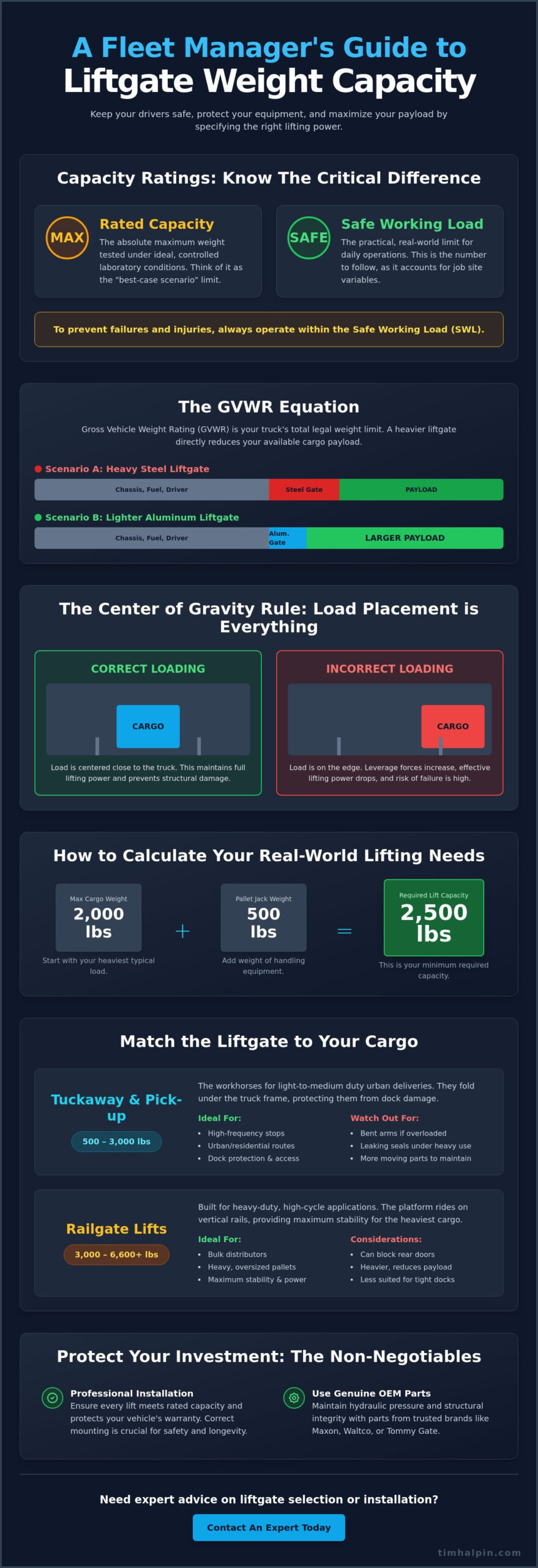
A Tail lift (liftgate) is much more than a simple metal shelf attached to the back of your truck. It’s a precision-engineered hydraulic tool designed to bridge the gap between the ground and your cargo bed. At its core, weight capacity refers to the maximum safe load a gate can lift when that load is centered at a specific point on the platform. This liftgate weight capacity guide highlights a critical reality: capacity isn’t a static number. If a pallet is sitting on the very edge of the platform, the leverage forces change, and the gate’s effective lifting power drops significantly.
You’ll frequently encounter two different terms in manufacturer manuals: rated capacity and safe working load (SWL). Rated capacity represents the absolute maximum weight the gate can handle under laboratory conditions. The safe working load is the practical limit you should stick to during daily operations to account for real-world variables like wind, uneven ground, or equipment age. For commercial fleets operating in Florida, exceeding these capacities is a serious liability. An equipment failure during a delivery in a crowded Miami neighborhood doesn’t just mean a broken gate; it means potential cargo damage, worker injury, and legal headaches that can tarnish a company’s reputation.
The Role of the Gross Vehicle Weight Rating (GVWR)
Every component added to your truck has a weight, and that weight counts against your Gross Vehicle Weight Rating (GVWR). This rating is the maximum legal weight your vehicle can reach, including the chassis, fuel, driver, and every pound of cargo. If you spec a massive, heavy-duty steel liftgate for a truck that doesn’t truly need it, you’re voluntarily shrinking your legal payload. We’ve seen many local businesses find success by switching to lighter aluminum platforms for their South Florida delivery routes. These platforms offer the durability required for high-frequency stops while keeping the truck’s total weight low enough to maximize the amount of product you can carry in one trip.
Static vs. Dynamic Loading
There’s a significant difference between weight that’s sitting still and weight that’s in motion. Static weight is the simple measurement of your pallet while it’s parked on the platform. Dynamic weight is the force generated when that pallet moves, such as when a driver hits the “up” switch or when a heavy pallet jack rolls over the edge of the gate. These movements create momentary spikes in pressure within your hydraulic lines. Dynamic load stress occurs when movement amplifies the effective weight of the cargo, which can eventually lead to blown hydraulic seals or structural cracks. Ensuring your hydraulic system is properly maintained is the only way to guarantee the gate can handle these daily stresses without a breakdown.
Matching Liftgate Types to Weight Requirements
Choosing the right equipment is a lot like picking the right vehicle for a specific South Florida route. You wouldn’t use a heavy-duty tractor-trailer to deliver a single pallet of artisan goods in a quiet residential neighborhood. This liftgate weight capacity guide emphasizes that the structural design of a gate is the foundation of its lifting power. The way a gate attaches to your truck, whether it’s tucked under the frame or mounted on vertical rails, dictates the physics of every lift. Brands like Maxon and Waltco have spent years refining these designs to serve different capacity tiers. While Maxon is often celebrated for its robust tuckaway models, Waltco is a frequent choice for high-cycle rail gates used by our local distributors.
There’s always a trade-off between platform size and lifting power. A larger platform gives your drivers more room to maneuver, but it also increases the leverage applied to the hydraulic cylinders. If you select a platform that is too deep for the gate’s rated capacity, even a standard load can become a safety risk if it’s placed too far from the truck. Balancing these technical needs requires a steady, knowledgeable hand to ensure your fleet remains both productive and safe during every stop.
Tuckaway and Pick-up Lifts (500 – 3,000 lbs)
These units are the absolute workhorses for urban delivery routes across Miami. They fold neatly under the truck frame when not in use, which protects the gate from dock damage and allows for easy access to the rear doors. While they’re perfect for light-to-medium duty tasks, they do have limitations. The folding mechanism has more moving parts and pivot points than a fixed rail gate. When these units are pushed to their 3,000-pound limit day after day, the most common failure points are bent lifting arms or leaking hydraulic seals. If your business regularly handles oversized pallets that exceed the platform’s depth, a tuckaway might not provide the long-term reliability you need.
Rail, Column, and Cantilever Lifts (3,000 – 6,000+ lbs)
When your cargo involves heavy industrial machinery or bulk beverage crates, you need the vertical strength of a rail or column lift. Rail lifts move along tracks mounted directly to the rear of the vehicle body. This design is the preferred choice for South Florida beverage and food distributors because it offers a massive, stable platform that stays level throughout the entire lift cycle. Cantilever lifts take this a step further by offering a “level-ride” feature that compensates for uneven ground. If you’re struggling to decide which high-capacity model suits your specific chassis, consulting with experts in liftgate repair and installation can help you avoid a costly spec’ing mistake that might void your truck’s warranty.
How to Calculate Your Required Liftgate Capacity
Calculating the right capacity isn’t just about looking at your heaviest pallet and picking a matching number. It’s a precise calculation that ensures your equipment operates within its comfort zone rather than at its breaking point. Most fleet owners start by identifying their heaviest possible single-pallet load. If you’re hauling 2,500 pound loads of construction materials or bulk beverages, you might think a 3,000 pound gate is plenty. However, that logic often leads to premature hydraulic failure. This liftgate weight capacity guide recommends a more thorough four-step approach to protect your investment.
- Step 1: Identify your heaviest single pallet. Always spec for the “worst-case” scenario.
- Step 2: Factor in the weight of your pallet jack or motorized walkie. This is the most common omission in fleet planning.
- Step 3: Account for the driver or operator. A person standing on the platform adds another 150 to 250 pounds of dynamic weight.
- Step 4: Add a 10 to 20 percent safety margin. This buffer prevents your hydraulics from running at maximum pressure during every cycle, which significantly extends the life of your seals and motor.
The Pallet Jack Factor
The equipment you use to move cargo is just as important as the cargo itself. A standard manual pallet jack typically adds 150 to 200 pounds to your total lift weight. If your team uses electric pallet jacks or motorized walkies, the impact is much more dramatic. These units often weigh between 600 and 1,000 pounds. If you don’t account for that extra half-ton, you’ll find your “rated” gate struggling to clear the ground. Beyond weight, you must ensure your platform depth is large enough to fit both the jack and the pallet safely without the wheels hanging over the edge.
Laden vs. Unladen Considerations
A truck’s behavior changes depending on how much it’s carrying. When your vehicle is fully loaded, the suspension compresses, and the bed height can drop by several inches. You need to ensure your liftgate has enough “travel” to reach the ground comfortably when the truck is empty and sitting at its highest point. Conversely, you don’t want the gate bottoming out or scraping when the truck is laden. Level-ride features are particularly helpful here. They keep the platform parallel to the ground regardless of the truck’s angle, which is essential for keeping tall or unstable loads from tipping during the transition from the bed to the street.
Factors That Impact Real-World Lifting Power
A weight rating sticker on a liftgate is a promise of performance, but that promise depends on the laws of physics and the state of your equipment. Even if you’ve followed this liftgate weight capacity guide to the letter during the spec’ing phase, real-world factors can quickly sap your lifting power. One of the most misunderstood concepts in fleet management is the Center of Gravity (CoG) rule. Most manufacturers calculate their rated capacity based on a load center situated 24 inches from the inner edge of the platform. When a driver places a heavy pallet at the very tip of the gate to make room for a pallet jack, they are unintentionally doubling the stress on the hydraulic cylinders. A 3,000 pound load at the edge can act like a 6,000 pound load, causing the platform to flex or the relief valve to bypass, which results in a failed lift.
Load Positioning and the Leverage Principle
Centering your cargo is the simplest way to prevent equipment damage. When a load is placed too far back, it creates a leverage effect that forces the hydraulic pump to work much harder than intended. This extra strain doesn’t just slow down the lift; it can lead to the platform “dropping” or tilting unevenly. To stay safe, drivers should always aim to have the heaviest part of the cargo as close to the truck’s rear as possible. This positioning ensures the weight is distributed directly over the lifting arms, allowing the gate to operate within its engineered safety parameters.
Hydraulic and Electrical Health
South Florida’s unique environment also plays a role in how your equipment performs. The intense heat and humidity can cause hydraulic fluid to thin out or seals to become brittle over time. If you have leaking seals or a worn pump, your system will struggle to maintain the pressure required to move heavy cargo. This is why regular inspections of truck hydraulics in Miami are essential for preventing mid-route breakdowns. When hydraulic fluid bypasses a seal internally, the gate might “creep” downward under load, a clear sign that you’re losing effective capacity.
Your electrical system is the heart of the operation. Electric-hydraulic liftgates require a consistent, high-voltage current to drive the motor. If your battery connections are corroded or the charging lines are too thin, the motor will spin slower and generate less torque. Heavy-duty gates often require dedicated battery boxes mounted to the trailer frame to ensure there’s enough “juice” for high-cycle routes. If you notice your gate moving slower than usual or making a strained, high-pitched whining sound, it’s time to test your voltage and hydraulic pressure before a minor issue turns into a total equipment failure. If your fleet is struggling with these symptoms, it’s time to schedule a professional liftgate inspection to restore your rated lifting power.
Professional Installation and Parts Sourcing in Miami
Specifying the right equipment is only half the battle. The final, and perhaps most critical, step is ensuring that your chosen unit is installed by experts who understand the nuances of truck geometry. You can follow every calculation in this liftgate weight capacity guide, but if the mounting plates aren’t welded correctly or the electrical lines are undersized, the gate will never reach its rated potential. A professional installation guarantees that the physics of the lift align with the manufacturer’s intent, protecting your drivers and your cargo from the risks of structural failure. We’ve seen how improper mounting can lead to frame twisting or premature hydraulic wear, issues that are easily avoided with a steady, knowledgeable hand at the helm.
Maintenance is a long-term commitment to safety. Regular inspections allow our team to catch small issues like weeping seals or frayed cables before they lead to a total breakdown in the middle of a delivery route. We understand that in the fast-paced South Florida market, every hour of downtime is an hour of lost revenue. By using high-quality diagnostics and keeping our shelves stocked with the right components, we help you maintain the lifting power your fleet needs to stay competitive and reliable.
Sourcing OEM Liftgate Parts
The risks associated with generic or “will-fit” parts are simply too high when you’re dealing with high-capacity hydraulic systems. These parts might look identical to the naked eye, but they often lack the precise metallurgy or heat treatment required to handle the dynamic stresses we discussed earlier. Staying with genuine Waltco liftgate parts Miami ensures your equipment stays within its original safety parameters and maintains its warranty status. We carry an extensive selection of Maxon, Tommy Gate, and Anthony components, serving as a vital resource for export truck parts Miami businesses use to keep their operations running smoothly across the region and beyond.
South Florida’s Trusted Liftgate Partner
Tim Halpin Equipment Corp has been a steady, knowledgeable guide for the Miami trucking community since 1987. We take immense pride in our local roots and the long-term relationships we’ve built with fleet owners across our regional districts. Our goal is to reduce the stress of equipment management by providing authoritative data and neighborly service. We’re seasoned experts who believe that no fleet fluctuation is too complex to solve with the right experience. Whether you need a capacity evaluation for an aging gate or you’re ready to spec a new fleet upgrade, we’re here to help. Contact us today to ensure your liftgates are ready for the road ahead.
Empowering Your Fleet for the Road Ahead
Choosing the right equipment is about more than just reading numbers on a sticker; it’s about the longevity of your vehicles and the safety of your drivers. By using this liftgate weight capacity guide, you’ve taken the first step toward understanding how load centers and hydraulic health dictate your real-world lifting power. Remember that factoring in the weight of your pallet jacks and maintaining a healthy safety margin are the keys to avoiding mid-route failures. It’s these small technical details that keep a business running smoothly and efficiently day after day.
We’ve been a family-owned staple in the Miami community since 1987. We’re proud to offer one of the largest liftgate parts inventories in the USA alongside expert hydraulic and mechanical repair on-site. Whether you need a quick fix or help spec’ing a complex new fleet, our team provides the seasoned expertise you can rely on. Need expert advice on your next liftgate? Contact Tim Halpin Equipment Corp today for professional spec’ing and parts. We look forward to helping you keep your operations moving safely through every neighborhood in South Florida.
Frequently Asked Questions
What is the standard weight capacity for a box truck liftgate?
Standard capacities for box trucks typically range from 2,000 to 3,000 pounds for general freight applications. While smaller delivery vehicles might operate with 1,000 to 1,500 pound units, heavy duty box trucks often require 4,000 or 5,000 pound capacities. Your choice depends entirely on your specific cargo and the frequency of your delivery stops.
Can I increase the weight capacity of my current liftgate?
You cannot safely increase the rated weight capacity of an existing liftgate because the limit is determined by the unit’s structural engineering and hydraulic specifications. Attempting to modify a gate to lift more than its original rating can lead to catastrophic failure. If your needs have outgrown your current equipment, the only reliable solution is to install a new unit designed for higher loads.
How does the weight of a pallet jack affect my liftgate needs?
A pallet jack adds significant weight that many fleet managers overlook when calculating their total requirements. A standard manual jack adds roughly 150 to 200 pounds, while an electric pallet jack can add between 600 and 1,000 pounds to every lift. This liftgate weight capacity guide emphasizes that you must combine the weight of the jack, the pallet, and the operator to find your true needs.
Why does my liftgate struggle to lift loads even when they are under the rated capacity?
Your liftgate might struggle due to poor load positioning or underlying mechanical issues like low hydraulic pressure or weak electrical voltage. Even if a load is technically under the rated weight, placing it at the very edge of the platform creates leverage that strains the cylinders. We often find that leaking internal seals or corroded battery connections are the culprits behind a sluggish or weak lift.
Is a 3,000 lb liftgate enough for a standard grocery pallet?
A 3,000 pound liftgate is generally sufficient for standard grocery pallets, which typically weigh between 1,500 and 2,500 pounds. However, you must account for the additional weight of the pallet jack and the driver standing on the platform. If your pallets regularly push the 2,500 pound mark, a 4,000 pound gate provides a safer buffer and reduces long term wear on your hydraulics.
How often should I have my liftgate capacity and hydraulics inspected?
You should schedule a professional inspection of your liftgate and hydraulic system at least every six months to ensure peak performance. High cycle fleets that make dozens of stops per day might require more frequent checkups to catch wear and tear early. Regular maintenance helps you avoid the stress of a roadside failure and keeps your equipment operating at its full rated capacity.
What happens if I exceed the liftgate weight capacity?
Exceeding the weight capacity can lead to bent lifting arms, blown hydraulic seals, or a total structural collapse of the platform. Beyond the immediate damage to your equipment and cargo, it creates a major safety risk for your drivers and a liability for your business. It’s always better to over spec your equipment than to risk a dangerous failure during a busy delivery shift.
Does a higher capacity liftgate require a different truck battery?
Higher capacity gates don’t always require a different truck battery, but they often need a dedicated auxiliary battery box and heavy gauge charging lines to handle the increased electrical draw. Standard truck batteries are designed for starting the engine, not for the high cycle demands of a heavy duty hydraulic motor. Installing a dedicated power source ensures the gate receives the consistent voltage it needs to lift heavy loads without stalling.
