

What if the extra investment you make today could prevent your fleet from being sidelined by corrosion or payload violations three years from now? Deciding on an aluminum vs steel service body has become a complex financial equation in 2026. With raw aluminum trading at roughly $3,100 per metric ton and hot-rolled coil steel hovering near $1,130, the initial cost gap is a major factor in your procurement strategy. You’ve likely felt the pressure of high fuel costs eating into your margins while strict GVWR limits restrict what your team can actually carry to the job site.
We understand that you need equipment that works as hard as you do without the constant headache of premature failure. This guide promises to help you navigate these shifting material costs to maximize your truck’s lifespan and resale value. We’ll compare the 30% weight advantage of aluminum against the reality that aluminum repairs can cost up to 145% more than traditional steel work. You’ll get a clear look at how these choices impact your five to seven year ROI, especially in our salt-heavy environment where rust never takes a day off.
Key Takeaways
- Evaluate how a 30% weight reduction can increase your legal payload capacity while lowering fuel consumption and wear on your vehicle’s suspension.
- Compare the long-term durability of an aluminum vs steel service body specifically within the corrosive salt air and humidity of the South Florida coast.
- Weigh the higher upfront investment of aluminum against the straightforward, cost-effective repairability and maintenance of traditional steel bodies.
- Identify the “Hidden ROI” factors, such as significantly higher resale values and reduced vehicle downtime, that drive fleet profitability over a 7-year lifecycle.
- Determine the best material for your specific trade, balancing the rugged structural strength needed for towing with the lightweight efficiency required for service work.
Aluminum vs Steel Service Body: Understanding the Core Differences
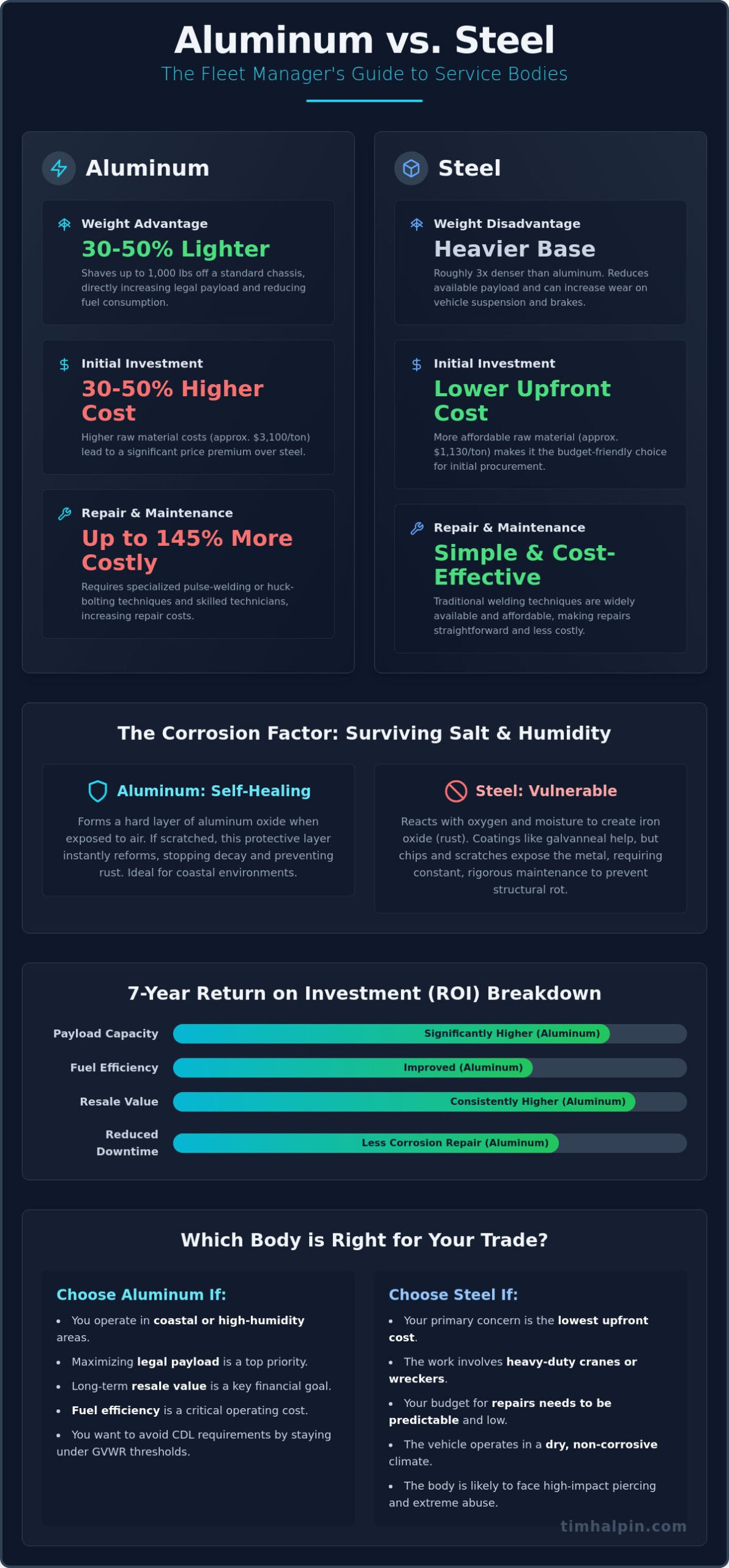
Choosing between an aluminum vs steel service body starts with basic physics. Steel is roughly three times denser than aluminum. This density provides a rugged foundation that has served fleets for decades, but it comes at the cost of significant mass. In contrast, a typical aluminum body weighs about 30% to 50% less than its steel counterpart. While the weight savings are attractive, you’ll likely face an initial price premium of 30% to 50% for aluminum. It’s a classic trade-off between a lower upfront cost and long-term operational efficiency.
Modern engineering has largely debunked the idea that aluminum is too soft for heavy work. By leveraging the specific properties of aluminum alloys, manufacturers create bodies that rival steel in durability. Most builders use 5052-H32 aluminum for side panels because it resists salt-water corrosion, while using 6061-T6 alloys for structural channels. We also see a shift in how these bodies are put together. Many premium aluminum bodies use huck-bolting or specialized pulse-welding. These techniques prevent the metal from becoming brittle, ensuring the body doesn’t crack under the constant vibration of South Florida roads.
The Structural Strength Debate
Steel remains the undisputed king of tensile strength. This is why you’ll almost always see steel used for heavy-duty crane bodies or wreckers that handle massive lifting stresses. Aluminum bodies compensate for lower natural rigidity by using thicker gauge materials. A steel body might use 14-gauge sheets, while an aluminum body uses 3/16-inch or 1/8-inch plating to achieve similar stiffness. This extra thickness makes aluminum surprisingly resistant to the dings and dents from heavy tools, though steel still handles high-impact piercing better in extreme environments.
Weight and GVWR Implications
Your Gross Vehicle Weight Rating (GVWR) is a hard ceiling set by the manufacturer. Every pound the truck body weighs is a pound you can’t use for tools, parts, or equipment. Swapping to aluminum can easily shave 1,000 pounds off a standard Class 3 or Class 4 chassis. That weight savings translates directly into increased payload, allowing your technicians to carry more inventory without exceeding legal limits. Staying under these weight thresholds isn’t just about safety; it’s about avoiding the red tape of modern trucking. Choosing a lightweight aluminum body can often keep a medium-duty truck below the 26,001-pound threshold that requires the driver to hold a Commercial Driver’s License.
Corrosion Resistance and the South Florida Environment
Living in South Florida means dealing with an atmosphere that’s essentially a slow-motion car wash of salt and moisture. When comparing an aluminum vs steel service body, the environment is often the deciding factor in your long-term ROI. Steel reacts with oxygen and moisture to create iron oxide, which flakes away and exposes more metal to the elements. Aluminum creates its own defense. It forms a hard, microscopic layer of aluminum oxide that seals the metal and stops structural decay in its tracks. This difference is why a truck parked near the Port of Miami ages differently than one in a dry, inland climate.
Many fleet managers ask if galvanneal steel is enough to stop the rot. It’s certainly an improvement over standard cold-rolled steel because the zinc-iron coating provides a sacrificial layer. However, once a technician tosses a heavy wrench into a compartment and chips that coating, the countdown to rust begins. If you choose steel, your maintenance routine must be rigorous. Without constant care, the “Coastal Factor” will turn a small scratch into a structural hole within a few seasons. We recommend a few basic steps to protect your investment:
- Rinse the undercarriage and body weekly to remove salt buildup.
- Inspect powder coatings for chips or scratches every month.
- Apply a high-quality rust inhibitor to internal box seams and hidden channels.
- Touch up any exposed metal immediately with automotive-grade primer.
The Self-Healing Properties of Aluminum
Aluminum bodies often look “new” even after a decade of service because of that protective oxide layer. If the surface gets scratched, the metal simply re-oxidizes and seals itself again. This lack of visible rust is a massive advantage for resale. Buyers pay a premium for a used truck that hasn’t been eaten alive by the humidity of the Everglades. It’s one of the reasons aluminum bodies consistently command higher prices on the secondary market, often recouping a large portion of their initial cost premium.
Protecting Steel in High-Humidity Climates
Steel bodies in high-humidity areas face a unique challenge: “inside-out” corrosion. Moisture gets trapped in the structural channels or behind tool racks where paint can’t reach. While powder coating offers a tough exterior, it can hide rust that’s bubbling underneath until it’s too late to fix. For those sticking with steel, professional commercial truck upfitting in Miami can provide the advanced coatings and sealing techniques needed to fight back. Understanding the differences between steel vs. aluminum body repairs is also critical, as fixing a rusted steel panel is often a simpler process, even if it happens more frequently. If you’re noticing early signs of wear, our team provides expert truck repair and installation services to keep your fleet looking professional and running safely.
Performance and Financials: Calculating the Real ROI
When you sit down to review your fleet budget, it’s easy to get stuck on the initial invoice. However, the true cost of an aluminum vs steel service body isn’t found in the purchase price; it’s found in the daily operating expenses over five to seven years. Physics doesn’t lie. Because an aluminum body is typically 30% lighter, your truck isn’t working nearly as hard to move the same amount of equipment. Industry data shows that this weight reduction can make a truck 8% to 10% more fuel-efficient. Over 25,000 miles a year, those savings at the pump quickly begin to offset the higher upfront investment of aluminum.
There are also “hidden savings” that many fleet managers overlook during the first year. Every time your driver hits the brakes or rounds a corner in South Florida traffic, that extra 1,000 pounds of steel is putting stress on the vehicle. By choosing a lighter body, you’re significantly reducing the wear and tear on brake pads, tire treads, and suspension bushings. You’ll likely find that your maintenance intervals for these “wear items” stretch out longer, keeping your trucks on the road instead of in the shop. It’s about looking at the total cost of ownership rather than just the day-one check.
Maximizing Your Daily Payload
Consider a local plumbing contractor who switches from a traditional steel setup to an aluminum utility body. By shaving half a ton off the vehicle’s curb weight, that plumber can now carry 20% more inventory, pipes, and specialized tools while staying within legal weight limits. This extra capacity often means the difference between finishing a job in one visit or making a time-wasting trip back to the warehouse. Increasing your “inventory-per-trip” ratio directly boosts your billable hours and reduces the fuel burned per job completed. It’s a simple way to make your existing fleet more productive without adding more drivers.
Resale Value and Body Swapping
One of the most compelling financial arguments for aluminum is its potential as a “lifetime” asset. While a steel body might be showing significant structural rust by the time the truck’s engine reaches 200,000 miles, an aluminum body often remains in excellent condition. This durability allows many fleets to perform a “chassis swap,” moving the existing aluminum body onto a brand-new truck. Even if you decide to sell the entire unit, the used market reflects this longevity. Aluminum bodies consistently hold a higher percentage of their original value because the next owner doesn’t have to worry about hidden corrosion. If you’re looking to upgrade your current setup, we offer professional installation services to ensure your body and chassis are perfectly matched for the long haul.
The Repairability Factor: Welding and Maintenance
When a truck is involved in a fender bender or a structural crack appears after years of heavy use, the debate between an aluminum vs steel service body moves from the balance sheet to the shop floor. Steel is the old reliable of the repair world. Most local shops in South Florida have a MIG welder and a technician who can patch a steel body in an afternoon. This “farm-fix” accessibility is a major advantage for fleets that can’t afford a single day of downtime. If you can weld, you can likely fix a steel body well enough to get it back into service by the next morning.
Aluminum demands a much higher level of technical sophistication. Because aluminum is highly sensitive to contamination, it requires a dedicated “clean room” environment to prevent steel dust from causing future corrosion. Repairs typically involve TIG welding and inert gas setups that are far less common than standard steel equipment. In fact, as of July 2025, only about 10% of North American repair shops held the specific certifications required for aluminum work. This scarcity often leads to higher labor rates and longer wait times for your vehicles. Research suggests that aluminum body repairs can cost between 40% and 145% more than equivalent steel repairs, a factor that must be weighed against the fuel savings we discussed earlier.
Welding and Structural Repairs
Improperly repairing an aluminum body can lead to significant heat-warping, which compromises the structural integrity of your tool compartments. You need a partner who understands the metallurgical nuances of these modern alloys. For deep-rooted industry knowledge, you can read about Tim Halpin and the legacy behind South Florida’s truck equipment experts. Having a seasoned guide helps you avoid the “cheap fix” that ends up costing a fortune in the long run. We’ve seen many “quick repairs” fail because the technician didn’t account for the specific heat-sink properties of the alloy.
Preventative Maintenance for Both Materials
Regardless of the material you choose, certain maintenance tasks are universal. Hinges and latches need regular lubrication to stay smooth in our salty air. However, aluminum owners must be especially vigilant about mounting points. When an aluminum body sits on a steel chassis, the two metals can react, leading to galvanic corrosion. High-quality installations use non-conductive isolators to prevent this electrical reaction. Checking these isolators and the integrity of the mounting bolts should be part of your quarterly inspection. If you’re concerned about the current state of your equipment, our team provides expert truck repair and installation services to keep your fleet in peak condition.
Decision Matrix: Which Body is Right for Your Trade?
The final choice in the aluminum vs steel service body debate usually comes down to the specific daily demands of your business. We’ve spent decades watching how different materials perform on the streets of Miami and across South Florida’s unique coastal environment. While the financial data from earlier sections provides a clear framework, your primary trade often dictates the winner. If your truck is a mobile workshop that needs to carry thousands of small parts, your needs differ wildly from a heavy-duty recovery operator who faces massive structural stresses every hour.
Trade-Specific Recommendations
For those in heavy-duty towing and recovery, steel remains the undisputed industry standard. The high tensile strength required for wreckers and boom trucks simply demands the rigidity that steel provides. If you are managing a recovery fleet, you can find specialized insights in our guide to tow truck parts in Florida. We often recommend steel for these high-impact roles because it handles the torsion and weight of a winching operation without the risk of structural cracking.
In contrast, aluminum is the gold standard for mobile mechanics, electricians, and plumbers. These trades rely on high payload capacity to carry a full inventory of parts and tools. By choosing aluminum, you can often add advanced Adrian Steel van interiors or heavy-duty Weather Guard truck toolboxes without worrying about exceeding your legal GVWR. For public safety and municipal fleets, aluminum also offers the weight “headroom” needed to install complex Whelen Engineering or Federal Signal public safety lighting systems and specialized gear.
Construction and landscaping professionals often find themselves in the middle. If your team is frequently tossing heavy debris or jagged materials into the bed, the impact resistance of steel is a major plus. However, if your trucks spend their lives in the humid, salt-heavy air near the coast, the rust-resistance of aluminum might save you a fortune in body replacements over the next decade.
The Final Verdict: Your 3-Point Checklist
- Environmental Exposure: Is your fleet operating within 20 miles of the coast? If yes, the corrosion resistance of aluminum offers a much higher long-term ROI.
- Payload Pressure: Are your trucks consistently running within 500 lbs of their legal weight limit? Aluminum can instantly provide the “breathing room” you need to stay compliant.
- Lifecycle Strategy: Do you plan to keep the vehicle for more than 5 years? Aluminum’s higher resale value and “swapability” make it the smarter choice for long-term assets.
Next Steps: Upfitting Your Fleet
Once you’ve settled on a material, the quality of the installation determines your real-world success. Sourcing OEM parts and ensuring that your body is mounted with the correct non-conductive isolators is essential for maintaining your warranty. Whether you need a rugged steel utility body or a high-efficiency aluminum setup, we’re here to act as your steady, knowledgeable guide. Contact Tim Halpin Equipment Corp today to discuss your custom service body build and ensure your fleet is ready for the challenges of 2026.
Building a Fleet That Lasts Beyond 2026
We’ve explored how your choice of an aluminum vs steel service body defines your fleet’s future profitability and daily performance. From the weight-saving advantages that boost your payload to the rugged resilience required for heavy-duty recovery, your material selection is a long-term investment. In our specific South Florida climate, accounting for salt air and humidity is just as vital as calculating your initial purchase price. You need equipment that stands up to the elements while keeping your operational costs lean. If you apply this same focus on long-term value to your property search, you can discover DeFeo Luxury Properties for expert real estate services from Tampa to Sarasota.
At Tim Halpin Equipment Corp, we’ve been serving this community since 1987 with a commitment to quality and neighborly service. We maintain a massive inventory of OEM liftgate and truck parts and offer expert installation and repair for all service body types. Whether you’re looking for the lifetime durability of aluminum or the proven strength of steel, we’re here to act as your steady guide. Request a custom upfitting quote from Tim Halpin Equipment Corp to ensure your next vehicle is built to the highest professional standards. You don’t have to make these complex decisions alone; we’re ready to help you move forward with a fleet you can be proud of.
Frequently Asked Questions
Is an aluminum service body strong enough for a crane?
Yes, but it requires specific structural reinforcement. While steel is naturally more rigid for high-stress lifting, modern aluminum crane bodies use heavy-duty subframes and thicker plating to handle the torque. Most heavy-duty wreckers still stick with steel. However, for light to medium-duty service cranes, aluminum is a proven choice that keeps your vehicle weight well within legal limits.
How much weight do you actually save with an aluminum truck body?
You typically save about 30% in weight compared to a steel body of identical dimensions. For a standard Class 3 or 4 truck, this often translates to a weight reduction of 800 to 1,200 pounds. This extra “headroom” allows your technicians to carry more inventory or tools. It can also prevent your truck from requiring a driver with a Commercial Driver’s License.
Does aluminum rust in salt air environments like Miami?
No, aluminum does not rust, though it can undergo surface oxidation. Unlike steel, which flakes away and loses structural integrity when exposed to South Florida’s salt spray, aluminum forms a protective oxide layer that seals the metal. This makes it an ideal choice for fleets operating near the Port of Miami or along the coast where humidity is a constant factor.
Can any welding shop repair an aluminum service body?
No, aluminum repairs require specialized equipment and a clean environment to prevent contamination. Because aluminum is sensitive to heat and cross-metal contact, you need a shop with TIG welding capabilities and technicians trained in specific alloys. Standard MIG welding setups used for steel can actually damage an aluminum body if handled incorrectly. It’s best to seek out a certified repair facility.
What is the typical price difference between steel and aluminum service bodies?
Aluminum bodies generally carry a 30% to 50% price premium over steel options. This higher upfront cost reflects the more expensive raw materials and complex manufacturing processes like huck-bolting or pulse-welding. You’ll need to weigh this initial investment against the long-term fuel savings and the body’s significantly higher resale value. For many local fleets, the math favors aluminum over a seven-year lifecycle.
Will an aluminum body improve my truck’s fuel economy?
Yes, reducing the vehicle’s curb weight by roughly 1,000 pounds can improve fuel efficiency by 8% to 10%. By choosing an aluminum vs steel service body, your engine and drivetrain don’t have to work as hard during stop-and-go South Florida traffic. Over several years of service, these fuel savings often recoup the initial cost of the aluminum upgrade while reducing wear on your brakes.
Is it possible to move a service body from an old chassis to a new one?
Yes, this is a major advantage of durable aluminum bodies. Since they don’t suffer from the same structural rot as steel, an aluminum vs steel service body can often outlast two or three truck engines. As long as the frame width and cab-to-axle measurements match, a professional installer can swap the body to a new chassis, making it a true “lifetime” asset for your business.
Does steel or aluminum have a better resale value?
Aluminum consistently commands a higher resale value on the used market. Buyers are willing to pay more for a used body that shows no signs of rust or structural decay. Because the body remains aesthetically clean and structurally sound even after a decade of service, it remains a highly liquid asset. Steel bodies often require expensive sandblasting and repainting to reach the same market appeal.
