

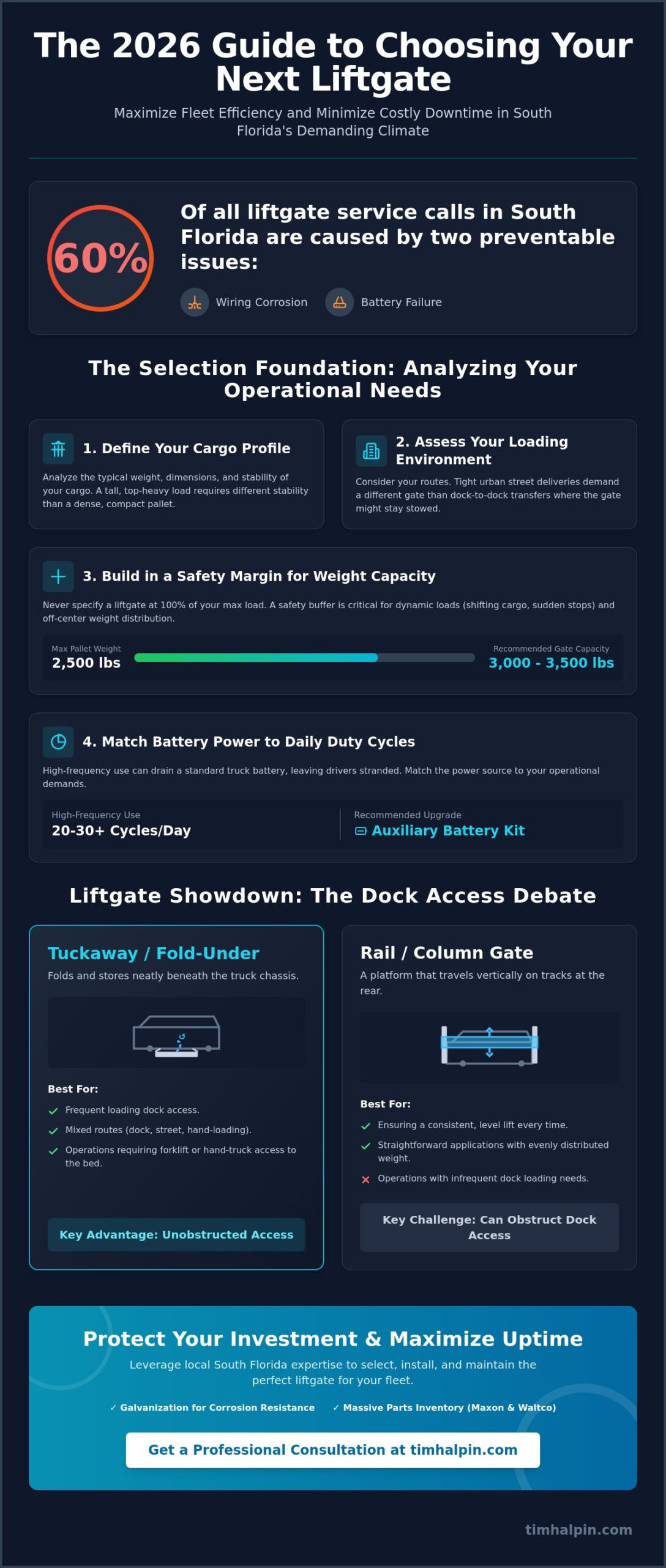
In South Florida, 60% of all liftgate service calls are triggered by simple wiring corrosion or battery failure. It’s a frustrating reality for local fleet managers who just want their drivers back on the road and their cargo delivered on time. You likely know the headache of a gate that cycles too slowly or, even worse, one that fails mid-route because the humid salt air finally took its toll on the electrical system. If you’ve been researching the process of choosing the right liftgate for my truck, you’ve likely realized it’s about more than just the initial price tag. It is a mechanical extension of your chassis that must be perfectly calibrated to your specific cargo and environment.
I believe that a reliable equipment setup is the backbone of any successful logistics operation. This 2026 guide will help you master the technical specifications and operational factors needed to maximize your fleet’s efficiency while minimizing costly downtime. We will identify the exact liftgate mechanisms for your specific industry, break down capacity requirements to ensure you never exceed chassis limits, and explore how to maintain long-term reliability in our demanding coastal climate. From understanding the latest safety standards to selecting materials that resist the Florida sun, you’ll gain the clarity needed to make a confident investment.
Key Takeaways
- Define your specific cargo weight and loading environment to build a selection foundation that prevents premature equipment failure.
- Compare the operational benefits of Rail, Cantilever, and Tuckaway models when choosing the right liftgate for my truck to ensure seamless dock-to-street transitions.
- Match technical specifications like bed height and platform size to your chassis to maintain vehicle stability and long-term operational safety.
- Protect your investment from the South Florida climate by understanding why galvanization is essential for fighting salt-air corrosion on hydraulic systems.
- Leverage local expertise and a massive inventory of parts for brands like Maxon and Waltco to keep your fleet moving and minimize costly downtime.
Analyzing Your Operational Requirements: The Selection Foundation
Choosing the right liftgate for my truck starts with a clear-eyed look at your daily cargo and your delivery schedule. It is easy to pick a gate based on a single heavy item you might move once a month, but that is a recipe for long-term inefficiency. You need to define your cargo profile by weight, dimensions, and stability. A tall, top-heavy piece of medical equipment requires a different level of platform stability than a dense pallet of landscaping stone. If you are just starting to explore what is a liftgate and how it fits your business, remember that the loading environment dictates the physical footprint of the gate.
Consider where your drivers spend their time. Street-level deliveries in tight urban corridors demand a different mechanical approach than dock-to-dock operations where the gate might stay folded for half the day. We often see fleet owners stuck in a cycle of expensive, recurring repairs. If you are rebuilding hydraulic cylinders every six months or fighting constant electrical shorts caused by our South Florida humidity, it is time to stop rebuilding and start upfitting. Investing in a new, modern gate often pays for itself through reduced downtime and improved driver productivity within the first year of service.
Weight Capacity and Safety Margins
Never specify a liftgate at 100% of your maximum load. If your heaviest pallet is 2,500 lbs, you should look at a gate with a 3,000 lb or 3,500 lb capacity. This provides a necessary safety buffer for dynamic loads, which occur when a pallet jack stops suddenly or a load shifts during the lift. You must also account for the center of gravity. Most capacities are rated for a load centered on the platform. If the weight is positioned at the very edge, it puts significantly more strain on the hydraulic arms and the truck chassis itself, leading to premature wear and potential structural failure.
Daily Duty Cycles and Battery Demands
Your truck’s electrical system is the lifeblood of the liftgate. High-frequency deliveries, where the gate cycles 20 to 30 times a day, can quickly drain a standard starting battery. For these heavy-duty applications, I always recommend auxiliary battery kits to prevent getting stranded at a delivery site. Duty Cycle is the ratio of operation time to rest time to ensure system longevity. If you ignore this balance, you risk overheating the motor and shortening the lifespan of your hydraulic components. Choosing the right liftgate for my truck involves matching the power source to the frequency of use to ensure the gate is ready to work every time the driver hits the switch.
Comparing Liftgate Types: Rail, Column, Cantilever, and Tuckaway
Selecting the mechanical heart of your delivery system requires understanding how different gates interact with your truck’s body and your daily route. Railgates are often considered the versatile workhorse of the industry. They feature a platform that travels vertically along tracks mounted to the rear of the vehicle, ensuring a level lift every time. These are excellent for straightforward applications where the cargo stays relatively flat and the weight is evenly distributed. However, if your business requires frequent dock loading, you might find that a fixed rail becomes an obstacle to your efficiency.
This is where tuckaway, or fold-under, gates shine. They are designed to fold and store neatly beneath the truck chassis when they aren’t in use. This allows your driver to back directly into a loading dock without the gate interfering with the door or the dock seal. When you are in the process of choosing the right liftgate for my truck, the tuckaway is often the preferred choice for its compact footprint and operational flexibility in tight spaces. If you’re unsure which mechanism fits your current chassis, our team can provide a professional liftgate repair assessment or installation consultation to get you moving.
Tuckaway vs. Railgate: The Dock Access Debate
The choice between a tuckaway and a railgate often comes down to bed access. If your route involves a mix of manual hand-loading at a warehouse and mechanical lifting at a customer site, the tuckaway is superior. It leaves the rear of the truck completely clear for forklift or hand-truck access. In tight urban Miami delivery zones, where every inch of clearance matters, the tuckaway’s ability to stay tucked prevents accidental damage from passing traffic or tight turns. While railgates have fewer folding hinges to maintain, the tracks require consistent lubrication and cleaning to prevent the slides from binding in our humid climate. You can find more detailed advice on choosing the right liftgate based on your specific body style from industry manufacturers.
Cantilever and Column Lifts for Specialized Freight
For operations involving fragile or palletized cargo that requires extreme precision, cantilever lifts are the gold standard. These gates allow the driver to tilt the platform, which is essential for maintaining a level surface on the slanted driveways common in South Florida’s drainage-heavy landscapes. Column lifts, on the other hand, are the heavy-duty solution for high-capacity freight. Often found on large trailers, they provide the highest weight ratings and longest travel distances. Whether you’re hauling heavy machinery or delicate beverage pallets, matching the gate type to the cargo’s stability requirements is the only way to protect your bottom line. Choosing the right liftgate for my truck means looking past the lifting capacity and focusing on how that cargo actually sits on the platform during the move.
Technical Specifications: Matching the Gate to Your Chassis
Getting the technical specifications right is the difference between a tool that helps your business and an expensive anchor attached to your bumper. The marriage between your truck’s chassis and the liftgate requires precision. It starts with a simple but vital measurement: bed height. You must measure this distance when the truck is completely empty and when it’s fully laden. A gate that can’t reach the pavement on a high-clearance chassis is useless. I’ve seen many owners overlook how much a truck’s suspension compresses under a full load, leading to alignment issues at the loading dock. Choosing the right liftgate for my truck means ensuring that the geometry works across every stage of your delivery route.
Platform size is another area where “bigger” isn’t always better. While a large platform offers more room for pallets, it also creates a significant lever effect. The further the weight moves from the rear of the truck, the more strain it puts on the hydraulic pump and the mounting brackets. If your cargo doesn’t strictly require a 60-inch deep platform, sticking to a more compact size will improve your overall stability and reduce wear on the system. It’s all about finding the balance between cargo capacity and mechanical longevity.
The Impact of Platform Material on Payload
Aluminum platforms have become incredibly popular for South Florida fleets, and for good reason. They are significantly lighter than steel, which directly increases your legal cargo capacity by reducing the vehicle’s tare weight. In our humid coastal air, aluminum also offers natural resistance to the rust that can quickly compromise a gate’s structural integrity. However, steel remains the king of durability for abrasive or high-impact loads. If you’re hauling heavy construction equipment or metal scrap, a steel platform with a high-quality galvanized finish is often the smarter long-term investment. We always look at your specific cargo to determine if weight savings or sheer impact resistance should take priority.
Chassis Integration and Mounting
Before you commit to a specific model, you must verify your frame width and the clearance available for hydraulic cylinders. Choosing the right liftgate for my truck involves looking underneath the bed to ensure the fuel tank, exhaust system, or DEF tank won’t interfere with the mounting plates. Adding a heavy-duty gate can easily add 1,000 pounds or more to your vehicle, which directly impacts your Gross Vehicle Weight Rating (GVWR). This is why professional commercial truck upfitting in Miami is so essential. We ensure the installation is structurally sound and that the electrical system is properly protected. Whether you’re running a 12V or 24V system, we prioritize sealed connectors and high-quality circuit breakers to prevent the corrosion-related electrical failures that account for 60% of local service calls.
The South Florida Factor: Durability in Coastal Climates
Living and working along the Atlantic coast means facing a unique set of environmental challenges that most manufacturers in the Midwest simply don’t encounter. Salt air never sleeps. It’s a silent, relentless force that can turn a pristine piece of equipment into a rusted liability in just a few seasons. Choosing the right liftgate for my truck in this region is as much about chemistry as it is about mechanics. If you don’t account for the high humidity we see in Miami, you’re essentially setting a timer on your equipment’s failure.
The electrical system is usually the first victim of our climate. We often see “green rot,” a specific type of corrosion that eats through wiring harnesses from the inside out. This happens when moisture and salt penetrate standard connectors, creating a high-resistance bridge that drains batteries and kills motors. To prevent this, I always insist on sealed electrical connectors and dielectric grease at every junction. Your hydraulic fluid choice matters too. In high-temperature, high-humidity environments, standard fluids can emulsify if moisture enters the reservoir. This leads to “foaming” and a significant loss in lifting power, which is why we prioritize high-viscosity fluids designed to separate water effectively.
Combatting Corrosion with Galvanized Finishes
When you’re comparing finishes, hot-dip galvanization is the superior choice for coastal fleets. Unlike powder coating, which sits on top of the metal like a hard shell, galvanization creates a molecular bond with the steel. If a powder-coated gate gets a small chip, salt air gets underneath the paint and begins to lift it, causing “spiderweb” rust that’s nearly impossible to stop. A galvanized gate remains protected even if the surface is scratched. While the initial cost of galvanized components is higher than standard paint, the extension of the gate’s service life in South Florida makes it a far better value. We see the most rust on pivot points and the underside of the platform, areas that are constantly pelted by road salt and moisture.
Proactive Maintenance for Miami Fleets
A “set it and forget it” mentality will lead to a breakdown at the worst possible moment. We recommend monthly lubrication schedules for all pivot points and rollers to displace salt-laden moisture. It is also vital to regularly inspect truck hydraulics in Miami for any signs of water contamination or milky fluid. Regular pressure testing for hydraulic cylinders ensures that seals haven’t been compromised by the heat. If you’ve noticed your gate struggling or seen rust spots forming, don’t wait for a total failure. Reach out to us for a professional liftgate repair consultation to keep your fleet moving safely.
The Tim Halpin Advantage: Expertise and Inventory Support
Choosing the right liftgate for my truck is a significant operational decision, but the support you receive after the installation determines your long-term success. Equipment is only as good as the team standing behind it. At Tim Halpin Equipment Corp, we don’t just sell parts; we provide a partnership rooted in decades of South Florida logistics experience. We maintain one of the largest liftgate parts inventories in the United States, which means we likely have the specific component you need sitting on our shelf right now. This inventory depth is critical for local businesses that cannot afford to have a vehicle sitting idle for weeks while waiting on a backordered shipment.
Our technicians carry certified expertise across the industry’s most respected brands. We provide comprehensive support and installation for:
- Maxon and Waltco for heavy-duty commercial applications.
- Tommy Gate and Anthony for versatile, lighter-duty needs.
- Thieman, Leyman, and Palfinger for specialized freight requirements.
By combining this brand knowledge with our deep understanding of hydraulic repair and trailer maintenance, we offer a level of diagnostic precision that general repair shops simply cannot match. We identify the root cause of a failure, whether it’s a structural alignment issue or a hydraulic leak, and fix it right the first time.
Sourcing OEM Parts for Maximum Reliability
We prioritize sourcing original equipment manufacturer (OEM) components to ensure your gate operates exactly as the engineers intended. We are a primary source for Waltco liftgate parts in Miami, providing local fleets with immediate access to the high-quality cylinders, switches, and motors they rely on daily. You might find “will-fit” aftermarket parts elsewhere, but these often lack the precise tolerances required for heavy-duty lifting. Using substandard parts in our demanding coastal environment is a gamble that usually ends in premature failure and higher long-term costs. Our inventory depth ensures your vehicle spends more time on the road and less time in the service bay.
Partnering with Miami’s Truck Equipment Experts
Our family-owned legacy of service has been a staple of the South Florida community since 1987. We take immense pride in our local heritage and the long-term relationships we’ve built with municipal and private fleets across the region. We don’t just look at the liftgate; we consult on your entire vehicle setup. From installing Adrian Steel van interiors to configuring Whelen Engineering public safety lighting, we ensure every piece of equipment works in harmony. Ready to upgrade your fleet? Contact Tim Halpin Equipment Corp for a professional liftgate consultation today. We’ll help you navigate the technical details and ensure your equipment is ready for the unique demands of the Miami climate.
Future-Proofing Your Fleet with the Right Equipment
Since 1987, our family-owned team has stood as South Florida’s leading commercial upfitting experts. We maintain a massive inventory of Waltco, Maxon, and Tommy Gate parts to ensure that your repairs are handled with speed and precision. We understand the unique pressures of our local market and we’re here to help you navigate every technical specification with confidence. Ready to eliminate downtime and maximize your efficiency? Get a Professional Liftgate Consultation at Tim Halpin Equipment today. Let’s get your fleet equipped for the road ahead.
Frequently Asked Questions
How do I determine the right weight capacity for my liftgate?
You should base your capacity choice on your heaviest expected pallet plus a 20% safety margin. Specifying a gate at its absolute limit is risky because dynamic loads, such as a pallet jack stopping suddenly, create force that exceeds the static weight. When choosing the right liftgate for my truck, remember that the center of gravity matters. A 3,000 lb load at the platform edge puts more strain on the hydraulics than the same weight at the center.
What is the difference between a tuckaway and a railgate?
A tuckaway gate folds and stores neatly beneath the truck chassis, while a railgate travels vertically along fixed tracks mounted to the rear. Tuckaways are the preferred choice for dock loading because they stay clear of dock seals and doors. Railgates offer a more stable, level lift for tall or top-heavy cargo but can become an obstacle when you need to back directly into a warehouse bay without using the lift.
Can I install a liftgate on my existing truck, or do I need a new body?
You can almost always install a liftgate on an existing truck as long as the rear frame is structurally sound. Our technicians evaluate your current bed height and frame width to ensure the mounting plates and hydraulic cylinders have proper clearance. While we sometimes need to reinforce the rear sill or relocate a bumper, a completely new body is rarely required. We focus on ensuring the installation doesn’t compromise your truck’s integrity.
How does South Florida humidity affect liftgate maintenance?
Our local humidity accelerates “green rot” in wiring and causes moisture to emulsify within your hydraulic fluid. This leads to foaming and a loss of lifting power. In this coastal environment, you’ll need to lubricate pivot points more frequently to displace salt-laden air. We also recommend regular pressure testing for cylinders to ensure that heat and moisture haven’t compromised the internal seals, which can lead to dangerous mid-lift failures.
Which liftgate brands are easiest to find parts for in Miami?
Maxon, Waltco, and Tommy Gate are the most widely supported brands in the Miami area for parts and service. Because we maintain one of the largest inventories of these OEM parts in the country, we can often complete repairs immediately. When choosing the right liftgate for my truck, selecting a major brand ensures that a simple broken switch won’t leave your vehicle sidelined for weeks waiting for a specialized component to ship.
How often should a commercial liftgate be serviced?
We recommend a professional inspection and lubrication every six months for standard operations, or quarterly for high-cycle delivery fleets. This service includes checking hydraulic fluid levels, inspecting battery connections for corrosion, and testing the pump’s pressure. Frequent preventive maintenance is the most effective way to avoid the mid-route breakdowns that lead to expensive emergency service calls and lost productivity for your drivers.
Is an aluminum liftgate platform worth the extra cost?
Aluminum is worth the investment for South Florida fleets because it resists corrosion and significantly reduces your vehicle’s tare weight. Since aluminum doesn’t rust like steel, it maintains its structural integrity and resale value much longer in our salt-laden air. By lowering the weight of the gate itself, you increase your legal cargo capacity, which can improve the overall efficiency and profitability of your daily routes.
What electrical upgrades are needed for a high-capacity liftgate?
High-capacity gates typically require auxiliary battery kits and heavy-duty charging lines to handle the intense amperage draw. Standard truck batteries aren’t designed for the deep cycles required by frequent heavy lifting. We often install dedicated circuit breakers and larger gauge wiring to minimize voltage drop. This ensures the motor receives consistent power, which prevents it from overheating and extends the life of your entire electrical system.
