
When a liftgate fails or a hydraulic line bursts during a busy delivery run, the clock doesn’t just stop; it starts counting backward against your bottom line. With unscheduled downtime often costing $2,000 or more per day, the specialized equipment that actually does the heavy lifting can be your greatest asset or your most expensive headache. Proper commercial truck equipment maintenance is no longer just a chore. It’s a strategic necessity for any fleet looking to stay competitive in 2026.
You likely already understand that your revenue depends on your gear’s reliability, especially with the 2026 CVSA out-of-service criteria becoming stricter for specialized vehicles. We’ve designed this guide to help you move beyond basic engine care and into specialized maintenance for your liftgates, hydraulics, and towing gear. You’ll learn how to protect your revenue-generating assets, extend equipment lifespan, and source OEM parts more efficiently. We will explore everything from proactive corrosion prevention in our coastal environment to utilizing the latest Right to Repair diagnostic tools to ensure your trucks stay on the road where they belong.
Key Takeaways
- Shift your focus from basic chassis care to the vocational components like liftgates and booms that actually perform the work and generate revenue.
- Learn to identify early warning signs of hydraulic failure, such as hose “weeping” or fluid contamination, before they lead to expensive job-site breakdowns.
- Discover specific strategies for combating the “green crust” corrosion and salt air damage unique to South Florida’s demanding coastal environment.
- Implement a more effective schedule for commercial truck equipment maintenance by tracking PTO usage hours instead of relying solely on odometer mileage.
- Understand how partnering with a local expert with a massive OEM parts inventory can drastically reduce your repair turnaround times and keep your fleet moving.
The Role of Commercial Truck Equipment Maintenance in Fleet Uptime
Many fleet owners treat their trucks like standard delivery vans. They focus on tires, brakes, and oil. While these are vital parts of fleet management, they only tell half the story for vocational vehicles. True commercial truck equipment maintenance focuses on the “work-end” of your vehicle. This includes the liftgates, booms, winches, and hydraulic systems that allow your team to actually perform their jobs. If your truck arrives at a site but the liftgate won’t lower, the entire trip is a loss.
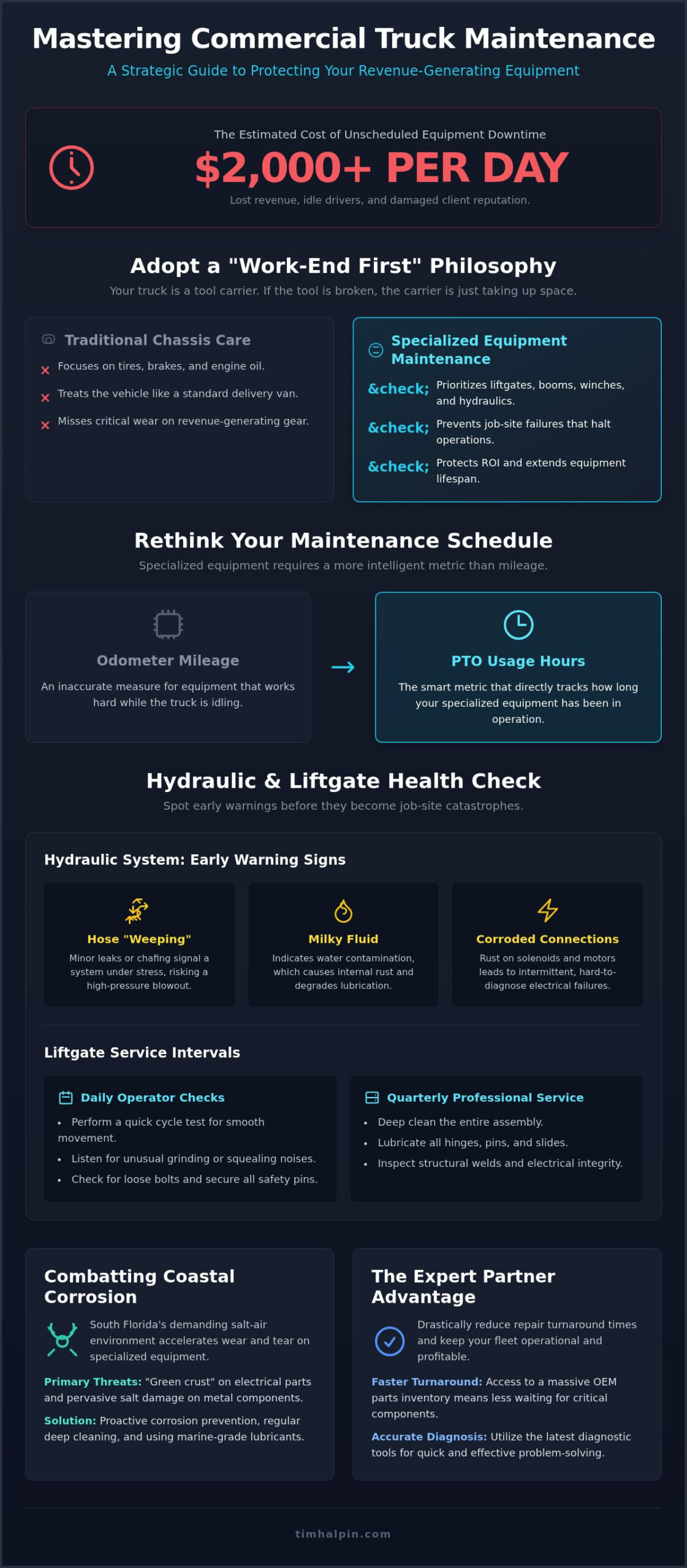
We advocate for a “Work-End First” philosophy. It’s a simple idea: your truck is a tool carrier, and if the tool is broken, the carrier is just taking up space. Neglecting these specialized components leads to unexpected job-site failures that frustrate customers and stall your schedule. A functioning engine is useless if your revenue-generating gear is stuck in the upright position.
Equipment vs. Chassis Maintenance
Standard maintenance usually follows the odometer. You change the oil every few thousand miles. While full-service shops like Midway Auto Repair are essential for maintaining the vehicle’s engine and chassis, specialized equipment operates on different cycles. A tow truck might sit at idle for hours while the winch does all the heavy lifting. Standard chassis service won’t catch a weeping hydraulic seal or a frayed winch cable until it’s too late. Specialized gear requires a separate, dedicated inspection checklist.
- Hydraulic systems require regular flushing and fluid analysis that standard engine service misses.
- Specialized gear needs its own inspection checklist, focusing on pins, bushings, and structural welds.
- Neglecting lifting gear creates significant safety risks for your operators and the public.
The True Cost of Equipment Downtime
When specialized gear fails, the costs go far beyond the repair bill. Industry data suggests that unscheduled downtime can cost $2,000 or more per day in lost revenue and missed opportunities. You’re paying a driver to sit idle while your reputation with the client takes a hit. Proactive service protects the long-term ROI on your upfitting investment, ensuring that expensive additions like service bodies or booms last for years.
Preventive equipment maintenance is the proactive servicing of non-chassis components to ensure operational readiness. By staying ahead of wear and tear, you transform your fleet from a source of stress into a reliable engine for growth. It’s about protecting the equipment that protects your bottom line.
Hydraulic and Liftgate Maintenance: Protecting Your Revenue-Generating Gear
If your truck’s engine is the heart of your operation, the hydraulic system is the muscle. Without it, your liftgate won’t drop, your boom won’t reach, and your revenue stops moving. Effective commercial truck equipment maintenance requires a keen eye for the small details that signal big trouble. We often see operators ignore “weeping” hoses or minor chafing, but these are the early warnings of a system under stress. A hose that fails under pressure doesn’t just stop your day; it creates a safety hazard that can lead to serious injury or property damage.
Monitoring your hydraulic fluid is another critical step. If the fluid appears milky, you’ve got water contamination, likely from high humidity or a failed seal. This moisture creates internal rust and degrades the lubricating properties of the oil. You should also regularly inspect electrical solenoids and motors. Corroded connections are common in our environment, and they can cause intermittent failures that are difficult to diagnose on the fly. Following OSHA vehicle maintenance standards ensures that your safety features, like pressure relief valves and auto-leveling systems, are always in top shape to protect your crew.
Liftgate-Specific Service Intervals
Routine care for your liftgate should be split into two categories: daily operator checks and quarterly professional service. Every morning, your drivers should perform a quick cycle test to ensure the platform moves smoothly without unusual noises. They should look for loose bolts and check that all safety pins are secure. Every three months, a deeper dive is necessary. This involves deep cleaning the assembly and lubricating all hinges, pins, and slides to prevent metal-on-metal wear. For those running specialized fleets, sourcing high-quality waltco liftgate parts miami ensures your equipment remains within OEM specifications for long-term reliability.
Hydraulic System Health
Oxidation is a silent killer for hydraulic pumps. Over time, heat and use cause the fluid to break down, forming a sludge that clogs valves and wears out seals. You might also notice your equipment acting “spongy” or hearing a high-pitched whining noise. This usually means air has entered the system, which causes cavitation and can destroy a pump in short order. If you’re noticing these symptoms, seeking expert truck hydraulics in miami can help you catch the problem before a cylinder fails completely. Staying proactive with commercial truck equipment maintenance is the best way to keep your fleet moving and your customers happy.
Managing Corrosion and Wear in South Florida’s Coastal Environment
Operating a fleet in South Florida offers beautiful views, but the environment is undeniably harsh on your machinery. The same salt air that draws visitors to our beaches acts as a relentless corrosive force on your gear. When we discuss commercial truck equipment maintenance in our region, we’re essentially discussing a constant battle against rust and oxidation. High humidity levels don’t just make the afternoons heavy; they facilitate “green crust” corrosion on electrical connections. This copper oxidation can quickly disable upfitted electronics, public safety lighting, and liftgate control boxes if left unchecked.
Salt air accelerates rust on liftgate platforms and tow truck subframes at a rate much faster than in inland climates. Because our air is so saturated with moisture and salt, standard lubrication schedules often fall short. Grease can wash away or become contaminated more quickly, leading to seized pins and grinding hinges. To combat this, we recommend proactive coatings and specialized treatments for any exposed metal surfaces. Protecting these vulnerable areas now is far more cost-effective than replacing a structurally compromised subframe or platform later.
Fighting the Miami Salt Air
South Florida trucks require a more aggressive wash and lubrication schedule than the national average. It isn’t just about aesthetics. Rinsing the underside of your vehicle helps remove salt deposits that settle into the crevices of your equipment. It’s also vital to distinguish between how corrosion affects different materials. While steel bodies will show bright orange rust, aluminum bodies often suffer from pitting and white oxidation that can be just as damaging. Using dielectric grease on all electrical terminals is a simple, effective way to seal out moisture and protect your investment in public safety lighting and upfitted electronics.
Heat and Hydraulic Performance
The extreme heat in our region presents another challenge for commercial truck equipment maintenance. High ambient temperatures significantly affect hydraulic fluid viscosity. When the oil thins out too much, your pumps have to work harder to maintain pressure, which leads to premature wear. Constant heat also causes rubber seals to become brittle and crack, resulting in the “weeping” leaks we discussed in previous sections. Monitoring seal integrity and ensuring your heavy-duty hydraulic pumps have functioning cooling systems are essential steps for keeping your equipment operational during a South Florida summer. A little extra attention to these tropical-specific issues keeps your fleet steady and reliable.
Creating a Proactive Maintenance Schedule for Specialized Truck Equipment
Building a successful schedule for commercial truck equipment maintenance starts with a shift in perspective. You can’t treat a boom truck like a standard delivery van. The first step is to inventory every piece of specialized gear and record the specific OEM service requirements. We’ve seen many fleets miss critical service windows because they only looked at the truck’s odometer. Instead, you must track usage hours, specifically Power Take-Off (PTO) time. A truck idling at a job site while the winch is working hard isn’t racking up miles, but the hydraulic system is definitely aging. Focusing on PTO hours ensures you’re servicing the parts that actually do the heavy lifting.
Once you have your data, establish a formal “Pre-Trip” equipment inspection for your operators. This keeps small issues from becoming day-ending disasters. We also recommend partnering with a local expert for quarterly deep-dive inspections. These professionals have the diagnostic tools to spot structural fatigue or internal pump wear that a standard visual check might miss. Finally, maintain a digital record of every repair and part replacement. This history is invaluable for identifying recurring problems and maximizing your equipment’s resale value over time.
The Operator’s Daily Checklist
Your drivers are your eyes and ears on the road. A simple five-minute check each morning can save thousands in repairs. This routine should include a visual inspection of all pins, clips, and mounting hardware to ensure nothing has vibrated loose. Operators should also perform a full “up/down” and “stow” cycle test before leaving the yard. It’s the best time to listen for unusual mechanical noises or grinding. If something sounds off, it usually is. Catching a loose clip in the yard is much better than losing a pin on the highway.
The Role of Fleet Management Software
Modern data tools make it easier than ever to stay ahead of the curve. You can use software to set automated reminders for hydraulic filter changes based on actual PTO hours. This predictive approach also helps you know exactly when a tow truck parts florida order will be necessary, preventing delays when a component finally reaches its limit. Tracking ‘cycles’ rather than ‘miles’ provides a more accurate maintenance window for liftgates. If you’re ready to modernize your approach and reduce downtime, we invite you to contact us for a professional equipment evaluation to get your fleet on the right track.
Expert Equipment Service and Parts: The Tim Halpin Advantage
Since 1987, Tim Halpin Equipment Corp has served as a steady, knowledgeable guide for South Florida’s vocational fleets. We take immense pride in our local heritage and the long-term relationships we’ve built across our community. We aren’t just another repair shop; we’re a family-owned business where accountability is a personal guarantee. This deep connection to our neighbors informs every aspect of our commercial truck equipment maintenance strategies. We understand that your reputation depends on your gear’s reliability, and we’ve built our own reputation on supporting yours with integrity.
One of the most significant hurdles in fleet repair is the wait for specialized parts. We solved this by building one of the largest liftgate and towing parts inventories in the United States. This massive stock allows us to minimize your downtime through immediate diagnosis and in-stock OEM components. When a hydraulic cylinder or a liftgate motor fails, you don’t have to wait weeks for a shipment from a distant warehouse. We likely have what you need on the shelf right now. This is how tim halpin combines national parts reach with the attentive, friendly service of a local expert.
National Parts Inventory, Local Service
Our reach extends well beyond our immediate district. Our expertise in sourcing and shipping export truck parts miami has made us a global leader in equipment support. This international perspective gives us unique insights into part durability and manufacturer trends that others might miss. Because we also handle complex installations and upfitting, our maintenance advice is grounded in practical, hands-on knowledge. We know how these machines are built from the ground up, so we know exactly how to keep them running at peak performance.
Your Partner in Fleet Longevity
We provide more than just reactive repairs. We offer customized maintenance plans tailored to the specific needs of municipal and commercial fleets. Whether you’re managing a handful of tow trucks or a large department of utility vehicles, our goal is to reduce the stress of asset management through reliable gear. We believe in being a partner in your success, helping you navigate the complexities of commercial truck equipment maintenance with a seasoned, calm approach. We treat your equipment with the same care we’d give our own, ensuring your investment remains productive for years to come. Contact Tim Halpin Equipment Corp today to schedule your equipment inspection.
Securing Your Fleet’s Future on the Road
Maximizing uptime requires a shift from simply fixing what is broken to actively protecting your revenue-generating gear. By implementing a “Work-End First” philosophy and accounting for South Florida’s unique corrosive environment, you ensure your liftgates and hydraulic systems remain as reliable as the engines that power them. Remember that tracking PTO hours and conducting daily cycle tests are the simplest ways to prevent the expensive daily losses associated with unscheduled downtime.
In addition to preventive care, having a reliable partner for when your vehicles are involved in road incidents is crucial. You can explore Heavy-Duty Towing and Accident Recovery to see how professional recovery services complement a robust maintenance program by providing expert assistance when your fleet needs it most.
At Tim Halpin Equipment Corp, we have been the steady guide for local fleets since 1987. As specialists in Waltco, Maxon, and Miller Industries equipment, we combine deep technical expertise with one of the largest liftgate parts inventories in the US to keep your operation moving. We understand the stress of asset management and are here to provide the accountability of a family-owned partner. Don’t wait for a job-site failure to address your commercial truck equipment maintenance needs. Schedule Your Equipment Maintenance with Tim Halpin Today and gain the peace of mind that comes with a truly road-ready fleet. We look forward to helping you reach your long-term business goals with confidence.
Frequently Asked Questions
How often should a commercial truck liftgate be serviced?
Professional service should occur every three months to ensure peak performance and operator safety. While daily operator checks are vital, a quarterly deep-dive allows technicians to inspect structural integrity and fluid health. This frequency helps identify wear in pins and bushings before they require total replacement. For high-cycle fleets, more frequent lubrication may be necessary to maintain smooth operation throughout the year.
What are the most common signs of hydraulic system failure in a truck?
Slow or jerky movement and high-pitched whining are the most common indicators of hydraulic distress. You should also watch for “weeping” fluid on hoses or around cylinder seals. These symptoms often point to air contamination or pump wear. Catching these signs early prevents a total system lockout during a critical delivery, saving you from expensive emergency repairs and lost revenue.
Is it necessary to use OEM parts for liftgate repairs?
Using OEM parts is the best way to guarantee that your equipment meets its original safety and weight-rating specifications. While aftermarket alternatives might seem cheaper, they often lack the precise fit required for high-stress vocational gear. Sticking with OEM components like Waltco or Maxon parts ensures long-term reliability. It also maintains the value of your upfitted assets and keeps your manufacturer warranties intact.
How does the South Florida climate affect truck equipment maintenance?
The local environment requires a more aggressive approach to commercial truck equipment maintenance due to relentless salt air and high humidity. These factors cause rapid “green crust” oxidation on electrical terminals and pitting on metal surfaces. We recommend more frequent rinsing and the consistent use of dielectric grease to protect sensitive electronic components from the harsh tropical elements common in our region.
What is included in a DOT inspection for specialized truck equipment?
A DOT inspection focuses on the safe operation and securement of all vocational components. Inspectors check for cracked welds, missing safety pins, and visible hydraulic leaks that could pose a road hazard. They also verify that public safety lighting systems are functional and that the equipment does not exceed width or weight regulations when stowed for transport. Keeping these items in check prevents costly out-of-service orders.
Can regular maintenance help prevent hydraulic hose bursts?
Proactive inspections significantly reduce the risk of catastrophic hose failure by identifying wear before the line fails. Technicians look for outer jacket chafing, kinking, or heat-related brittleness that precedes a burst. Replacing a suspect hose during scheduled service is much cheaper and safer than dealing with a high-pressure spill on a job site. It protects both your equipment and the environment from oil contamination.
Should I track maintenance by mileage or by engine hours?
You should track commercial truck equipment maintenance by PTO hours or cycles because mileage doesn’t account for stationary work time. A truck might only drive ten miles but operate its boom or liftgate for several hours at a delivery site. Using hour meters ensures that your hydraulic pumps and lifting mechanisms are serviced based on actual mechanical wear rather than just the distance the tires have traveled.
What should an operator check during a pre-trip equipment inspection?
Operators should verify that all safety pins are in place and that there are no visible hydraulic puddles under the vehicle. They must also perform a full cycle test to ensure the equipment moves smoothly through its entire range of motion. Listening for grinding or clicking sounds during this test can help identify mechanical issues before the truck leaves the yard. This simple routine keeps your crew safe and your schedule on track.
