
The truck is only part of the decision: the right equipment has to suit the work it will do. Commercial truck equipment sales in Florida can involve outfitting a vehicle for cargo handling, service work, utility tasks, or public safety, while truck capacity depends on the specific model and configuration. For example, a properly equipped 2026 Ford F-450 can tow up to 40,000 lbs. with a gooseneck.
Choosing a hydraulic liftgate or other equipment means matching it to the truck’s role and daily workload, not just choosing by name. This guide covers common commercial truck equipment categories, what to consider when selecting a liftgate, and how commercial truck equipment sales in Florida differ from buying equipment for a truck you already operate. Use it to weigh the decisions that shape a practical, work-ready setup.
Key Takeaways
- Match commercial truck equipment to the vehicle’s capacity and the work it needs to handle.
- Compare equipment types by their practical role, including how a hydraulic liftgate supports loading and unloading.
- When evaluating dealers and warranties, focus on the coverage terms and how well the equipment fits your operation.
- Know when a repair need calls for truck, liftgate, trailer, or hydraulic repair support.
What types of commercial truck equipment are sold in Florida?
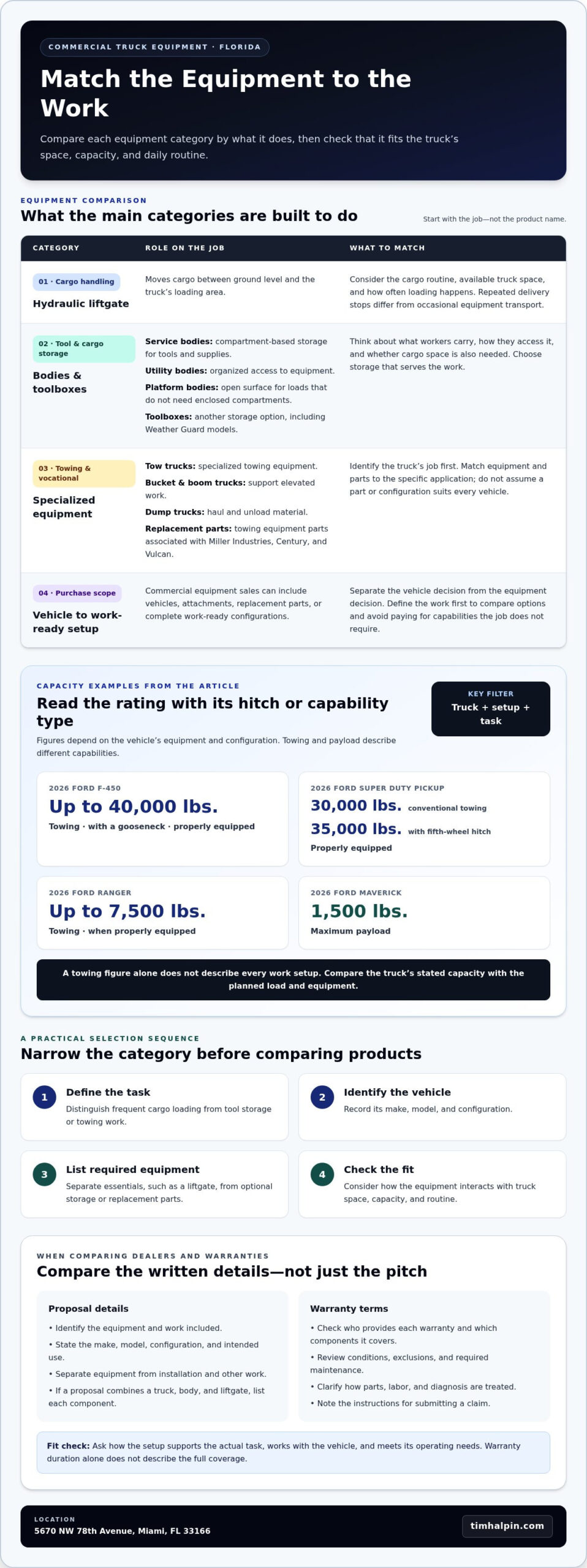
In Florida, commercial truck equipment sales can include vehicles, attachments, replacement parts, or complete work-ready configurations. These purchases address different needs. A contractor may need a truck body for organized storage, while a delivery operation may prioritize cargo loading. A towing operator may focus on towing equipment and compatible parts. Start by defining the work, then separate the vehicle decision from the equipment decision. This makes options easier to compare and helps avoid paying for capabilities the job does not require.
Hydraulic liftgates move cargo between ground level and a truck’s loading area. When comparing liftgate equipment, consider the cargo-handling routine, available truck space, and how often loading takes place. A delivery route with repeated stops has different demands from a truck used for occasional equipment transport. The hydraulic components matter, too, because they enable the liftgate to operate. Match the equipment to the truck’s intended use rather than choosing a liftgate by name alone.
Commercial bodies organize a truck for its daily tasks. Service bodies offer compartment-based storage for tools and supplies, while utility bodies support work that requires organized access to equipment. Platform bodies provide an open surface for loads that do not need enclosed compartments. Truck toolboxes, including Weather Guard models, provide another storage option. Consider what workers carry, how they access it, and whether the truck also needs cargo space. These details help identify useful storage and avoid adding equipment that does not serve the work.
Towing and vocational trucks need equipment suited to their roles. Tow trucks use specialized towing equipment, while bucket trucks and boom trucks support elevated work. Dump trucks are designed to haul and unload material. Replacement parts are another part of the equipment market, including towing equipment parts associated with Miller Industries, Century, and Vulcan. For each category, identify the truck’s job first, then match equipment and parts to that application. Do not assume a part or configuration suits every vehicle.
Truck capacity is another practical filter. A properly equipped 2026 Ford F-450 can tow up to 40,000 lbs. with a gooseneck. A properly equipped 2026 Ford Super Duty pickup can tow up to 30,000 lbs. conventionally or 35,000 lbs. with a fifth-wheel hitch. These examples show why hitch type and vehicle configuration matter. A towing figure alone doesn’t describe every work setup. Compare the truck’s stated capacity with the load and equipment planned for the job.
Use these steps to narrow the equipment category before comparing specific options:
- Define the task. For example, distinguish frequent cargo loading from tool storage or towing work.
- Identify the vehicle. Record its make, model, and configuration, such as a 2026 Ford F-450.
- List required equipment. Separate essentials, such as a liftgate, from optional storage or replacement parts.
- Check the fit. Consider how the equipment interacts with the truck’s space, capacity, and routine.
In Miami, a buyer can begin by sorting needs into clear categories: cargo handling, tool storage, towing, or vocational work. A Freightliner M2 106, International MV607, Kenworth K270, or Isuzu NPR XD represents a distinct vehicle example, but a model name alone doesn’t determine whether it suits a particular operation. Consider the truck’s intended route, worksite, cargo, and equipment needs together. That process helps narrow the right vehicle category without assuming every configuration serves the same purpose.
The clearest choice comes from connecting each item to a specific job. A liftgate supports cargo handling; a service body organizes work tools; a toolbox adds storage; and towing parts support towing equipment. A 2026 Ford Ranger can tow up to 7,500 lbs. when properly equipped, while a 2026 Ford Maverick has a maximum payload of 1,500 lbs. These figures describe different capabilities. Use the relevant capacity, equipment function, and daily task together when assessing a commercial setup.
How do I compare commercial truck equipment dealers and warranties in Florida?
Compare dealers by how clearly they help you assess your needs, not by a sales pitch alone. A liftgate purchase involves equipment fit, installation details, and future service needs. A truck body purchase raises different questions about storage access and vehicle use. Start with the exact truck, equipment, and job requirements, then compare each dealer’s written information against the same checklist. Asking consistent questions makes differences easier to identify.
Request itemized details that identify the equipment and work included. If a proposal combines a truck, body, and liftgate, separate those components. Check that the make, model, configuration, and intended use are clearly described. The proposal should distinguish equipment from installation and other work. This helps you understand what each option covers and gives your team a useful record for comparing proposals or discussing future service.
Product knowledge matters when equipment must suit a particular vehicle and routine. A truck used for repeated cargo loading, for example, has different demands from one used mainly to carry tools. Discuss how the proposed setup supports the actual task. Ask for a plain-language explanation of the equipment’s role, compatibility, and operating considerations. A useful answer connects the component to your work instead of relying on broad claims about quality.
Compare warranty terms carefully. Read the written warranty for the equipment and any separate coverage for installation. Note who provides each warranty, which components it covers, and what conditions apply. Look for exclusions, required maintenance, and instructions for submitting a claim. Duration matters, but it does not tell the whole story. Warranties may cover different components or impose different conditions, so compare the actual terms.
Clarify how a warranty treats parts, labor, and diagnosis. These terms can affect what happens if a liftgate component fails or a truck body needs attention. Check whether the document explains where service takes place and how to make a claim. Keep the warranty, purchase paperwork, and equipment identification together. If your operation has several vehicles, file each document with the corresponding truck to make later service discussions more precise.
Use this comparison checklist for each dealer and equipment proposal:
- Fit: Does the proposal name the truck and equipment configuration?
- Scope: Are equipment, installation, and other work separated?
- Warranty: Are coverage, exclusions, maintenance terms, and claim steps written down?
- Support: Can the dealer explain the repair path for the specific equipment?
- Documentation: Will you receive records identifying the equipment and work performed?
For used trucks, separate the vehicle’s condition from the equipment’s condition. A listing for a Freightliner M2 106, for example, identifies a vehicle model, not the condition or warranty terms of every attached component. Review the truck and equipment as distinct parts of the purchase. Ask for the documents that describe each one, and compare them with your intended use. This distinction helps prevent a vehicle description from being mistaken for equipment coverage.
Base the comparison on your operation. A towing business evaluating Miller Industries, Century, or Vulcan towing equipment parts should consider which equipment those parts support. A crew choosing Weather Guard truck toolboxes should assess its storage needs and access during a typical workday. The right choice depends on fit, useful documentation, and service considerations, not the brand name alone. For commercial truck equipment sales in Florida, a clear written comparison is more useful than a broad promise.
Before deciding, summarize the differences in one record: equipment included, work covered, warranty conditions, and service process. That makes it easier to discuss the options with your purchasing team. If equipment or repair needs shape your decision, explore truck equipment support as part of your next step.
Are you evaluating the right truck, equipment, and intended configuration? Coverage: Are equipment and installation terms identified separately? Service: Is the route for requesting help clear? Financing: The dealership offers flexible financing options for truck buyers. Ask for the available terms in writing and compare them with the full equipment proposal, rather than treating financing as a substitute for fit, coverage, or service clarity. Review what is being financed and any conditions before deciding. Keep the financing information with the relevant proposal so your team can assess the complete purchase on consistent grounds.
Tim Halpin Equipment: Truck Repair
Tim Halpin Equipment provides truck repair for commercial vehicles that need service to stay suited to their work. Turn to its repair services when a truck, liftgate, trailer, or hydraulic system needs attention. Focusing on the affected component helps keep the repair discussion connected to the equipment and its role in your operation.
A liftgate that is not working as expected may need liftgate repair, while a concern with hydraulic equipment may call for hydraulic repair. Trailer repair and truck repair address other parts of a commercial setup. These services are a practical next step when equipment condition becomes part of your fleet decision.
For repair support, contact Tim Halpin Equipment or visit timhalpin.com.
Plan Your Fleet’s Next Move
Make your next decision around the work your fleet needs to handle, not just the equipment in front of you. Before moving ahead with commercial truck equipment sales in Florida, identify the vehicle or equipment that most affects your day-to-day operation. Note its role, the issue you are addressing, and the outcome your team needs. This gives your next conversation a clear starting point.
When maintenance is part of that decision, Tim Halpin Equipment offers truck repair, liftgate repair, and trailer repair. Pinpointing the equipment concern helps you explain what needs attention and consider a practical next step for your operation.
Reach out to Tim Halpin Equipment to discuss your needs. Contact Tim Halpin Equipment and take the next step with a clear plan.
Frequently Asked Questions
Which Florida dealers sell commercial truck equipment?
For commercial truck equipment, parts, installation, and repair in South Florida, Tim Halpin Equipment Corp serves customers in Miami. Its offerings include truck bodies, liftgate parts, towing equipment parts, and installation services. The company focuses on equipment and related services, not commercial vehicle sales. Businesses in Miami, Doral, Fort Lauderdale, Hialeah, Kendall, Medley, Key West, and across South Florida can consider whether these offerings suit their needs.
What Florida companies sell truck bodies, liftgates, and service bodies?
Tim Halpin Equipment Corp offers service bodies, utility bodies, platform bodies, liftgate parts, and installation services in Miami. These options can serve different fleet needs, from organizing work equipment to supporting cargo handling. Its location is 5670 NW 78th Avenue, Miami, FL 33166. For businesses around Miami, Doral, Fort Lauderdale, Hialeah, Kendall, Medley, and Key West, the relevant choice depends on the truck’s role and equipment requirements.
