

Imagine it’s a humid Tuesday morning in Medley and your driver is stuck at a critical delivery because the liftgate refuses to budge. You hear that telltale clicking sound, a noise that usually signals a looming delay during peak South Florida delivery hours. It’s easy to assume the entire motor has failed, but often, the culprit is a much simpler component. Understanding the nuances of a liftgate solenoid replacement in Miami can be the difference between a minor setback and a day of lost productivity.
We know how frustrating it is to juggle tight schedules while worrying about electrical damage or ordering the wrong OEM part for your Maxon or Waltco gate. This guide is designed to take the guesswork out of the process. You’ll learn how to quickly diagnose the failure, source the exact part from a local expert, and perform the replacement yourself. We’re going to walk through the technical steps and local sourcing tips to ensure your fleet stays moving through the streets of Miami without missing a beat.
Key Takeaways
- Identify the specific “clicking” symptom to distinguish between a simple solenoid failure and a more costly motor issue.
- Learn how to source the exact OEM parts for brands like Maxon and Waltco to ensure compatibility with your specific liftgate model.
- Master the voltmeter diagnostic test to confirm you need a liftgate solenoid replacement in Miami before beginning any disassembly.
- Follow a structured step-by-step replacement guide that prioritizes electrical safety and prevents common installation errors.
- Understand how leveraging local inventory and professional expertise can significantly reduce your fleet’s downtime during peak hours.
Recognizing the Symptoms of a Failing Liftgate Solenoid
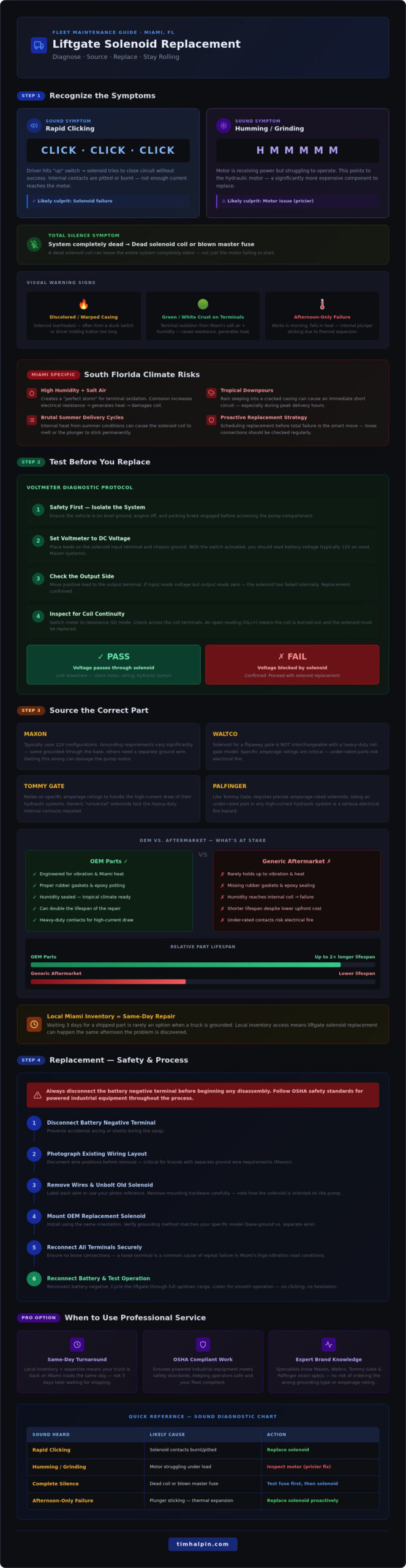
Identifying a failing component starts with your ears. When a driver hits the “up” switch and hears a rapid clicking sound, it’s usually the solenoid trying to close the circuit without success. This component acts as the gatekeeper for your liftgate’s electrical system. If the internal contacts are pitted or burnt, they won’t pass enough current to turn the motor. Sometimes, you might experience total power loss. While a blown master fuse is a possibility, a dead solenoid coil often leaves the system completely silent. A quick liftgate solenoid replacement in Miami is frequently all that’s required to get that truck back on the road.
Visual cues are just as telling as sounds. If you pop the pump cover and see a discolored or warped plastic casing on the solenoid, it has likely overheated. This often happens when a switch gets stuck or a driver holds the button too long, forcing the solenoid to stay engaged until it cooks itself. You should also look for intermittent operation. If the gate works perfectly during the morning shift but starts acting up during the heat of the afternoon, the internal plunger is likely sticking due to thermal expansion.
The Solenoid vs. The Motor: A Crucial Distinction
Many fleet managers fear the worst when a liftgate stops moving. They assume the hydraulic motor has burned out, which is a much pricier fix. However, the solenoid is essentially a high-amperage bridge between your battery and the motor. If you hear a low humming or grinding, that’s the motor struggling. If you only hear a click, the solenoid is likely the culprit. To understand the physics behind these components, you can look into how solenoid valves work and how electromagnetism moves internal plungers. Replacing a small electrical component is always better than condemning an expensive motor prematurely.
Environmental Factors in South Florida
Our local climate is notoriously tough on electrical systems. In Miami, the combination of high humidity and salt air from the coast creates a perfect storm for terminal oxidation. You’ll often see a green or white crust forming on the solenoid terminals. This corrosion increases electrical resistance, which generates heat. During the brutal summer delivery cycles, this internal heat can cause the solenoid coil to melt or stick. We’ve seen many cases where a tropical downpour seeps into a cracked casing, causing an immediate short. Regularly checking for loose connections can prevent a breakdown during your busiest hours. Scheduling a liftgate solenoid replacement in Miami before the part fails entirely is a smart move for any proactive fleet manager.
Sourcing the Correct Solenoid for Your Liftgate Brand
Finding the right component for a liftgate solenoid replacement in Miami involves more than just picking a part off a shelf. Each brand has specific electrical requirements that must be met to ensure safe operation. Maxon solenoids, for example, typically use 12V configurations but can vary significantly in their grounding requirements. Some are grounded through the base, while others require a separate ground wire. Getting this wrong can lead to a dead circuit or, worse, damage to your expensive pump motor.
Waltco systems present their own set of challenges. The solenoid used for a flipaway gate isn’t always interchangeable with the one found on a heavy-duty rail-gate model. Similarly, brands like Tommy Gate and Palfinger rely on specific amperage ratings to handle the high-current draw of their hydraulic systems. Many generic “universal” solenoids found online lack the heavy-duty internal contacts needed for these brands. Using an under-rated part is a recipe for an electrical fire. Following OSHA safety standards for powered industrial equipment is vital during maintenance to ensure your equipment remains compliant and your operators stay safe.
OEM vs. Aftermarket: Making the Right Choice
While aftermarket parts might save a few dollars upfront, they rarely hold up to the vibration and heat of Miami’s industrial districts. High-quality OEM components are engineered to withstand the constant jarring of South Florida roads. Choosing genuine Waltco liftgate parts in Miami ensures that your weather sealing is up to par. Many knock-off parts skip the rubber gaskets or epoxy potting that keeps our tropical humidity from reaching the internal coil. This simple difference can double the lifespan of your repair.
Miami Inventory: Getting Parts Today
Waiting three days for a shipped part is rarely an option when a truck is grounded. Having access to a local inventory means you can perform a liftgate solenoid replacement in Miami the same afternoon the problem is diagnosed. Always have your liftgate’s model and serial number ready before you call. This allows a specialist to verify compatibility immediately. If you’re unsure which mounting bracket or terminal nuts you need, it’s always best to consult with a local liftgate expert who understands the specific hardware configurations used in our region. This neighborly guidance prevents the frustration of multiple trips for the same repair.
Diagnostic First: Testing the Solenoid Before Replacement
Before you commit to a liftgate solenoid replacement in Miami, you must confirm that the electrical signal is actually failing at the component level. Jumping straight to a part swap without a diagnosis often leads to wasted time and money. Start by securing your workspace. Chock the wheels of the truck and ensure the liftgate is either fully lowered or safely supported. You don’t want a sudden restoration of power to move the gate while your hands are near the hydraulic mechanism. Safety is always the first step in any fleet maintenance routine.
The most reliable way to test the unit is with a voltmeter. Touch the positive lead to the battery side of the solenoid; it should read at least 12.4 volts. Next, have an assistant engage the liftgate switch while you check the signal terminal. If you see voltage at the switch terminal but the motor side stays dead, the solenoid’s internal contacts have failed. You can also perform a “jumper” test by briefly bridging the two large terminals with a heavy-gauge insulated cable. If the motor spins when bypassed, you’ve confirmed the solenoid is the bottleneck. Use caution here, as this can create a spark.
Sometimes, the part itself is perfectly fine. In our coastal environment, a “bad solenoid” is frequently just a victim of a loose or corroded ground. If the solenoid isn’t making a clean connection to the truck’s chassis or the dedicated ground wire, the electromagnetic coil won’t engage. Clean the mounting surface and the ground wire terminals with a wire brush before deciding the part is scrap. A few minutes of cleaning can often save you the cost of a new component.
Tools Required for a Professional Diagnostic
A professional diagnostic requires more than just a pair of pliers. You’ll need a Digital Multimeter (DMM) capable of measuring DC voltage and continuity. Circuit testers are also helpful for tracing breaks in the wiring harness that runs along the frame. Because of our local humidity, keep a terminal cleaning tool or a small file handy to strip away oxidation before taking your readings. Clean metal is essential for accurate electrical testing.
Interpreting Your Test Results
Interpreting these numbers requires a bit of nuance. A significant voltage drop across the solenoid indicates high internal resistance, which means the component is failing even if it still “clicks.” If there’s no signal at the switch terminal, the problem lies in your cab switch or the wiring harness rather than the solenoid itself. However, if the motor runs strong but the platform refuses to move, it’s time to look at your truck hydraulics instead. Diagnosing the system as a whole ensures you only replace what’s truly broken, keeping your fleet’s repair budget in check.
How to Replace a Liftgate Solenoid: Step-by-Step Guide
Once your diagnostic tests confirm a failure, performing a liftgate solenoid replacement in Miami is a straightforward task that can save your fleet hours of shop time. The process requires basic hand tools and a commitment to safety. Before you begin, ensure the truck is parked on level ground and the liftgate is fully lowered to the pavement. Working on a pressurized or raised system is a safety risk you don’t want to take.
- Step 1: Disconnect the main power. Locate the primary power lead at the truck battery and disconnect it. This prevents accidental shorts that could damage the motor or cause a fire while you’re working with high-amperage cables.
- Step 2: Label each wire. Before removing anything from the old unit, use tape to label the Battery, Motor, and Switch wires. It’s easy to lose track of which lead goes where once they’re all hanging loose in the pump box.
- Step 3: Clean the mounting surface. Remove the mounting bolts and pull the old solenoid. Take a moment to scrape the frame or mounting plate with a wire brush to reveal shiny metal. Since many solenoids ground through their base, a clean connection here is essential for proper operation.
- Step 4: Install and torque. Bolt the new unit in place. When attaching the wires, ensure every nut is torqued to the manufacturer’s specifications.
- Step 5: Test the system. Reconnect the battery and perform a full-cycle test. Run the gate up and down three times to ensure the solenoid engages consistently without overheating.
Pro-Tips for a Long-Lasting Installation
Applying a generous layer of dielectric grease to every terminal is the best defense against Miami’s salt-air corrosion. This simple barrier prevents the green oxidation that often leads to premature electrical failure in South Florida. While you have the system open, take a minute to inspect the wiring harness for any frayed insulation or “hot spots” that might indicate a larger electrical issue. Applying too much force when tightening terminals can easily crack the solenoid’s plastic housing, leading to internal failure. If you need to stock up on reliable components for your fleet, you can source heavy-duty liftgate parts directly from our local inventory.
Common Mistakes to Avoid
One of the most frequent errors involves mixing up the “S” and “I” terminals on four-post solenoids. Reversing these connections will prevent the coil from engaging when you hit the switch. You should also check the condition of the battery cables themselves. If the copper inside the terminal lug is black or brittle, a new solenoid won’t solve your power problems. Finally, never skip the mounting bolts; a loose solenoid will vibrate against the frame, leading to internal wire breakage and a repeat of the very failure you’re trying to fix.
Why Professional Replacement at Tim Halpin Minimizes Fleet Downtime
While a DIY approach is possible, choosing a professional liftgate solenoid replacement in Miami offers a level of certainty that a busy fleet manager needs. Since 1987, our family-owned business has focused on one goal: keeping South Florida moving. Tim Halpin Equipment Corp maintains one of the largest liftgate parts inventories in the country. This means we don’t just order the part for you; we likely have it on the shelf right now. Whether you’re running Maxon, Waltco, or Tommy Gate equipment, we have the OEM components ready for immediate installation to get your drivers back on the road.
Our technicians bring decades of hands-on experience to every service call. They often spot underlying issues, such as a failing motor or a compromised hydraulic line, that a simple part swap might overlook. By addressing the root cause, we help you avoid the stress of a repeat failure during your busiest delivery hours. Ensuring the repair meets rigorous safety standards is also about reducing liability for your commercial or municipal operations. Every job we do comes with the Tim Halpin Equipment Corp guarantee of accountability; it’s a personal promise from our family to yours that the job is done right.
Beyond the Solenoid: Comprehensive Liftgate Care
A solenoid failure is often a symptom of a larger electrical or hydraulic strain. We recommend pairing electrical repairs with regular hydraulic maintenance to ensure your entire system operates at peak performance. If you’re expanding your operations, the team at Tim Halpin Equipment Corp also specializes in commercial truck upfitting for new fleet additions. We can design a preventative maintenance plan that catches terminal corrosion or solenoid sticking before it grounds your vehicle, saving you from expensive emergency repairs down the line.
Visit Our Miami Facility
Our facility is conveniently located to serve the Doral and Miami areas, making it a perfect hub for fast parts pickup or drive-in service. Tim Halpin Equipment Corp has spent years building a reputation as the trusted local expert for South Florida fleets who value reliability and integrity. Beyond our local community, we also support international export markets from our South Florida hub. This global reach is built on the same individual accountability we offer our neighbors. If you’re ready to get your truck back in service, reach out to Tim Halpin Equipment Corp today to verify your part is in stock. We’re here to help you handle your liftgate solenoid replacement in Miami with the care and expertise your business deserves.
Keep Your Miami Fleet Moving Without Delay
Restoring your vehicle’s productivity starts with a clear understanding of the electrical hurdles unique to South Florida. From identifying that frustrating clicking sound to mastering the voltmeter diagnostic, you now have the tools to handle a liftgate solenoid replacement in Miami with confidence. Remember that sourcing the correct OEM part for your Maxon, Waltco, or Tommy Gate is the best way to prevent future electrical damage and keep your drivers safe on the road.
Since 1987, we’ve taken great pride in being the steady guide for our local commercial community. As an authorized dealer with the largest liftgate parts inventory in Miami, we focus on minimizing your downtime through expertise and immediate availability. Our family-owned team is here to ensure your repairs are seamless and reliable. Get Your Liftgate Back in Service-Contact Tim Halpin Today to verify your specific part is in stock. We look forward to helping you keep your delivery schedule on track and your business moving forward.
Frequently Asked Questions
Is it the liftgate solenoid or the motor that is failing?
You can distinguish between the two by listening for a specific clicking sound when you engage the switch. If you hear a click but the motor doesn’t spin, the solenoid is likely failing to bridge the electrical current. Total silence usually points toward a blown fuse or a broken switch wire. A motor failure typically presents with a low humming or grinding noise. Performing a liftgate solenoid replacement in Miami is often the first step before condemning a more expensive motor.
Can I use a generic automotive solenoid for my commercial liftgate?
Using a generic automotive solenoid is a significant risk that often leads to electrical fires or melted wiring. Commercial liftgates require heavy-duty solenoids designed to handle high-amperage draws, often exceeding 150 amps during operation. Automotive versions are typically built for lighter duty cycles and will fail almost immediately under the strain of a hydraulic pump. Always stick to OEM-spec components to ensure your fleet remains safe and compliant with industrial standards.
How long does it take to replace a liftgate solenoid in a shop?
A professional technician can typically complete the replacement in under an hour if the parts are already on hand. This includes the time needed for a full electrical diagnostic and a post-installation cycle test. At our Miami facility, we prioritize efficiency because we understand that every hour your truck sits in the shop is an hour of lost revenue. Having the largest local inventory allows us to move much faster than shops waiting on shipping.
Where can I buy Maxon or Waltco solenoids in Miami today?
You can find a complete stock of Maxon and Waltco solenoids right here at Tim Halpin Equipment Corp in Miami. We’ve maintained one of the largest liftgate parts inventories in the country since 1987, ensuring you don’t have to wait for backordered items. Whether you need a specific 12V post-mount or a specialized grounding configuration, our team can verify compatibility and have the part ready for local pickup or immediate installation today.
What tools do I need for a DIY liftgate solenoid replacement?
For a successful DIY replacement, you’ll need a digital multimeter to verify voltage and a set of insulated wrenches for the terminal nuts. A wire brush is essential for cleaning South Florida corrosion off the mounting surface and cable lugs. We also recommend having dielectric grease on hand to seal the new connections against our local humidity. These basic tools allow you to perform a professional-grade liftgate solenoid replacement in Miami right in your own yard.
Why does my liftgate solenoid keep burning out?
Frequent burnouts are usually caused by high electrical resistance or low battery voltage. If your battery cables are corroded or the ground connection is weak, the solenoid has to work harder, generating internal heat that melts the coil. In Miami’s tropical climate, terminal oxidation is a constant battle. Regularly checking your charging system and cleaning your connections can prevent the heat buildup that leads to premature failure and repetitive part replacements.
What happens if I jump the solenoid terminals to operate the gate?
Jumping the terminals should only be done as a last-resort diagnostic test, never as a permanent way to operate the gate. This method creates a high-amperage spark that can damage the terminal threads or cause the battery to vent. It also bypasses all safety switches, which puts the operator at risk of injury if the gate moves unexpectedly. If your solenoid is failing, it’s always safer to replace the component rather than relying on dangerous bypass methods.
Are there different solenoids for 12V and 24V liftgate systems?
Yes, 12V and 24V solenoids are distinct components and are not interchangeable. Installing a 12V solenoid on a 24V system will cause the internal coil to burn out almost instantly due to the excessive voltage. Conversely, a 24V solenoid won’t have enough power to engage the plunger on a 12V system. Always check the data plate on your liftgate pump motor or the existing solenoid casing to verify the correct voltage before purchasing a replacement.
