

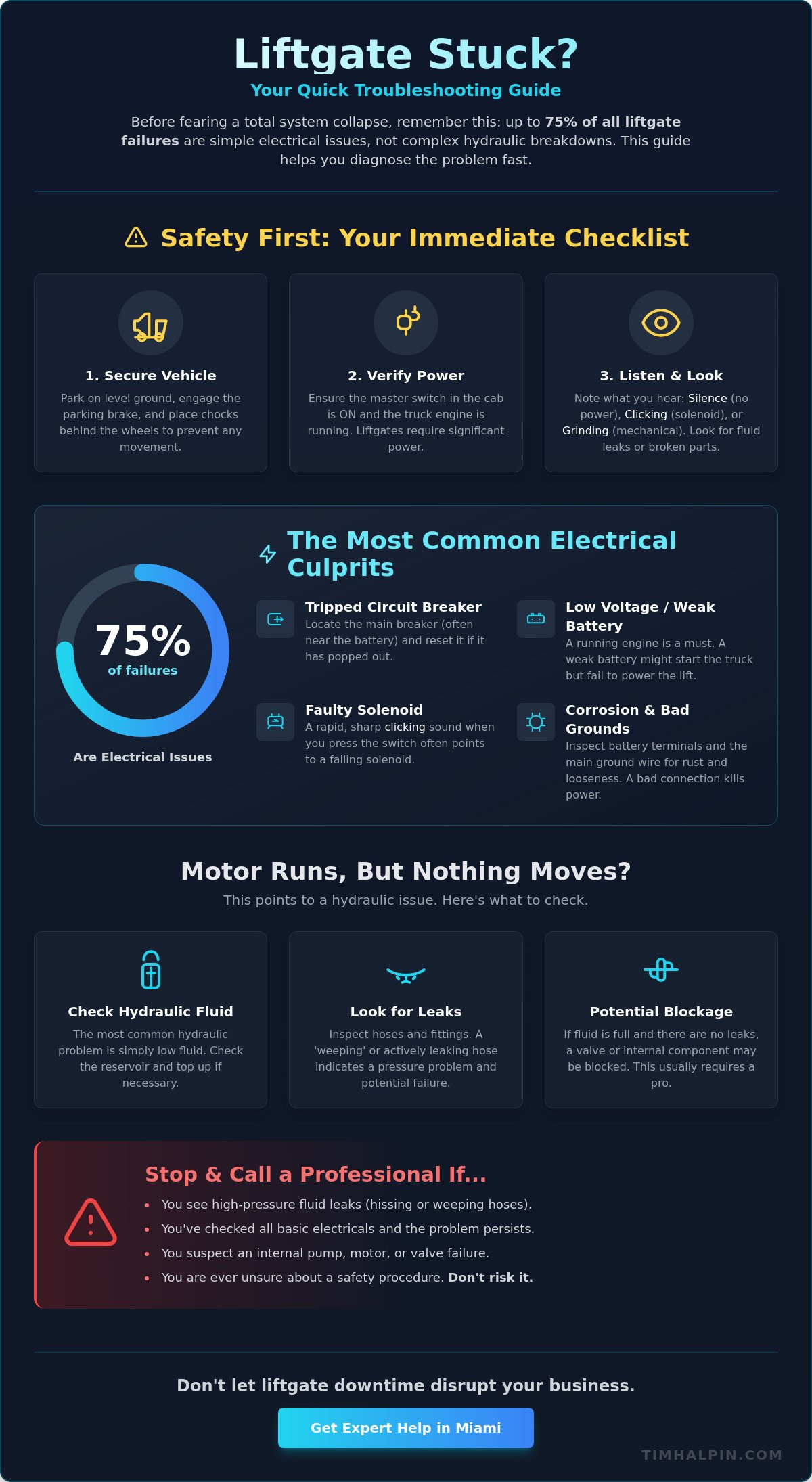
Did you know that up to 75% of all liftgate failures are actually electrical issues disguised as hydraulic breakdowns? When your liftgate won’t go up or down, it’s easy to fear the worst and imagine a total system collapse. However, that silence you hear when you hit the switch often points to a simpler culprit like low voltage or a faulty solenoid. We know the stress of watching a delivery schedule slip away while you’re forced to unload heavy freight by hand; it’s a physical and financial burden that disrupts your entire day.
We understand that every hour your truck sits idle in the Miami sun represents lost revenue and unnecessary strain. It’s frustrating to feel stuck between a DIY gamble and the fear of an expensive repair bill. This guide will help you identify the root cause of your equipment failure so you can decide when to perform a quick fix or call in a professional. We’ll walk you through common electrical gremlins, hydraulic warning signs, and the specific steps to get your Waltco or Maxon gate moving again to minimize your vehicle’s downtime.
Key Takeaways
- Prioritize safety by securing your perimeter and chocking wheels before you begin any inspection of a stuck liftgate.
- Identify whether your liftgate won’t go up or down due to common electrical gremlins like corroded ground wires or tripped circuit breakers.
- Learn to distinguish between a simple low-fluid issue and a complex valve blockage when your motor runs but the platform stays put.
- Gain insights into brand-specific troubleshooting for Waltco, Maxon, and Tommy Gate systems to address unique mechanical quirks.
- Determine when to transition from DIY checks to professional Miami hydraulic repair services to avoid the high-pressure risks of advanced system failures.
Emergency Diagnostics: Immediate Steps When Your Liftgate Fails
When your liftgate won’t go up or down, the first sixty seconds are critical for your safety and the security of your cargo. Whether you’re parked on a busy street in Wynwood or at a quiet warehouse in Doral, a malfunctioning platform creates an immediate hazard. Your primary goal is to stabilize the vehicle. Ensure the truck is on level ground to prevent the platform from shifting unexpectedly. Engage the parking brake immediately and place chocks behind the wheels. This isn’t just about the truck moving; it’s about ensuring the heavy steel platform doesn’t become a lever that shifts the entire vehicle’s weight.
Before you touch a single tool, take a moment to understand the mechanical basics. What is a Liftgate? Essentially, it is a complex hydraulic or pneumatic system designed to bridge the gap between your truck bed and the ground. If it fails, you need to identify its current state. Is it stuck at bed height, resting on the pavement, or hovering precariously mid-travel? Listen closely when you press the control switch. Complete silence often points to a total power loss, while a rapid clicking sound suggests a struggling solenoid or low battery voltage. A grinding noise usually signals a mechanical obstruction or a pump that’s running dry.
Safety Protocols for Stuck Liftgates
A gate stuck in the raised position is a heavy weight held up by aging seals or a single hydraulic cylinder. Never walk under a raised platform that isn’t moving. If the liftgate won’t go up or down and it’s stuck in the air, use safety chains or heavy duty jack stands to support the weight. Watch for warning signs of extreme pressure, such as a ‘weeping’ hydraulic hose or a faint hissing sound. If you’re stuck ‘down’ in a high-traffic area, use orange cones to create a wide perimeter around the platform. A lowered gate is nearly invisible to passing motorists and can cause a serious collision if the area isn’t clearly marked.
The ‘First Minute’ Checklist
Before calling for a tow or professional repair, run through these quick checks. First, verify the master switch in the cab is actually in the ‘on’ position; it’s surprisingly easy to bump it during a long shift. Second, ensure the truck engine is running. Modern liftgates require high voltage to operate, and a resting battery might not have the juice to move a heavy load. Finally, do a quick visual sweep for obvious signs of trouble like fresh fluid puddles or snapped cables. These simple steps often resolve what looks like a major failure in seconds.
Electrical Failures: Why Your Liftgate Has No Power
When your liftgate won’t go up or down, the problem is rarely a catastrophic mechanical break. Statistics suggest that nearly 75% of these failures are rooted in the electrical system. You should start your search at the heart of the power supply. Most commercial trucks feature a dedicated circuit breaker or a high-amp fuse located within three feet of the battery box. A sudden surge or even a heavy vibration can trip this breaker. If you see a small lever or button popped out on the breaker housing, simply resetting it might solve your entire problem in seconds.
Amperage is the lifeblood of your lifting mechanism. While a battery might have enough voltage to start the truck, it may lack the deep-cycle strength required to move a heavy platform. Check your toggle switches and remote controls for loose internal wiring or cracked housings. These components are exposed to the elements daily, and a small amount of moisture inside a control box can easily bridge a connection or cause a short circuit that leaves you stranded at the loading dock.
The Role of the Solenoid
The solenoid acts as the gatekeeper between your battery and the liftgate motor. If you press the “up” switch and hear a sharp, repetitive clicking sound, your solenoid is likely trying to engage but failing. This usually happens when internal contacts are burnt or when the battery doesn’t have enough juice to hold the magnetic coil shut. You can safely test a solenoid by checking for power on both large terminals while the switch is engaged, but always remember that OSHA safety standards emphasize the danger of working on high-power systems without proper training. A burnt-out motor starter solenoid is a common point of failure that requires a specific replacement part to restore reliable operation.
Corrosion and Connection Issues
Our South Florida climate is notoriously tough on electrical systems. The combination of intense humidity and salt air from the coast accelerates terminal oxidation at an alarming rate. A ground wire that appears solid might actually be plagued by hidden corrosion inside the terminal crimp. This “green crust” increases resistance, which starves the motor of power and causes it to overheat. We recommend cleaning your battery posts and ground points at every oil change to ensure a clear path for current. If you notice that your power cables are stiff or bulging, it is likely time to source professional liftgate repair services to prevent a total electrical fire or harness failure.
Hydraulic System Issues: When the Motor Runs but Nothing Moves
If the motor whirrs but your liftgate won’t go up or down, the struggle has moved into the hydraulic system. This is a common point of frustration for drivers who can hear the equipment trying to work while the platform remains motionless. Unlike electrical issues, hydraulic failures often involve physical blockages or fluid deficiencies. Start by checking the hydraulic reservoir fluid level, but do this only when the gate is fully lowered to the ground. Checking the level while the gate is raised will provide a false low reading, which often leads to overfilling and potential reservoir damage once the gate is lowered.
Listen for a high-pitched, screeching whine known as cavitation. This sound indicates that air has entered the lines, often due to a leak or a low fluid level. The pump is essentially trying to compress air bubbles rather than fluid, which prevents the pressure needed to lift heavy loads. While you’re back there, look for “weeping” cylinders or damp spots on high-pressure hoses. A small leak today is often a precursor to a total hose burst tomorrow, especially under the heavy weight of a full delivery. When your liftgate won’t go up or down despite a working motor, identifying these visual cues early can prevent a mess on the warehouse floor.
Common Hydraulic Valve Failures
The heart of the system relies on a series of valves to direct fluid flow. The lowering valve is a frequent culprit; if it fails to open, your gate won’t descend even if the electrical system is perfect. Within the valve body, a stuck “spool” can prevent fluid from reaching the cylinders altogether. Pressure relief valves are designed to prevent system blowouts by venting excess pressure, but they can occasionally fail or become misadjusted. Maintaining these components is a core part of OSHA liftgate safety standards, which emphasize that proper maintenance prevents the sudden, uncontrolled drops that lead to workplace injuries.
Fluid Maintenance and Contamination
Miami’s intense humidity creates a unique challenge for hydraulic systems. Water vapor can settle in the reservoir, turning the oil into a milky, ineffective mess that causes internal corrosion. If the fluid appears dark or smells burnt, it has likely been subjected to extreme heat and lost its protective properties. Using the wrong hydraulic oil weight can also cause the system to sluggishly respond or seize up entirely. To keep your equipment in peak condition, consider reaching out for expert truck hydraulics in Miami for a professional system flush and inspection. This simple preventative step can save you from a much more expensive pump replacement down the road.
Troubleshooting by Brand: Waltco, Maxon, and Tommy Gate
Every manufacturer designs their equipment with unique engineering philosophies, which means your troubleshooting approach must adapt to the specific brand on your truck. General diagnostics get you started, but specific brands have distinct mechanical personalities. For instance, if your Waltco liftgate won’t go up or down, the first thing to check is whether you have a gravity-down or power-down model. Gravity-down systems rely on the weight of the platform to descend. This means a seized hinge or a simple lack of lubrication can halt movement entirely. Conversely, power-down systems use hydraulic pressure to push the gate in both directions. Understanding this distinction prevents you from chasing an electrical ghost when the problem is actually a mechanical bind.
Maxon units often feature sophisticated limit switches that cut power to prevent over-travel. If these switches are caked in road grime or knocked out of alignment, the system will assume the gate is already in the correct position and refuse to move. Similarly, check the slide pads on Maxon column lifts. If these pads wear down or become dry, the resulting friction can trip the circuit breaker. Tommy Gate owners should pay close attention to the dual-drive cables. If these cables lose tension or fray, the platform will tilt and bind in the tracks. This creates a “stuck” sensation even if the motor is healthy and the fluid is full.
Sourcing OEM Replacement Parts
When a component fails, the temptation to use a generic, universal part is high. However, these often lack the exact specifications required for high-cycle commercial use and can lead to premature failure. We always recommend using original equipment manufacturer (OEM) parts to preserve your manufacturer warranty and ensure long-term reliability. If you find yourself stranded, sourcing Waltco liftgate parts in Miami ensures you get a perfect fit from a local team that understands the demands of South Florida trucking. Keeping a small emergency kit with spare fuses and a starter solenoid can often be the difference between a minor delay and a lost day of revenue.
Mechanical Bindings and Lubrication
Sometimes the issue isn’t power or fluid; it’s physics. A minor impact at a loading dock can slightly bend a frame or misalign a track, putting immense stress on the pivot points. This leads to the “dry pin” problem, where friction becomes too great for the motor to overcome. Regular greasing at every service interval prevents these total lockups and keeps the movement smooth. If you notice jerky movement or a loud groaning sound during operation, your bushings are likely worn out and need replacement. If your system requires more than basic grease, our team offers professional liftgate repair services to restore your equipment to factory standards.
When to Call a Professional Miami Liftgate Specialist
While a quick reset of a circuit breaker can save the day, there are moments when your liftgate won’t go up or down due to internal failures that remain invisible to the naked eye. Handling high-pressure hydraulics requires specialized tools and a deep understanding of fluid dynamics to prevent catastrophic injury. We often see fleet owners lose significant productivity while trying to troubleshoot complex issues in-house. In 2025 and 2026, the average cost of downtime for a commercial truck climbed to between $1,200 and $2,800 per day. When you weigh those losses against the median South Florida labor rate of $149 per hour, the financial logic is clear. A professional fix isn’t just about the repair. It’s about returning your vehicle to the road with total confidence.
For older equipment that has weathered years of heavy use, a professional liftgate rebuild is often the most sustainable path forward. Instead of chasing individual leaks or electrical shorts, a rebuild restores the entire system to peak performance. This proactive approach eliminates the ‘rolling’ failures that plague aging fleets. It transforms an unreliable asset back into a dependable tool for your daily operations.
Professional Diagnostic Advantages
Our team utilizes advanced load-testing equipment to identify ‘ghost’ electrical draws that drain batteries overnight. We don’t simply guess which component is failing; we pressure-test pumps to ensure they meet original factory specifications. This rigorous diagnostic process ensures your equipment remains in full compliance with ANSI and OSHA safety standards. By identifying microscopic cracks in hoses or internal valve bypass issues, we prevent the sudden platform drops that lead to expensive insurance claims and workplace injuries.
South Florida Fleet Support
We take immense pride in supporting the commercial and municipal fleets that keep Miami moving every single day. From the busy distribution hubs near the airport to the local delivery routes in Coral Gables, Tim Halpin Equipment Corp stands as a steady, knowledgeable guide for our neighbors. Our massive inventory of OEM parts for brands like Waltco, Maxon, and Tommy Gate means we rarely have to wait for shipping while your truck sits idle. We value our reputation in this community as much as the quality of our work. Contact Tim Halpin for expert liftgate repair and parts today to ensure your fleet stays on schedule and your drivers stay safe.
Restoring Your Fleet’s Momentum
Dealing with equipment that refuses to cooperate is a stressful hurdle in an already demanding industry. By understanding the balance between electrical gremlins and hydraulic pressure, you’ve taken the first step toward regaining control of your delivery schedule. Remember that most issues start with simple connections or fluid levels, but recognizing when a mechanical bind requires a professional eye is what keeps your drivers safe and your trucks productive. Whether you’re navigating the busy streets of Miami or managing a regional fleet, having a reliable partner makes every breakdown more manageable.
Since 1987, our family-owned business has stood as a steady guide for South Florida’s trucking community. We maintain one of the largest liftgate parts inventories in the USA to ensure that when your liftgate won’t go up or down, your downtime is kept to an absolute minimum. We’re here to provide the expertise and the components you need to stay moving. Get your fleet back on the road with expert liftgate repair at Tim Halpin today. Your reputation for reliability is our top priority, and we’re ready to help you uphold it.
Frequently Asked Questions
Why is my liftgate clicking but not moving?
A clicking sound usually indicates that your solenoid is receiving a signal but lacks the electrical current to engage the motor. This happens when your battery voltage is too low or when the solenoid’s internal contacts are burnt. It is a common sign that your power supply is struggling to bridge the connection needed to activate the hydraulic pump.
Can I manually raise a liftgate if the motor is dead?
Most commercial liftgates cannot be manually raised because the hydraulic fluid is locked within the cylinders. While some specialized models feature a manual hand pump for emergencies, standard tuckunder or railgate units usually require a forklift or a heavy duty jack to move the platform. You must always secure the gate with safety chains before attempting to transport the vehicle with a dead motor.
How do I know if my liftgate motor is burnt out?
You can identify a burnt motor by testing for power directly at the motor terminals while the switch is engaged. If your voltmeter shows 12 volts but the motor remains silent and cold, the internal windings have likely failed. A distinct smell of burnt electrical insulation or visible discoloration on the motor’s metal housing are also clear indicators that the unit needs a professional replacement.
What kind of hydraulic fluid does a truck liftgate use?
Most manufacturers recommend a high quality ISO 32 hydraulic oil or a multi-viscosity fluid designed for a wide range of operating temperatures. In South Florida’s heat, using the correct viscosity is essential to prevent the fluid from thinning out and losing its lifting power. Always consult your specific Waltco or Maxon manual, as using the wrong fluid can damage seals and void your equipment warranty.
Why does my liftgate go up but won’t come down?
When a liftgate won’t go up or down properly and is stuck in the raised position, the lowering valve is usually the culprit. This valve must open electrically to allow fluid to return to the reservoir. If the valve is stuck or the coil is burnt, the fluid remains trapped in the cylinders, keeping the gate up even if the motor is perfectly healthy.
How often should I grease my commercial liftgate?
We recommend greasing all pivot points at least once a month or every 250 cycles to ensure smooth operation. In our local Miami climate, the salt air and high humidity can cause pins to seize much faster than in drier regions. Consistent lubrication prevents the mechanical binding that often makes it feel like your liftgate won’t go up or down due to a power issue.
Is it safe to weld a cracked liftgate frame myself?
Welding a structural frame is a high-risk repair that should only be performed by a certified professional using the correct high-tensile materials. A DIY weld often lacks the penetration needed to support heavy commercial loads, which can lead to a sudden structural collapse. For the safety of your drivers and the public, structural repairs should always meet original manufacturer specifications.
Where can I find Maxon or Waltco parts in Miami?
Tim Halpin Equipment Corp maintains one of the largest inventories of Maxon and Waltco parts in the country right here in South Florida. We stock everything from solenoids and switches to complete pump motor assemblies and hydraulic hoses. Our local team provides the immediate parts availability and expert guidance you need to minimize downtime and keep your fleet moving.
