

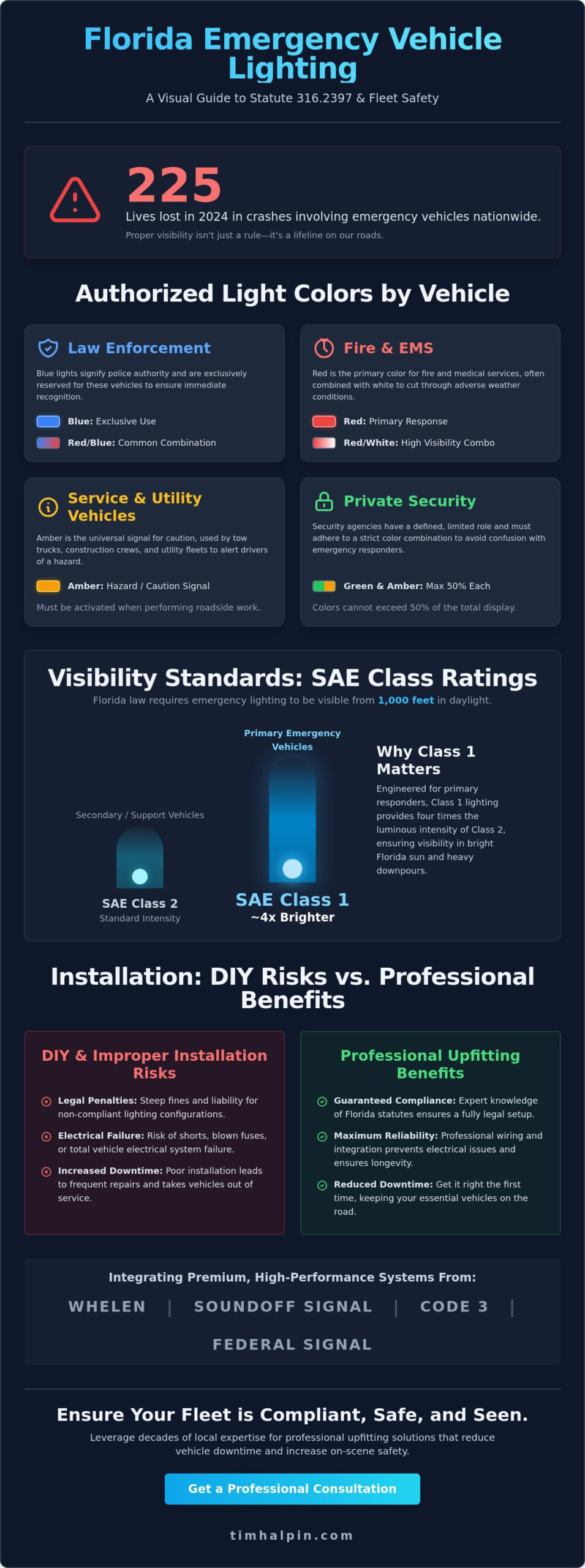
In 2024, 225 people lost their lives in crashes involving emergency vehicles across the country. It’s a heavy statistic that reminds us that visibility isn’t just a legal chore; it’s a matter of life and death for our neighbors and our teams. You likely understand that keeping your fleet seen is your top priority, yet the complex language of Florida Statute 316.2397 often causes more confusion than clarity. Whether you’re worried about non-compliance fines or the risk of a total electrical failure from a poor DIY job, the pressure to get your public safety vehicle lighting florida configuration right is real.
This guide will help you move past the guesswork and find a steady path forward. We’ll show you how to satisfy Florida’s strict lighting laws while discovering professional upfitting solutions that reduce vehicle downtime and increase on-scene safety. We will cover the specific color codes for your industry and the latest integrated LED systems from brands like Whelen, SoundOff Signal, and Code 3 to ensure your fleet is both legal and incredibly durable.
Key Takeaways
- Master the nuances of Florida Statute 316.2397 to keep your fleet legally compliant and protected against non-compliance penalties.
- Identify the exact light colors authorized for your vehicle type to ensure immediate recognition and safety on Florida’s busy roads.
- Learn why professional installation for public safety vehicle lighting florida is the best way to avoid the common electrical pitfalls of DIY setups.
- Discover how to integrate premium lighting from brands like Whelen and SoundOff Signal with audible warnings for a complete, high-performance safety system.
- Leverage decades of local expertise to reduce vehicle downtime and ensure your equipment remains as reliable as the team operating it.
Florida Public Safety Vehicle Lighting Statutes (2026)
Florida Statute 316.2397 serves as the essential rulebook for every fleet manager in the Sunshine State. It isn’t just a list of restrictions; it’s a safety blueprint that dictates exactly who can use specific colors and flash patterns. For those of us managing municipal or private fleets, staying on the right side of this law is about more than avoiding a citation. It’s about ensuring that when your team is on the road, they’re recognized instantly as a source of help. Non-compliance often leads to steep fines, but the deeper concern is the legal liability following an accident where lighting failed to meet state-mandated visibility benchmarks.
Defining Authorized Emergency Vehicles
Under Florida law, the “Authorized Emergency Vehicle” designation is strictly controlled. It primarily covers vehicles operated by law enforcement, fire departments, and ambulance services. If you’re a volunteer first responder, you’re required to obtain specific permits before displaying red lights on a personal vehicle. Private security agencies also have a defined role, though they are limited to green and amber lights where neither color exceeds 50% of the display. Determining your status involves reviewing your agency’s charter or contract with the state, as the designation is often tied to the specific service being performed. For a broader perspective on these systems, this Emergency Vehicle Lighting Overview provides excellent context on how these standards are applied across different jurisdictions.
Visibility Standards and SAE Class 1 Ratings
The legal benchmark for public safety vehicle lighting florida is visibility from 1,000 feet in normal sunlight. This requirement makes the choice between SAE Class 1 and Class 2 equipment a primary concern for fleet safety. Class 1 lighting is engineered for primary emergency vehicles, offering roughly four times the light output of Class 2. In the bright Florida sun or during a heavy afternoon downpour, that extra intensity is what ensures other drivers see you in time to move over. We recommend high-intensity LED systems from trusted names like Whelen, SoundOff Signal, or Federal Signal to meet these 2026 standards. These systems are designed to withstand our local climate while providing the consistent, piercing light required by state law. Choosing the right class of lighting isn’t just a preference; it’s a commitment to the safety of your operators and the public they serve.
Authorized Light Colors by Vehicle Type in Florida
In the high-speed environment of Florida’s highways, color serves as an immediate language. It tells drivers exactly who is behind them and what action they need to take. This visual shorthand is strictly regulated by Florida Statute 316.2397, which reserves specific colors for different tiers of emergency response. Getting these combinations wrong doesn’t just invite a fine; it creates confusion on-scene that can lead to secondary accidents. For anyone managing public safety vehicle lighting florida, understanding these color distinctions is the first step toward a compliant and safe fleet.
Law Enforcement and Fire/EMS Requirements
Blue lights remain the exclusive domain of law enforcement in the state of Florida. It’s a third-degree felony for a non-law enforcement vehicle to use blue lights in an attempt to stop another motorist. While many agencies use a red and blue split, the presence of blue is the definitive marker of police authority. Fire departments and EMS teams typically utilize a combination of red and white lighting. White lights are excellent for cutting through heavy rain or fog, but they must be positioned so they don’t blind oncoming traffic. When these vehicles are stationary, rear-facing amber lights are often integrated into the light bar. This helps manage traffic flow around the scene, providing a clear signal to passing motorists without the aggressive glare of primary response colors.
Service, Tow, and Utility Vehicle Lighting
Amber is the universal signal for a hazard. It’s the primary color for utility fleets, construction crews, and roadside service vehicles. For those sourcing tow truck parts Florida, it’s vital to ensure your amber beacons or light bars are SAE Class 1 rated for maximum visibility. These vehicles must activate their warning lights whenever they’re performing work on the roadside or signaling a hazard to others. A unique Florida standard also exists for mobile command posts, which often utilize a flashing green light to identify the incident commander’s location at a large-scale scene. Private security agencies also have their own niche, permitted to use a 50/50 mix of green and amber to distinguish themselves from government first responders. If you’re looking to build a fleet that meets these exact standards, you might find our insights on public safety lighting in Miami helpful for your next upfitting project.
Beyond the Light Bar: Essential Public Safety Equipment
While the roof-mounted light bar is the most recognizable part of your fleet, it’s only one piece of a much larger visibility ecosystem. Truly effective public safety vehicle lighting florida setups rely on a layered approach that provides 360-degree coverage. This means looking beyond the roof to include perimeter lighting, grille lights, and intersection warnings. We’ve found that the most reliable fleets in our community don’t just “bolt on” lights; they integrate them with audible warning systems and smart controllers to ensure the vehicle is seen and heard long before it arrives at a scene. As you look deeper into the Florida Vehicle Lighting Statutes, you’ll see that compliance involves more than just color; it involves how those lights are mounted and integrated into the vehicle’s electrical framework to maintain visibility from every possible angle.
Brand reliability is a non-negotiable factor for Florida agencies. Our local climate is notoriously tough on electronics, with high humidity and salt air acting as constant stressors. This is why brands like Whelen Engineering, SoundOff Signal, and Federal Signal dominate the landscape. These manufacturers build equipment designed to withstand extreme conditions without flickering or failing. For undercover or unmarked units, the shift toward low-profile and “stealth” lighting has become the standard. These systems remain virtually invisible until activated, allowing for discrete operation without sacrificing the high-intensity output required by SAE Class 1 standards when it’s time to move.
Primary and Secondary Warning Systems
A full-size light bar is ideal for a standard patrol SUV or a large fire chassis, but mini-bars and beacons often serve better for utility trucks or smaller response units. To achieve total coverage, we recommend supplementing primary bars with secondary systems. Grille lights and dash lights help clear traffic in the rearview mirror, while hide-away strobes in the headlights or tail lights provide essential side-profile visibility. For our neighbors operating in South Florida, high-output scene lighting is also a critical safety requirement. It turns the area around the vehicle into a well-lit workspace during night-time operations, reducing the risk of trip hazards or missed details during an investigation.
Control Systems and Electrical Management
Modern lighting is only as good as the brain behind it. Programmable controllers allow your team to switch between different flash patterns or dimming levels based on the environment. For example, a “park” pattern can be programmed to be less aggressive than a “pursuit” pattern, which helps prevent blinding other first responders on a crowded scene. Managing the battery draw is equally important. High-intensity LEDs are efficient, but a full suite of equipment can still drain a battery if the system isn’t managed correctly. We always emphasize the importance of weather-sealed wiring and professional-grade connectors. In Florida’s damp environment, a single unsealed wire can lead to corrosion that shuts down your entire lighting system when you need it most.
The Risks of DIY Lighting vs. Professional Florida Upfitting
The allure of budget-friendly lighting from online marketplaces is a trap that many well-meaning fleet managers fall into. These products often arrive without the necessary SAE Class 1 certifications required for primary emergency use in our state. Beyond the initial brightness, the real danger lies in the lack of longevity. A light that flickers out after six months of South Florida sun isn’t just a nuisance; it’s a safety hazard. When a vehicle is involved in a collision and the lighting is found to be non-compliant or malfunctioning due to poor quality, the resulting liability can be staggering. Professional public safety vehicle lighting florida installation ensures that every beacon, bar, and strobe is legally compliant and physically capable of performing when a life is on the line.
Electrical Integrity and CAN Bus Integration
Modern vehicle chassis are far more complex than the simple 12-volt systems of the past. Today’s trucks and SUVs use CAN Bus networks to communicate between sensors, safety systems, and the engine. An amateur installer who taps into the wrong wire can inadvertently disable critical features like automatic braking or lane-keep assist. This is where the value of commercial truck upfitting in Miami becomes clear. Professionals use dedicated power distribution blocks and vehicle-specific harnesses to protect the original electrical integrity. This approach doesn’t just prevent “ghost” dash lights; it protects your manufacturer’s warranty and maintains the vehicle’s resale value by avoiding a hacked-up wire harness.
Durability in the Florida Environment
Our local climate is a relentless adversary for electrical equipment. Between the corrosive salt air near the coast and our daily summer deluges, water intrusion is the leading cause of lighting failure in the region. Professional mounting involves more than just a few screws. It requires specialized gaskets, heat-shrink connectors, and industrial-grade sealants to prevent leaks that lead to interior mold or roof rust. If an online light fails, you’re often stuck dealing with a digital return process and weeks of vehicle downtime. Choosing a local partner provides you with immediate access to support and parts that are actually stocked in our neighborhood. If you want to ensure your fleet is built to last and remains fully compliant, explore our Installation Services today.
Ultimately, the cost of a professional install is an investment in your team’s safety and your agency’s reputation. We’ve seen far too many “simple” installs turn into expensive repairs when a short circuit fries a vehicle’s main control module. By choosing professional upfitting, you’re choosing a steady, knowledgeable guide to navigate these technical complexities, allowing your operators to focus on their mission without worrying about their equipment failing at the worst possible moment.
Custom Public Safety Lighting Solutions in South Florida
Since 1987, our team has been a steady fixture in the South Florida community. We understand that for local agencies, equipment isn’t just a line item in a budget; it’s a lifeline for the people behind the wheel. While national websites can ship a box of lights to your door, they can’t offer the neighborly accountability that comes with decades of serving Miami-Dade and the surrounding areas. Our approach to public safety lighting in Miami is built on this foundation of local trust. We don’t just sell parts; we provide the professional expertise needed to ensure your public safety vehicle lighting florida setup is durable, compliant, and ready for the specific challenges of our tropical environment.
We specialize in custom builds tailored to the unique needs of police, fire, tow, and municipal service vehicles. Every department has a different operational rhythm, and their lighting should reflect those requirements. Whether it’s a high-profile patrol unit or a municipal dump truck requiring hazard beacons, we focus on minimizing your fleet’s downtime. By maintaining an extensive local inventory and employing technicians who understand the technical nuances of the latest standards, we get your vehicles back in service faster than any “plug-and-play” online alternative. We take pride in knowing that our work helps keep our neighbors safe every single day.
The Tim Halpin Advantage for Florida Fleets
Our shop maintains an on-site inventory of the industry’s most respected brands, including Whelen Engineering and Feniex Industries. This immediate access allows us to handle large-scale fleet rollouts and individual custom builds with the same level of precision and care. The Tim Halpin legacy is built on a commitment to quality that transcends a simple commercial transaction. We view ourselves as partners in your agency’s mission. Our reputation in the community is our most valuable asset, and it serves as a personal guarantee of service that you simply won’t find with a faceless corporate entity.
Next Steps for Your Fleet Lighting Project
If you’re looking to update your fleet, the process begins with a detailed consultation where we listen to your specific operational needs. We’ll help you design a system that maximizes visibility while staying strictly within the bounds of state law. For agencies with older units, we also offer comprehensive retrofitting services. We can replace outdated, power-hungry strobes with 2026-compliant LED technology, extending the life of your vehicles and significantly improving on-scene safety. Contact our Miami shop today for a professional quote. We’re here to guide you through the technical details, ensuring your fleet remains a source of pride and safety for our entire community.
Securing Your Fleet for the Future
Ensuring your vehicles are visible and compliant is more than a legal requirement; it’s a commitment to the safety of our South Florida neighbors. By understanding the nuances of Florida Statute 316.2397 and prioritizing high-intensity SAE Class 1 equipment, you protect your team and the public alike. We’ve explored why professional installation is the only way to safeguard your vehicle’s complex electrical systems from the long-term effects of our humid climate. When you choose quality over a quick fix, you ensure your equipment works perfectly the moment a life is on the line.
Since 1987, we’ve stood as a trusted partner for agencies across the region. As an authorized dealer for Whelen, SoundOff Signal, and Federal Signal, our certified technicians bring decades of expertise to every project. If you’re ready to modernize your fleet with reliable, 2026-compliant public safety vehicle lighting florida, we’re here to guide you. Request a Professional Lighting Quote from Tim Halpin Equipment Corp to get started on a build you can depend on. We look forward to helping you keep our community safe and your fleet running at its absolute best.
Frequently Asked Questions
What are the legal colors for emergency vehicle lights in Florida?
Florida law dictates a specific color hierarchy to ensure immediate identification on the road. Law enforcement vehicles are the only ones permitted to use blue lights, while fire and EMS teams utilize red and white combinations. Amber is the standard for tow trucks and utility vehicles to signal hazards. Private security agencies are permitted a mix of green and amber. Adhering to these codes ensures your public safety vehicle lighting florida setup is both effective and legally compliant.
Can private security vehicles use flashing lights in Florida?
Private security vehicles are allowed to use flashing lights, but they must follow strict color limits. They are authorized to use a combination of green and amber lights only. Neither color can make up more than 50% of the total lighting displayed at any time. This unique combination helps distinguish private security from government first responders while still providing the necessary visibility for the property and personnel they protect.
Do I need a permit for emergency lights on my personal vehicle?
You generally need a specific permit if you’re a volunteer first responder using red lights on a personal vehicle. Florida law requires formal authorization for volunteer firefighters or medical staff to display these warnings while responding to calls. It’s best to consult with your local department head or the Department of Highway Safety and Motor Vehicles to ensure your paperwork is in order before scheduling a professional installation.
What is Florida Statute 316.2397 and who does it apply to?
Florida Statute 316.2397 is the primary legislation that defines which vehicles can use specific light colors and flash patterns. It applies to every motorist and fleet operator in the state, from police officers to private utility contractors. The statute aims to prevent confusion on the road by reserving certain colors for specific types of response. Following this law is the essential foundation of any professional fleet upfitting project in our local community.
Are blue lights legal for anyone other than police in Florida?
No, blue lights are strictly reserved for law enforcement vehicles in the state of Florida. It is a third-degree felony for any unauthorized person to use blue lights in an attempt to stop another vehicle. This exclusivity helps the public immediately identify a police presence. Even within a broader public safety fleet, only sworn law enforcement officers should have blue lighting integrated into their vehicle’s warning system to remain on the right side of the law.
How much does professional public safety lighting installation cost?
The cost of professional installation varies significantly based on the complexity of your fleet’s needs and the specific equipment chosen. Factors like the total number of light heads, the type of programmable controller, and the vehicle chassis all play a role in the final project. Because every build is custom, we recommend checking with a qualified local upfitter for a detailed quote that matches your specific visibility and system integration requirements.
What is the difference between SAE Class 1 and Class 2 lighting?
SAE Class 1 lighting is designed for primary emergency vehicles and is roughly four times brighter than Class 2. This high intensity is necessary for clearing traffic in bright Florida sunlight or during heavy afternoon rain. Class 2 lighting is intended for maintenance and service vehicles that don’t require the same level of aggressive warning. For public safety vehicle lighting florida applications, Class 1 is almost always the preferred standard for maximum operator safety.
Can tow trucks use red lights in Florida during an emergency?
No, tow trucks in Florida are not authorized to use red lights, even when responding to an emergency scene. Their primary warning color is amber, which is used to signal a hazard to other motorists. While tow trucks are essential for scene clearing and recovery, they fall under the category of service vehicles rather than primary emergency response vehicles like fire trucks or ambulances. Sticking to amber ensures your tow fleet remains fully compliant with state statutes.
