

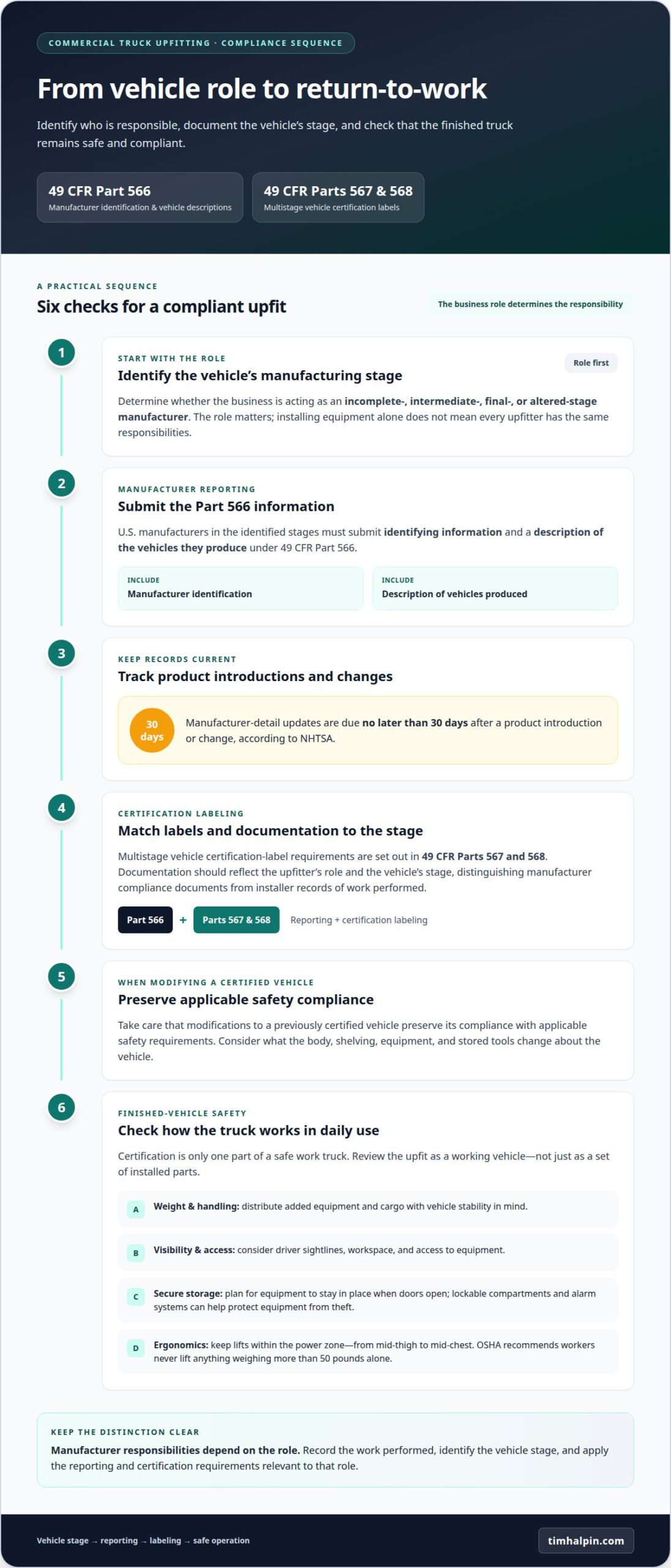
NHTSA responsibility follows the role a business performs in manufacturing a vehicle. For safety standards for commercial truck upfitting, an upfitter acting as an incomplete-, intermediate-, final-, or altered-stage manufacturer must submit identifying information and a description of the vehicles it produces under 49 CFR Part 566, according to the Electronic Code of Federal Regulations. The specific role matters, so the same reporting responsibility doesn’t automatically apply to every installer.
It’s easy to focus on certification labels and overlook how an upfit affects the truck in daily use. Weight distribution, driver visibility, vehicle handling, and secure equipment storage are also important parts of a safety-minded design. Certification-label requirements for multistage vehicles are set out in 49 CFR Parts 567 and 568.
This guide explains who handles manufacturer reporting and certification, which regulations may apply to modifications, and how visibility upgrades and regular fleet maintenance support safety. It offers a practical framework for understanding what an upfit changes and what to consider before a truck returns to work.
Key Takeaways
- Identify the role your business plays in a vehicle’s manufacturing stages to understand which NHTSA reporting and certification responsibilities apply.
- Plan visibility upgrades around the truck’s work, including lighting and camera needs for operating and maneuvering safely.
- Match equipment, storage, and vehicle modifications to the job while keeping weight, handling, and driver access in view.
- Keep manufacturer details current: according to the National Highway Traffic Safety Administration, updates are due no later than 30 days after a product introduction or change.
- When modifying a previously certified vehicle, take care to preserve its compliance with applicable safety requirements.
1. U.S. multistage vehicle certification responsibilities
NHTSA responsibilities depend on the role a business plays in producing or modifying a vehicle. U.S. incomplete-, intermediate-, final-, and altered-stage manufacturers must submit identifying information and a description of the vehicles they produce under 49 CFR Part 566, according to the Electronic Code of Federal Regulations. That filing requirement makes the manufacturer’s role central. Installing equipment alone does not establish that every upfitter has the same responsibilities.
What are the NHTSA rules for vehicle alterers, final-stage manufacturers, and incomplete vehicles? The relevant manufacturers must submit the Part 566 information, while multistage vehicle certification-label requirements are set out in 49 CFR Parts 567 and 568. The applicable role determines which responsibilities apply as a vehicle moves from its incomplete stage toward its final configuration. Applying safety standards for commercial truck upfitting starts with identifying that role and the vehicle’s stage.
What certifications and documentation should a commercial truck upfitter provide? For a multistage vehicle, Parts 567 and 568 govern certification labeling, while Part 566 addresses manufacturer identification and vehicle descriptions. Documentation should reflect the upfitter’s role and the vehicle’s stage. Those records help distinguish a manufacturer’s compliance documents from an installer’s records of the work performed.
Certification is only one part of a safe work truck. Distribute added equipment and cargo with vehicle stability in mind, and consider how bodies, shelving, and stored tools affect handling. Plan storage so equipment stays in place when doors open. Lockable compartments and alarm systems can help protect equipment from theft. For ergonomic planning, keep lifts within the power zone, from mid-thigh to mid-chest. OSHA recommends that workers never lift anything weighing more than 50 pounds alone. These practical choices complement safety standards for commercial truck upfitting by addressing how people use the finished vehicle.
A commercial vehicle enforcement van illustrates how specific design choices support safer work. One upfit used a 10-inch-diameter circular cut-out to store signage boards and cargo netting to provide ventilation for an air conditioner or heater. These examples show how a defined storage purpose can guide layout while preserving access and workspace. What does commercial truck upfitting typically cost, and how do safety certifications affect price? Price depends on the project and is given after a quote request; the vehicle, equipment, installation needs, and certification-related work shape the overall cost. Certification requirements guide the work and documentation, but no single cost applies to every configuration.
2. Visibility, cameras, and supplemental lighting
Lighting should suit the commercial vehicle’s work, not simply add brightness. Start by mapping what the driver needs to see while driving, reversing, parking, and working beside the truck. A utility vehicle carrying a ladder, for example, needs clear visibility around its body and access points. Check whether racks, toolboxes, or other equipment block mirrors or cast shadows across the work area.
Rear-view cameras and surround-view systems can help drivers judge space around larger vehicles. The National Highway Traffic Safety Administration required rear-view cameras in all vehicles built on or after May 1, 2018. A 360-degree camera system can also be relevant when a large, complex upfit makes maneuvering more challenging. Camera placement matters: equipment and bodywork should not obstruct the view the system is meant to provide.
Plan supplemental lighting around tasks and locations. Interior cargo-area lights illuminate stored tools, while exterior work lights can brighten a service area beside or behind the vehicle. Lighting for night operations can support visibility during early starts and late returns. Aim each light at the work surface, and consider whether its beam could affect the driver’s view or other road users. Test the lighting with the truck configured for its actual work, including doors, ramps, and equipment in working positions.
Amber beacons and auxiliary lights provide visible signals around work vehicles. Choose their location based on the vehicle’s profile and tasks, so equipment or an open body does not conceal them. For example, a service truck working near traffic may need a warning light visible from multiple directions. Keep warning lights distinct from task lighting: one alerts others to the vehicle, while the other illuminates the job.
Liftgates and light-duty cranes create changing work zones. Consider where the operator stands, where cargo travels, and which surfaces need illumination while the equipment is in use. A light aimed at the loading area can show the platform edge and cargo position; ground-level handling may need a separate work light. Reassess visibility with the liftgate lowered and raised, or the crane positioned for work. These operating positions can change sightlines and shadows.
For trucks that need supplemental warning or work lights, public safety lighting options can be part of a visibility-focused upfit. Select lighting around the vehicle’s duties, driver sightlines, and the work area it must illuminate.
4. Commercial truck upfit definition and purpose
A work truck upfit modifies a stock truck with equipment, bodies, or systems for a specific job. A construction crew, for example, may need different onboard storage than a utility maintenance team. The goal is to configure the vehicle around daily operations, rather than treating a standard cargo area as suitable for every task. Work can involve an addition, a body change, equipment installation, or several coordinated modifications.
Start with the work itself. Identify the tools, parts, and materials employees use most often, then map how each item moves from storage to the job. A mechanic may need a drawer for frequently used hand tools and a separate space for larger equipment. A crew carrying building materials may need a layout suited to those loads and the way workers handle them. The order of tasks helps determine where equipment belongs.
Body type shapes a vehicle’s purpose. A service body can organize tools and supplies for mobile repairs. A dump body supports work involving the transport and unloading of loose material. A box truck body creates enclosed cargo space for goods or equipment. These are different configurations, not interchangeable labels: the right design depends on the work, cargo, and how the vehicle is used at each site.
Upfitting can also improve how workers reach and use equipment. Place frequently used items where they can be retrieved without moving unrelated cargo. Secure long materials, such as ladders or pipes, in appropriate racks or carriers. A layout that reduces unnecessary searching and rearranging can make daily operations more orderly. Arrange the setup around the crew’s tools and work sequence, not a generic vehicle layout.
Some systems serve purposes beyond carrying tools. Commercial truck upfits can include GPS tracking systems to monitor vehicle locations and support vehicle security. For a fleet, vehicle location can become part of operational planning. Modular, adaptable designs can also make it easier to reconfigure storage as equipment inventories or service offerings change. Plan for the tools workers use now while leaving room for the interior arrangement to evolve.
Installation turns the chosen design into part of the working vehicle. The equipment, body, and systems should form a practical configuration for the intended job. After installation, assess the completed setup against real tasks: retrieving a tool, loading materials, and accessing equipment in its working position. This final walkthrough connects the design to the vehicle’s actual purpose and helps identify layout conflicts before routine operations begin.
5. Compliance with applicable regulations
Compliance depends on the vehicle, its modifications, and how the finished truck operates. Federal, state, and local regulations can address weight limits, cargo securement, and vehicle marking. A shelving installation, for example, should not obstruct required markings or leave equipment unsecured. Plan the complete configuration, including bodies, lighting, and cargo, rather than assessing each component in isolation.
For manufacturer records, the National Highway Traffic Safety Administration requires U.S. manufacturers to submit updated manufacturer details no later than 30 days after a product introduction or change. This applies to the specified manufacturer information, not as a universal deadline for every repair or equipment installation. The vehicle’s manufacturing stage and the business’s role help determine which certification and reporting responsibilities apply.
Lighting requirements can affect a modified vehicle’s equipment and visibility. The National Highway Traffic Safety Administration required rear-view cameras in all vehicles built on or after May 1, 2018. That requirement is a specific example, not a complete list of rules governing every lamp, bumper, step, liftgate, or auxiliary component. Changes should preserve the vehicle’s intended safety functions and avoid blocking cameras or lighting.
How do OSHA standards apply to commercial truck bodies, lifts, and installed equipment? Employers must account for workplace hazards when workers use or access truck equipment. According to the U.S. Department of Labor, employers in states with OSHA-approved state plans may be subject to different or additional requirements. For a liftgate, consider the work area, operator access, and cargo handling.
What are the DOT and FMCSA requirements for upfitted commercial trucks, including weight and cargo securement? Applicable requirements can involve weight limits, securement, and vehicle marking, so assess the upfit and cargo arrangement together. State and local rules can add jurisdiction-specific requirements; the vehicle’s location and use shape which rules apply. Check the complete configuration against the regulations relevant to its operation.
What safety standards apply to truck lighting, bumpers, steps, liftgates, and auxiliary equipment? Requirements depend on the component and vehicle; rear-view cameras provide one concrete federal example. A General Certificate of Conformity must include 7 required elements, although no specific template or format is required, according to the U.S. Consumer Product Safety Commission.
Modifications that ignore applicable requirements can create practical safety problems. Poorly secured cargo may shift, added equipment may affect handling, and misplaced components may obstruct visibility. These issues can also complicate vehicle operation and compliance. A final review should consider the completed truck, its installed components, and its actual working configuration.
The completed truck, including its upfit and carried cargo, should meet applicable weight and securement limits, with required markings unobstructed. The rules that apply depend on the vehicle’s configuration, operation, and jurisdiction.
Requirements can vary by jurisdiction: state and local rules may add conditions, and the truck’s location and use affect which rules apply. Check the finished configuration against requirements for the places where the truck operates.
5. How do FMVSS requirements affect truck modifications and replacement equipment?
Federal Motor Vehicle Safety Standards, or FMVSS, remain relevant when a commercial truck’s body or equipment changes. The key distinction is whether the vehicle is new and still moving through multistage production, or already certified and in service. That difference affects who handles certification labeling and what the modification must preserve. Assess equipment changes as part of the complete vehicle, not as isolated components.
For a used vehicle already certified, licensed, and titled in a state, a modifier changing its body does not need to apply a new certification label. Review the modification to ensure the finished vehicle’s safety-related functions remain appropriate. For example, replacing a body or adding work equipment should not leave a safety system blocked, damaged, or unable to function as intended. Not needing a new label does not remove the obligation to maintain compliance.
Replacement equipment also needs to suit the truck’s original design and current configuration. Before changing a component, identify what it connects to and which vehicle functions could be affected. A replacement lamp, for instance, should work within the existing lighting arrangement and remain visible after bodywork is installed. A body-mounted storage unit should not cover a camera or interfere with an existing safety feature. These checks can reveal conflicts before the truck returns to service.
Keep a clear record of the work. A useful file can identify the vehicle, describe the modification, list components replaced or added, and note the installation work performed. Keep relevant manufacturer information and details from the vehicle’s existing certification label with those records. This documentation helps explain how the finished configuration differs from the original and supports future maintenance or repair decisions.
For multistage vehicles, certification labeling requirements are set out in 49 CFR Parts 567 and 568. The manufacturer’s stage and role matter because incomplete, intermediate, final, and altered-stage production can involve different responsibilities. A modification performed after a vehicle is already certified follows a different labeling situation than work completed as part of manufacturing. Keep those cases distinct when planning a body change or equipment installation.
Review the truck from its original configuration through to the completed setup. Compare the intended work with affected vehicle systems, confirm replacement components suit their application, and inspect the finished installation for blocked or impaired functions. Then retain the work records with the vehicle file. This process gives fleet teams a consistent way to assess modifications, manage future repairs, and keep the truck aligned with applicable FMVSS requirements.
Tim Halpin Equipment Corp
Tim Halpin Equipment Corp helps keep commercial trucks and their working equipment in service through truck, liftgate, trailer, and hydraulic repair. Turn to the team when routine inspections or daily use reveal a repair need, or when equipment affected by an upfit needs attention. These services support the practical side of maintaining a safe, dependable work vehicle.
For help with repair needs involving your truck or equipment, contact Tim Halpin Equipment Corp to discuss the work.
Keep the Next Upfit Ready for Work
A safe truck configuration is not a one-time decision. As a fleet’s work changes, new equipment, replacement components, or repairs can alter how a vehicle performs. Treat each change as a reason to review the completed setup against its intended tasks and keep vehicle records current. This steady process makes safety standards for commercial truck upfitting part of everyday fleet decisions, not just a final installation check.
When a truck needs attention after an upfit, Tim Halpin Equipment offers Truck Repair, Liftgate Repair, and Trailer Repair. These services can address equipment and vehicle repair needs that affect the truck’s readiness for work. Share what the vehicle does and what needs attention, then discuss the appropriate repair.
Contact Tim Halpin Equipment Corp to talk through your truck repair needs and take the next step with confidence.
Frequently Asked Questions
Do upfitters have to register as manufacturers with NHTSA?
Not every business that installs equipment automatically has the same manufacturer responsibilities. The relevant question is whether it acts as an incomplete-, intermediate-, final-, or altered-stage manufacturer. Those manufacturers submit identifying information and vehicle descriptions under 49 CFR Part 566. A business’s role in producing or altering the vehicle, rather than the word “upfitter” alone, determines which reporting responsibilities apply.
What Is a Truck Upfit?
A truck upfit adapts a vehicle’s equipment and layout to the work it must perform. For example, a utility crew’s truck might have organized shelving for tools, a ladder carrier, or task lighting. The right combination depends on the crew’s operations and the vehicle’s intended use. The goal is a practical working configuration, with added equipment arranged to support access and daily tasks.
What federal safety standards apply to commercial truck upfitting in the United States?
Applicable federal requirements depend on the vehicle’s manufacturing stage and the type of modification. Multistage certification labels are addressed in 49 CFR Parts 567 and 568, while manufacturer identification and vehicle descriptions fall under Part 566. Federal Motor Vehicle Safety Standards also remain relevant after modifications. For a previously certified vehicle, a body change does not require a new certification label, but the vehicle must still meet applicable FMVSS requirements.
How can upfitters verify a truck’s GVWR, GAWR, payload, and axle loads after modifications?
Start with the truck’s rated limits and compare them with the completed vehicle in its working configuration. Measure the vehicle’s total weight and individual axle loads with installed equipment and typical cargo aboard. Then compare those measurements with the applicable GVWR and GAWR, and account for added weight when determining remaining payload. For Miami and South Florida fleets, repeat the review when equipment or cargo arrangements change.
What safety standards apply to truck lighting, bumpers, steps, liftgates, and auxiliary equipment?
Lighting should suit the truck’s work and support visibility. Work lights can illuminate cargo or work areas, while cameras should remain unobstructed. Liftgates can make loading and unloading easier and reduce injury risk. Install equipment securely and ensure modifications preserve applicable FMVSS compliance.
How do state and local rules for commercial truck upfitting vary across the United States?
Requirements can include weight limits, cargo securement, and vehicle marking, but applicable rules depend on the jurisdiction. Commercial vehicle modifications should comply with federal, state, and local requirements.
What does commercial truck upfitting typically cost, and how do safety certifications affect price?
The final cost includes the chassis, upfit, and installation; certification requirements guide the work and documentation, but no single cost applies to every project.