

The most useful service body isn’t the one with the most compartments. It’s the one that fits your truck, equipment, and daily work. Start planning service body installation miami by defining those needs, rather than choosing a layout based on appearance or storage count.
To choose a body that suits your chassis and payload needs, first list the tools and materials you carry, the tasks you handle, and how you need to access equipment on the job. Separate essential features from optional ones. That simple step helps keep the installation plan focused on what the crew will actually use.
This guide explains how to compare service, utility, and platform bodies, plan storage and access, and prepare for installation. Tim Halpin Equipment Corp. is a family-owned Miami business that provides service bodies, utility bodies, platform bodies, and installation services. With a clear specification, you can plan a work truck around the jobs ahead in Miami and across South Florida.
Key Takeaways
- Start with the tools, materials, and equipment your crew carries during a typical workday.
- Compare service, utility, and platform bodies by storage needs, work type, and access priorities.
- Plan service body installation miami around the specific truck, its chassis and payload needs, and its intended work.
- Gather vehicle details, an equipment inventory, and your priorities before planning installation.
- Tim Halpin Equipment Corp. provides truck body installation in Miami and serves South Florida.
Why Service Body Installation in Miami Starts With the Work
A work truck should make the crew’s routine easier, not simply look more specialized. That’s why service body installation miami planning should begin with the jobs the vehicle handles, the equipment it carries, and how the crew uses it throughout a typical day.
Service body installation means fitting a work-focused body to a compatible commercial truck chassis. Compartments and layout can help organize tools and make frequently used equipment easier to reach. The right plan matches storage and access to actual tasks while accounting for the truck as a whole.
A service body is an enclosed, compartmented truck body that gives a crew organized onboard storage for tools and job-specific equipment. It turns the truck into a mobile workspace. This service truck overview explains how these vehicles support field work.
What should a service body help your crew do?
Start with the work, not a catalog. List the jobs performed most often and the tools or materials each requires. Then separate daily-use equipment from items carried only for occasional calls. This helps you decide what needs quick access and what can be stored out of the way.
- Frequent tasks: Identify the tools used repeatedly and where the crew needs to reach them.
- Occasional work: Note specialized equipment that needs a designated place without dominating the layout.
- Shared use: Consider how many crew members use the truck and whether they need the same tools at once.
Job-site routines matter, too. A crew that works mainly from one side of the truck may have different access priorities from one that moves around the vehicle. Think through how equipment is loaded, removed, and returned during a normal shift.
Which Miami-area work conditions belong in the plan?
Consider where the truck parks, loads, and operates across Miami and South Florida. A vehicle that often works in tight urban spaces may need a different access plan from one that regularly serves larger sites in Doral, Medley, Hialeah, Kendall, or Fort Lauderdale. Include typical stops, parking conditions, and how the crew approaches the truck when deciding what should be easiest to reach.
Rain and humidity also belong in the planning discussion. Review the stated specifications for materials and finishes, and consider how the truck will be cared for. Don’t assume a particular choice guarantees corrosion protection or weather performance. Make local conditions one part of the body-selection discussion, alongside equipment access and daily workload.
Once you define the work, body selection becomes more practical. Aim for a layout that supports the crew’s routine and suits the truck, rather than adding storage that offers little value.
How to Spec a Work Truck for Service Body Installation
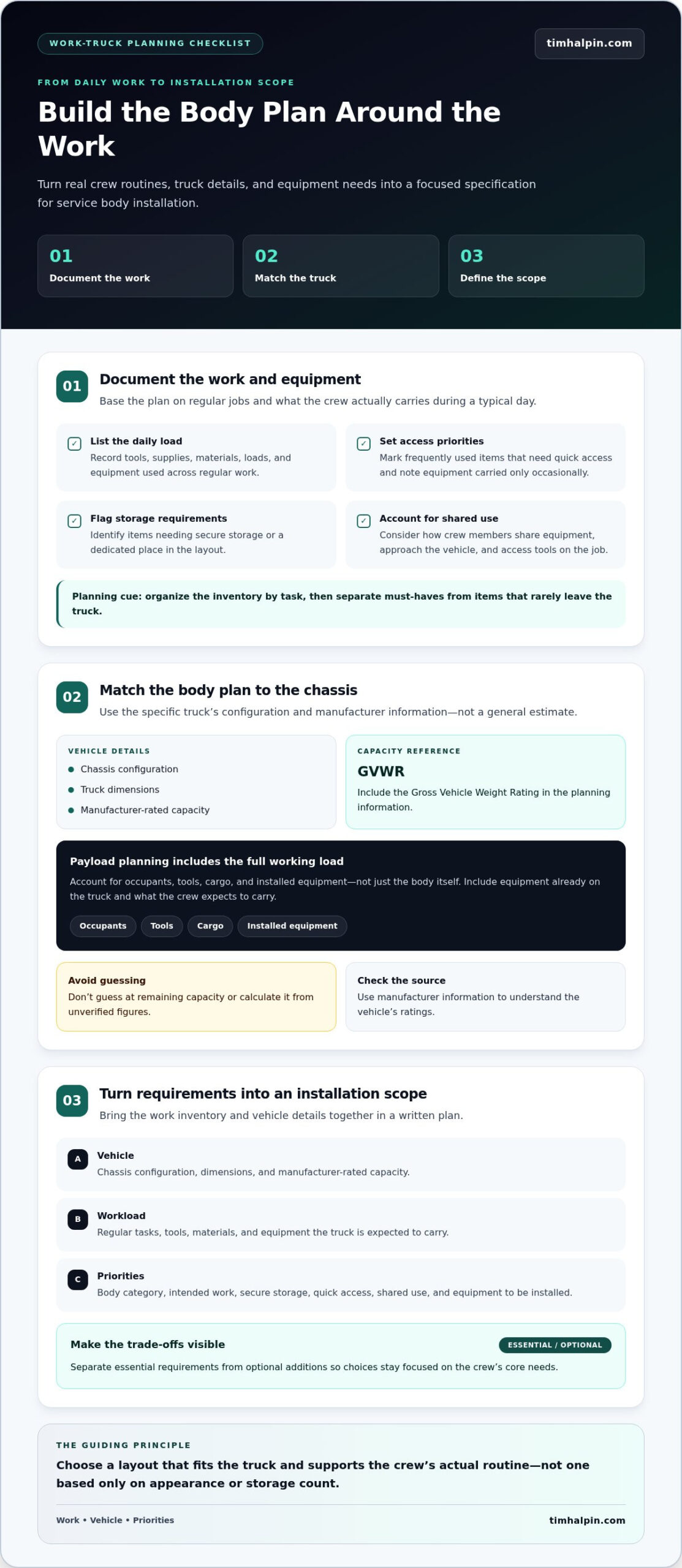
A clear specification turns daily tasks into a practical body plan. For service body installation miami, work through the requirements in order: document what the crew carries, match the plan to the truck, and define the installation scope. This keeps essential needs in view before optional features enter the discussion.
1. Document the work and equipment
Base the plan on actual work routines. Review regular jobs and list the tools, supplies, materials, loads, and equipment the truck carries during a typical day. Note which items are used often, which need secure storage, and whether any require dedicated space. A tool used at nearly every stop, for example, has a different access priority from equipment carried for occasional work.
If several crew members use the truck, include how they share equipment and approach the vehicle. Organizing the inventory by task makes priorities easier to discuss and helps distinguish must-haves from items that rarely leave the truck.
2. Match the body plan to the chassis
Record the truck’s chassis configuration and dimensions, then refer to the manufacturer’s information for its rated capacity. Include the Gross Vehicle Weight Rating (GVWR) in your planning. Don’t rely on a general estimate or assume that a body that fits one truck will suit another.
Payload planning must account for occupants, tools, cargo, and installed equipment, not just the body itself. Consider the full working load, including equipment already on the truck and what the crew expects to carry. Use manufacturer information to understand the vehicle’s ratings. Don’t guess at remaining capacity or calculate it from unverified figures. Fleet managers can also use resources from the NAFA Fleet Management Association for broader fleet planning.
3. Turn requirements into an installation scope
Bring the inventory and vehicle details together in a written scope. Identify the body category, intended work, access priorities, and equipment to be installed. Separate essential requirements from optional additions so you can weigh trade-offs without losing sight of the crew’s core needs.
- Vehicle: Chassis configuration, dimensions, and manufacturer-rated capacity.
- Workload: Regular tasks, tools, materials, and equipment.
- Priorities: Secure storage, quick access, shared use, and essential additions.
A well-organized scope gives installation planning a solid starting point. For wider fleet-planning context, the Miami commercial truck upfitting guide explores how equipment decisions relate to fleet needs. Tim Halpin Equipment Corp. installs truck bodies in Miami. Explore its truck equipment and installation services to put a defined project into motion.
Service, Utility, or Platform Body: Compare Work-Truck Options
The right body category depends on what the truck carries and how the crew handles the load. A service body is worth considering for trades that bring multiple tools and supplies from job to job. Utility and platform bodies support different work patterns. Compare their broad purposes, then weigh the actual truck, equipment, workload, and installation scope.
| Body category | Work it may suit | Storage approach | Access considerations |
|---|---|---|---|
| Service body | Field work involving multiple tools and supplies, such as recurring repair or maintenance jobs. | Enclosed compartments support organized onboard tool storage. | Plan which tools need frequent access and how the crew will reach them during a workday. |
| Utility body | Work that benefits from an open working area for carrying or handling equipment. | Consider how the crew will arrange and secure the items it regularly transports. | Think through loading, unloading, and reaching the equipment at the job site. |
| Platform body | Tasks involving larger or bulky cargo that benefits from a flat, open bed. | Offers an open-bed approach rather than enclosed tool compartments. | Consider how cargo will be loaded, positioned, and accessed for each type of job. |
When does a service body make sense?
Consider a service body when technicians routinely carry hand tools, supplies, and job-specific equipment between sites. Enclosed compartments provide organized storage, while the useful arrangement depends on the selected body and the crew’s routine. Identify frequently used tools, items needing secure storage, and equipment that calls for dedicated space. Treat access as a planning criterion, not a guaranteed feature of every body.
For example, if the crew moves between several service calls, quick access to commonly used equipment may matter more than maximizing compartment count. A body that looks spacious may still be a poor fit if the tools used most often are difficult to reach.
How do utility and platform bodies differ in purpose?
Start with the cargo. An open working area may suit equipment and tasks that call for flexible handling, while a flat, open platform may better suit bulky loads that need an unobstructed bed. These are broad distinctions, not rankings. The same trade can have different needs from one job to another, so compare body categories with the work the truck actually performs.
Tim Halpin Equipment Corp. offers service, utility, and platform bodies, along with installation services. The right fit depends on the truck’s chassis, the equipment it will carry, the workload, and the installation scope. For service body installation miami, use those practical requirements to guide the decision rather than choosing by appearance or category alone.
Plan Service Body Installation Around Your Miami Fleet
Preparation helps turn a service body project into a clear plan. Before coordinating service body installation miami, gather the vehicle information, equipment needs, and operating priorities that shape the scope. These details are useful for a single truck and even more so when several fleet vehicles are involved.
What information helps organize an installation project?
Put the project essentials in one place so the truck and its intended use are easy to understand. Include its make, model, year, chassis details, and the work it will perform. Add an equipment and cargo inventory, noting what needs frequent access, secure storage, or a particular place. This gives installation planning a practical starting point.
- Vehicle: Make, model, year, and available chassis information.
- Work: The truck’s main duties and the conditions where it operates.
- Equipment: Tools, cargo, and supplies, with access and storage priorities.
- Related needs: Any electrical, hydraulic, or other upfit requirements tied to the project.
If hydraulic equipment is part of the planned setup, include it early in the scope. A South Florida truck hydraulics guide can provide additional context for considering hydraulic needs alongside the body plan.
How can a fleet reduce disruption during the upfit?
Plan vehicle use around operational demand while installation work is coordinated. Timing depends on the truck and project, so don’t build a schedule around an assumed installation duration. Clear priorities and organized vehicle details help keep decisions focused as the scope takes shape.
For multiple vehicles, record what should remain consistent across the fleet, then document differences such as chassis details, equipment, or assigned work. This helps prevent similar-looking trucks from being treated as identical projects and gives fleet managers a clearer basis for coordinating vehicles around their individual requirements.
What local factors should South Florida operators consider?
Think through the routes, parking, loading areas, and job-site access the truck encounters around Miami, Doral, Medley, Hialeah, Kendall, and Fort Lauderdale. A vehicle that works in tighter parking areas may have different access priorities from one that regularly handles larger loads at open sites. Include rain and humidity in care and material-selection discussions, and use stated specifications rather than assuming a material or finish will perform a certain way.
Tim Halpin Equipment Corp. installs truck bodies around the specific vehicle and project. A prepared scope gives the planning discussion a useful foundation. For service body installation miami, discuss your truck body installation project with the local team serving South Florida.
Arrange Service Body Installation in Miami With Tim Halpin
A work-truck body should support the way your crew operates, from the equipment it carries to the tasks it handles in the field. Tim Halpin Equipment Corp. provides service bodies, utility bodies, platform bodies, and installation services in Miami. The installation plan connects the body choice with the truck’s intended work, so the finished vehicle suits your operation.
Tim Halpin Equipment Corp. is a family-owned Miami truck-equipment business serving South Florida. Contractors and fleet managers can discuss a work-truck project with a local team that understands commercial equipment and upfitting. Start with the vehicle and its daily duties to bring the equipment plan and installation scope together.
What to expect when planning a body installation
Bring the truck’s make, model, year, and chassis details, along with a concise description of its trade and regular work. An equipment inventory is useful, too. Note the tools and materials carried, what the crew reaches for most, and any related equipment needs. These details frame the project around the actual vehicle and the work it needs to support.
Next, consider the body category, priorities, and installation scope for that project. A service body may suit a different work pattern than a utility or platform body, so the right configuration depends on the truck and its intended use. Keeping essential requirements separate from optional preferences helps maintain focus.
Take the next step for your South Florida work truck
For contractors and fleet managers in Miami, Doral, Medley, Hialeah, Kendall, and Fort Lauderdale, planning ahead can make the next step clearer. Bring your truck details, work priorities, and equipment needs together before discussing installation. That gives the project a practical foundation without assuming every vehicle or fleet has identical requirements.
For broader build-planning context, the commercial truck upfitting guide explores how equipment decisions relate to fleet needs. If you’re ready to discuss service body installation miami for your work truck, share your project details with Tim Halpin Equipment Corp.’s team.
Talk with Tim Halpin Equipment Corp. about your truck equipment project.
Set Your Work Truck Up for the Jobs Ahead
Turn your priorities into a clear project brief. Consider what the truck needs to do from its first stop to the last, and which choices will make daily work easier for the crew. A focused brief gives installation planning a practical starting point and keeps the build connected to operating needs.
For service body installation miami, bring the vehicle details and work requirements together, then discuss how a body and installation scope can suit the project. Tim Halpin Equipment Corp. is a family-owned business serving customers in Miami and across South Florida, with installation and commercial upfitting services.
Talk with Tim Halpin about your truck equipment project and take the next step toward a work truck set up for the demands ahead.
Frequently Asked Questions
What is included in a service body installation?
A service body installation covers fitting the selected work body to a compatible commercial truck chassis. Any additional equipment is handled according to the project scope. A truck receiving a body alone has a different scope from one also planned for related commercial equipment. Clarify which items are included so the installation plan reflects the complete work-truck setup.
How do I choose the right service body for my work truck?
Choose based on the equipment your crew uses and how it needs to be accessed during a job. Note whether technicians retrieve tools in a particular order or need shared access while working at a site. Those observations help distinguish a storage requirement from a convenience. Then compare the body category with the truck’s intended workload and the equipment it must carry.
Can any truck have a service body installed?
No. The truck’s chassis, dimensions, and manufacturer-rated capacity affect whether a body is a suitable match. Review the vehicle manufacturer’s information rather than assuming a body can be fitted to every truck. Consider the vehicle as it will operate, with the installed body, occupants, tools, and cargo. This frames compatibility around the complete work setup, not the truck model alone.
What is the difference between a service body and a utility body?
A service body uses enclosed compartments for onboard tool storage, while a utility body generally provides an open working area. A platform body, by comparison, is a flat, open bed suited to handling larger or bulky cargo. These categories support different work patterns, so consider whether your crew needs enclosed storage, open access, or a flat cargo surface for regular jobs.
How do I estimate the payload needed for a service body truck?
Account for the entire working load: the body, occupants, tools, cargo, and other installed equipment. Compare that picture with the truck’s manufacturer-rated information, including its Gross Vehicle Weight Rating (GVWR). Don’t base the estimate on the empty truck or an assumed payload figure. If loads vary by job, include the heaviest routine setup in planning so the vehicle is considered for its actual duties.
How should a Miami business prepare for service body installation?
For service body installation miami, organize the truck’s identifying details, equipment list, and intended work before discussing the project. Include where it operates and parks across Miami, Doral, Fort Lauderdale, Key West, Medley, Hialeah, Kendall, and the wider South Florida area. Note rain and humidity as conditions to consider in care and material discussions, and record any related electrical or hydraulic equipment needs.
