

You step out into the thick Miami humidity, ready for the first job of the day, only to realize your open truck bed has been picked clean overnight. It’s a nightmare scenario that many South Florida fleet owners face when they choose a configuration that prioritizes quick access over total security. Deciding between a service body vs utility body is often complicated by the fact that many manufacturers use these terms interchangeably, leaving you to guess which setup actually protects your investment and which one leaves your tools exposed to the salt air.
We understand that selecting the right equipment is about more than just storage; it’s about protecting your livelihood and keeping your crew on the road. With FMCSA CSA scoring now carrying 25% higher severity weights for maintenance violations in 2026, choosing a body that minimizes vehicle downtime is more critical than ever. This guide provides a clear decision-making framework to help you choose between enclosed security and open-air versatility. You’ll discover which configurations support seamless liftgate integration and how to select materials, like corrosion-resistant aluminum, that can withstand our local climate while maximizing your fleet’s efficiency.
Key Takeaways
- Learn to navigate the industry’s terminology confusion to ensure your choice of a service body vs utility body provides the exact balance of storage and security your business requires.
- Compare the workflow efficiency of open-bed compartments against the superior theft protection offered by fully enclosed utility configurations.
- Discover why selecting the right materials is vital for Miami fleets, where salt air can quickly turn a budget steel body into a maintenance liability.
- Gain insights into integrating essential performance upgrades, including high-quality liftgates and public safety lighting, without compromising the structural integrity of your truck.
- See how partnering with a local, family-owned expert can streamline your upfitting process and minimize the time your vehicles spend off the road.
Service Body vs. Utility Body: Clearing Up the Terminology Confusion
If you’ve ever spent an hour browsing upfit catalogs only to realize two different manufacturers use the same word for two completely different products, you aren’t alone. The choice between a service body vs utility body is often clouded by industry jargon that hasn’t quite kept pace with modern designs. Since 1987, our team at Tim Halpin Equipment has watched these definitions evolve. We’ve seen how a simple misunderstanding can lead a fleet manager to order a configuration that doesn’t actually meet their daily operational needs here in South Florida.
Properly identifying truck classifications and body types is the foundation of a successful fleet. Some manufacturers use utility to describe a basic flatbed. Others use it for a high-roof enclosed workshop. In 2026, where 91.5% of active U.S. motor carriers operate small fleets of 10 trucks or fewer, every equipment decision impacts the bottom line significantly. This section clears the air so you can make an informed decision for your upcoming upgrades.
The Service Body: The Mobile Toolbox
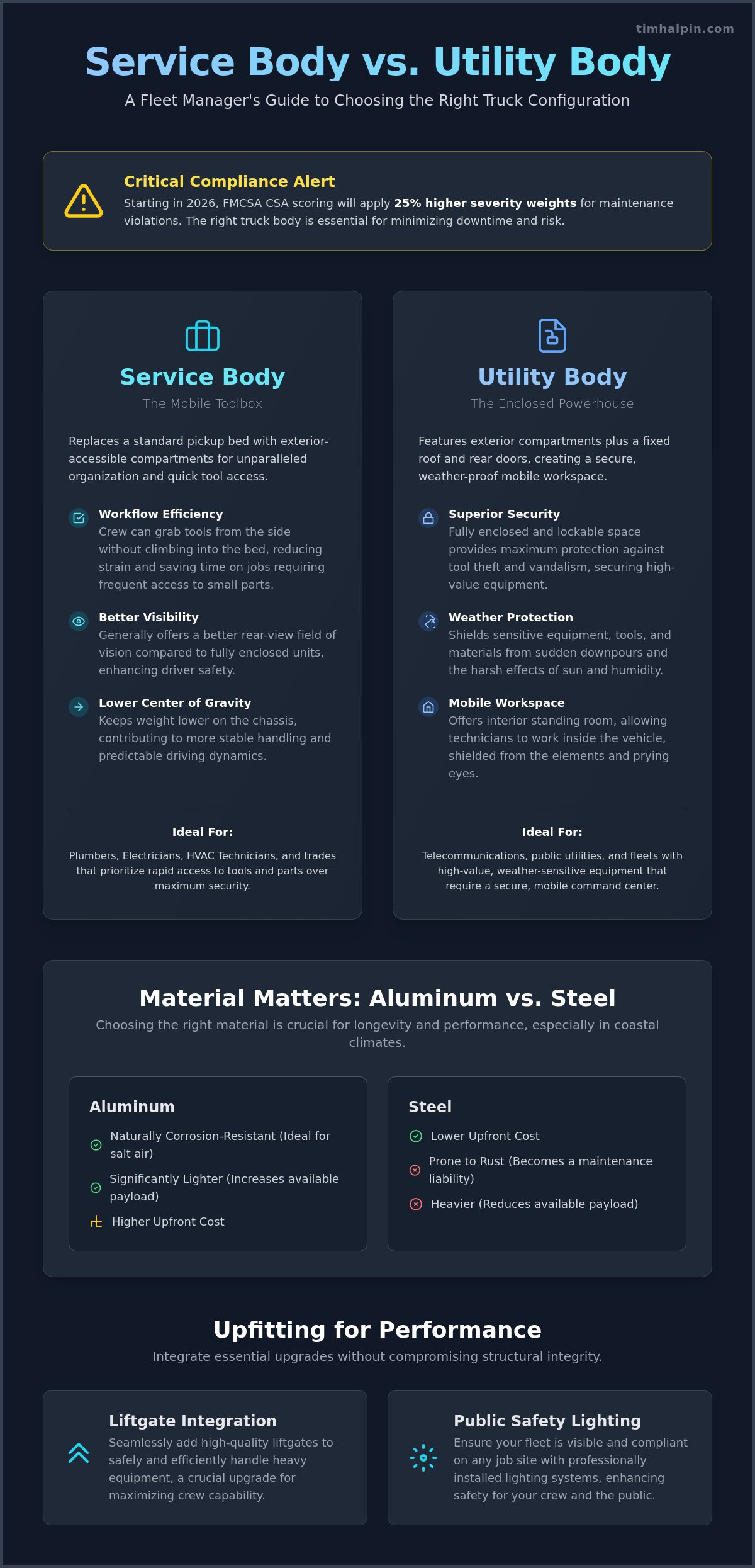
A service body is built specifically for organization and external accessibility. It replaces the standard pickup bed with a series of vertical and horizontal compartments accessible from the outside of the vehicle. This setup is the industry standard for organized mobile workshops. It’s the perfect choice for trades like plumbing or electrical repair where technicians need to grab small parts and hand tools dozens of times a day. As a great example of how these tools are put to use, you can learn more about Alberto Pro Plumbing and their commitment to efficient residential and commercial service. You don’t have to crawl into a dark bed to find what you need. Everything is exactly where you left it, organized and ready for work.
The Utility Body: The Enclosed Powerhouse
In the current market of 2026, the term utility body has largely shifted to mean an enclosed service unit. While it still features those vital exterior compartments, it adds a fixed roof and rear doors to create a protected interior workspace. This configuration is a favorite for Miami fleets that need to protect sensitive equipment—much like the inventory carried by Affordable Garage Door Repair & Sales LLC—from our sudden tropical downpours and the constant threat of tool theft. It offers enough interior standing room for a technician to work inside the truck. It effectively turns the vehicle into a mobile office that shields your gear from the elements and prying eyes.
We often see confusion when a client asks for a utility bed but actually needs a platform body for hauling bulky machinery. A flatbed provides an open surface but lacks the secure compartments that define a service body. At Tim Halpin Equipment, we’ve set a standard for local fleets that prioritizes clarity. We help you look past the labels to find the physical configuration that minimizes your downtime and maximizes your crew’s efficiency on every job site.
Organization vs. Protection: Comparing Core Functionalities
Choosing between a service body vs utility body often comes down to a simple question: do you need to reach your tools in seconds, or do you need to lock them behind a steel wall? For many of our neighbors running fleets in Coral Gables or Doral, this choice impacts everything from daily fuel costs to how often they have to replace equipment lost to a quick afternoon thunderstorm. It’s a balance between the speed of your workflow and the ultimate security of your assets.
Workflow speed is where the open service body shines. Your crew can access vertical and horizontal compartments from the sidewalk without ever stepping into the bed. This reduces the physical strain on technicians and keeps the job moving. However, this accessibility comes with a trade-off in visibility. While service bodies generally offer a better rear-view field of vision than enclosed units, the height of your specific compartment configuration can still create blind spots. We always recommend evaluating your driver’s comfort level before finalizing a tall-compartment layout.
Storage Volume and Payload Management
Payload management is where the technical differences become clear. An open service body keeps the weight low, which helps maintain a stable center of gravity and predictable handling. When you step up to an enclosed utility body, you’re adding significant weight and height to the chassis. This shift can eat into your available payload, especially if you’re working with a Class 3 or 4 truck. Referencing Caltrans vehicle equipment standards can help you understand how these bodies are officially classified based on their intended duty cycle and weight limits.
If you’re worried about hitting your Gross Vehicle Weight Rating (GVWR), remember that material choice is your best friend. Opting for aluminum can reduce body weight by up to 50% compared to steel, giving you back that much-needed payload for heavy machinery or materials. If you aren’t sure which configuration fits your chassis, our team can provide a professional consultation to ensure your truck remains compliant and safe.
Security and Weather Resistance
Miami’s climate adds another layer to the decision. Our tropical downpours happen in an instant. While high-quality service bodies feature automotive-grade seals on every door, an enclosed utility body offers a single-point-of-entry security model that’s hard to beat. It acts as a psychological deterrent; if a thief can’t see what’s inside, they’re less likely to attempt a break-in. This is a major factor for fleets carrying high-value diagnostic tools or specialized electronics.
Securing your equipment on the road is vital, but protecting the facility where you park your fleet is just as important for long-term peace of mind. To explore custom security solutions for your business property, learn more about Iron Guys and their expert ironwork fabrication.
The “Miami Heat” factor is the final piece of the puzzle. On a typical 90-degree July afternoon, the interior of an unventilated enclosed body can soar. If your crew needs to spend time working inside the unit, or if you’re storing temperature-sensitive chemicals, you’ll need to consider insulation or powered ventilation. For many, the open-air ventilation of a standard service body combined with master-locking compartment systems provides the best of both worlds: security for the tools and a cooler environment for the equipment.
Material Matters: Aluminum vs. Steel in South Florida’s Salt Air
Living and working in South Florida means your fleet is constantly battling the elements. Between the salt spray off the Atlantic and our relentless humidity, the metal on your truck is under attack from the moment it leaves our shop. When you’re deciding between a service body vs utility body, the material you choose is just as important as the layout. Since 1987, we’ve seen how quickly the wrong choice can lead to “rust-out” failures. These failures take a perfectly good truck off the road long before its engine gives up, costing you both time and money.
Understanding the technical boundaries of these vehicles is essential for any fleet manager. For instance, the California DMV vehicle definitions highlight how these specialized bodies are legally distinguished from standard pickups. This distinction is vital because the weight of your body material directly affects your legal payload and road performance. In our experience, choosing the right material is the best way to ensure your vehicle remains a reliable asset for years to come.
The Case for Aluminum in Miami
In 2026, aluminum has become the preferred choice for fleets operating near the coast. Its natural resistance to corrosion means you won’t be chasing rust spots every few months. Beyond durability, the weight savings are transformative for your daily operations. Aluminum bodies can reduce weight by up to 40% compared to steel. This reduction isn’t just about fuel efficiency, which can see year-over-year savings of 15% to 30%. It also means less wear on your brakes, tires, and suspension. By keeping the weight low, you maximize your payload capacity, allowing your crew to carry more tools without exceeding safety limits.
When Steel Still Reigns Supreme
Despite the rise of aluminum, high-strength steel remains the champion for heavy-duty impact environments. If your work involves heavy crane mounts or hauling jagged demolition debris, the sheer impact resistance of steel is hard to beat. It’s often the more cost-effective choice for fleets on shorter rotation cycles or those operating primarily inland, away from the salt air. Modern powder-coating technologies have come a long way. They provide a much tougher barrier against the elements than the spray paints of the past, though they still require regular inspection to prevent moisture from creeping under the finish.
At Tim Halpin Equipment, we take a long-term view of your fleet’s health. We often recommend aluminum for coastal upfitting because the return on investment through fuel savings and longevity is undeniable in our climate. However, we also recognize that every business has different needs. Whether you need the brute strength of steel or the lightweight efficiency of aluminum, we’re here to guide you toward a configuration that keeps your downtime to a minimum and your reputation in the community strong.
Upfitting for Performance: Integrating Liftgates and Lighting
Once you’ve settled on the material and basic layout of your service body vs utility body, the focus shifts to how that vehicle actually performs on the job site. A truck is only as good as the tools integrated into its structure. In Miami, where efficiency and visibility are paramount, upfitting with the right liftgates and lighting systems can be the difference between a productive day and a costly delay. This is where the structural differences between these two body types become most apparent, as each configuration offers unique advantages for equipment mounting.
The electrical backbone of your truck deserves just as much attention as the steel or aluminum frame. Modern configurations require sophisticated wiring harnesses to support secondary power sources, strobe systems, and hydraulic pumps. We pre-plan these routes during the installation process to minimize vehicle downtime and prevent future electrical failures. Every connection is sealed against our local humidity to ensure long-term reliability for your fleet.
Liftgate Compatibility and Installation
Mounting a liftgate requires a deep understanding of the body’s rear architecture. Enclosed utility bodies often feature full-height rear doors that swing outward. This can create significant challenges when trying to mount certain rail-gates, as the lift mechanism may interfere with the door’s operation. Conversely, service bodies are typically the preferred choice for tuckaway liftgate integration. Because the rear is open or uses a standard tailgate, the lift platform can fold neatly under the chassis when not in use. At Tim Halpin Equipment, we maintain a massive inventory of waltco liftgate parts miami, ensuring that whether you choose a rail-gate or a tuckaway, we have the components and the structural expertise to handle the installation correctly.
Public Safety and Fleet Visibility
Optimizing visibility is another critical factor for South Florida fleets. High-roof utility bodies provide an excellent platform for mounting light bars, but their height requires careful consideration of clearance and wiring paths. Service bodies allow for more flexible perimeter lighting integrated directly into the exterior compartments. This setup is invaluable for night-shift safety, illuminating the immediate work area around the truck so your crew can see exactly what they’re doing. When we design these systems, we ensure they meet all Florida-specific safety lighting regulations while providing maximum coverage. Integrating public safety lighting miami into the initial build prevents the need for invasive drilling or makeshift wiring later. If you’re ready to optimize your vehicle’s performance, we invite you to contact our expert team for a detailed upfitting assessment.
Customizing Your Fleet with Tim Halpin Equipment in Miami
Choosing the right configuration is only half the battle. The partner you select to execute that vision determines whether your truck becomes a long-term asset or a source of constant frustration. Since 1987, our family-owned business has served as a steady guide for South Florida fleet managers. We understand that navigating the choice between a service body vs utility body requires more than just a catalog. It takes a deep understanding of how your crew works on the ground in neighborhoods from Hialeah to Homestead.
Our reputation is built on sincerity and local pride. We don’t just ship parts; we provide a personal guarantee of service from a team that lives and works in your community. By maintaining the largest inventory of liftgate parts in the United States, we ensure that your vehicle spends less time in the shop and more time generating revenue. This commitment to reducing downtime is the cornerstone of our consultative approach to commercial truck upfitting miami.
The Professional Upfitting Process
When you walk through our doors, we begin a comprehensive process that covers everything from chassis selection to final light-bar testing. We take the stress out of the technical details by handling the complex hydraulic and electrical integrations ourselves. Local expertise is vital here. We know the regional fleet requirements and environmental challenges that out-of-state competitors often overlook. Our Miami hub also serves as a strategic gateway for international export markets. We regularly support clients across the Caribbean and Latin America who require high-quality American equipment and expert engineering.
We treat every build with the same level of attention to detail, whether you’re a single-truck owner or managing a municipal fleet. Our technicians are specialists in law enforcement and public safety lighting, ensuring your vehicle is compliant and visible in any conditions. We take pride in our heritage and the long-term relationships we’ve built with local businesses over the last four decades. You aren’t just a transaction to us; you’re a neighbor.
Get Your Fleet Job-Ready
There’s no substitute for seeing these configurations in person. We invite you to visit our South Florida facility for a custom consultation where we can walk through your specific workflow needs. We’ll help you weigh the pros and cons of each body type, ensuring your final choice supports your business goals for 2026 and beyond. Whether you need a simple organization system or a complex mobile workshop, we have the tools and the talent to make it happen. Partner with Miami’s truck equipment experts today.
Drive Your Business Forward with the Right Configuration
Your truck is the most important tool in your arsenal. Making the right call on a service body vs utility body ensures your crew stays efficient while your high-value equipment remains secure from both the tropical elements and the threat of theft. We’ve seen how the right combination of corrosion-resistant materials and professional lighting integration transforms a standard vehicle into a reliable mobile workshop that serves your business for years. Every choice you make today impacts your payload, safety, and long-term operating costs.
Beyond the vehicle itself, the safety and efficiency of your fleet depend on the skill of your operators. For business owners looking to expand their team, affordable CDL training Orlando provides the necessary certification to ensure your drivers are as high-performing as your equipment.
Since 1987, our family has helped South Florida neighbors navigate these complex decisions with confidence. We’re proud to be specialists in OEM tow truck and safety equipment, and we maintain the largest inventory of liftgate parts in the United States to ensure your downtime stays at a minimum. We’re here to act as your steady, knowledgeable guide through every step of the upfitting process. Consult with Tim Halpin for your custom truck upfit and let’s get your fleet ready for the road. We look forward to seeing you at the shop soon.
Frequently Asked Questions
Is a service body the same as a utility bed?
No, they aren’t exactly the same. A service body is a specialized configuration that replaces a standard pickup bed with exterior compartments designed for tool organization. While the term “utility bed” is often used interchangeably with flatbeds or platform bodies, many modern manufacturers now use it to describe fully enclosed service units. We help you look past the labels to find the physical layout that actually fits your workflow.
Which is better for tool security, an open service body or an enclosed utility body?
An enclosed utility body offers the highest level of security for your equipment. While high-quality service bodies feature individual locking compartments, an enclosed unit provides a single point of entry and keeps your high-value tools completely out of sight. This acts as a powerful psychological deterrent against theft, which is a major concern for many of our neighbors managing fleets in Miami.
Can I install a liftgate on an enclosed utility body?
Yes, you can install a liftgate on an enclosed unit, but it requires precise engineering. Service bodies are generally more compatible with tuckaway liftgates that fold neatly under the chassis. Enclosed bodies often require specific rail-gates to ensure the lift mechanism doesn’t interfere with the rear doors. We maintain a massive inventory of parts to ensure your liftgate integrates perfectly with whichever configuration you choose.
How much does the weight of a utility body affect my truck’s payload?
The weight of a utility body can impact your available payload significantly. Enclosed units add more mass and height to the chassis, which can eat into your Gross Vehicle Weight Rating (GVWR) and shift the center of gravity. When comparing a service body vs utility body, remember that opting for aluminum can mitigate this weight gain. Aluminum bodies are often up to 50% lighter than steel, allowing you to carry more equipment safely.
What is the best material for a truck body in the Miami climate?
Aluminum is the superior choice for the Miami climate. Our local salt air and relentless humidity can cause traditional steel bodies to develop rust spots quickly. Aluminum offers natural corrosion resistance, ensuring your truck stays on the road longer without the need for constant body repairs. It’s an investment in longevity that pays off by preventing premature “rust-out” failures common in coastal regions.
Do I need special lighting for my service body to be street-legal in Florida?
Yes, commercial vehicles must comply with Florida-specific safety lighting regulations. This often includes perimeter lighting, strobes, and high-visibility markers to protect your crew during roadside work. We specialize in public safety lighting and integrate these systems directly into your body’s structure during the upfitting process. This ensures your vehicle is both street-legal and optimized for maximum visibility on busy South Florida roads.
How long does a typical truck body upfitting take at Tim Halpin?
The duration of an upfitting project depends on the complexity of your specific requirements and the amount of custom integration needed. Our primary goal is always to minimize your vehicle’s downtime. By leveraging our massive on-site inventory and our team’s decades of experience since 1987, we streamline the mounting and testing processes to get your crew back to work as quickly as possible.
Should I choose aluminum or steel for my South Florida fleet?
We generally recommend aluminum for South Florida fleets due to its weight savings and rust resistance. It provides a better long-term return on investment through fuel efficiency and reduced wear on brakes and tires. However, steel remains the champion for heavy-duty impact environments or specialized crane mounts. We’ll act as your steady guide to help you choose the material that best supports your specific trade and budget.
