

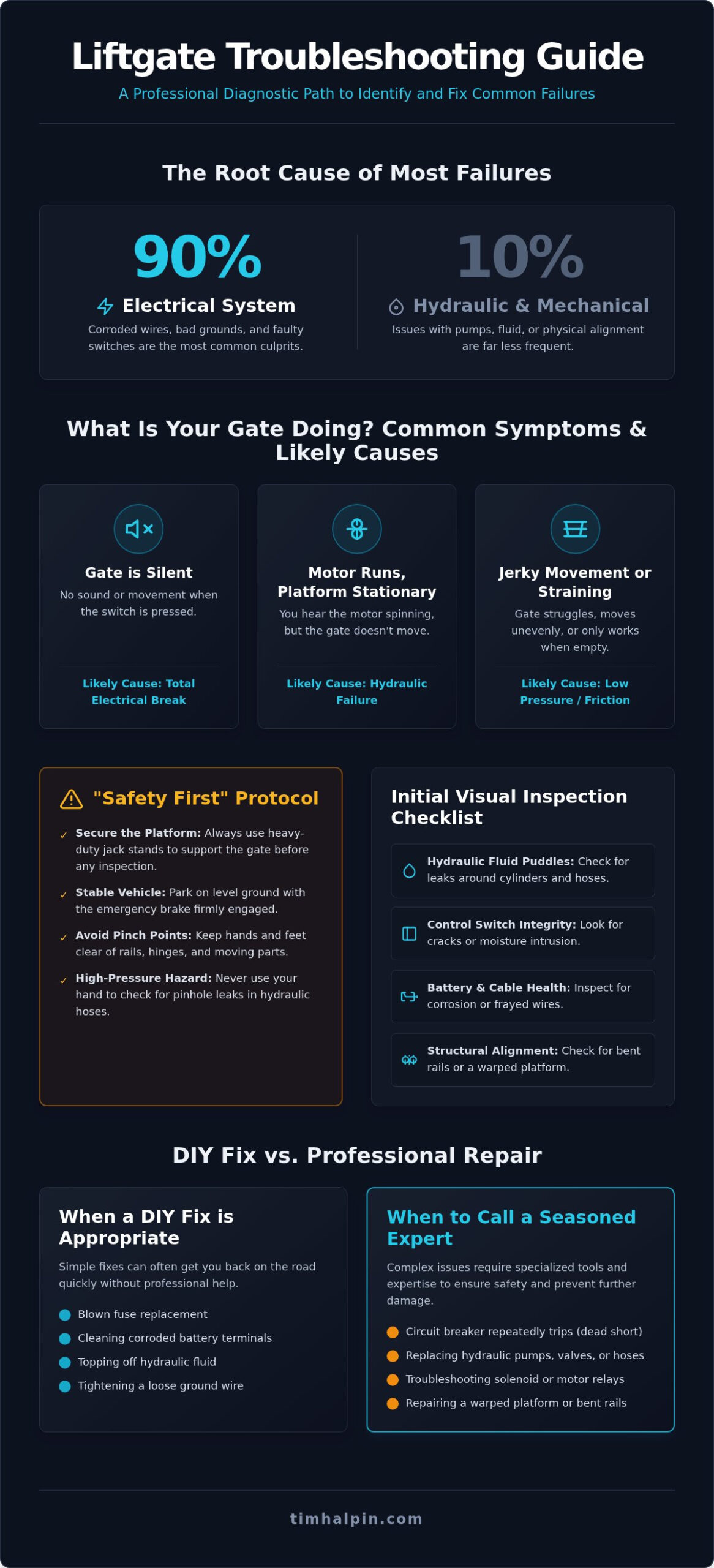
You might be tempted to crack open the hydraulic fluid reservoir the moment your liftgate stops moving, but you’re likely looking in the wrong place. Most operators assume a lifting failure immediately points to a pump or fluid issue, yet nearly ninety percent of common problems actually stem from the electrical system. At Tim Halpin Equipment Corp, we’ve seen every possible failure since we started serving our community in 1987. We understand that every minute your truck sits idle is a minute of lost revenue and added stress for your delivery team.
Mastering tommy gate liftgate troubleshooting doesn’t have to be a guessing game. This guide provides a clear, professional diagnostic path to identify whether your struggle is electrical, hydraulic, or mechanical. You’ll learn how to spot the difference between a simple blown fuse and a complex valve failure, ensuring you only spend money on the parts you actually need. We’ll cover the essential steps to get your equipment back in service safely while helping you decide when a DIY fix is appropriate and when it’s time to consult a seasoned expert to protect your fleet’s longevity.
Key Takeaways
- Learn why nearly ninety percent of liftgate failures are electrical and how to verify power at the source before inspecting the pump.
- Follow a professional diagnostic path for tommy gate liftgate troubleshooting to identify why your motor is running but the platform isn’t moving.
- Identify the specific “whining” sounds of pump cavitation and learn the correct way to top off your hydraulic fluid reservoir.
- Discover the critical maintenance steps for vertical rails and rollers that prevent expensive platform frame warping.
- Understand the difference between a simple DIY fuse replacement and when you need a professional to ensure your fleet’s safety and reliability.
Common Tommy Gate Failure Symptoms: What is Your Gate Doing?
Diagnosing a problem begins with observing exactly how the equipment behaves under pressure. When a driver calls in a failure, the description is often “it’s just not working,” but effective tommy gate liftgate troubleshooting requires more detail. We’ve found that most issues fall into distinct categories that point toward specific systems. A gate that stays silent when you hit the switch is usually suffering from a total electrical break. If you hear the motor spinning but the platform remains stationary, the link between the pump and the cylinders has likely been compromised. Jerky movement or a gate that only works when empty suggests that the system is struggling against friction or a lack of hydraulic pressure. Identifying these symptoms early saves hours of aimless searching.
The “Safety First” Troubleshooting Protocol
Before you or your mechanic crawl under a vehicle, you must secure the environment. A heavy steel platform held up only by hydraulic pressure is a significant risk. We always insist on using heavy duty jack stands to support the platform during any inspection. This prevents a sudden drop if a hose bursts or a valve fails while you’re working. You should also ensure the truck is parked on level ground with the emergency brake firmly engaged. Keep your hands and feet clear of known pinch points, especially around the vertical rails and folding hinges. High pressure hydraulic fluid can be dangerous if a leak occurs; never use your hand to check for pinhole leaks in the hoses.
Initial Visual Inspection Checklist
Sometimes the fix is staring you right in the face. A quick walk around can reveal obvious damage that saves you from deeper technical testing. Our team has been performing these checks in Miami since 1987, and we’ve learned that the simplest things are often the culprits. Look for these signs during your first pass:
- Hydraulic Fluid Puddles: Look for wet spots on the pavement or oily residue around the cylinders and hose connections.
- Control Switch Integrity: Check the exterior housing for cracks or moisture intrusion that could short out the internal contacts.
- Battery Connection Health: Inspect the main power cables for green corrosion or frayed wires where they connect to the battery or the motor solenoid.
- Structural Alignment: Look for any obvious bends in the platform or the vertical rails that might be physically jamming the mechanism.
Taking these initial steps ensures you’re working with a clear picture of the situation. It’s about being methodical. By narrowing down the symptoms and ensuring the vehicle is safe to inspect, you’ve already done half the work required to get your fleet back on the road.
Electrical System Diagnosis: The #1 Cause of Failure
Electrical issues are the most frequent culprits in tommy gate liftgate troubleshooting, often disguised as mechanical failures. The circuit path is the lifeblood of your equipment. Start at the battery. You should see at least 12.4 volts at rest. If the voltage at the motor is significantly lower than the voltage at the battery, you have a high-resistance connection somewhere in between. This is often a corroded terminal or a frayed cable hiding inside a wire loom. Never ignore the ground connection. In our experience, a loose ground wire on the chassis causes more “ghost” problems than any other component. It’s a simple fix that saves you from replacing a perfectly good motor.
Check the circuit breaker and master disconnect switch. These safety devices are designed to trip under load to protect the motor. If the breaker is tripped, reset it once. If it trips again immediately, you have a dead short that needs professional attention. We’ve seen many cases where a simple reset got a delivery driver back on the road in seconds, but a recurring trip is a warning you can’t afford to ignore.
Testing the Liftgate Control Switch
The control switch lives a hard life in the elements. Use a multimeter to check for continuity across the toggle terminals. If you don’t see a clear path when the switch is engaged, the internal contacts are likely burnt or corroded from South Florida’s salt air. You can briefly bypass the switch by jumping the “hot” wire to the solenoid signal wire to see if the gate moves. If it does, your switch is the problem. If you find yourself needing a reliable replacement, our Miami shop stocks Tommy Gate liftgate parts to get your vehicle back on its route without delay.
Solenoid and Motor Relay Troubleshooting
The solenoid is the heavy-duty switch that sends high amperage to the motor. Listen closely while someone else operates the control. You should hear a distinct metallic “click” as the contacts engage. If you hear the click but the motor doesn’t spin, measure the voltage on both large terminals of the solenoid. If power goes in but doesn’t come out, the internal plate is stuck or burnt. If there is no click, the solenoid isn’t receiving the signal from your switch. A motor that smells like ozone or feels excessively hot is usually failing internally, whereas a silent, cool motor usually points back to a relay or solenoid failure.
Hydraulic Troubleshooting: Pumps, Valves, and Fluid
If the electrical signals are clear but the gate still won’t budge, your tommy gate liftgate troubleshooting must shift to the hydraulic system. This is the muscle of the operation. A common indicator of trouble is a high-pitched whining or growling sound coming from the pump box. This usually signals cavitation, which happens when the pump is trying to move air instead of fluid. Check your reservoir level immediately. If the fluid is low, the pump can’t build the pressure needed to lift the platform, leading to a stalled delivery and a frustrated driver.
Methodical tommy gate liftgate troubleshooting also involves checking for both external and internal leaks. The lowering valve is a frequent site for small blockages. Even a tiny piece of grit can prevent the valve from seating properly, causing the gate to “drift” downward or fail to hold a load. Keep a close eye on your cylinder seals as well. An external leak is easy to spot by the oily residue on the housing, but an internal bypass is trickier. If the gate lowers slowly under a heavy load but you see no puddles, the fluid is likely leaking past the internal piston seals, requiring a professional reseal.
For fleet managers who require specialized mobile support with complex hydraulic issues, you can check out Ms. Hydraulics LLC for professional heavy equipment repair.
Fluid Quality and Aeration Issues
In our humid South Florida climate, moisture can easily contaminate your system. If you pull the dipstick and the fluid looks milky, water has mixed with the oil. This significantly reduces the fluid’s ability to protect the pump and can lead to internal rust. Foamy fluid indicates air is being sucked into the lines through a loose fitting or a bad seal. Bleeding the system involves cycling the gate through its full range of motion several times to purge trapped air. We always recommend using a high-quality ISO 32 fluid that can handle our local heat without thinning out prematurely.
Pressure Relief Valve Adjustments
When a gate refuses to lift a weight it should handle easily, the pressure relief valve might be out of spec. This valve is a safety feature that prevents the system from blowing a hose under extreme stress. You must resist the urge to simply tighten it down without a pressure gauge. Over-tightening can lead to catastrophic pump failure or structural damage to the platform. If the gate continues to struggle despite proper fluid levels and a clean valve, it is likely time for a comprehensive truck hydraulic lift gate service to test the pump’s actual output and ensure your safety.
Mechanical Alignment and Railgate Maintenance
Even a perfectly powered hydraulic system can’t overcome a physically jammed mechanism. Mechanical issues often present as a gate that “walks” or chatters as it moves up the rails. During tommy gate liftgate troubleshooting, you should carefully inspect the vertical outrails and roller systems for any signs of scoring or uneven wear. If the platform frame is bent or the rails are twisted, the added friction will eventually burn out your motor or blow a hydraulic seal. We’ve seen many cases where a minor collision with a loading dock went unnoticed until the liftgate stopped functioning entirely. Our team has been servicing South Florida fleets since 1987, and we know how our local environment can accelerate this type of wear.
Don’t overlook the smaller components like pivot pins and bushings. These parts bear the full brunt of the weight every time you transition the platform. If you notice excessive play or the gate feels loose when it’s under load, the bushings are likely worn down. Similarly, ensure the latching mechanism is clear of road debris and grit. A latch that doesn’t engage fully is a major safety hazard for your driver and other motorists on the road. Taking ten minutes to clear out the hinges can prevent a catastrophic failure during a delivery.
Lubrication Best Practices
Grease is the lifeblood of a smooth-running railgate, but the type of grease you use matters. Thick, tacky grease might seem like a good idea, but it often traps road grit, turning into an abrasive paste that eats away at the rollers. We recommend a high-quality lithium-based grease that stays fluid in our Miami humidity. Create a monthly maintenance schedule to wipe away old, dirty grease before applying a fresh layer. This simple habit prevents mechanical binding and extends the life of your equipment significantly.
Platform Leveling and Adjustment
An unlevel platform isn’t just an inconvenience; it’s a load safety risk. If one side of the gate is sagging, it places uneven stress on the chains or cables, leading to premature failure. Depending on your specific Tommy Gate model, you may need to adjust the tensioning nuts or inspect the cable pulleys for alignment. When physical wear reaches a point where simple adjustments no longer hold, a comprehensive truck liftgate rebuild is the only way to restore factory-level safety. If you’re unsure about the structural integrity of your equipment, our experts can provide a full liftgate repair assessment to keep your fleet operational and safe on the road.
Sourcing Tommy Gate Parts and Professional Repair in Miami
Once you’ve completed your tommy gate liftgate troubleshooting and identified the failed component, the focus shifts to sourcing the right replacement. In our decades of service, we’ve seen how tempting it is to use generic parts to save a few dollars. However, OEM Tommy Gate parts are engineered specifically for the tolerances of your equipment. Using a third-party solenoid or motor might get you through the day, but it often leads to premature failure or electrical mismatches that can damage your entire system. Minimizing vehicle downtime is about fixing it right the first time so your truck doesn’t end up back in the shop a week later.
There is a point in every diagnostic process where DIY efforts should stop. If you’ve verified your battery voltage, cleaned your grounds, and checked your fluid levels but the gate still refuses to operate correctly, a professional diagnostic is the safest next step. Complex issues like internal pump bypass or intermittent wiring shorts can be frustrating to track down without specialized equipment. We believe in empowering fleet managers with knowledge, but we also know that protecting your equipment and your drivers is the highest priority.
If you find yourself needing a wider range of specialized tools for your shop, you can explore Equipment Rentals and Hardware Retail to find high-quality industrial equipment for any local project.
Miami’s Largest Liftgate Parts Inventory
Tim Halpin Equipment Corp has been a family-owned staple in the Miami community since 1987. We maintain one of the largest inventories in the country because we know that a truck waiting for a part is a truck losing money. Whether you need a specific control switch, a heavy duty motor, or a replacement solenoid, we likely have it on the shelf for immediate local pick-up or international export. Our location serves as a strategic hub, allowing us to support fleets across South Florida and into the Caribbean. We take immense pride in our commitment to keeping both tow truck parts in Florida and essential liftgate components ready for deployment at a moment’s notice.
Expert Installation and Repair Services
Our approach to service goes beyond simple part replacement. We specialize in the type of complex commercial truck upfitting in Miami that requires a deep understanding of both hydraulic and electrical integration. By choosing professional repair and installation, you ensure that every component is aligned to factory specifications, which significantly reduces your long-term maintenance costs. Our team acts as a steady, knowledgeable guide for your fleet, helping you navigate equipment failures with the confidence that comes from nearly forty years of industry experience. If your tommy gate liftgate troubleshooting has reached a standstill, contact us for the expert assistance your business deserves.
Keeping Your Fleet Moving Through South Florida
Success in tommy gate liftgate troubleshooting comes down to a methodical approach. By checking the battery and ground connections first, you eliminate the most common electrical gremlins that often mimic hydraulic failure. When physical wear or pump issues arise, choosing high quality OEM components ensures your truck stays on the route rather than sitting in the bay. We’ve seen how a small maintenance oversight can lead to a significant delay, but with the right diagnostic path, most issues are manageable. You don’t have to navigate these technical challenges alone.
We’ve been a family-owned staple in Miami since 1987, and we’ve built one of the largest liftgate parts inventories in the USA to support our neighbors. Whether you’re managing a local delivery route or an international fleet, we’re here to act as your steady guide. Don’t let equipment downtime derail your operations when expert help is just a call away. Get Expert Tommy Gate Repair and Parts in Miami and experience the reliability that comes with decades of professional expertise. Your equipment is a major investment, and we’re committed to helping you protect it. Safe travels on the road ahead.
Frequently Asked Questions
Why is my Tommy Gate motor clicking but not lifting?
A clicking sound usually indicates that the solenoid is engaging but isn’t delivering enough current to the motor. This happens when there’s high resistance from corroded battery terminals or if the battery charge is too low to turn the motor under load. You should test the voltage at the solenoid terminals while the switch is depressed. If you see a significant drop, the solenoid itself or the main power cable likely needs replacement.
How do I manually lower a Tommy Gate if the power fails?
You can lower the platform by slowly opening the manual release valve located on the hydraulic pump assembly. It’s usually a small knurled knob or a hex screw. Before touching this valve, you must ensure the area under the platform is completely clear. The gate will descend using gravity alone. We recommend having a second person assist to monitor the descent and ensure the platform doesn’t drop too quickly or unevenly.
What type of hydraulic fluid should I use in my Tommy Gate?
Most models require a high-quality ISO 32 hydraulic oil to ensure smooth operation in various temperatures. In our South Florida climate, the heat can cause thinner fluids to lose their protective properties. Avoid using automatic transmission fluid unless specifically authorized by the manufacturer for your model. Using the correct fluid prevents the pump from overheating and keeps the internal seals from degrading prematurely during long Miami summers.
How often should I lubricate the rails on my liftgate?
We recommend a thorough lubrication of the vertical rails and all pivot points at least once every thirty days. If your truck operates near the coast where salt air is a factor, you might need to do this more frequently. Regular greasing prevents the “chatter” often encountered during tommy gate liftgate troubleshooting. Always wipe away the old, grit-heavy grease before applying a fresh layer of lithium-based lubricant to the sliding surfaces.
Can a weak truck battery cause my liftgate to move slowly?
A weak battery is one of the most common reasons for sluggish liftgate performance. If the voltage drops below 12 volts while the motor is running, the system won’t have the power needed to lift a full load. This extra strain also creates excessive heat, which can damage the motor windings over time. Always keep your truck’s engine running during operation to ensure the alternator is supporting the battery’s output.
Is there a reset button or fuse for the Tommy Gate system?
Yes, your system is protected by a heavy-duty circuit breaker, typically located within two feet of the truck battery. If the gate is completely unresponsive, check for a tripped lever or a blown fuse in the main power line. Resetting the breaker is a standard first step in tommy gate liftgate troubleshooting. If it trips again immediately, you likely have a short circuit in the wiring that requires professional inspection.
Why does my liftgate platform tilt to one side when rising?
Tilting is usually a sign of uneven tension in the lift chains or cables. Over time, one side can stretch more than the other, or a pulley may become partially seized. You should also check the vertical rails for debris or physical damage that might be causing one side to bind. If the platform isn’t level, it creates a dangerous situation for your cargo and puts unnecessary torque on the lift cylinders.
What is the average lifespan of a Tommy Gate hydraulic pump?
You can expect a well-maintained hydraulic pump to last between seven and ten years in a commercial environment. The lifespan depends heavily on fluid cleanliness and regular use. Pumps that are forced to work with contaminated, milky fluid or those that frequently cavitate due to low levels will fail much sooner. Consistent maintenance is the only way to ensure you get the maximum return on your equipment investment.
