

The most organized work truck isn’t always the one with the most storage. Choosing between a utility body and a van means looking at how your crew reaches tools on the job, not just where everything fits. Exterior compartments put selected equipment within reach, while a van keeps tools and materials enclosed and can provide a walk-in workspace.
Weigh access against weather protection, workspace, and payload. The right setup depends on your crew’s daily routine, the equipment you carry, and the conditions at your job sites. A configuration that works well for one trade may slow another down.
This guide compares utility bodies and vans through practical trade-offs, including how an upfit can shape the way your vehicle works. Tim Halpin Equipment Corp is a family-owned Miami business serving South Florida, with utility bodies, van interiors, and installation services. Use the comparisons below to see how each option fits different work routines and what to plan before an upfit.
Key Takeaways
- When choosing between a utility body and a van, start with how your crew retrieves tools and works at each job site.
- Compare quick-access exterior compartments with enclosed interior storage to see which better supports daily tasks.
- Consider South Florida rain, heat, parking, and frequent stops when weighing weather protection and job-site access.
- Separate your crew’s must-haves from preferences before choosing a layout and planning an upfit.
- Tim Halpin’s utility bodies, service bodies, van interiors, and installation services support different work routines.
Utility Body vs. Van: What Is the Practical Difference?
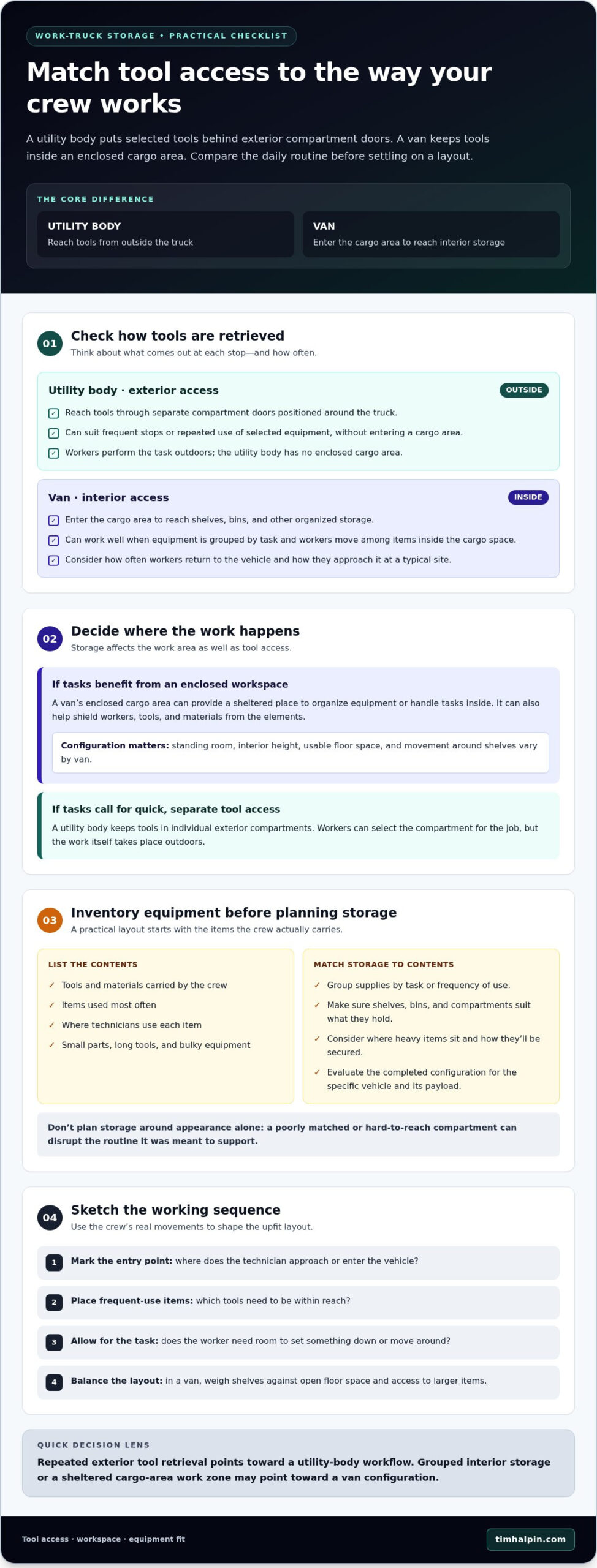
A utility body is a truck body fitted with storage compartments along its exterior. Instead of opening a main cargo area, a technician reaches tools through compartment doors positioned around the vehicle. A van keeps cargo inside an enclosed body, where shelving, bins, and other interior storage can organize equipment. Both are commercial vehicle configurations, but they create different ways to store and retrieve what a crew needs.
The difference affects more than where tools ride. It shapes how workers prepare for a job, move around the vehicle, and get equipment throughout the day. Choosing between a utility body and a van is less about finding a universally better setup and more about matching storage and access to your crew’s routine, equipment, and job sites.
| Work consideration | Utility body | Van |
|---|---|---|
| Tool access | Reach tools through separate exterior compartments. | Enter the cargo area to reach organized interior storage. |
| Enclosed workspace | Storage is outside the truck cab; there’s no enclosed cargo area. | The enclosed interior can offer a sheltered place to work, depending on its configuration. |
| Typical workflow | Useful when jobs call for retrieving selected tools from outside the vehicle. | Useful when the crew benefits from grouping equipment inside and working from the cargo area. |
How do you access tools in each setup?
With a utility body, workers can reach compartments from around the truck and choose the door that holds the tools they need. This can suit a routine with frequent stops or repeated use of specific equipment, since the crew can retrieve items without entering a cargo area. In a van, workers step inside to reach shelves or bins. That approach can work well when tools are grouped by task and the crew needs to move among them inside the cargo space. Consider what gets used at each stop and how often workers return to the vehicle.
What does each setup make easier at a job site?
A van’s enclosed interior can help shield workers, tools, and materials from the elements while they organize equipment or handle tasks inside. Usable workspace, including whether there’s room to stand, depends on the specific van configuration. Utility-body compartments keep frequently used tools separated and accessible from outside. That can simplify a grab-and-go routine, though workers perform the task outdoors.
The layout changes how workers reach and use equipment. If a job involves moving between tools and a sheltered interior work area, a van’s enclosed cargo space may be valuable. For a crew that wants separate exterior access to its equipment, a utility body may better match the workflow. List the tools used most often, where each task happens, and how workers approach the vehicle at a typical site. Those details make the comparison practical, rather than just a choice between two storage styles.
How Do Utility Bodies and Vans Handle Tools, Workspace, and Equipment?
The storage plan should follow the work. In a van, interior shelving and bins can group parts, hand tools, and supplies inside one enclosed cargo area. Workers can arrange items by task or frequency of use, but reaching equipment generally means opening the cargo area and moving through the interior. In a utility body, separate exterior compartments provide access from outside the truck. Each compartment can have a purpose, so a technician can open the section suited to the job at hand.
Neither layout organizes itself. Shelves that fit small parts may not suit long tools, while compartments planned around everyday hand tools can leave less convenient space for bulky equipment. Before choosing between a utility body and a van, list the equipment your crew carries, note what comes out most often, and consider where technicians use it. That inventory gives an upfit a practical starting point.
When does enclosed workspace matter most?
An enclosed cargo area can be useful when technicians regularly sort parts, prepare equipment, or complete tasks from inside the vehicle. It also keeps stored tools and materials inside the vehicle instead of directly exposed to outdoor conditions. A van doesn’t guarantee standing room or a specific amount of usable floor space. Interior height and layout vary by vehicle configuration, so consider how workers will move around shelves and handle equipment.
Sketch the working sequence: where a technician enters, which items need to be within reach, and whether a task requires room to set something down. A well-organized interior can keep related supplies together, but storage also takes up cargo space. Balance shelves, open floor area, and access to larger items before settling on a layout.
When is exterior compartment storage more practical?
Exterior compartments can suit jobs where workers repeatedly retrieve selected tools without entering the vehicle. Separate spaces can group equipment by task, such as keeping frequently used hand tools apart from fittings or less-used supplies. This can make it easier to return each item to a designated spot. The benefit depends on thoughtful organization: a compartment that’s hard to reach or poorly matched to its contents can disrupt the routine it was meant to support.
Bulky or heavy equipment needs attention in either setup. Shelves, bins, and compartments must suit the items they hold, and the completed configuration should be evaluated for the specific vehicle and its payload. Avoid planning storage around appearance alone. Consider where heavy items will sit, how they’ll be secured, and whether the crew can handle them safely and conveniently during daily work.
Before finalizing a layout, walk through a typical job from arrival to pack-up. Identify the first tools needed, the equipment used together, and what must remain accessible throughout the day. Tim Halpin Equipment Corp provides commercial upfitting and installation to help turn those priorities into a working vehicle, with utility body and van interior options suited to different routines.
Which Setup Fits South Florida Routes, Weather, and Job Sites?
Miami and South Florida add practical considerations, but the region alone doesn’t determine the setup. Rain, heat, outdoor work, parking, and the rhythm of service calls all shape how useful a storage layout will be. A crew working at one site for an extended period may prioritize different features from a crew making frequent stops across the area. Look at actual routes and tasks instead of assuming every local fleet needs the same configuration.
How can South Florida weather affect daily use?
Consider how often technicians need to organize parts or access equipment during rain or in direct heat. A van’s enclosed cargo area keeps stored items inside the vehicle and can provide a sheltered place to sort supplies. Exterior utility-body compartments keep tools separately accessible, but workers retrieve items outdoors. Neither arrangement removes the need to plan for the conditions crews encounter. The better fit depends on how often and how long they work outside.
For example, a technician who regularly prepares parts at the vehicle may value an enclosed interior. A crew making brief stops to retrieve specific tools may prefer direct access through exterior compartments. These are workflow considerations, not promises about temperature or vehicle performance. Think about what workers do during a typical service call and whether they need a protected place to organize equipment between tasks.
What job-site and route patterns should you compare?
Map a normal shift: where the vehicle parks, how often workers open storage, and whether they need to move equipment from the vehicle to the work area. Include different stops, such as customer properties, service locations, and tighter sites where space to maneuver or open doors may be limited. A setup that’s convenient at one location could be less practical at another, so consider the full route rather than a single familiar job.
| Setup | Potential advantage | Trade-off to consider |
|---|---|---|
| Utility body | Separate exterior compartments can make selected tools accessible without entering a cargo area. | Workers access compartments outside, which may matter during rain or outdoor tasks. |
| Van | An enclosed cargo area keeps equipment inside the vehicle and can provide a sheltered place to organize it. | Accessing stored items means entering the cargo area, and parking space may affect how conveniently workers can use it. |
To make the comparison concrete, track representative shifts. Note when tools are retrieved, the conditions during outdoor work, and where the vehicle can park while equipment is unloaded. Ask technicians which moments feel awkward or slow, then separate recurring needs from occasional exceptions. That record can guide a layout more reliably than a general preference for one vehicle style.
Route patterns and tool access should guide the configuration, not location alone. For crews choosing between a utility body and a van, the strongest fit is the one that supports their actual stops, work conditions, and equipment routine across South Florida, from Miami, Doral, and Fort Lauderdale to Key West, Medley, Hialeah, and Kendall.
How to Decide Between a Utility Body and a Van for Your Crew
Make the decision with the people who use the vehicle, not from a storage sketch alone. A crew-level review can reveal different routines across technicians, routes, and job types. Use this sequence to separate essential requirements from preferences and turn everyday work into a clear configuration brief.
- Map a typical workday. List the jobs the crew handles, the tools and equipment used most often, and the order in which workers need them. Include occasional specialized gear, but distinguish it from items that come out at nearly every stop.
- Record who and what travels. Note how many crew members typically ride along, how often they retrieve equipment, and whether they need space inside the vehicle to sort parts or prepare for a task.
- Capture route and site conditions. Describe usual parking, tight access points, customer properties, weather exposure, and any job-site requirements that affect where workers can open doors or handle equipment.
- Sort must-haves from preferences. Mark needs that would disrupt the workday if missed, such as protected interior workspace or quick access to particular tools. Keep convenience features in a separate preference list.
- Review the complete configuration. Match the storage plan to frequent tasks, then evaluate the vehicle’s payload and chassis suitability with the intended equipment and upfit in mind.
What should you document before choosing?
Ask technicians to describe real shifts rather than ideal ones. Note which tools are used together, what gets retrieved repeatedly, who rides in the vehicle, and where workers need to stand or organize materials. Include route, parking, weather exposure, and specialized site needs. This shared record helps surface crew-wide requirements instead of letting one person’s preferred setup define the whole fleet.
How do you turn those needs into a configuration?
Use the crew’s most frequent tasks to set priorities, then compare how each layout supports them. Payload and chassis suitability belong in that review because the finished vehicle includes the equipment and upfit, not just the storage components. An experienced upfitter can help translate the crew’s priorities into a practical layout. For broader planning considerations, see this guide to commercial truck upfitting in Miami.
| If the crew prioritizes… | Consider giving more weight to… |
|---|---|
| Direct access to selected tools from outside | Utility-body compartments |
| Enclosed space to organize equipment or parts | Van interior storage |
| Bulky gear or a demanding equipment load | Vehicle-specific payload and chassis evaluation for either setup |
| Several different work routines | A documented layout that balances shared must-haves with task-specific storage |
Choosing between a utility body and a van becomes more straightforward when the crew can explain what it needs, why it needs it, and how often that need comes up. Tim Halpin Equipment Corp provides commercial upfitting and installation in Miami, helping turn work routines into practical vehicle configurations. Plan your work truck upfit around the crew’s day-to-day needs.
Plan Your Utility Body or Van Upfit with Tim Halpin
Once your crew’s priorities are clear, turn them into a usable work-vehicle layout. Tim Halpin Equipment Corp provides commercial upfitting and installation in Miami, helping businesses align storage choices with the way their teams work. Utility bodies, service bodies, and van interiors offer different starting points. The right configuration depends on the vehicle’s intended use, the equipment it carries, and how workers need to access it.
Coordination matters because a storage plan is only useful if it works in practice. A crew that needs separate access to tools may prioritize a different layout from one that organizes parts inside an enclosed van. Clear notes about daily tasks give the upfit team a practical basis for planning, rather than relying on assumptions about what a trade typically needs.
What can an upfitter help coordinate?
An upfitter connects the chosen storage approach to the vehicle’s commercial purpose and plans truck-body or van-interior installation around work requirements. Bring a list of frequently used tools, larger equipment, crew routines, and must-have access points. Those details help shape the layout and installation around the actual work instead of a generic template.
What is a useful next step for South Florida businesses?
Start with a straightforward discussion of your crew’s workflow: what equipment travels, how often it’s used, and what workers need from the vehicle at a job site. Tim Halpin is a family-owned Miami business serving South Florida. Its truck equipment and upfitting experience can help you consider how a utility body, service body, or van interior can support your operation.
Before the discussion, gather input from the people who use the vehicle most. A few practical notes can keep planning focused:
- Which tools or materials must be easiest to reach?
- Does the crew need an enclosed area to organize equipment?
- What bulky or specialized items shape the storage plan?
- Which access or workspace needs are essential, and which are preferences?
Tim Halpin’s South Florida equipment expertise includes commercial truck upfitting, installation, and truck equipment repair. Choosing between a utility body and a van becomes more manageable when the layout starts with documented crew needs and those priorities carry through to installation.
Ready to put your work requirements into a practical plan? Discuss your commercial upfitting needs with Tim Halpin.
Turn Your Crew’s Needs Into a Workable Setup
Bring the people who use the vehicle into the planning conversation. Ask each crew member what slows them down, which equipment needs to be easiest to reach, and what would make the workday more comfortable or organized. Those practical observations can reveal priorities that a vehicle checklist alone might miss.
Choosing between a utility body and a van becomes less daunting when you treat the decision as the start of a layout plan, not a one-time either-or choice. Your crew’s needs can guide how storage and workspace come together, with room to distinguish essential features from nice-to-haves. Tim Halpin can help translate those priorities into a commercial upfit that fits the way your team works.
Discuss your commercial upfitting needs and take the next step toward a setup your crew can rely on throughout the workday.
Frequently Asked Questions
Can a utility body be fitted to any pickup?
No. Compatibility depends on the pickup’s chassis, cab, and body configuration, so a utility body isn’t a universal fit. Identify the specific vehicle and intended use, then evaluate whether the body and installation suit that combination. This is especially useful for Miami fleets adding equipment to vehicles already in service. A vehicle-specific review helps avoid building a storage plan around assumptions that don’t match the truck.
How much payload capacity does a utility body or van upfit use?
There isn’t one universal amount. The body or interior components contribute weight, as do the tools, materials, and other cargo the crew carries. Account for the complete working setup, not just the empty storage system. Use the vehicle’s specifications and the planned equipment list to evaluate remaining capacity. If tools or stock change between jobs, include the heaviest expected load in that assessment before finalizing the configuration.
Can a work van carry ladders and long tools?
Yes, a van can be planned to carry ladders and long tools, but the suitable arrangement depends on the vehicle’s dimensions and the length and handling needs of the equipment. Consider how workers will load and secure each item, whether it could obstruct access to other gear, and how much interior room it occupies. For example, a long tool used daily should be easy to retrieve without unloading several bins first.
Can a utility body or van be configured for more than one trade?
Yes. A vehicle can support more than one trade if the layout accounts for the equipment and routines involved. Separate storage zones can keep one task’s materials distinct from another’s, while a shared area can hold commonly used supplies. Start by identifying which tools overlap and which must remain separate. In a Miami fleet, documenting those needs helps make the configuration useful across the crew’s actual assignments.
What happens if my crew’s equipment changes after the upfit?
Revisit the layout and vehicle load whenever an equipment change affects storage, access, or total weight. A new tool may need a different place, while added materials can change how the vehicle should be evaluated for payload. Keep an updated inventory and note which items are permanent versus job-specific. That record gives your team a clearer basis for adapting the setup as work evolves.
Is a utility body or van easier to keep organized?
Either can be organized well if the storage plan reflects how the crew returns and retrieves equipment. A technician who assigns tools to dedicated exterior compartments may find that system intuitive; another crew may prefer interior shelves grouped by task. Try mapping a real work order to the proposed layout: can workers find each item and put it back without shifting unrelated gear? That simple test can reveal whether the organization fits.
Should I choose the same setup for every vehicle in my fleet?
Not necessarily. Standardizing vehicles can make shared procedures and equipment assignments simpler, but crews with different duties may benefit from different configurations. Start with common requirements, such as frequently used tools, then account for each team’s specialized equipment and job patterns. Choosing between a utility body and a van across a Miami fleet is best approached vehicle by vehicle, with a consistent planning process rather than a single assumption for every role.
