

The most useful plumbing van isn’t necessarily the one with the most shelves. Van upfitting for plumbers in Miami works best when storage, racks, cable management, and workflow are planned around the tools and materials used on the job.
Fittings can get mixed together, bulky supplies can take up valuable room, and cords or hoses can become obstacles. A thoughtful layout makes it easier to find what you need, keep equipment organized, and restore order between calls.
This guide explains how to plan storage for tools and pipe fittings, choose shelving and racks, manage cables, and arrange the van around daily workflow. It also covers what to consider when comparing cargo vans and utility vans, so your setup suits the work you do across Miami.
Key Takeaways
- Sort tools and fittings by how often you use them, then plan storage so everyday essentials stay easy to reach.
- Match shelving, racks, and cable management to the equipment you carry and the way you work inside the vehicle.
- Build a repeatable workflow by assigning clear places for supplies, tools, and gear that moves between jobs.
- Compare vans and utility vehicles by usable cargo space, access, and payload needs, not just exterior size.
- For work vehicles needing repair support, Tim Halpin Equipment offers truck, liftgate, trailer, and hydraulic repair.
Custom storage for tools and pipe fittings
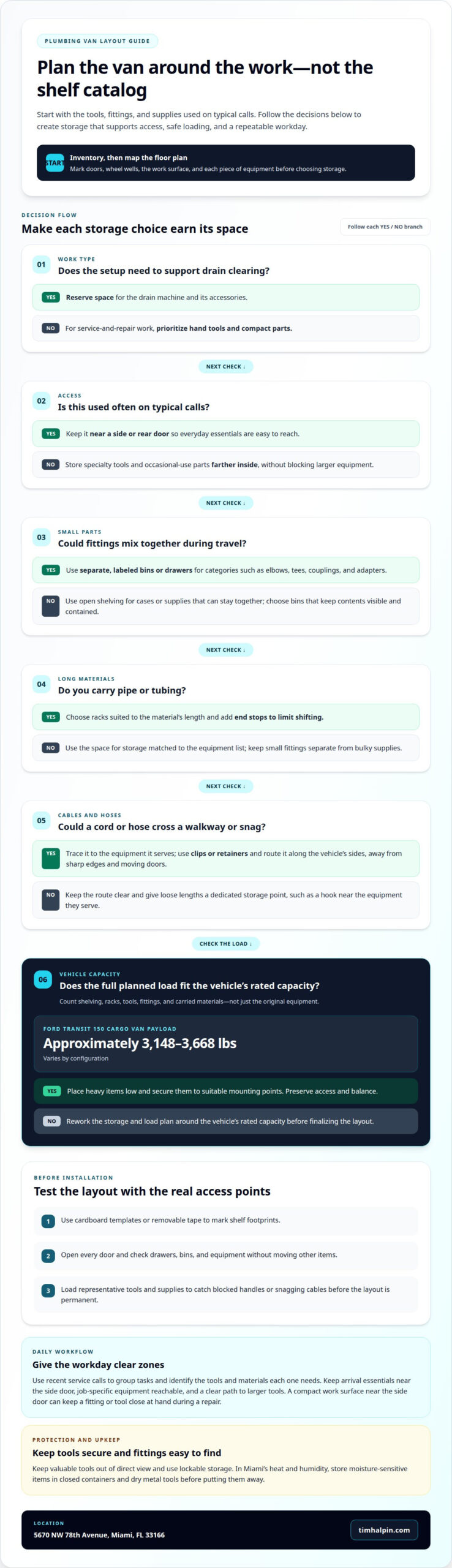
Start a custom layout with an inventory, not a shelf catalog. List the tools, fittings, and supplies used on typical calls, then group them by task. Keep frequently used items near a side or rear door, and store specialty tools and occasional-use parts farther inside. For example, a plumber handling faucet repairs might separate cartridges, supply lines, wrenches, and sealants into labeled zones.
Pipe fittings need compartments that keep small parts from mixing during travel. Use bins or drawers sized for categories such as elbows, tees, couplings, and adapters. Label each compartment by fitting type or job. Store longer pipe and tubing on racks suited to their length, with end stops to limit shifting. Keeping small fittings separate from long stock also makes restocking easier.
Tailor the layout to the crew’s actual plumbing work. A drain-clearing setup may need space for a machine and its accessories, while a service-and-repair setup may prioritize hand tools and compact parts. Sketch the van’s floor plan before choosing storage. Mark the doors, wheel wells, work surface, and equipment footprint. Place heavy items low and secure them to suitable mounting points.
Van upfitting for plumbers in Miami also means considering the vehicle’s capacity. The Ford Transit 150 Cargo Van has a payload capacity ranging from approximately 3,148 to 3,668 lbs, depending on configuration. Add the weight of shelving, racks, tools, fittings, and carried materials when planning the load. A storage plan should preserve access and balance, not simply use every open space.
A plumbing van upfit can combine shelving, drawers, bins, racks, and work surfaces. Treat a package as a starting point, then adjust it to your equipment list. A plumber carrying pipe cutters and a drain machine needs different clearances from one carrying mostly hand tools. Each storage choice should serve a clear purpose: protect equipment, separate supplies, or make it quicker to start work.
Florida requirements depend on the modification, so plan for the vehicle’s rated capacity, secure mounting, clear visibility, and unobstructed access. The work involved depends on the layout, materials, vehicle condition, and installation. A practical process is to inventory equipment, map storage zones, select components, install them, then load the van and test access with actual tools.
To reduce theft exposure, keep valuable tools out of direct view and use lockable storage. In Miami’s heat and humidity, store moisture-sensitive items in closed containers and dry metal tools before putting them away. This helps protect equipment while keeping commonly used fittings easy to find.
Commercial van shelving and cable management
Shelving should leave clear access to tools, supplies, and vehicle doors. Plan cable routes alongside storage so cords don’t cross walkways or snag on equipment.
Custom and Prefabricated Shelving
Prefabricated shelving provides a defined layout that may suit common tools and supplies. Custom shelving can use the vehicle’s dimensions and accommodate unusual equipment, but needs careful planning for clearances and mounting. Compare options by measuring the cargo area, listing bulky items, and mapping door access. For example, a fixed shelf may fit standard cases but leave awkward gaps around a wheel well.
Shelving and Storage Systems
A plumber’s setup can combine open shelves for cases, closed bins for small fittings, and racks for longer materials. Choose bin sizes that keep items visible without letting contents spill during travel. Add dividers for compact parts and reserve a shelf for equipment that needs to stay together, such as a tool case and its accessories. Driverge identifies shelving, cable management, and door panels as popular plumbing van upfit additions.
Plan cable management separately. Trace each cord or hose from its storage point to the equipment it serves. Use retainers or clips to contain loose lengths, keeping them away from sharp edges, moving doors, and frequently handled tools. For example, give a coiled extension cord a dedicated hook near its power tool case instead of leaving it across a shelf.
Before installation, lay out cardboard templates or mark shelf footprints with removable tape. Open every door and check that drawers, bins, and equipment are accessible without moving other items. Then load representative tools and supplies. This test can reveal a blocked handle or a cable catching on a shelf corner before the layout becomes permanent.
Keep the work area separate from storage. A compact surface near the side door can hold a fitting or tool during a repair, while nearby bins give small parts a consistent place. Secure loose supplies and route cords along the vehicle’s sides rather than across the floor. These choices make the interior easier to use between calls.
For a work vehicle needing fitted equipment, commercial vehicle installation services provide a practical next step for planning the layout and installation.
Plumbing van organization and workflow
An efficient van supports the whole workday, from dispatch and arrival to repair and restocking. Map that sequence before assigning storage, so each task has a practical place in the vehicle.
Start with a log of recent service calls. Group tasks such as leak diagnosis, faucet replacement, and drain clearing, then note the tools and materials each requires. A faucet call may need a basin wrench, replacement cartridge, supply line, and sealant. This list shows which items need quick access and which can stay farther from the doors.
Arrange work zones around how a plumber enters and moves through the van. Keep arrival essentials near the side door, place job-specific equipment where it can be reached without unloading unrelated supplies, and leave a clear path to larger tools. If a drain machine must come out first, for example, don’t block it with cases used only for occasional repairs.
Build a repeatable routine around four parts of the day:
- Before departure: Match the work order to the tools and materials assigned to that job.
- At arrival: Take only the required equipment, such as a repair kit and diagnostic tool.
- After the repair: Return reusable tools to their designated locations before loading new supplies.
- At day’s end: Separate used materials from clean stock and note parts that need replenishing.
- Before the next shift: Put commonly used tools back in their set places, ready for the next call.
Restocking is more reliable when every parts category has a set place. Keep a simple inventory sheet organized by fittings, repair parts, consumables, and specialty equipment. After replacing a shutoff valve, for example, record the supply line or fitting used. This helps identify what to replenish before the next similar job.
Plan for changing schedules across Miami. A call may shift from a planned fixture repair to another task, so reserve a defined area for commonly needed supplies. Don’t fill it with unrelated equipment. A clear reserve zone lets the plumber see what remains available without searching through job-specific kits.
Review the layout after using it on real jobs, not just during installation. At the end of a busy day, note any tool that required moving another item, any hard-to-find supply, and any unsecured equipment. Fix one workflow problem at a time. This practical review keeps the van efficient as service needs and the work mix change.
Work van and truck upfitting in Miami
Choose equipment based on the vehicle, the plumbing work, and daily use. A cargo van and a service truck offer different storage options, so compare access, usable space, and the equipment each needs to carry.
Start by recording the vehicle’s make, model, roof height, cargo dimensions, and current equipment. Then measure the items that must travel inside, including long pipe, tool cases, and bulky machines. Leave room for doors to open and for equipment to be removed without shifting other loads. A layout that fits on paper still needs a practical access test.
Roof height can shape how workers move inside a van. The Ram ProMaster 1500 Cargo Van’s low roof provides approximately 65.4 inches of interior standing height, while its high roof provides approximately 76 inches. Consider those clearances alongside the worker’s tasks. A setup requiring frequent interior movement may benefit from a different arrangement than one focused on reaching equipment from the side door.
Payload matters, too. The Ram ProMaster 1500 Cargo Van’s payload capacity ranges from approximately 3,760 to 4,000 lbs. Add the weight of the upfit components and the tools, parts, and materials carried each day. Keep a written load inventory, then remove equipment that no longer supports the work mix. This gives the layout a useful purpose without treating every empty space as storage.
A work truck may need a different approach from an enclosed van. An open service body can make some tools accessible from outside, while a covered toolbox can separate smaller equipment from exposed cargo. A plumber carrying long materials and a compact diagnostic kit, for example, may need both organized storage and a secure place for the longer load. Match each component to the truck’s actual configuration.
Warranty coverage, financing, and fleet discounts are separate commercial terms, not automatic parts of every upfit. Consider them separately from the equipment list, installation scope, and any repair work.
For a fleet, record each vehicle’s model and intended role before choosing a common layout. A service van and a truck assigned to carry larger materials may need different equipment. Standardized labels or storage zones can simplify shared routines while preserving each vehicle’s specific needs.
In Miami, consider where equipment will sit during a typical workday, how often it moves between vehicles, and whether workers can secure it after a call. Before approving the layout, load representative tools, open every access point, and confirm daily-use items remain reachable. Configure the truck or van around its work, not simply the equipment it can hold.
Utility vans for plumbing businesses
A utility van can suit plumbing work that needs organized storage and frequent equipment access. Before choosing a layout, compare its cargo dimensions with the tools, parts, and materials your crew carries.
The Chevrolet Express 3500 Utility Van has approximately 283 cubic feet of cargo volume behind the front seats, depending on configuration. Its maximum cargo length is approximately 127 inches, also depending on configuration. Use those figures as planning references, then measure the specific vehicle and the longest items it must carry.
Start with a load map. Mark the doors, wheel wells, and available floor area, then add the footprint of large equipment. A drain machine, pipe sections, and tool cases may compete for space. Assign each item a storage zone and check that workers can reach it without unloading unrelated supplies.
A utility van’s layout should support the plumbing work it performs. A service-focused crew may prioritize organized compartments for fittings, repair parts, and hand tools. A team transporting longer materials may need to preserve clear cargo length and secure those materials separately. Match shelves and partitions to the actual load rather than filling every available space.
Before selecting a configuration, consider these practical checks:
- Measure the cargo: Compare interior length and width with pipe, tool cases, and bulky equipment.
- Plan access: Confirm that frequently used supplies are reachable through the doors workers use most.
- Account for the full load: Include storage components as well as tools, parts, and materials.
- Test the arrangement: Place representative equipment in the vehicle and check loading and removal.
A plumber carrying pipe cutters and long stock, for example, can put compact tools in accessible compartments and reserve a clear path for longer materials. Balance the layout around actual use, and secure items so they stay in place during travel. A stable arrangement also makes it easier to spot a tool or supply left behind.
Utility vans can support consistent routines across a plumbing crew. Use the same labels for shared categories, such as repair parts or specialty tools, and return each item to its place after a call. If vehicles serve different jobs, record each unit’s storage plan. This makes restocking and equipment transfers clearer without assuming every van needs an identical interior.
For a utility vehicle setup, plan your vehicle configuration around the equipment, access points, and work the van must handle.
Tim Halpin Equipment: Truck Repair
Tim Halpin Equipment Corp helps keep commercial vehicles working with truck, liftgate, trailer, and hydraulic repair. Turn to the team when a vehicle problem affects access to equipment, trailer use, or hydraulic functions. For example, a truck needing repair may require attention before its work setup can serve the crew reliably. Matching the repair to the affected system helps focus the next step, whether the issue involves the truck itself, a liftgate, a trailer, or hydraulics. For support with a commercial vehicle, contact Tim Halpin Equipment Corp.
Make your next setup work harder
Turn your layout into a working checklist. After each call, note what was hard to reach, what went unused, and what needed restocking. Use these observations to make practical adjustments as your plumbing work changes. A thoughtful plan for van upfitting for plumbers in Miami should serve the crew’s real routine, not just look organized on installation day.
If a commercial vehicle also needs repair support, Tim Halpin Equipment Corp offers truck, liftgate, and trailer repair. These services address vehicle and equipment needs alongside your planning for a more functional work setup. For details or to discuss a repair need, contact Tim Halpin Equipment Corp.
With a clear plan and steady attention to how the vehicle is used, your crew can build a setup that supports the work ahead.
Frequently Asked Questions
Which van models and sizes are best for plumbing work in Miami?
Ford Transit, Ram ProMaster, and Chevrolet Express models can all suit plumbing work, depending on the crew’s load and access needs. Compare the specific configuration, not just the model name: roof height, cargo length, door access, and payload affect how tools and materials fit. A plumber carrying long pipe, for example, should prioritize usable cargo length, while frequent interior work makes standing clearance more relevant.
How should a plumbing van layout be designed for tools, pipe, and fittings?
Design the layout around a representative service call, then test it with the actual equipment. Simulate a fixture repair by loading its tools and parts, for example, and check whether the worker can retrieve them without shifting pipe or unrelated cases. Keep fragile gauges away from heavy equipment, and separate clean replacement parts from used materials. A trial load can reveal access problems before the setup becomes routine.
What permits, vehicle regulations, or safety requirements apply to commercial van upfitting in Florida?
Florida requirements depend on the modification. Plan for the vehicle’s rated capacity, secure mounting, clear visibility, and unobstructed access.
