

What if the most critical factor in your fleet’s safety isn’t just the brightness of your strobes, but how well your lights integrate with your vehicle’s computer? You already know that keeping your operators visible on a busy Miami highway is a matter of life and death. With Florida’s Move Over law expanded as of January 1, 2025, to include any vehicle stopped with hazard lights, the pressure to maintain reliable warning systems has never been higher. We understand the frustration of a truck sitting idle because of a failed lighthead or a complex wiring delay. It’s a stress no fleet manager needs when trying to keep a community moving.
This comparison of Whelen vs Code 3 lighting provides a professional look at which system offers the best long-term value for your specific fleet. You’ll learn how the Whelen Cloud Platform 4.7.0 and WeCanX technology stack up against the software-defined customization of the Code 3 Matrix system. We will look at durability in our unique South Florida climate, ease of installation, and how to ensure you always have access to replacement parts right here in town. By the end, you’ll have a clear path to lower maintenance costs and a safer, more efficient fleet.
Key Takeaways
- Understand the fundamental differences between these two industry giants to determine which lighting platform aligns with your fleet’s specific operational needs.
- Learn how specialized lens technologies from both brands are designed to withstand the intense UV exposure and salt air common in the South Florida climate.
- Compare the technical advantages of digital “plug-and-play” control systems when evaluating Whelen vs Code 3 lighting for your next vehicle build.
- Identify how to balance initial purchase costs with long-term maintenance savings by choosing the right lightbar profile for your specific commercial vehicle.
- Discover why local parts availability and professional wiring services in Miami are essential for minimizing vehicle downtime and ensuring operator safety.
Whelen vs. Code 3: Understanding the Industry Giants
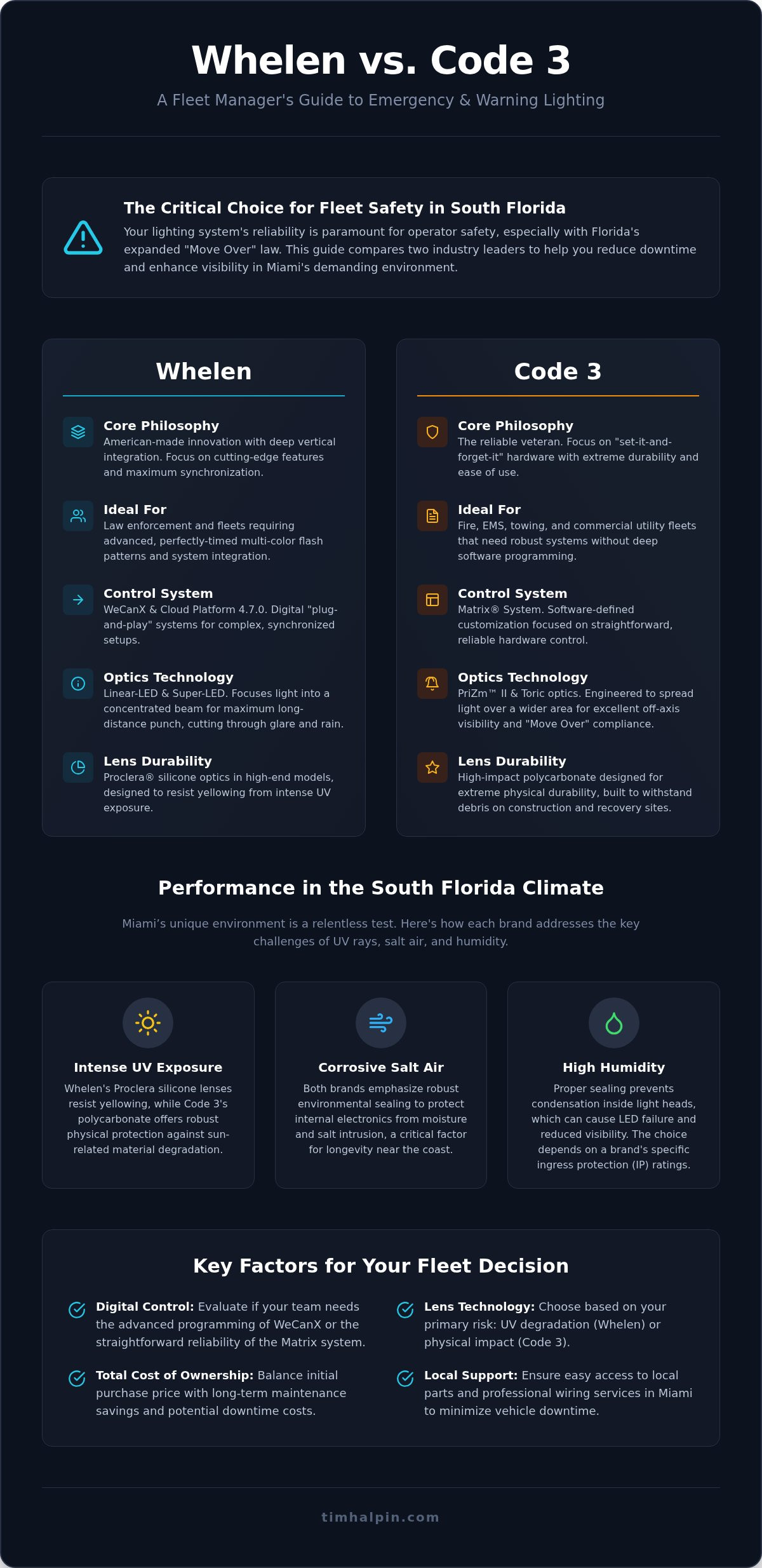
Choosing between Whelen vs Code 3 lighting is often called the “Ford vs. Chevy” debate of the public safety world. Both companies have spent decades perfecting the technology that keeps our first responders and commercial operators visible. For a fleet manager in Miami, this choice isn’t about flashy brochures. It’s about which system will stand up to the relentless humidity and intense UV rays of South Florida. For a foundational look at the history and standards of these systems, this Emergency vehicle lighting overview provides excellent context on how lighting designations work across different sectors.
Your choice between these giants will dictate your fleet’s maintenance rhythm for years. We see it every day at our facility; a well-chosen system reduces downtime, while a mismatched one leads to constant wiring headaches. Brand choice impacts everything from your initial upfitting timeline to how easily you can source a replacement lens when a pebble chips a lighthead on I-95.
The Heritage of Whelen Engineering
Whelen has built its name on a foundation of American-made innovation. They’re unique because of their vertical integration. They design and manufacture almost every component in-house, from the LED optics to the complex control software. This level of control results in high-end innovation that many South Florida law enforcement agencies rely on for daily operations. Their systems are often the choice for fleets that require maximum synchronization and cutting-edge features. When you see a patrol car with perfectly timed, multi-color flash patterns, you’re likely looking at the result of Whelen’s proprietary technology.
The Reliability of Code 3
Code 3 is the reliable veteran of the industry. While they’ve kept pace with modern tech, their core philosophy centers on “set-it-and-forget-it” hardware. This approach has made them a favorite for fire, EMS, and towing sectors. Their designs are often more straightforward, which translates to extreme durability and ease of use. For smaller commercial fleets or utility operators who want a robust system without the need for deep software programming, Code 3 is a fantastic option. It’s about getting the job done with hardware that’s built to take a beating on a construction site or a recovery scene.
In our experience serving the Miami community since 1987, we’ve found that both brands have their place. The “best” brand is usually the one that matches your existing fleet’s wiring standards and your team’s technical comfort level. We take pride in being a neutral guide, helping you weigh these heritage brands against the practical realities of your daily operations.
Optics and Durability: Performance in the South Florida Climate
Miami’s environment is a relentless testing ground for fleet equipment. Between the tropical sun and the salt air blowing off the coast, your lighting system faces constant chemical and thermal stress. When comparing Whelen vs Code 3 lighting, we look past the initial brightness. We focus on how these units hold up after three years of South Florida humidity. A lightbar that looks great in a showroom might fail when the Florida rains hit if the seals aren’t up to the task.
Effective off-axis visibility is essential for navigating congested intersections like those in Downtown Miami or Doral. If a motorist can’t see your warning lights from a 45-degree angle, your safety is at risk. Both brands engineer their optics to meet or exceed SAE International standards, but they achieve this through different lens geometries. Whelen utilizes their Proclera silicone technology in high-end models to resist yellowing. Code 3 relies on high-impact polycarbonate designed for extreme physical durability.
Light Output and Warning Patterns
Whelen’s Linear-LED and Super-LED technologies are designed for maximum punch. Their optics focus light into a concentrated beam that cuts through heavy rain and glare. Code 3 takes a different approach with their PriZm II and Toric optics. These are specifically engineered to spread light over a wider area, providing excellent “Move Over” law compliance. This ensures you are visible from a distance even on curved highway on-ramps. Both brands offer the intensity needed to stay safe, but the choice often depends on whether you prioritize long-distance warning or wide-angle coverage.
Environmental Sealing and Longevity
Humidity is the silent killer of LED electronics. If a gasket fails, moisture enters the housing, causing the LEDs to flicker or dim. Code 3 uses robust gasket designs that we’ve found to be incredibly resilient in our local salt-heavy environment. Whelen’s hard-coated lenses are equally impressive. They resist the “clouding” effect that often plagues cheaper alternatives left in the sun. Repairability is another major factor for Miami fleet managers. If a module fails, most modern Whelen and Code 3 systems allow for individual module replacement. This modularity is a lifesaver for keeping maintenance costs low. If you’re currently dealing with a foggy lens or a dimming bar, our team at Tim Halpin Equipment Corp can help you determine if a simple repair or a full upgrade is the most cost-effective path.
Control Systems: WeCanX vs. Code 3 Matrix
The days of running thick bundles of individual wires for every single flash pattern are over. In 2026, the real battle in Whelen vs Code 3 lighting is fought in the software and the control modules. Modern upfitting has shifted toward digital “plug-and-play” systems that use a single data cable to communicate with every lighthead on the vehicle. This change doesn’t just make the installation cleaner; it fundamentally changes how your fleet operates on the streets of Miami. By moving to digital controls, we can program automated responses that take the guesswork out of operator safety.
Your choice of control system directly impacts your upfitting timeline and long-term maintenance costs. A digital network allows for faster diagnostics and easier expansion. If you need to add more perimeter lighting a year from now, you won’t need to pull new wires through the entire chassis. You simply tap into the existing data network, saving hours of labor and reducing the risk of electrical faults.
Whelen WeCanX and V2V Sync
Whelen’s CenCom Core system, powered by the WeCanX ecosystem, represents the high-water mark for customization. WeCanX is a high-speed communication protocol designed to manage complex lighting and siren functions across a vehicle’s digital network. With the release of the Whelen Cloud Platform version 4.7.0 in July 2026, fleet managers can manage configurations with unprecedented precision. One of the most significant safety features is Vehicle-to-Vehicle (V2V) synchronization. This allows multiple vehicles at a scene to synchronize their flash patterns, creating a unified warning wall that is less confusing for motorists. Additionally, Dynamic Variable Intensity (DVI) automatically adjusts the brightness of the LEDs based on ambient light, which helps reduce night-blindness for both the operator and the public.
Code 3 Matrix and Z3 Siren Integration
While Whelen offers deep customization, Code 3 focuses on making that power accessible through the Matrix system. Their Matrix Configurator Software uses a drag-and-drop interface that significantly reduces the time spent in the programming bay. This system integrates directly with the vehicle’s OBD-II data to trigger automated responses. For example, you can program the lights to automatically switch to a specific “park” pattern the moment the transmission hits park, or activate scene lights when a side door opens. For tow fleets and utility operators in South Florida, this simplicity is a major advantage. It often leads to lower diagnostic downtime because the system is easier for a technician to troubleshoot without needing specialized programming expertise.
We’ve seen that the best system is the one your team can manage effectively. While the initial hardware for these digital systems might carry a premium, the reduction in installation hours often balances the total upfitting cost. This flexibility makes the 2026 generation of public safety lighting a smart investment for any growing Miami fleet looking to maximize safety and minimize vehicle downtime.
Application Guide: Which Brand Fits Your Vehicle?
We always tell our neighbors that the initial purchase price is only half the story. Total cost of ownership includes how quickly you can get back on the road after a fender bender. Because we maintain a huge local inventory here in Miami, we can often get a replacement module for a Whelen or Code 3 bar into your hands the same day. Buying a “bargain” brand online often means waiting weeks for parts while your truck sits idle. Reliability in the South Florida sun is a non-negotiable requirement for your bottom line.
Best for Towing and Recovery
Towing and recovery work puts unique demands on lighting. Wreckers need 360-degree warning power and intense rear-facing work lights to illuminate a scene safely. We’ve found specific models from both brands perform exceptionally well in this sector:
- Code 3 21TR and 27 Series: These have long been staples for wreckers because of their rugged construction and straightforward controls.
- Whelen Justice and Century Elite: These are preferred for heavy-duty towing due to their incredible light punch and longevity.
If you’re looking for more ways to keep your recovery fleet in top shape, check out our Tow Truck Parts in Florida guide for maintenance tips and local insights.
Best for Public Safety and Law Enforcement
Law enforcement agencies usually prioritize aerodynamics and maximum light intensity for high-speed response. These fleets require systems that can be programmed for complex multi-color patterns and high-intensity “take-down” lighting. Our top recommendations include:
- Whelen Liberty II and Legacy: These models are the gold standard for police fleets, offering a slim profile that doesn’t sacrifice visibility.
- Code 3 Pursuit and Defender: These are excellent municipal choices, known for their easy-to-clean housings and reliable electronics.
For a deeper look at protecting your officers and maximizing your visibility on the road, see our specialized page on Public Safety Lighting in Miami. If you’re ready to see these systems in person, contact our Miami upfitting team today to discuss a custom build for your fleet.
Professional Upfitting and Lighting Support in Miami
While deciding between Whelen vs Code 3 lighting is a major step, the installation process is where that investment either pays off or becomes a liability. We’ve seen many fleet managers tempted by DIY advice found on social media. Modern digital systems aren’t a simple weekend project. Improperly wired lights lead to electrical fires, voided warranties, or erratic behavior in your vehicle’s sensitive computer systems. Professional installation ensures your high-performance warning gear performs exactly as intended when every second counts on a busy highway.
Our team understands a lightbar is only as good as the technician who installs it. We focus on creating a reliable electrical foundation that withstands the vibrations of a heavy truck and the environmental stressors of our South Florida environment. By choosing professional support, you aren’t just buying lights. You’re securing the peace of mind that comes with a system built to last.
Custom Upfitting Solutions
At our facility, we treat every lighting project as an integral part of commercial truck upfitting in Miami. It’s about more than bolting a bar to a roof. We evaluate weight distribution and structural integrity to ensure your vehicle stays balanced and safe during high-speed maneuvers. Our technicians prioritize professional grounding techniques to prevent the common radio interference and electrical glitches that often plague poorly installed systems. We want your communication gear and your warning lights to work in perfect harmony.
The Tim Halpin Advantage
Tim Halpin Equipment Corp’s approach to service has supported South Florida’s operators with a neighborly touch since 1987. We know every hour your truck spends in the shop is an hour of lost revenue. That’s why we maintain a massive local inventory of public safety lighting parts. You won’t wait weeks for a shipment from across the country. We likely have the specific module or mounting bracket you need right here in Miami. This local presence is our personal guarantee of service and accountability.
Ongoing maintenance is the final piece of the safety puzzle. The salt air and humidity we face daily require a proactive approach to keep your warning systems bright for years. We’re here to be your long-term partner, offering the expertise and local support you need to keep your fleet visible and your operators protected. If you’re ready to upgrade or need a professional eye on your current setup, Contact Tim Halpin Equipment Corp for a lighting consultation and let us help you build a fleet you can rely on.
Secure Your Fleet with the Right Lighting Choice
Choosing between these industry leaders isn’t just a matter of brand preference. It’s about matching the digital capabilities of WeCanX or Matrix technology to your fleet’s operational reality on the streets of Miami. We’ve explored how our unique climate demands superior optics and how professional installation prevents costly electrical downtime. Whether you prioritize the high-end synchronization of Whelen or the simplified integration of Code 3, the goal remains the same: maximum visibility and safety for your team.
When you weigh Whelen vs Code 3 lighting, remember that local support is the ultimate tie-breaker. Our family-owned shop has been a trusted guide since 1987. We serve as an authorized dealer for both brands, maintaining a massive local inventory to ensure you aren’t waiting weeks for simple replacement parts. This commitment to local availability helps you keep your vehicles in service and your operators protected.
Upgrade Your Fleet with Expert Lighting Solutions at Tim Halpin Equipment Corp. We look forward to helping you build a safer, more efficient fleet that’s ready for any challenge the Florida highways throw your way.
Frequently Asked Questions
Is Whelen lighting more expensive than Code 3?
Whelen often carries a higher initial price tag for their advanced digital ecosystems, while Code 3 is frequently viewed as the more budget-friendly veteran. However, the true value depends on your specific vehicle application. We recommend looking at the total cost of ownership rather than just the sticker price. A system that lasts longer in our humid Miami salt air will always be the more affordable choice in the long run.
Can I use a Whelen controller with a Code 3 lightbar?
You cannot directly connect a modern Whelen controller to a Code 3 digital lightbar because they use proprietary communication languages. While older analog systems could sometimes be cross-wired with significant effort, the 2026 digital platforms like WeCanX and Matrix are not compatible. Attempting to force these systems to work together usually voids your warranty and risks damaging the sensitive electronics in your vehicle’s control network.
Which brand has a better warranty for commercial users?
Both brands typically provide a five-year warranty on their LED components, which is the industry standard for professional-grade gear. Whelen and Code 3 have built their reputations on standing behind their products. Since we are an authorized dealer for both, we handle the warranty process locally in Miami. This means you won’t have to deal with a faceless corporate entity if a module fails prematurely.
What is the best lightbar for a tow truck in Miami?
The Code 3 21TR and the Whelen Justice are the top contenders for tow trucks operating in South Florida. These models provide the 360-degree visibility required for scene safety and are built to handle the constant vibrations of recovery work. When evaluating Whelen vs Code 3 lighting for towing, consider which controller your drivers find more intuitive during high-stress roadside recoveries on the Palmetto Expressway.
How long does a professional lightbar installation take?
A professional lightbar installation typically takes between four and eight hours. This timeline depends on the complexity of your control system and any additional perimeter lighting you require. We take the time to ensure every wire is properly routed and grounded to prevent future electrical issues. Our goal is to get your truck back in service as quickly as possible without cutting corners on safety.
Are LED lightbars repairable if a single bulb goes out?
Yes, modern LED lightbars are designed to be modular so you can replace a single lighthead without buying a new bar. If one module dims or fails, we can simply swap it out for a new one from our local inventory. This modular design is a huge advantage for fleet managers. It keeps your maintenance costs low and ensures your vehicle spends more time on the road and less time in the shop.
Do Whelen and Code 3 lights meet Florida Move Over law requirements?
Yes, both brands offer SAE Class 1 certified lighting that fully complies with the Florida Move Over law requirements. As of January 1, 2025, the law requires drivers to move over for any vehicle with visible emergency signals. We ensure that your flash patterns and light intensity meet these legal standards. Proper compliance is about more than avoiding tickets; it’s about making sure every driver sees you clearly.
What is the difference between Whelen Super-LED and standard LEDs?
Whelen Super-LED technology is a proprietary design that focuses on superior thermal management and light concentration. Unlike standard LEDs that may dim as they heat up, Super-LEDs are engineered to maintain their peak brightness during long shifts in the Florida heat. This technology provides a much higher light output per watt. It ensures your warning signals remain crisp and punchy even after hours of continuous operation at a scene.
