

Imagine you’re navigating a tight delivery window in the heart of Miami, and your liftgate is crawling so slowly that your schedule starts to slip. It’s a common frustration, but it can quickly turn into a safety hazard if that platform begins dropping faster than your crew can react. Masterfully adjusting liftgate speed isn’t just about shaving seconds off a stop; it’s about protecting your team and your equipment from unnecessary wear. Whether you’re operating a Maxon GPT-4 or a Tommy Gate G2, your equipment relies on precise hydraulic flow to stay within safe OEM specifications.
We understand that your truck is your livelihood, and downtime on the road is never an option. You deserve a gate that operates with the same reliability and precision you bring to your business every day. In this guide, we’ll walk you through the essential steps to diagnose speed issues and manage hydraulic adjustments safely. You’ll learn to distinguish between a simple mechanical adjustment and a sign of impending failure, helping you find the right local parts and repair solutions to keep your fleet at peak productivity.
Key Takeaways
- Balance delivery efficiency with operator safety by understanding the OEM speed standards for your specific liftgate model.
- Learn how the flow control valve manages platform descent and why adjusting liftgate speed requires a deep understanding of hydraulic mechanics.
- Identify common electrical culprits, like low battery voltage or poor grounding, that cause frustrating “slow up” cycles during your routes.
- Discover the specific mechanical nuances and valve locations for major brands like Waltco, Maxon, and Tommy Gate to avoid damaging sensitive components.
- Recognize when a speed issue signals a mechanical failure that requires professional hydraulic repair and genuine OEM parts to ensure long-term fleet safety.
Understanding Commercial Liftgate Speed: Safety vs. Productivity
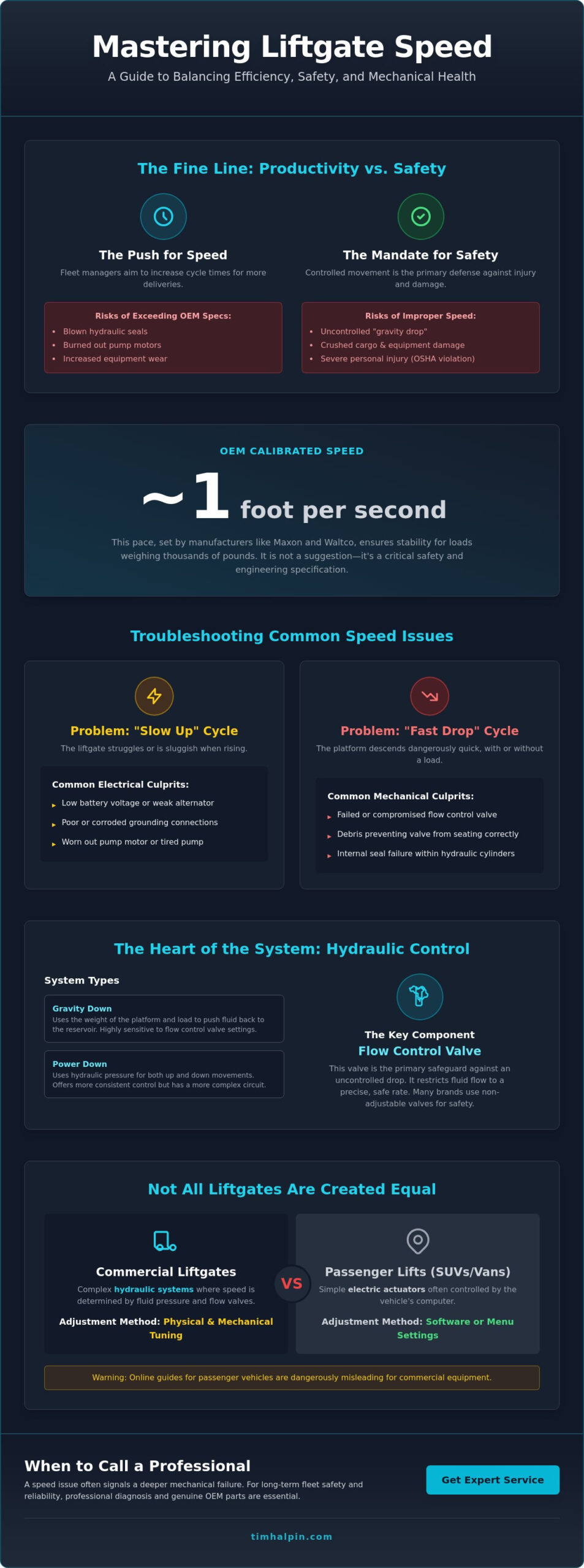
A standard commercial tail lift is designed with a specific rhythm in mind. For most heavy-duty units, a “normal” operating speed is roughly one foot per second. This pace is carefully calibrated by manufacturers like Waltco and Maxon to ensure the platform remains stable while carrying thousands of pounds. While it might feel slow during a busy shift in Miami, this controlled movement is your primary defense against equipment failure and workplace injury.
The tension between productivity and safety is real. Fleet managers often feel the urge to increase cycle times to squeeze in more deliveries. However, adjusting liftgate speed beyond the original equipment manufacturer (OEM) specifications is dangerous. When you force a hydraulic system to work faster than its design, you risk blowing seals or burning out the pump motor. It’s vital to recognize if a gate is performing poorly because of a settings issue or if it’s signaling a deeper mechanical failure. A slow ascent often points to electrical trouble or a tired pump, while a “fast drop” usually indicates a compromised valve.
The Safety Risks of Improper Liftgate Speed
The most immediate danger of a fast-moving gate is the “gravity drop.” If a platform descends too quickly, the operator has no time to react if a load shifts or a foot gets caught. This lack of control leads to crushed cargo and severe personal injury. Conversely, a gate that moves at a snail’s pace creates its own set of risks. Frustrated drivers often resort to dangerous “workarounds,” such as jumping off a moving platform or bypassing safety rails to save time. OSHA enforces safety under the General Duty Clause, which means keeping your liftgate at a steady, predictable speed isn’t just a preference; it’s a legal obligation to provide a safe workplace.
Commercial vs. Passenger Liftgates: Why the SERP is Misleading
If you search online for information about speeding up a liftgate, you’ll often find guides for luxury SUVs and minivans. These consumer vehicles use simple electric actuators that can sometimes be adjusted via a dashboard menu or a key fob. Commercial equipment is entirely different. Heavy-duty trucks use complex hydraulic systems where speed is determined by fluid pressure and flow control valves. You won’t find a software patch to fix a slow Maxon gate. Restoring or adjusting liftgate speed on a commercial vehicle requires a steady hand and mechanical expertise. It involves physically tuning the hydraulic flow, which is why fleet owners rely on professional service rather than a DIY “hack” found on a passenger car forum.
The Mechanics of Speed: Hydraulic Flow Control and Valves
While the electric motor provides the initial muscle, the hydraulic fluid acts as the messenger that dictates exactly how your platform moves. The upward speed of a commercial liftgate is determined by the volume of fluid the pump can displace. If your pump is worn or the motor is receiving insufficient voltage, the ascent will feel sluggish. However, the descent is a different mechanical process altogether. Most gates rely on a flow control valve to regulate how quickly fluid returns to the reservoir. This valve is the primary guardian against an uncontrolled drop, ensuring the platform maintains a steady pace regardless of the weight it carries.
Speed adjustment also depends on whether your truck uses a “Gravity Down” or “Power Down” system. In a gravity down system, the weight of the platform and the load pushes the fluid back through the lines. These systems are highly sensitive to the flow control valve’s setting. Power down systems use hydraulic pressure to move the gate in both directions, offering more consistent control but adding complexity to the hydraulic circuit. Understanding which system you have is the first step in safely adjusting liftgate speed without compromising the internal seals of your cylinders.
The Flow Control Valve: The Heart of Speed Adjustment
The flow control valve is typically located directly on the lift cylinder or within the main manifold block. Its job is to restrict fluid passage to a specific rate. Many manufacturers like Maxon or Waltco use fixed orifice valves for safety. These are non-adjustable components designed to prevent the gate from ever exceeding a safe speed. If you find your gate is dropping too fast, it’s often a sign that this valve has failed or that debris is preventing it from seating correctly. It’s about precision; even a tiny piece of grit can disrupt the entire cycle.
Viscosity and Temperature: The Miami Factor
Our South Florida climate plays a significant role in how your equipment behaves on the road. The extreme heat and humidity we experience in Miami can cause hydraulic fluid to thin out significantly. Thinner fluid flows through valves with less resistance, which can lead to a noticeably faster descent during a long afternoon of deliveries. Maintaining a consistent speed requires using a fluid grade that can handle these tropical temperatures without losing its “body.”
If your gate feels “loose” or moves unpredictably when the temperature spikes, you might need a high-viscosity oil specifically formulated for heavy-duty use in warm climates. You can find more detailed insights on this in our guide regarding Expert Truck Hydraulics in Miami. Keeping your fluid in top condition is the simplest way to ensure your gate remains predictable. If you’re noticing strange fluctuations in performance, a quick hydraulic repair check can save you from a much costlier pump replacement down the road.
Brand-Specific Speed Nuances: Waltco, Maxon, and Tommy Gate
While the physics of hydraulics remains constant, each manufacturer has their own way of managing fluid flow. Waltco, for example, often integrates the flow control directly into the lift cylinder. This design choice protects the delicate valve from road salt and grime, but it makes access a bit more technical. On older Waltco models, you can often find adjustment screws located on the manifold block, though these require a precise touch to avoid over-pressurizing the system. If you’re working on these units in South Florida, having a reliable source for Waltco Liftgate Parts in Miami is essential for keeping your fleet in top shape.
Maxon systems, particularly the heavy-duty GPT-series models like the 72-25, are engineered for high-volume delivery cycles. A healthy Maxon 72-25 typically completes a full lifting cycle in about 15 to 20 seconds. Modern Maxon units may feature “Smart Lift” technology, which helps maintain consistent speeds even as loads vary. However, the mechanical valve settings remain the foundation of the system’s safety. For those operating Tommy Gate units on service bodies or pickups, the cycle times are often shorter due to lower weight capacities. Even so, the need for adjusting liftgate speed remains a priority to prevent the platform from slamming against the ground or the truck frame.
Adjusting Waltco and Maxon Systems
When you’re troubleshooting a Maxon 72-25, it’s helpful to time the cycle with a stopwatch. If the platform takes longer than 25 seconds to reach the bed height, you’re likely looking at a pump efficiency issue rather than a simple valve adjustment. For Waltco units, locating the adjustment screws requires looking near the main hydraulic manifold. We always suggest making small, quarter-turn adjustments. This cautious approach prevents the hydraulic system from experiencing sudden shocks that can damage the internal components of the pump unit.
The Dangers of Aftermarket “Speed Kits”
We often see fleet owners tempted by aftermarket “speed kits” or universal flow controllers. While these might promise a faster route, they often lack the specific orifice sizing required for your gate’s lifting capacity. Using a non-OEM valve on an Anthony, Thieman, or Palfinger gate can lead to dangerous pressure spikes. These spikes don’t just affect speed; they can cause catastrophic seal blowouts or even structural cracks in the lift arms. When it comes to adjusting liftgate speed, sticking with genuine OEM parts is the only way to ensure your equipment remains as reliable as the day it was installed. It’s about more than just speed; it’s about the integrity of your entire hydraulic circuit.
Troubleshooting Common Liftgate Speed Issues
Identifying the root cause of a speed variance is often a process of elimination. When you are adjusting liftgate speed, you must first determine if the issue is a simple setting or a symptom of a deeper mechanical struggle. A “Slow Up” problem is usually the result of a thirsty motor. Low battery voltage or a corroded ground wire can drop the motor’s RPM, making the ascent feel like a struggle. In our humid South Florida climate, even a small amount of terminal corrosion can disrupt the electrical flow enough to cripple your productivity. Listen for a high-pitched whining; that’s often the sound of cavitation or a pump nearing the end of its life.
The “Fast Down” issue is significantly more alarming for fleet safety. If the platform drops too quickly, the flow control valve is likely stuck open or damaged by debris in the hydraulic fluid. Internal cylinder leaks can also cause this problem by allowing fluid to bypass the piston seals. This effectively removes the hydraulic cushion that controls the descent. If your gate feels jerky or inconsistent, it’s often a sign of air trapped in the lines or contaminated fluid that has lost its ability to maintain steady pressure.
Step-by-Step Diagnostic for Fleet Managers
Start with the basics. Check the reservoir fluid level while the gate is in the lowered position. If the fluid is low, the pump will draw in air, leading to erratic movement and potential pump damage. Next, test the battery and charging system under load. In our Miami heat, batteries often fail prematurely, and a weak charge will always result in a sluggish motor. Finally, inspect the ground connection to the truck frame. A clean, tight connection is vital for maintaining the high amperage these motors require to lift heavy loads at a standard pace.
Bleeding the Hydraulic System
Air pockets are the enemy of precision. They make the platform feel spongy and unpredictable, which can be dangerous when loading heavy equipment. To bleed a dual-cylinder liftgate system, you generally need to cycle the gate fully several times through its entire range of motion. Some heavy-duty models have specific bleeder valves located at the top of the lift cylinders. Safety is paramount during this process. Never crack a hydraulic line or bleeder valve while the platform is raised or under load. The sudden loss of pressure can cause the gate to drop instantly, leading to catastrophic injury. If these diagnostic steps don’t restore your equipment’s performance, it’s time to seek professional Liftgate Repair to ensure your fleet stays safe and compliant.
Professional Liftgate Service and Parts in Miami
Tim Halpin Equipment Corp has been a cornerstone of the South Florida trucking industry since 1987. Our family-owned business was built on the idea that local fleets deserve a higher standard of service and a partner who truly understands the demands of the road. When you find yourself adjusting liftgate speed to compensate for a sluggish motor or a fast-dropping platform, you’re dealing with more than just a minor inconvenience; you’re managing a potential liability. Our technicians don’t just swap parts. We diagnose the entire hydraulic circuit to find the most efficient and cost-effective solution for your specific vehicle, ensuring every repair is built to last.
Our reputation is founded on long-term relationships rather than quick transactions. We take immense pride in our local heritage and our ability to support the logistics infrastructure that keeps our Miami community thriving. To understand the values and the dedication that drive our work every day, we invite you to explore Tim Halpin: The Legacy Behind South Florida’s Truck Equipment Experts. It’s this commitment to excellence that has made us the steady, knowledgeable guide for fleet managers across the region.
The Largest Liftgate Parts Inventory in the Country
Our Miami facility is home to what we consider one of the largest liftgate parts inventories in the nation. We stock genuine OEM parts for Maxon, Waltco, Tommy Gate, and Palfinger, along with many others. This massive on-site selection means your truck spends less time in the bay and more time making deliveries. We also act as a vital export link, shipping high-quality components to fleets globally. Having immediate access to the right flow control valves and pump units is why so many local businesses trust us as their primary equipment partner. We’ve got the parts you need on the shelf right now, ready to get your equipment back to peak performance.
Schedule Your Liftgate Inspection Today
Catching a speed issue early can be the difference between a simple valve adjustment and a total hydraulic failure. Our preventive maintenance programs are designed to keep your equipment within strict OEM operating standards. We offer expert hydraulic testing and precision adjusting liftgate speed services to ensure your platform moves with the stability your operators expect. Whether you’re running a single delivery van or a massive commercial fleet, our Miami facility is equipped to handle your installation, upfitting, and repair needs with a level of care you won’t find at a faceless corporate chain. Visit us today and let our family help you maintain a safer, more productive fleet.
Ensuring Long-Term Performance for Your Commercial Fleet
Maintaining a safe and efficient delivery schedule in South Florida requires equipment that performs exactly as expected. We have explored how adjusting liftgate speed is a delicate balance between hydraulic flow and mechanical integrity. A platform that drops too fast or rises too slowly isn’t just a nuisance; it’s a sign that your system needs professional attention. By prioritizing OEM parts and understanding the specific nuances of your Waltco or Maxon unit, you protect your investment and your operators.
Since 1987, Tim Halpin Equipment Corp has served as a trusted partner for local fleets. As an authorized dealer for Tommy Gate, Maxon, and Waltco, we maintain one of the largest liftgate parts inventories in the USA. Our team is here to provide the expert diagnostics and repair services you need to stay on the road. We invite you to Get Expert Liftgate Repair & Parts in Miami and experience the reliability of a family-owned legacy. Your business keeps our community moving, and we’re proud to help you lead the way with confidence and safety.
Frequently Asked Questions
Can I adjust the speed of my liftgate by changing the hydraulic fluid?
Yes, the viscosity of your hydraulic fluid directly impacts how fast the platform moves. In our tropical Miami climate, heat can thin out standard oils, leading to a faster and sometimes unpredictable descent. Switching to a high-viscosity or multi-grade hydraulic oil can help stabilize the flow and provide more consistent movement during those long, humid afternoons on the road.
Why is my liftgate moving slower in the morning than in the afternoon?
This is almost always due to temperature fluctuations affecting fluid thickness. When your truck has been sitting overnight, the hydraulic fluid is cooler and more viscous, which creates more resistance for the pump. As the day warms up and the system works through several cycles, the fluid thins out and flows more easily, which naturally increases the operating speed of the gate.
Is there a specific screw to turn to make my Waltco liftgate go faster?
Most modern Waltco units use fixed orifice valves that are designed to maintain a specific, safe speed. While some older manifolds have adjustment screws, adjusting liftgate speed to exceed OEM specifications is a major safety risk. If your gate feels too slow, it’s usually a sign of a clogged filter, low voltage, or a failing pump rather than a setting that needs to be turned up.
What happens if my liftgate drops too fast while loaded?
A fast-dropping platform is a serious safety hazard known as a gravity drop. This usually indicates that the flow control valve is stuck open or that the internal seals in your lift cylinders have perished. If this happens, you should stop using the gate immediately and have a professional technician inspect the hydraulic circuit to prevent a catastrophic equipment failure or personal injury.
How often should I bleed the air out of my liftgate hydraulics?
You only need to bleed the system if it has been opened for a repair or if you notice the platform moving in a jerky, spongy manner. Air pockets are compressible, unlike hydraulic fluid, which leads to unpredictable and bouncy movement. It isn’t a routine maintenance task, but it’s a vital step whenever you replace a hose, cylinder, or pump unit.
Do I need to replace the whole pump if the speed is inconsistent?
Not necessarily, as inconsistent speed is often caused by simple electrical or fluid issues. Before investing in a new pump, we recommend checking your battery voltage and cleaning your ground connections. Adjusting liftgate speed often starts with ensuring the motor is getting the full amperage it needs to operate; a weak electrical draw will make even a brand-new pump feel sluggish and unreliable.
Can cold weather in other states affect the speed of the parts I buy from Miami?
Yes, temperature always dictates hydraulic performance. Since we export parts from our Miami facility to fleets across the country, it’s important to remember that a valve calibrated for South Florida may behave differently in a Northern winter. Thicker fluid in freezing temperatures will slow down the cycle time, so drivers in colder climates should use a low-viscosity “winter grade” fluid to maintain efficiency.
What is the standard cycle time for a commercial 2,500 lb liftgate?
The industry standard for most medium-duty commercial gates is approximately one foot per second of travel. For a standard truck bed height, a full cycle from the ground to the bed should take between 15 and 25 seconds. If your unit is taking significantly longer than 30 seconds to rise, you’re likely losing productivity and putting unnecessary strain on your electrical system.
