

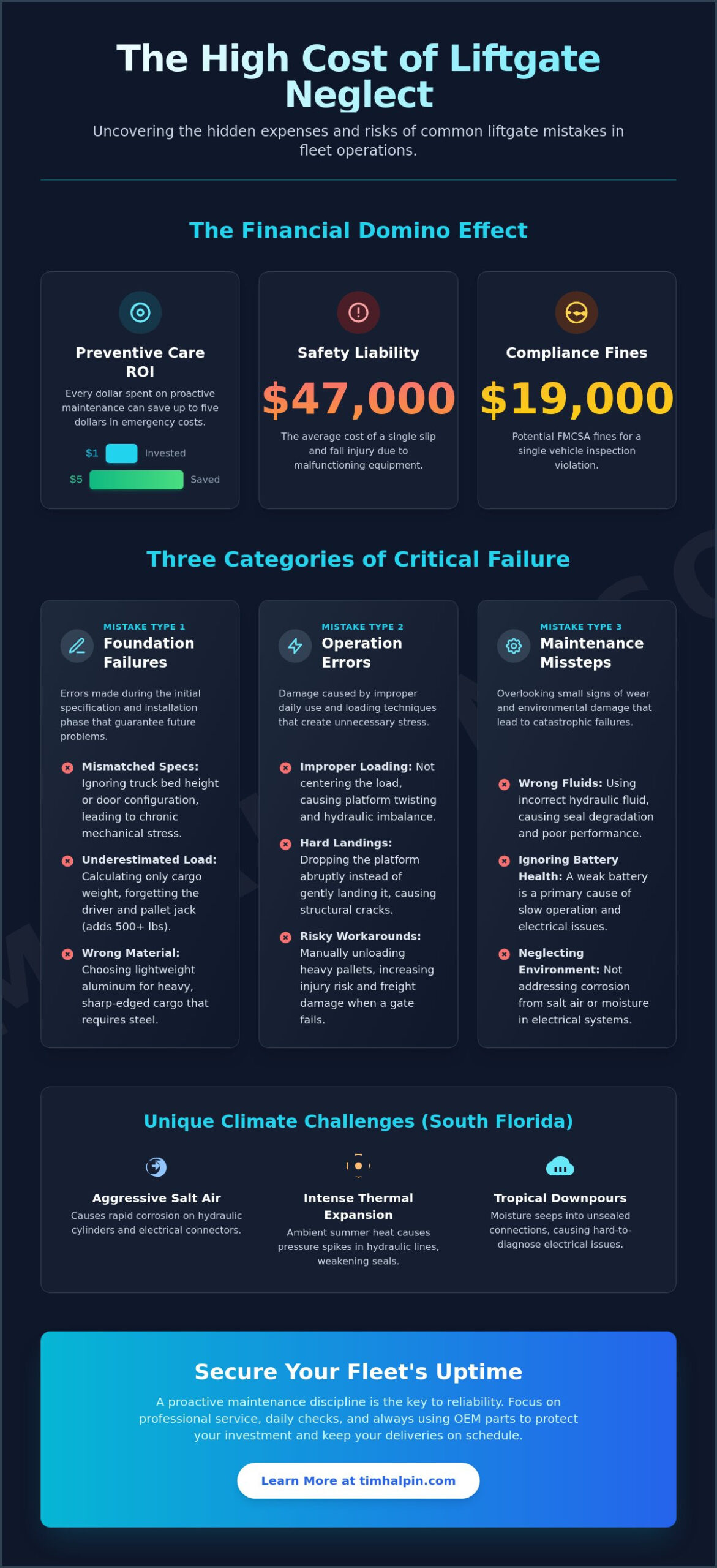
Did you know that for every dollar you spend on preventive care, you could save up to five dollars in emergency repairs and lost productivity? It’s a staggering figure, yet many fleets still find themselves reactive rather than proactive. When you focus on avoiding common liftgate mistakes, you aren’t just fixing machinery. You’re protecting your drivers from slip and fall injuries that average $47,000 per incident and shielding your business from FMCSA fines that can now reach $19,000 for inspection violations.
We understand the stress that comes with unexpected vehicle downtime. It’s frustrating to watch a delivery cycle stall because of a preventable hydraulic failure or a simple operational error. This guide provides the expertise you need to identify frequent pitfalls in equipment selection and daily use. We’ll walk through the essential steps to reduce repair costs, extend the lifespan of your Maxon, Waltco, or Tommy Gate systems, and ensure your team stays safe and efficient every single day. It’s about more than just maintenance; it’s about keeping our local commerce moving with confidence and the reliability your business deserves.
Key Takeaways
- Understand how precise specification, including bed height and total load calculations, prevents premature equipment failure.
- Learn the proper loading and landing techniques that stop structural cracks and hydraulic stress before they start.
- Protect your investment by avoiding common liftgate mistakes like using the wrong hydraulic fluid or overlooking battery health.
- See why using OEM parts for brands like Maxon and Waltco is essential for protecting your warranties and ensuring long-term reliability.
- Uncover the true “domino effect” of liftgate downtime and how a proactive maintenance discipline secures your delivery schedule.
The High Cost of Liftgate Downtime in South Florida
In our local logistics community, a liftgate isn’t just a mechanical addition to a truck. It’s the essential link between your cargo and its destination. When a gate fails on a busy Tuesday morning in Miami, the consequences ripple through your entire operation like a stone thrown into a pond. This “domino effect” starts with a single delayed delivery and quickly escalates into missed windows, frustrated customers, and a driver who’s essentially sidelined while the clock keeps ticking. Understanding and avoiding common liftgate mistakes is the only way to protect your schedule from these expensive, preventable disruptions.
The financial impact goes far beyond the immediate repair bill. You have to account for driver idle time, which is a pure loss of labor capital. Then there are the emergency service fees that always seem to arrive at the most inconvenient moments. Perhaps most dangerously, a malfunctioning gate creates a significant safety liability. As we mentioned earlier, the average cost of a slip and fall injury is roughly $47,000. When a platform doesn’t level correctly or stutters during operation, you’re risking a worker’s compensation claim that could’ve been prevented with better oversight of your Tail lift technology and daily maintenance habits.
The Impact on Fleet Efficiency and Reputation
Reputation is everything in South Florida’s competitive market. If a single stuck gate derails a 20-stop route, you aren’t just losing time; you’re losing the trust of 20 different businesses. We often see fleet managers try “work-arounds,” like asking drivers to manually unload heavy pallets. This is a high-risk gamble. Manual unloading significantly increases the chance of back injuries and damaged freight. During our peak seasons, when every vehicle needs to be at 100% capacity, even a few hours of downtime can mean the difference between a profitable month and a logistical nightmare. Avoiding common liftgate mistakes in your daily checks ensures your team stays on the road and out of the repair shop.
Environmental Stressors in the Miami Area
Our unique climate plays a massive role in equipment longevity. The salt air in our coastal districts is incredibly aggressive, causing rapid corrosion on hydraulic cylinders and sensitive electrical connectors. We also deal with intense thermal expansion. During a typical Florida summer, hydraulic lines can experience internal pressure spikes just from the ambient heat. This stress weakens seals and leads to those “mystery” leaks that eventually cause a total system failure. Additionally, our frequent tropical downpours can wreak havoc on electrical ground connections. Moisture seeps into unsealed housings, leading to intermittent power issues that are notoriously difficult to diagnose. Recognizing these local environmental threats is the first step toward a more resilient fleet.
Foundation Failures: Common Mistakes When Spec’ing a New Liftgate
Maximum uptime doesn’t start in the repair bay; it starts on the spec sheet. We’ve seen many fleet managers treat a liftgate as a generic add-on, but choosing the wrong model for your truck’s specific geometry is a recipe for chronic mechanical stress. If you want to succeed in avoiding common liftgate mistakes, you have to look at the “foundation” of your equipment. A gate that isn’t perfectly matched to your bed height or door configuration will eventually fail, regardless of how often you grease the fittings. It’s a conversation about physics as much as it is about logistics.
One of the most frequent errors is ignoring the rear door configuration. A tuckaway gate might seem like the versatile choice, but if your truck uses specific swing-door hardware that interferes with the arms, you’re looking at a costly retrofit. Similarly, mismatching the platform material to your cargo can lead to premature wear. While aluminum is lighter and resists the Miami salt air, heavy steel drums or sharp-edged machinery might require the ruggedness of a steel platform. Getting these details right during the installation services phase saves you from years of “work-around” headaches.
Calculating the Real Weight Capacity
Underestimating the “Total Load” is perhaps the most dangerous spec’ing error we encounter. You can’t just look at the weight of your heaviest pallet. You must factor in the driver and the equipment used to move the cargo. For instance, an electric pallet jack can weigh up to 500 lbs on its own. When you add a 2,000 lb pallet and a 250 lb driver, a 2,500 lb capacity gate is already operating at its absolute limit. Operating at peak capacity every day accelerates hydraulic seal wear and structural fatigue. Dynamic load refers to the increased force of the weight while the platform is in motion, whereas static load is the weight at rest. Ignoring this distinction often leads to the types of accidents detailed in OSHA liftgate safety standards, where equipment failure results in serious injury.
Clearance and Configuration Pitfalls
Precision matters when measuring bed height. We often see the “hovering gate” problem, where a gate is spec’d for a truck’s empty bed height, but sits too low once the suspension settles under a full load. This prevents the platform from reaching the ground properly, forcing the driver to “drop” the load the last few inches. Over time, this impact causes structural cracks. You also need to consider tuckaway clearance. A gate that fits perfectly when the truck is empty might scrape the pavement when the vehicle is fully loaded and hits a dip in the road. Taking the time to measure your fleet while fully loaded is a simple but effective strategy for avoiding common liftgate mistakes that lead to emergency repairs.
Operation Errors: Why Your Loading Techniques Are Damaging Your Equipment
We’ve seen it time and again across South Florida’s delivery routes. A driver is in a rush, the humidity is climbing, and a heavy pallet gets pushed onto the platform without being centered. While it might seem like a minor oversight, this is a primary driver of mechanical failure. When you’re focused on avoiding common liftgate mistakes, you have to prioritize how your team interacts with the equipment every single day. A liftgate is a precision instrument, not just a slab of metal. Proper operation is the difference between a seamless delivery and a broken system that leaves your cargo stranded.
One of the most destructive habits is off-center loading. Most modern heavy-duty gates use dual-cylinder systems designed to work in perfect synchronization. When a pallet is placed even six inches off-center, the hydraulic pressure becomes uneven. This forces one arm to bear a disproportionate load, which eventually twists the lift arms and blows out the high-pressure seals. We often see these “twisted” gates in our shop, and the repair is far more involved than a simple fluid change. It’s a structural issue that could’ve been avoided with ten seconds of driver attention.
Then there’s the “slam” factor. Drivers often let the platform drop to the pavement with full force. This repeated impact sends shockwaves through the entire assembly, leading to structural cracks in the frame and hinge points. Similarly, failing to use built-in retention systems or cart stops allows the load to shift during the lift. A shifting 2,000-pound pallet can create a sudden “dynamic shock” that snaps chains or bends cylinders instantly. We believe that training your drivers to land the gate softly and secure every load is the most cost-effective maintenance strategy you can implement.
Hydraulic motors also have a specific “cycle time” that shouldn’t be ignored. In our local heat, these motors reach critical temperatures much faster than they would in cooler climates. If a driver runs the gate continuously for a complex 30-minute unloading process without a break, the motor can overheat and seize. Avoiding common liftgate mistakes like these requires a shift in culture, where drivers understand the limits of their tools.
Proper Weight Distribution on the Platform
The “center of gravity” rule is your best defense against equipment fatigue. Drivers should always place the heaviest part of the load as close to the truck’s rear as possible, centered between the lift arms. We teach our clients’ drivers to listen to the machine. A struggling motor has a distinct, high-pitched groan that indicates the system is being pushed too hard. If they hear that sound, it’s time to stop, re-center the load, or break the pallet down into smaller segments before proceeding.
Daily Pre-Trip Inspections for Drivers
We recommend a five-minute daily check to catch small issues before they become route-ending failures. This isn’t just about efficiency; it’s about following OSHA safety regulations that require equipment to be in safe working order. Drivers should look for visible hydraulic “weeping” around the cylinders and test the control pendant for any frayed wires. Ensuring the platform lock is fully engaged before they pull out of the yard prevents the gate from bouncing during transit, which is a major cause of hinge wear and accidental deployment on the highway.
Maintenance Missteps: Overlooking the Small Signs of Hydraulic Failure
Maintenance is often viewed as a chore, but we see it as an investment in your fleet’s future. The most expensive repairs we handle usually start as small, ignored signs that something was off. When you’re avoiding common liftgate mistakes, you have to look closer at the components that seem “fine” until they aren’t. Rust on a pivot point or a slow-moving platform might not stop a route today, but it’s a countdown to a failure that will. We’ve seen many cases where a simple five-minute check could’ve saved a company thousands in emergency towing and lost cargo.
One of the biggest mistakes is attempting DIY repairs with generic, non-OEM parts. While a discount valve might look identical to a Maxon or Waltco component, the internal tolerances are often different. Using non-spec parts can void your warranty and lead to premature failure of the entire hydraulic block. We’ve seen “saved” money disappear instantly when a generic seal fails and ruins a day’s worth of deliveries. Sticking to genuine parts ensures that the pressure ratings and flow rates remain exactly where the manufacturer intended.
The Critical Role of the Electrical System
It might surprise you, but the number one cause of gate failure isn’t the hydraulics at all; it’s the electrical system. A weak truck battery forces the liftgate motor to draw more amperage to compensate for the low voltage. This extra heat cooks the motor’s internal windings, leading to a total burn-out. We recommend cleaning the ground strap regularly, as South Florida’s humidity creates a layer of corrosion that acts as an insulator, starving your gate of power. If you notice your gate clicking or moving slower than usual, it’s likely a failing solenoid or a bad connection rather than a pump issue.
Hydraulic System Hygiene
Hydraulic fluid isn’t “just oil.” Mixing different grades or brands can cause a chemical reaction that creates sludge, which then clogs the tiny orifices in your valves. In our region, using the correct viscosity is vital for handling the heat without losing pressure. A “weeping” seal is your early warning system. If you see a small drip, it means the seal has lost its integrity. Ignoring it leads to a major blow-out under load, which is both dangerous and messy. For high-use gates, we recommend a professional truck hydraulics miami service interval of every six months to ensure your fluid is clean and your system is purged of contaminants.
If you’ve noticed your equipment struggling or seen those tell-tale drips, don’t wait for a total breakdown. You can schedule a professional liftgate repair to catch these issues before they take your truck off the road.
Professional Solutions: How Tim Halpin Equipment Corp Minimizes Fleet Risks
We’ve spent decades observing how repetitive mechanical failures can drain a business of its momentum. At Tim Halpin Equipment Corp, we believe that true service goes beyond simply swapping out a broken component; it requires a deep dive into the root cause of the issue. Whether it’s a persistent hydraulic leak or a misaligned platform, our diagnostic approach is centered on avoiding common liftgate mistakes that lead to recurring shop visits. By identifying the underlying patterns in your fleet’s equipment usage, we help you transition from a reactive posture to a strategy of total reliability.
The reality of logistics in South Florida is that every hour spent in the repair bay is an hour of lost revenue. Our technicians are some of the most seasoned in the region, bringing a level of composure and expertise that only comes from years of hands-on experience with diverse fleet configurations. We view ourselves as more than just a repair shop; we’re a neighborly guide dedicated to reducing the friction of your daily operations. This focus on individual accountability ensures that when a truck leaves our facility, it’s ready to handle the rigors of the Miami delivery cycle with absolute confidence.
Sourcing the Right Parts Fast
Speed is a critical factor when a vital route is on the line, and we’ve built our facility to meet that need. We house the largest inventory of liftgate components in the country, including an extensive selection of Waltco liftgate parts miami and Maxon systems. This immediate availability allows us to bypass the shipping delays that often stall other shops. We also maintain a robust stock for Tommy Gate, Anthony, and Palfinger units, making us a primary hub for both local fleets and international partners exporting to the Caribbean and Latin America. Choosing OEM parts through us ensures your manufacturer warranties remain intact while providing the exact specifications your equipment requires.
Partnering for Long-Term Fleet Health
Effective fleet management isn’t a one-time event; it’s a partnership built on trust and consistent performance. We work closely with you to develop maintenance schedules that reflect your actual workload and the unique environmental challenges of our coastal district. The Tim Halpin legacy has been defined by quality and community service since 1987, and we carry that pride into every inspection and repair. If you’re ready to secure your uptime and protect your drivers, contact us today for a professional liftgate inspection or a specific parts inquiry. We look forward to keeping your business moving forward.
Securing Your Fleet’s Future on the Road
Managing a fleet in the high-demand South Florida market requires more than just reactive fixes; it demands a commitment to precision and foresight. By mastering the art of avoiding common liftgate mistakes, you’ve taken the first step toward reducing downtime and protecting your bottom line. Your success depends on three essential pillars: spec’ing the right equipment for the job, training your drivers on proper loading techniques, and never ignoring the small signs of hydraulic or electrical fatigue. These simple shifts in focus transform your liftgates from potential liabilities into reliable assets that keep your delivery cycles moving smoothly.
We’ve been part of this local community since 1987, and our family-owned business is dedicated to keeping your trucks on the road. With the largest inventory of liftgate parts in the United States and a team of experts specialized in South Florida installation and repair, we’re here to be your steady guide. Don’t let a preventable mechanical failure stall your progress. Whether you need a specific OEM component or a comprehensive system inspection, you can Get the Right Liftgate Parts & Service at Tim Halpin Equipment Corp. Let’s work together to ensure your equipment remains as resilient as the businesses it serves.
Frequently Asked Questions
What is the most common cause of liftgate failure?
Electrical system failures, specifically low voltage or poor grounding, are the leading causes of liftgate breakdowns. When the motor doesn’t get enough power, it works harder and generates excessive heat that eventually burns out the internal components. Keeping your batteries charged and connections clean is the simplest way to stay ahead of these issues and ensure reliable operation.
Can I use any hydraulic fluid in my truck’s liftgate?
No, you should only use the specific grade and type of hydraulic fluid recommended by your equipment manufacturer. Mixing different fluids can lead to a chemical reaction that creates sludge, which then clogs sensitive valves. In our South Florida heat, using the wrong viscosity can also result in significant pressure loss when the oil thins out too much during the day.
How often should a commercial liftgate be serviced?
We recommend a full professional service every six months for gates used in high-cycle delivery routes. This interval allows technicians to catch “weeping” seals or frayed cables before they lead to a total system failure. Regular inspections are a cornerstone of avoiding common liftgate mistakes that lead to expensive, unexpected downtime for your fleet.
Is it safe to exceed the liftgate’s weight capacity just once?
Exceeding the weight capacity is never safe and can cause immediate structural damage or hydraulic blow-outs. Even if the gate seems to lift the load, you’re creating micro-cracks in the steel and stressing the cylinders beyond their design limits. This one-time risk often leads to a catastrophic failure later on, even during a standard lift with a lighter load.
Why does my liftgate move slowly in the morning?
Sluggish morning operation is usually a sign of low battery voltage or a failing charging system. If the truck has been sitting overnight, the batteries may not have enough power to run the hydraulic pump at full efficiency. It could also indicate that your hydraulic fluid is contaminated with moisture, which affects the flow and requires a professional system flush.
What should I do if my liftgate gets stuck in the down position?
First, ensure the work area is safe and check for simple electrical fixes like a blown fuse or a loose control pendant connection. If the electrical system appears fine, the issue is likely a mechanical lock or a hydraulic bypass failure. Don’t attempt to force the gate up manually; instead, contact a professional technician to perform a safe, controlled diagnostic and repair.
Does the truck engine need to be running to operate the liftgate?
Yes, you should keep the engine running to ensure the alternator provides a steady stream of power to the batteries. Operating the gate on battery power alone quickly drains the voltage, especially during multi-stop routes. This low-voltage state is a primary cause of motor failure and solenoid damage that we see in our repair shop.
Are OEM liftgate parts really better than aftermarket versions?
OEM parts are superior because they’re engineered to the exact tolerances of your specific Waltco, Maxon, or Tommy Gate system. While aftermarket parts might look similar, they often lack the durability and precise fitment required for heavy-duty use in Miami’s climate. Using genuine components is a vital part of avoiding common liftgate mistakes and protecting your equipment’s long-term warranty.
