
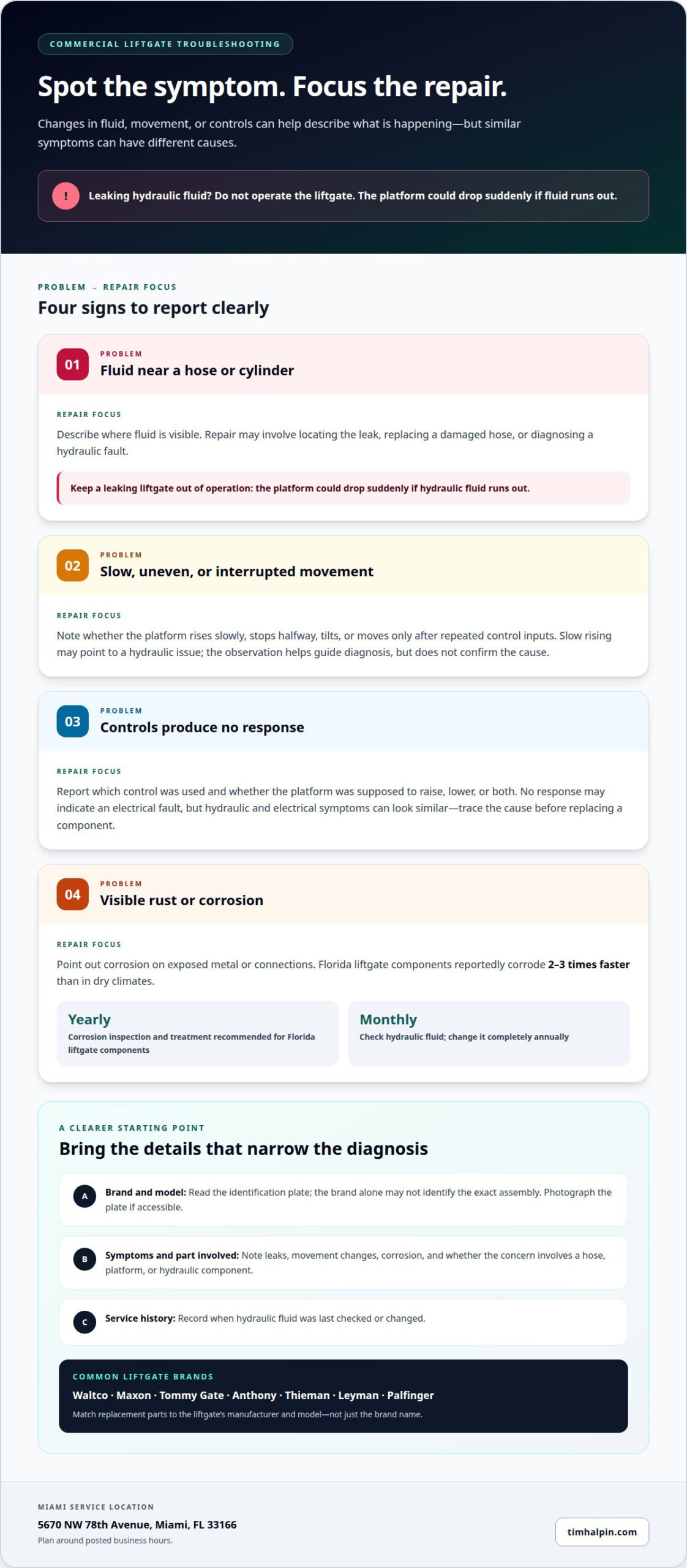
A leaking liftgate should not be operated: the platform could drop suddenly if hydraulic fluid runs out. For commercial truck liftgate repair in Miami, watch for fluid near a hose or cylinder, slow or uneven movement, or a platform that will not raise or lower. Repair may involve locating a leak, replacing a damaged hose, or diagnosing a hydraulic, electrical, or control fault.
A liftgate issue can disrupt deliveries and make loading or unloading difficult, so recognizing the symptoms early matters. This guide explains what common failures can look like, how hydraulic and hose problems are assessed, and what factors shape the repair needed. You’ll also learn what to consider when arranging service in Miami, including where to find local help and business hours. With a clearer picture of the problem, you can describe the symptoms and take a more informed next step.
Key Takeaways
- Identify the liftgate’s brand and model before sourcing replacement parts; matching components can help direct the repair.
- Florida’s humid, coastal conditions can accelerate corrosion, making regular inspection of liftgate components worthwhile.
- Hydraulic and electrical symptoms can look similar, so tracing the cause helps avoid replacing the wrong component.
- Don’t operate a liftgate that’s leaking hydraulic fluid, as the platform could drop suddenly if fluid runs out.
- Find the Miami service location at 5670 NW 78th Avenue, Miami, FL 33166, and review posted business hours when planning a visit.
Liftgate brands and dealers
The liftgate manufacturer helps identify compatible replacement parts. Common brands include Waltco, Maxon, Tommy Gate, Anthony, Thieman, Leyman, and Palfinger. Check the unit’s identification plate before describing the repair: the brand alone may not identify the exact assembly. Record the model information and photograph the plate if accessible. These details give a technician a clearer starting point for diagnosis.
Parts availability and authorized dealer status are different things. A business may supply parts for a brand without being its authorized dealer. First identify what the repair requires, such as a hose, hydraulic component, or platform part. Then match the component to the liftgate’s manufacturer and model. For example, a Waltco unit needs a part suited to its specific configuration, not simply one labeled for a different liftgate brand.
Florida conditions make component condition especially relevant. Liftgate components in Florida reportedly corrode 2-3 times faster than in dry climates. Corrosion can affect exposed metal and connections, so include visible rust in the repair description. A yearly corrosion inspection and treatment is recommended for liftgate components in Florida. Check the hydraulic fluid regularly and replace it when needed. These maintenance steps can help reveal developing issues before a liftgate becomes difficult to operate.
Before arranging commercial truck liftgate repair in Miami, gather a few useful details:
- Brand and model: Read the identification plate and note its information.
- Symptoms: Describe leaks, unusual movement, or parts that appear corroded.
- Part involved: Identify whether the concern involves a hose, platform, or hydraulic component.
- Service history: Note when the hydraulic fluid was last checked or changed.
These steps help distinguish a parts request from a repair diagnosis. Brand-specific parts may address one need, while repair work can require inspection of the complete liftgate assembly. If the exact model is unclear, a clear photo and the truck’s equipment details can help identify the unit. Waltco, Maxon, Tommy Gate, Anthony, Thieman, Leyman, and Palfinger are useful starting points, but model details help narrow the match.
For a Miami-area fleet, keep each truck’s liftgate brand and model with its maintenance records. Add inspection notes about corrosion and fluid checks. If a problem arises, share those records along with the symptoms. Organized information helps focus the discussion on a compatible part or repair, rather than relying on the brand name alone.
Service location and business hours
Florida liftgate maintenance includes attention to hydraulic fluid and corrosion. Check hydraulic fluid monthly and change it completely annually. Annual corrosion inspection and treatment is also recommended for liftgate components in Florida. These intervals provide practical points for scheduling routine checks, whether a truck operates near Miami or elsewhere in the state.
For a Miami service visit, use 5670 NW 78th Avenue, Miami, FL 33166. Plan your arrival around the business’s posted hours, especially if the truck must be driven between a delivery route and the service location. Before setting out, gather the liftgate’s brand, model, and symptoms. A concise description of a leak, uneven movement, or an unresponsive control helps frame the service need.
Mobile liftgate repair can reduce the need to move an affected truck, but availability and service boundaries vary. When arranging service, describe the truck’s location, whether it can be driven, and the liftgate’s condition. Do not operate a leaking liftgate: the platform could drop suddenly if hydraulic fluid runs out. Keep an unsafe unit out of loading operations until the fault is addressed.
South Florida operations face a climate-related maintenance concern: liftgate components in Florida reportedly corrode 2-3 times faster than in dry climates. Include visible corrosion in inspection notes, particularly around exposed metal and connections. Delivery routes across the region can also make convenient access to service important, but a South Florida-wide service area should not be assumed from a Miami address alone. Use the truck’s location and repair needs to determine the practical service plan.
Customer reviews and ratings for liftgate repair shops in Miami can offer perspective on communication and customer experience, but a rating alone does not show whether a shop handles the specific repair. Look for review details relevant to commercial equipment, such as diagnostic clarity and repair follow-through. Warranty terms and service turnaround depend on the repair and the work involved. Discuss applicable terms and scheduling as part of the repair conversation, and consider how parts and diagnosis may affect timing.
In the West Palm Beach area, delivery trucks may cycle liftgates 50-100 times per day, a workload worth noting when planning service.
Common liftgate failure symptoms
A liftgate often signals trouble through changes in movement, sound, or alignment. A slowly rising platform may point to a hydraulic issue, while controls that produce no response may indicate an electrical fault. Observe what happens during a normal operating cycle. For example, note whether the platform stops halfway, tilts, or moves only after repeated control inputs. These details help distinguish a single symptom from a pattern.
Observe the platform through its full travel, without placing anyone beneath it. Look for one side rising before the other, sudden pauses, or visible shaking. A platform that no longer sits evenly may indicate a problem beyond the control switch. Note whether the symptom occurs while raising, lowering, or both. That distinction gives a technician a clearer description than saying only that the liftgate “isn’t working.”
- Slow movement: Record whether raising, lowering, or both actions take longer than usual.
- Uneven travel: Note which edge moves first or whether the platform tilts.
- Unresponsive controls: Describe whether the switch is silent or produces a partial response.
- Visible damage: Photograph bent areas, loose connections, or fluid around components.
Listen for changes in sound during operation. A new click, grinding noise, or strained motor sound can help identify when a fault occurs. Note whether the noise starts with the control input or during platform movement. Do not keep cycling the liftgate to reproduce a sound if its movement becomes erratic. A short video taken from a safe position can show the sequence more clearly than memory alone.
Capacity also matters when diagnosing repeated performance problems. A liftgate rated for 2,500 lb can fail prematurely when carrying 3,500 lbs. Compare the load involved with the unit’s rated capacity, and note whether symptoms began after a particular load. This context can help separate a mechanical fault from a liftgate being asked to handle more than its rating.
Make the service description specific. Include the liftgate brand, the control used, the platform’s direction of travel, and any recent change in performance. For example, “the left side pauses while lowering” is more useful than “the gate is weak.” If the symptom appears only with a particular load or position, include that detail. Clear observations help focus inspection on the relevant controls, hydraulic components, platform, or hinge assembly.
Stop using a liftgate if its movement becomes unpredictable or visible damage affects the platform. Record the symptoms with the truck’s maintenance notes, including when the issue first appeared. This record can show whether a one-time fault has become a recurring pattern and support a more focused repair assessment.
Hose, platform, and hinge repairs
A damaged hydraulic hose can cause fluid loss or inconsistent liftgate movement. Look for wet fittings, cracked outer coverings, rubbing marks, or a hose that shifts during operation. Note where fluid appears, such as near a connection or along the hose route. Do not touch a pressurized hose or tighten a fitting while the system is operating. Keep the truck out of loading service until the leak is assessed.
Hose repair starts by locating the source, not simply wiping away fluid. A technician can inspect the hose, connections, and nearby components to determine whether the hose or a fitting has failed. Replacement requires a compatible hose routed appropriately through the liftgate assembly. If a hose rubs against the frame, it can wear again, so inspection should include nearby contact points and movement throughout the platform’s travel.
Platform damage requires a different assessment. A bent edge, cracked section, or uneven surface can affect how freight sits and how the platform moves. Record where the damage appears and whether its position changes during operation. Also note loose or damaged attachment points. A repair plan depends on the affected area and the platform’s condition, not appearance alone. Photograph the damage from a safe position to show its location.
Hinges connect platform movement to the liftgate structure. Corrosion, binding, or visible looseness around a hinge can interfere with smooth travel. Check for movement that differs between sides, unusual scraping, and metal wear near pivot points. Do not force a stiff hinge through repeated cycles. Inspection should consider the hinge, surrounding attachment points, and platform alignment together, because a symptom in one place may involve connected parts.
- For a hose concern: Record the leak location, nearby fitting, and visible abrasion.
- For platform damage: Photograph bends, cracks, and areas affecting freight contact.
- For a hinge concern: Note binding, scraping, corrosion, or uneven movement.
When arranging repair, share your observations along with the liftgate’s brand and model. A hose leak beside a hinge, for example, differs from a platform that tilts without visible fluid. Clear descriptions help focus inspection on the right assembly. After repair, check normal movement and the repaired area before returning the truck to routine loading work. Keep the observations with the truck’s service record to help identify recurring damage.
Hydraulic and electrical troubleshooting
A liftgate that will not move may have a hydraulic or electrical fault. Note what happens when you press the control: no sound, a motor sound without movement, or partial travel. Each response points toward a different inspection path. A silent control, for example, differs from a motor that runs while the platform stays still. Record the symptom before anyone attempts further operation.
Hydraulic troubleshooting focuses on fluid, hoses, connections, and movement. Look for fluid beneath the unit or around visible fittings. Do not operate a leaking liftgate: the platform could drop suddenly if hydraulic fluid runs out. A technician can trace the leak and assess whether a hose, connection, or another hydraulic component is involved. Avoid touching pressurized components or attempting repairs yourself.
Electrical checks follow a separate path. Note whether the control responds consistently, whether the motor makes a sound, and whether movement stops at the same point. A loose or damaged connection may interrupt the control signal, while a hydraulic problem can prevent movement even when the control responds. These clues help narrow the diagnosis, but do not replace safe system testing.
- No response: Record which control was used and whether anything clicked or moved.
- Motor sound, no lift: Note the sound and platform position when movement stops.
- Intermittent operation: Describe when the control works and when it fails.
- Uneven movement: Identify which side or direction behaves differently.
Keep your observations factual. “The switch is silent” is more useful than “the electrical system is bad.” Likewise, “fluid appears beneath the hose connection” gives a clearer starting point than “the liftgate leaks.” Include the liftgate brand and model, and say whether the issue occurs while raising, lowering, or both. A brief record can keep symptoms clear during diagnosis.
Hydraulic and electrical faults can overlap. A control may respond while a hydraulic issue prevents platform travel. Conversely, intermittent movement may suggest a hydraulic failure even when the signal is interrupted. Careful diagnosis follows the sequence from control input to motor response and platform movement, then connects the symptom to the affected component before repairs begin.
Don’t bypass a switch, open a hydraulic line, or continue cycling a malfunctioning platform. Those actions can create additional damage or expose someone to a moving load. Keep people clear of the liftgate, document its position, and share the symptoms with the repair team. To move toward a focused diagnosis, describe the liftgate’s hydraulic symptoms and the response you observed.
Tim Halpin Equipment Corp: Truck Repair
Tim Halpin Equipment Corp repairs liftgates when a hydraulic leak, damaged platform, or control issue disrupts truck operations. Its hydraulic repair service addresses hydraulic-system concerns, while truck and trailer repair support related equipment needs. Share the liftgate’s brand, model, symptoms, and any visible damage to describe the problem clearly.
For service in Miami, the location is 5670 NW 78th Avenue, Miami, FL 33166. Bring the truck’s maintenance notes and describe whether the platform raises, lowers, or remains unresponsive. These details help connect the observed fault with the repair needed.
For help with a liftgate or hydraulic repair, contact Tim Halpin Equipment Corp.
Keep Your Fleet Ready for the Next Route
A repair is also an opportunity to make future service decisions more deliberate. Keep a brief record of the work completed, the symptoms that prompted it, and any component identified for attention. This can help connect recurring issues with a particular truck or liftgate and make future maintenance discussions clearer. For commercial truck liftgate repair in Miami, focused diagnosis is a practical starting point when equipment problems interrupt daily work.
Tim Halpin Equipment Corp provides liftgate repair, truck repair, and trailer repair for fleets in Miami, Doral, Fort Lauderdale, Key West, Medley, Hialeah, Kendall, and across South Florida. Share what the liftgate is doing, when the issue began, and how it affects operations. Clear details help frame the next step without guesswork.
Contact Tim Halpin Equipment Corp to discuss your repair needs. A clear plan can help you move forward with confidence and keep your operation focused on the work ahead.
Frequently Asked Questions
Is mobile liftgate repair available in Miami-Dade County?
If a truck cannot be moved safely, share its exact location and liftgate symptoms when arranging repair. Tim Halpin Equipment Corp provides liftgate and hydraulic repair in the Miami area. Details such as the truck’s location, liftgate brand, and whether the platform is stuck raised or lowered help explain the situation. Keep a leaking or unstable liftgate out of operation while arranging repair.
What are common commercial truck liftgate problems and repairs?
Common issues include hydraulic leaks, slow or uneven movement, unresponsive controls, and hinge or platform damage. The repair depends on the fault: a technician may trace a leak, assess hydraulic components, or diagnose a control problem. A motor that runs without moving the platform, for example, calls for a different inspection than a silent switch. Describe what happens during operation, not just that the liftgate has failed.
Which truck liftgate brands are serviced in Miami?
Liftgate repair and parts support cover Waltco, Maxon, Tommy Gate, Anthony, Thieman, Leyman, and Palfinger equipment. The brand helps identify compatible parts, but the model and unit details matter too. Read the identification plate and share its information when describing the repair. A clear photo can help distinguish between models, especially when one manufacturer supplies different liftgate configurations.
Is emergency 24-hour liftgate repair available in Miami?
Don’t assume liftgate repair is available around the clock. For a failure outside business hours, keep the unit out of service if it’s leaking or moving unpredictably, and keep people clear of the platform. Tim Halpin Equipment Corp’s business hours are Monday through Friday, 8:00 am to 5:00 pm. Share the truck’s location and symptoms when contacting the company during those hours to discuss repair needs.
How should I choose a commercial liftgate repair shop in Miami?
Start by matching the repair need to the work offered. Tim Halpin Equipment Corp provides liftgate, hydraulic, truck, and trailer repair, as well as parts for brands including Waltco and Maxon. For fleets in Miami, Doral, Fort Lauderdale, Key West, Medley, Hialeah, Kendall, and across South Florida, provide the liftgate model and a clear description of the fault. This helps focus the repair discussion on the equipment involved.
liftgate repair shops in Miami customer reviews and ratings
Customer reviews and ratings can offer perspective on communication and customer experience. Look for details about commercial equipment, diagnostic clarity, and repair follow-through.
commercial truck liftgate repair warranty and service turnaround Miami
Most liftgate repairs described take 1 to 3 hours on-site. Warranty terms and turnaround depend on the repair, so ask the provider for the applicable warranty and estimated schedule.
