

What if a liftgate that slowly lowers doesn’t automatically mean the cylinder needs replacing? If you’re asking what causes hydraulic drift in a liftgate, possible causes include a worn cylinder seal, a lowering valve that isn’t closing fully, or another leak path in the hydraulic system. The movement is a warning sign, but it doesn’t identify the faulty part on its own.
It’s reasonable to be concerned about a platform that won’t stay in position, especially when a misdiagnosis could mean extra downtime or damage. A few careful observations, such as whether you see fluid around a cylinder or hose and when the drift occurs, can help narrow down the possibilities. Don’t work beneath a raised liftgate or stand in its path. Follow the manufacturer’s safety procedures.
This guide explains likely causes, safe observations that can help distinguish a cylinder issue from a valve or hose problem, and when professional hydraulic diagnosis is the better next step. Tim Halpin Equipment Corp provides liftgate and hydraulic repair in Miami and South Florida. A diagnosis-first approach helps match the repair to the fault.
Key Takeaways
- Learn what causes hydraulic drift in a liftgate, including faults that may not leave visible fluid behind.
- Use movement patterns and visible leaks as clues, not proof of which component has failed.
- Follow the manufacturer’s shutdown and securing instructions, then record what you observe before arranging diagnosis.
- Persistent, worsening, or unpredictable drift is a reason to stop operating the liftgate and seek repair.
- A diagnosis-first approach can help identify the faulty component without replacing parts based on symptoms alone.
What Does Hydraulic Drift in a Liftgate Look Like?
Hydraulic drift in a liftgate is unintended platform movement after the controls have stopped commanding it. The platform may slowly sink, rise, or shift from its resting position while the operator isn’t pressing a control. Direction and rate vary with liftgate design, load, temperature, and operating conditions, so there isn’t one movement pattern that defines every case.
Drift is different from normal lowering, which happens while the operator holds or presses the lowering control. It’s also different from a brief flex or bounce as the platform and load settle after movement. Those motions happen during an active operation or an initial change in load. Drift continues or begins after the controls are released. If you’re unsure whether movement is expected for your model, follow its manufacturer’s operating and service instructions.
A liftgate’s hydraulic components work together to control platform movement. A basic overview of a hydraulic system can help explain how fluid, cylinders, and valves interact, but the precise layout varies among liftgates. Recognizing drift is a useful first observation, not a diagnosis of the part responsible.
How to recognize liftgate drift during normal operation
Pay attention to what the platform does after the controls are released. Does it gradually lower while stationary, or move in another direction? Note when the movement starts, whether it recurs under similar operating conditions, and whether it seems to change with the load. These details help a technician understand the symptom, but they can’t confirm a failed cylinder, valve, hose, or other component.
Observe only from a safe position, with the area clear and without reaching under or standing in the platform’s path. Don’t try to reproduce the problem if doing so would put anyone at risk. A simple record of what happened during ordinary, safe operation is more useful than an improvised test.
Why even slow, unexplained movement deserves attention
A platform that moves unexpectedly can affect load handling and put people nearby at risk, even if the movement seems slight. If it can’t reliably hold position, stop using the liftgate and follow the manufacturer’s shutdown and securing instructions. Keep people clear of the platform and its travel area while you arrange an assessment.
Never work beneath a raised, unsupported platform. Don’t rely on the hydraulic system alone to keep it elevated. Treat unexplained movement as a reason for caution, not as proof that a particular part has failed. Identifying what causes hydraulic drift in a liftgate requires interpreting the symptom alongside an inspection, which helps avoid replacing components based on movement alone.
Which Hydraulic Failures Commonly Cause Liftgate Drift?
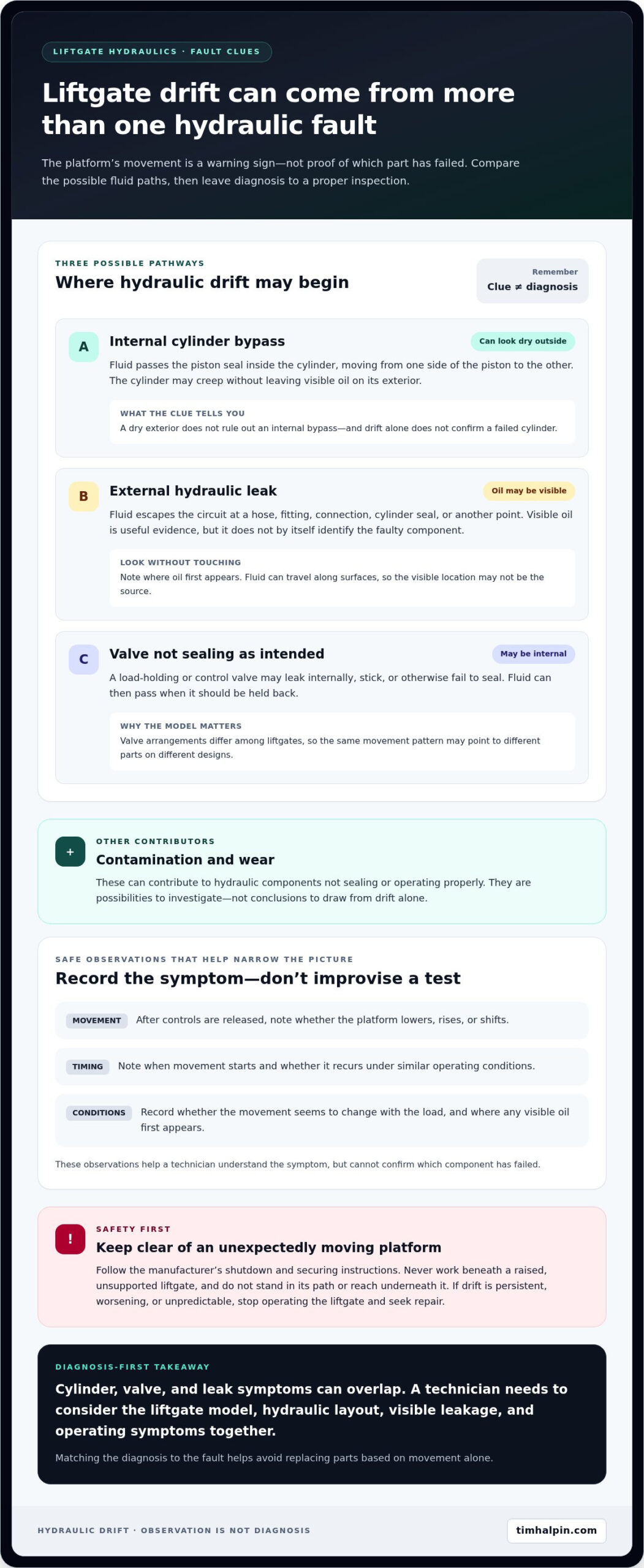
Several hydraulic faults can let a liftgate move after its controls are released. Fluid may bypass a cylinder’s piston seal internally, escape through an external leak, or pass through a load-holding or control valve that isn’t sealing as intended. The symptom alone doesn’t identify which path is involved. To determine what causes hydraulic drift in a liftgate, a technician needs to trace how the system behaves rather than replace the part that seems most obvious.
Internal cylinder bypass lets fluid pass the piston seal inside the cylinder, while an external leak lets fluid escape from the hydraulic circuit. Both can affect platform position, but only an external leak may leave oil visible on the cylinder, hose, fitting, or nearby surface.
Cylinder seal bypass versus a visible hydraulic leak
A piston seal separates pressure within the cylinder. If fluid passes that seal, it can move from one side of the piston to the other, allowing the cylinder to creep even when the exterior looks dry. Internal bypass is one possible cause of drift, not proof that a cylinder has failed. A proper diagnosis must distinguish it from valve leakage or another issue in the circuit.
Visible oil around a hose, fitting, connection, or cylinder seal is useful evidence that fluid is escaping, but it doesn’t establish which component is faulty or whether that leak alone explains the drift. Oil can travel along surfaces, making its apparent location misleading. Note where you first see it, but don’t loosen fittings or attempt cylinder disassembly. Seal service and testing depend on the liftgate’s design and manufacturer procedures.
Valves, contamination, and other possible contributors
A load-holding valve is intended to help control or retain a load, while control valves direct hydraulic flow during operation. If a relevant valve leaks internally, sticks, or otherwise fails to seal, fluid may pass when it should be held back. Valve arrangements differ across liftgate designs, so a symptom that suggests valve trouble on one model may point to a different component on another.
Contamination and wear can also contribute to hydraulic components not sealing or operating properly. They’re possibilities to investigate, not conclusions to draw from drift alone. A careful technician considers the liftgate model, hydraulic layout, visible leakage, and operating symptoms together. This diagnosis-first approach helps distinguish a cylinder issue from a valve or connection fault and reduces the risk of changing parts without addressing the underlying cause.
For persistent drift, liftgate and hydraulic repair can help identify the failing component and guide the repair. Matching the diagnosis to the liftgate’s design helps avoid unnecessary parts changes and added equipment downtime.
How Can You Tell Which Fault Is More Likely?
A symptom can help focus an inspection, but it can’t identify a failed component on its own. Dampness near a fitting, for example, points to an area worth examining, not necessarily the source of the leak. A platform that drifts without visible oil may still have an internal hydraulic leak or a valve-related fault. Use observations to describe the problem, not to decide which part to replace.
The patterns below are clues, not diagnoses. Liftgate configuration, load, and manufacturer procedures all affect how a technician interprets them.
Observed symptom: Dampness or oil near a hose, fitting, connection, or cylinder area.
Possible cause: An external leak at or near that location.
What it can’t prove: The visible spot may not be the leak’s origin or the only fault causing drift.
Observed symptom: The platform moves after controls are released, but no fluid is visible.
Possible cause: Internal cylinder bypass or leakage through a valve may be among the possibilities.
What it can’t prove: A dry exterior doesn’t confirm a cylinder or valve failure, and it doesn’t rule out a hidden external leak.
Observed symptom: Movement or operation seems inconsistent across routine uses.
Possible cause: A hydraulic control issue, a changing operating condition, or another system fault may be involved.
What it can’t prove: Inconsistency alone can’t isolate a particular component or establish that one fault is responsible.
What visible fluid and operating patterns may indicate
Make a note of where fluid appears, such as a damp fitting or cylinder area, without touching pressurized components or loosening connections. Also record when drift occurs during normal operation and whether the platform was loaded or unloaded. Don’t create a test by placing a load on the platform or repeating a movement that seems unsafe. No visible leak doesn’t rule out internal fluid bypass, and a visible leak doesn’t prove it explains all the movement.
Why a model-specific inspection matters
Liftgates can differ in hydraulic layout and load-holding arrangements. A check that applies to one design may not be suitable for another. Use the manufacturer’s manual for the specific liftgate model and follow its service procedures. Avoid relying on generic test limits or improvised checks. Knowing the model and describing when drift occurs gives diagnosis a more useful starting point.
For a broader overview of hydraulic repair support, the article Expert Truck Hydraulics in Miami offers related context. Ultimately, what causes hydraulic drift in a liftgate can’t be confirmed from symptoms alone. A model-specific inspection is the sound next step before choosing a repair or replacement part.
What Should You Do When a Liftgate Starts Drifting?
Unintended movement calls for a pause, not a quick repair attempt. Keep people and loads clear of the platform, take it out of service if it won’t reliably hold position, and follow the liftgate manufacturer’s shutdown and securing instructions. A drifting liftgate must be supported as specified by its manufacturer before anyone inspects or works near it. Never rely on hydraulic pressure alone to hold a raised platform.
Use this sequence to respond safely:
- Stop use. Don’t continue loading, unloading, or operating a platform that moves unpredictably.
- Secure the work area. Keep others clear and follow the manufacturer’s instructions for shutting down and securing the liftgate.
- Record what you observed. Note the model, movement, timing, operating conditions, and any visible fluid, without repeating a hazardous test.
- Arrange qualified diagnosis. Share your notes with the technician so the inspection can begin with the actual symptoms.
Safe observations operators can record
Write down the liftgate’s make and model if you can identify them safely, which direction the platform moved, and when you noticed it. Record whether fluid was visible and whether the movement occurred during ordinary use with or without a load. Don’t deliberately recreate a risky condition to gather more information. If photographing a leak, stay clear of moving parts and the platform’s path.
These details help explain the complaint, but they don’t establish what causes hydraulic drift in a liftgate. A dry cylinder exterior, for example, doesn’t rule out an internal hydraulic fault. Keep the record factual and let the inspection determine the cause.
Tests and repairs that belong with a qualified technician
Pressure testing, valve checks, and cylinder isolation can involve stored hydraulic energy and should be handled by trained personnel using suitable support equipment. The correct inspection steps depend on the liftgate’s design, so the manufacturer’s service procedure matters. Don’t loosen pressurized lines, bypass valves, or get beneath an unsupported platform to investigate drift.
A methodical process helps distinguish a cylinder fault from a valve or other hydraulic issue, rather than swapping parts based on a symptom. Tim Halpin Equipment Corp provides liftgate and hydraulic repair, with diagnosis focused on identifying the fault before selecting a repair.
If drift has made the platform unreliable, arrange liftgate hydraulic repair and share the observations you recorded. The related article How We Diagnose Hydraulic System Failures also explains why a structured inspection is a sound starting point.
When Does Liftgate Drift Need Professional Repair?
Stop operating the liftgate and arrange professional diagnosis if drift persists, gets worse, or happens unpredictably. A platform that won’t reliably hold its position can make loading and unloading unsafe, and continuing to use it may add equipment damage or fleet downtime. Don’t wait for a visible oil leak before taking unexplained movement seriously. Some hydraulic faults don’t leave an obvious external trace.
There isn’t one symptom that tells you exactly what to replace. What causes hydraulic drift in a liftgate has to be determined by checking how the hydraulic circuit behaves, not by guessing from platform movement alone. A diagnosis-first repair process helps avoid replacing a cylinder or valve based on an assumption while the actual fault remains.
What diagnosis can establish before parts are replaced
A technician can inspect the hydraulic circuit, assess relevant components, and work to identify where fluid is leaking or passing when it should be held. The findings help determine whether the issue is associated with a cylinder, valve, hose, fitting, or another part of the system. Inspection and testing should follow procedures appropriate to the liftgate’s make and model.
Part selection matters, too. Replacement components need to suit the liftgate’s make, model, and configuration. Matching the part to the equipment can help prevent avoidable fit or compatibility issues and support a focused repair plan. For additional background on liftgate parts and repair, see The Ultimate Guide to Liftgate Parts & Repair.
For a commercial vehicle, a clear diagnosis can help the repair plan address the fault without unnecessary parts changes. This supports an effort to limit downtime, though the time needed to complete a repair depends on what the inspection finds and what the equipment requires.
Get liftgate repair support in South Florida
Tim Halpin Equipment Corp provides liftgate repair and hydraulic repair in Miami and South Florida, including service for commercial equipment concerns such as liftgate drift. The family-owned truck-equipment business has served customers since 1987. A focused assessment helps identify the repair path and component needed for the specific liftgate.
If your liftgate is drifting, worsening, or no longer holding position reliably, discuss your repair needs with Tim Halpin Equipment Corp’s liftgate repair team. Share what you’ve observed and the liftgate’s identifying details, if available. Tim Halpin Equipment Corp serves businesses in Miami, Doral, Fort Lauderdale, Key West, Medley, Hialeah, Kendall, and across South Florida.
Make the Next Liftgate Decision a Confident One
Unexplained platform movement is a reason to make a deliberate maintenance decision, not guess at a replacement part. Treat the incident as useful information for your equipment records: note when the drift first appeared and share any changes in operation with the technician. Clear service notes can help your team recognize recurring concerns and plan repairs with better context.
Understanding what causes hydraulic drift in a liftgate starts with a careful assessment of the specific equipment. A considered repair can address the underlying fault and help your crew make safer decisions about returning the liftgate to service. If the platform’s movement is persistent or unpredictable, keep it out of operation until it’s assessed.
For a practical next step, discuss your liftgate repair needs with Tim Halpin Equipment Corp. Share the symptoms and liftgate details with Tim Halpin Equipment Corp to start a focused repair discussion.
Frequently Asked Questions
What is the most common cause of hydraulic drift in a liftgate?
There isn’t one cause that’s most likely for every liftgate. Internal cylinder bypass, a leak elsewhere in the circuit, or a valve fault can each allow movement. What causes hydraulic drift in a liftgate depends on its design and the details of the symptom. Tell the technician whether drift began suddenly or gradually and whether it appears after particular operating conditions. Those clues help guide diagnosis, but they don’t identify a failed part by themselves.
Can a liftgate drift without a visible hydraulic leak?
Yes. Fluid can pass internally through a cylinder seal or valve without leaving oil on the equipment’s exterior. A clean-looking hose and cylinder area therefore doesn’t show whether the platform is holding as designed. Note whether movement appears consistently or only under certain ordinary operating conditions, but don’t recreate a potentially unsafe situation to check. Share your observations with the technician and keep the liftgate out of use if it can’t hold position reliably.
Is it safe to use a liftgate that slowly lowers?
Not if the platform’s movement makes its position unreliable. Even gradual lowering can shift a load while someone is guiding cargo or standing nearby. Stop using the liftgate and follow its manufacturer’s securing instructions. Don’t treat a slow descent as harmless simply because it seems controlled. Have the fault assessed before the unit returns to service. For fleets in Miami and South Florida, planning around an unavailable liftgate is safer than relying on one that may move unexpectedly.
How do you diagnose a liftgate hydraulic cylinder that is drifting?
A technician starts by identifying the liftgate, then compares the reported movement and inspection findings with the manufacturer’s procedure for that model. For example, the equipment’s identification plate can help distinguish between similar-looking configurations with different hydraulic arrangements. The technician can then investigate whether fluid is bypassing the cylinder or passing elsewhere in the circuit. Don’t loosen lines or attempt pressure tests yourself. Movement patterns are clues, not confirmation of cylinder failure.
Can a faulty hydraulic valve cause a liftgate to drift?
Yes. Depending on the liftgate’s hydraulic design, a load-holding or control valve that isn’t functioning properly may allow unwanted platform movement. But a similar symptom can come from another point in the system, so replacing a valve based only on drift can miss the real issue. Give the technician details about when the movement occurs and any changes you’ve noticed. The liftgate’s service documentation should guide the inspection and component identification.
What should I do first if my liftgate starts drifting?
Take the liftgate out of use if it won’t reliably hold its position, and keep people clear while following the manufacturer’s securing instructions. Then record the model and the conditions surrounding the movement, such as whether it happened during routine loading or after the controls were released. If your fleet has an equipment-status process, mark the unit unavailable so another operator doesn’t unknowingly put it back to work before it’s assessed.
Can I replace the liftgate cylinder myself to stop drift?
Replacing the cylinder may not solve the problem if the fault is elsewhere in the hydraulic circuit. Liftgate components can also involve stored pressure and heavy moving equipment, so improvised removal creates serious risks. Unless you have the training, equipment, and model-specific service instructions for the work, leave diagnosis and repair to a qualified technician. A confirmed fault helps ensure the replacement part matches the liftgate’s make, model, and configuration.
